Topic 5.8 Notes – Reaction Mechanism and Rate Law
1. What a Reaction Mechanism Is
A reaction mechanism shows the step-by-step pathway from reactants to products. Most reactions do not happen in one collision. They occur in several elementary steps.
An elementary step is a single molecular event. It represents one collision or one decomposition.
When you add all the elementary steps together, anything formed and then used up cancels. What’s left is the overall balanced equation.
Notice:
- C and E appear in steps but cancel out.
- The overall reaction only shows species that remain after cancellation.
A mechanism must:
- Add up to the overall reaction.
- Be consistent with the experimentally determined rate law.
Key Vocabulary
Intermediate
- Formed in one step, consumed in a later step.
- Appears in the mechanism.
- Does not appear in the overall reaction.
- Cannot appear in the final rate law.
Catalyst
- Used in an early step, regenerated later.
- Appears in the mechanism.
- Does not appear in the overall reaction.
- Can appear in the rate law if it’s in the slow step.
Keep those distinctions clear. Students often mix up catalysts and intermediates.
2. The Rate-Determining Step and Molecularity
The rate-determining step (RDS) is the slowest step. It acts like a bottleneck. No matter how fast the other steps are, the reaction can’t go faster than this step.
In Topic 5.8, you’re in the simplest case:
- All steps are irreversible
OR
- The first step is the slow step
In these situations, the rate law comes directly from the slow step.
Molecularity
Molecularity is the number of reactant particles colliding in an elementary step.
- Unimolecular → one reactant
Rate = - Bimolecular → two reactant particles
Rate = or - Termolecular → three particles (rare)
Rate =
For elementary steps only, the exponents in the rate law match the coefficients of the reactants in that step.
That rule does not apply to overall reactions unless the reaction is a single elementary step, which is uncommon.
The table below summarizes common elementary steps and the rate laws that go with each molecularity.
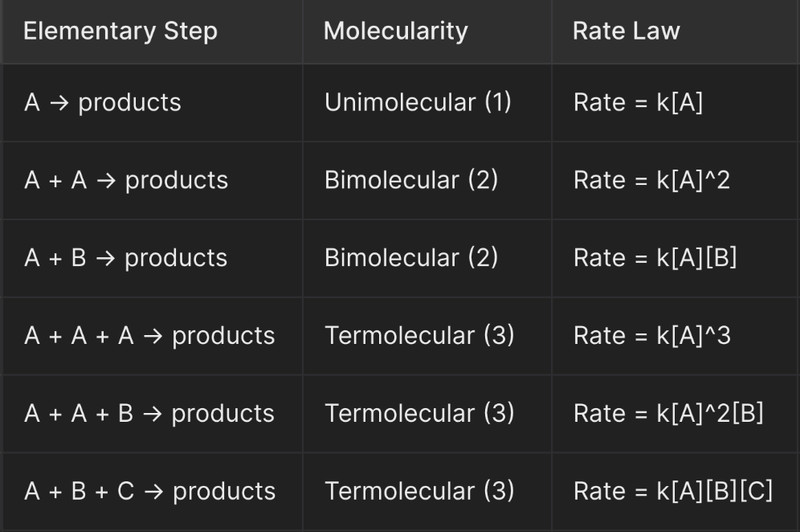
Molecularity and rate law patterns for elementary steps
3. How to Write the Rate Law from a Mechanism
When the first step is slow, this becomes mechanical.
Example mechanism:
Step 1 (slow):
Step 2 (fast):
Step 1 is the RDS.
The rate law comes directly from that step:
That’s it. You ignore the fast step for rate purposes.
If the slow step were:
Then:
Only use coefficients from the slow elementary step, never from the overall reaction.
4. Using Experimental Rate Laws to Test a Mechanism
This is where AP questions get interesting.
The rate law is determined experimentally.
The mechanism is a proposed explanation.
To check a mechanism:
- Identify the slow step.
- Write the rate law from that step.
- Compare it to the experimental rate law.
If they match, the mechanism is consistent.
If they don’t, the mechanism is invalid.
On FRQs, you must:
- State which step is slow.
- Write the rate law from that step.
- Explicitly compare to the experimental rate law.
If you skip the comparison sentence, you often lose the point.
5. Common AP Exam Traps
- Using coefficients from the overall reaction to write the rate law.
- Forgetting that the rule about exponents equals coefficients applies only to elementary steps.
- Not clearly identifying the slow step in your explanation.
- Writing a rate law that includes species not in the slow step.
When the first step is slow, these problems are straightforward. The exam is testing whether you understand why the slow step controls the rate.
Key Takeaways
Reaction Mechanism
A sequence of elementary steps that shows how reactants become products.
Elementary Step
A single molecular event in a mechanism that occurs exactly as written.
Rate-Determining Step / Rate-Limiting Step
The slowest step in a mechanism that controls the overall reaction rate.
Molecularity
The number of reacting particles in an elementary step, such as unimolecular or bimolecular.
Rate Law from a Slow Elementary Step
Use reactant coefficients in the slow step as exponents in the rate law.
Intermediate
A species produced in one step and consumed in a later step.
Overall Reaction from a Mechanism
Add all elementary steps and cancel intermediates to obtain the net balanced equation.
Experimental Rate Law vs. Mechanism-Derived Rate Law
Overall rate laws are determined experimentally and used to test whether a proposed mechanism is valid.
Notes
Reaction Mechanism
A sequence of elementary steps that shows how reactants become products.
Elementary Step
A single molecular event in a mechanism that occurs exactly as written.
Rate-Determining Step / Rate-Limiting Step
The slowest step in a mechanism that controls the overall reaction rate.
Molecularity
The number of reacting particles in an elementary step, such as unimolecular or bimolecular.
Rate Law from a Slow Elementary Step
Use reactant coefficients in the slow step as exponents in the rate law.
Intermediate
A species produced in one step and consumed in a later step.
Overall Reaction from a Mechanism
Add all elementary steps and cancel intermediates to obtain the net balanced equation.
Experimental Rate Law vs. Mechanism-Derived Rate Law
Overall rate laws are determined experimentally and used to test whether a proposed mechanism is valid.
