Topic 1.11 Notes – Causation in the Renaissance and Age of Discovery
How Causation Works in the Renaissance and Age of Discovery
These two developments were linked, not separate chapters.
- Long-term causes created the setting. Italian urban wealth, older trade networks, and growing monarchies made change possible.
- Immediate causes sped things up. Printing in the 1450s and new voyages in the late 1400s turned slower trends into major transformations.
- Motivating causes explain why people acted. Merchants wanted profits, rulers wanted power, and Christians wanted converts.
- Enabling causes explain how they acted. Ships, maps, finance, and stronger states made action possible.
- Consequences can be intended or unintended. Spain wanted silver and empire. It also helped trigger inflation and global rivalry.
The exam usually rewards ranking causes, not listing them. A strong claim sounds like this:
- Renaissance = classical revival + Italian wealth and patronage + city-state competition, with printing as the accelerator.
- Age of Discovery = commercial rivalry and religion as the motives, with technology, finance, and state power as the enabling conditions.
Key feedback loops:
- Urban wealth → patronage → Renaissance culture
- Stronger monarchies → overseas expansion → colonial wealth → stronger monarchies
- Commercial growth → more finance/capitalism → more expansion
Causes of the Renaissance
Classical revival and humanism
The Renaissance began with renewed study of Greek and Roman texts. Humanists studied the studia humanitatis: grammar, rhetoric, poetry, history, and moral philosophy. They wanted to go ad fontes, “to the sources,” and used philology to study language closely.
- Lorenzo Valla used philology to prove the Donation of Constantine was a forgery. That mattered because scholarship could now challenge old authority.
- Humanism encouraged secular interests and individual achievement, but it did not mean rejecting Christianity.
Italian wealth and competition
Italy’s political fragmentation helps explain why the movement started there. The map highlights the major city-states and powers that competed for wealth and prestige.
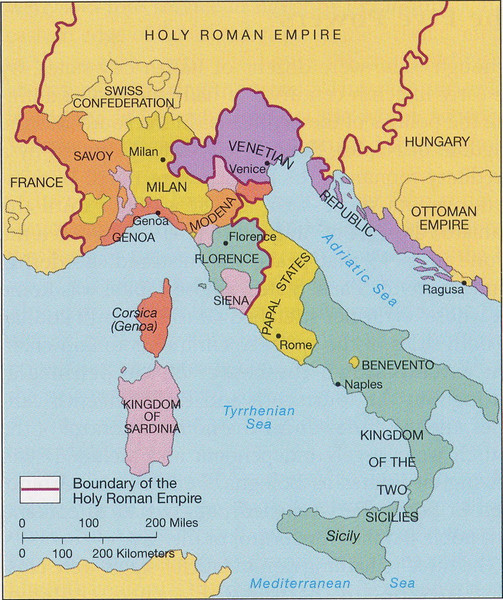
Italian states during the Renaissance
Italian city-states were rich from trade and banking.
- Florence, Venice, Milan, Rome had money to support artists and scholars.
- The Medici are the classic patronage example.
- Popes, guilds, rulers, and city governments all paid for art and learning.
- Political fragmentation pushed cities to compete for prestige. That helped produce civic humanism.
Observation and artistic methods
Artists looked closely at the human body and natural world.
- Brunelleschi developed linear perspective.
- Donatello, Raphael, Michelangelo, Leonardo da Vinci showed naturalism, anatomy, and classical influence.
- Renaissance art served personal fame, political power, and religion all at once.
Printing spreads the movement
Printing turned Renaissance ideas into something that could spread quickly. This image shows a print shop, with the type pieces and letter arrangement below.
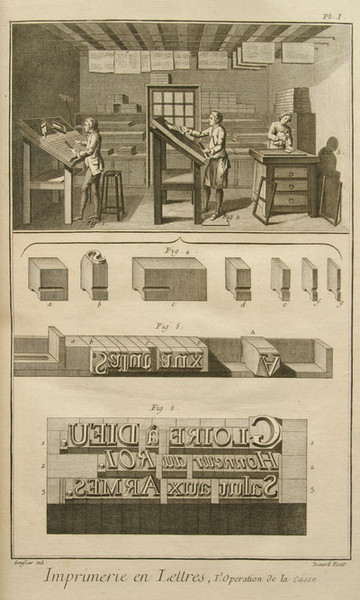
Early movable-type printing
Gutenberg’s movable type in the 1450s made books cheaper and faster to produce.
- Renaissance ideas spread beyond Italy.
- Books, maps, and scholarship circulated more widely.
- Erasmus shows northern humanism, which stayed more clearly Christian.
- Printing helped vernacular languages and broader literacy grow.
Consequences of the Renaissance
The Renaissance changed authority inside Europe before it changed territory beyond Europe.
- Education and thought shifted away from near-total dependence on scholasticism. Classical languages, rhetoric, history, and textual criticism gained ground.
- Medieval learning did not disappear. Authority became more diverse, which later helped the Reformation challenge Church authority.
- New values stressed reputation, worldly success, and cultivated behavior.
- Pico della Mirandola emphasized human potential.
- Castiglione’s Book of the Courtier described the ideal refined courtier.
- Machiavelli in The Prince analyzed power in practical, secular terms. That fit the growth of stronger monarchies in Spain, France, and England, even though centralization was still incomplete and Italy and the Holy Roman Empire stayed fragmented.
Causes and Forms of the Age of Discovery
Overseas expansion grew out of mixed motives and new capacity.
Main causes together
- Commercial motives drove the search for direct access to gold, spices, and luxury goods.
- Religious motives included crusading energy, conversion, and missionary work.
- State centralization and rivalry mattered because monarchs could tax, sponsor voyages, and claim land.
- Enabling technology included the compass, astrolabe, portolan charts, sternpost rudder, lateen sail, improved maps, and gunpowder weapons.
- Finance mattered too. Banking, credit, insurance, double-entry bookkeeping, and later joint-stock companies spread risk and raised capital.
Key voyages and state examples
The map highlights the major routes taken by Portugal and Spain first, then by later northern European rivals.
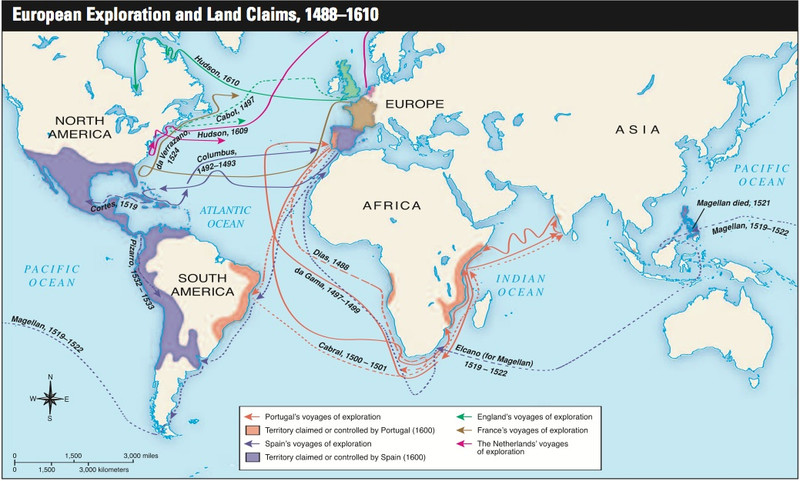
European exploration and land claims, 1488-1610
- Portugal led early exploration. Bartolomeu Dias rounded the Cape of Good Hope in 1488, and Vasco da Gama reached India by sea in 1498.
- Spain sponsored Columbus in 1492, beginning lasting colonization in the Americas.
- The Treaty of Tordesillas in 1494 divided claims between Spain and Portugal.
- Later challengers were England, France, and the Dutch Republic.
- The Dutch East India Company and English East India Company joined private investment to state-backed power.
Different forms of empire
- Portugal mainly built fortified trade posts and controlled routes.
- Spain built a territorial empire in the Americas through conquest, settlement, labor systems, and silver extraction.
Consequences of the Age of Discovery
Columbian Exchange
The Columbian Exchange linked Europe, Africa, and the Americas in a massive transfer of crops, animals, people, and diseases.
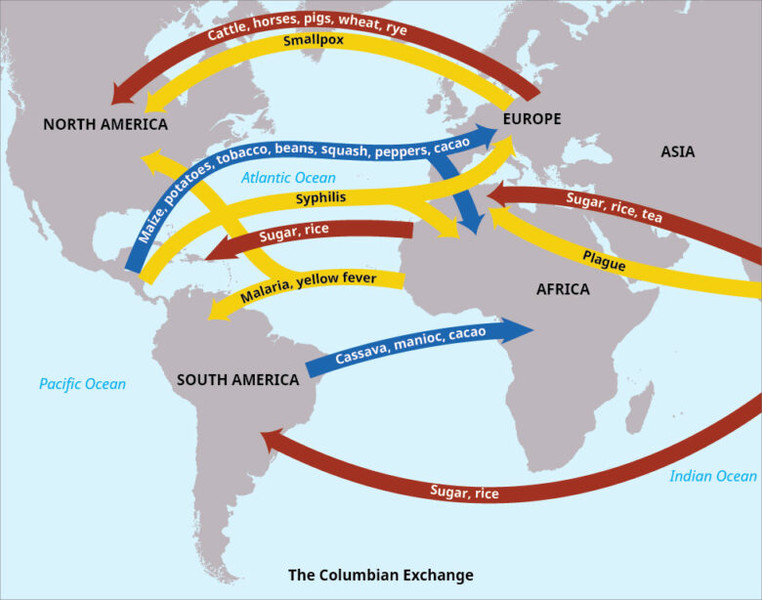
The Columbian Exchange
- Americas → Europe: potatoes, maize, tomatoes, tobacco
- Europe/Africa → Americas: wheat, horses, cattle, pigs, sheep, people, smallpox, measles
The effects were unequal. Europeans gained food crops and trade goods. Indigenous peoples suffered catastrophic population loss from disease, plus conquest and labor exploitation.
Conquest, labor, and slavery
Disease, warfare, and forced labor weakened indigenous societies. Plantation economies needed workers, so Europeans expanded the Atlantic slave trade. The Middle Passage carried enslaved Africans under brutal conditions.
Economic and social change in Europe
Atlantic expansion shifted power from Mediterranean centers toward Antwerp, Amsterdam, London, and Bristol.
| Change | What it meant |
|---|---|
| Mercantilism | states used colonies, monopolies, and trade rules to build power |
| Commercial Revolution | trade and financial capitalism expanded |
| Price Revolution | American silver helped drive inflation |
| New elites | merchants, financiers, officeholders gained influence |
Continuity mattered too.
- Most Europeans still lived in the countryside.
- Social hierarchy remained strong.
- In the west, enclosure and market agriculture grew.
- In the east, landlords tightened control through the second serfdom.
Political consequences
Colonial wealth strengthened some monarchies, especially Spain at first. Overseas rivalry also intensified European conflict and diplomacy. Sovereignty and centralization grew, but rulers still had to share power with nobles, churches, and local institutions.
