Topic 8.4 Notes – Versailles Conference and Peace Settlement
What the Versailles Settlement Tried to Do
Making peace in 1919 meant solving many problems at once. Europe had just gone through total war, and four empires had collapsed, so the peacemakers had to decide who would rule where, who would pay, and how to keep the whole system from exploding again.
- Woodrow Wilson pushed the Fourteen Points. He wanted self-determination, open diplomacy, collective security, and a League of Nations. His idea was that a fair peace would make future war less likely.
- Georges Clemenceau cared most about French security. France had been invaded and devastated, so he wanted Germany weakened through reparations, military limits, and protection along the Rhine.
- David Lloyd George stood in the middle. He wanted Germany punished enough to satisfy British voters, but not crushed so badly that Europe’s economy collapsed or Bolshevism spread.
- Vittorio Orlando wanted the territory Italy had been promised. When Italy did not get all it expected, nationalists called it a “mutilated victory.”
Germany and Bolshevik Russia were excluded from negotiations, which made the peace look imposed by the winners. That matters because the whole settlement mixed Wilsonian idealism with old-style power politics and imperial interests. That contradiction runs through everything that followed.
What the Paris Peace Conference Created
This was never just one treaty. It was a whole peace system.
The treaties
- Treaty of Versailles with Germany
- Treaty of Saint-Germain with Austria
- Treaty of Trianon with Hungary
- Treaty of Neuilly with Bulgaria
- Treaty of Sèvres with the Ottoman Empire, later replaced by Lausanne after Mustafa Kemal’s victories
The new map
The old empires broke apart, and Europe was redrawn around nationalism. Germany also lost territory in Europe and all of its overseas colonies, which this map highlights.
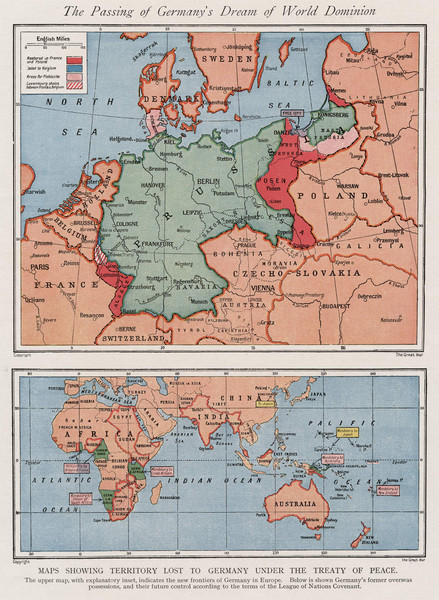
Germany’s territorial losses after World War I
- Austria-Hungary disappeared.
- Poland was restored.
- Czechoslovakia and Yugoslavia were created.
- Finland and the Baltic states became independent.
- Romania grew larger.
- Germany, Austria, and Hungary were reduced.
The limits of self-determination
Borders could not match ethnic groups neatly.
- Germans ended up in the Sudetenland and in parts of Poland.
- Many Hungarians were left outside Hungary after Trianon.
- Yugoslavia contained mixed populations with different identities.
- Austria was barred from uniting with Germany.
Many successor states began as democracies, but they were fragile from the start because of minorities, weak economies, border disputes, and fear of communism.
The Treaty of Versailles and Why Germans Rejected It
Versailles hit Germany in ways that were practical, symbolic, and emotional.
- Territorial losses included Alsace-Lorraine to France, the Polish Corridor, Danzig as a Free City, the Saar under League control with French coal rights for 15 years, a demilitarized Rhineland, and loss of all colonies.
- Military restrictions limited the army to 100,000 volunteers, banned conscription, and prohibited tanks, submarines, an air force, and the General Staff.
- Article 231, the war guilt clause, gave the legal basis for reparations. Germans read it as saying Germany alone caused the war.
- Reparations were fixed in 1921 at 132 billion gold marks.
When France and Belgium occupied the Ruhr in 1923, Germany answered with passive resistance. The government printed money to support workers, and that helped trigger hyperinflation.
The Weimar Republic got blamed for accepting this “Diktat,” or dictated peace. The stab-in-the-back myth claimed Germany had been betrayed from within. That lie hurt democracy badly. On exams, be careful here. Versailles weakened Weimar and later helped Nazi appeal, but it did not by itself cause Hitler or World War II.
The League of Nations and the Mandate System
Wilson’s main institutional goal was the League of Nations. It was supposed to keep peace through collective security, arbitration, sanctions, and treaty supervision.
Its weaknesses were built in:
- The U.S. never joined because the Senate rejected ratification and feared Article X commitments.
- Germany and Soviet Russia were initially excluded.
- The League had no standing army.
- Unanimity made action slow.
- Britain and France often put national interests first.
It did have some success in refugees, public health, and technical cooperation, but it was weak when major powers clashed.
The mandate system showed another contradiction. Former German and Ottoman territories were handed to victors under League supervision rather than given true independence.
- France received Syria and Lebanon
- Britain received Iraq and Palestine, with Transjordan administered separately
The map highlights how those former Ottoman lands were divided between British and French mandates.
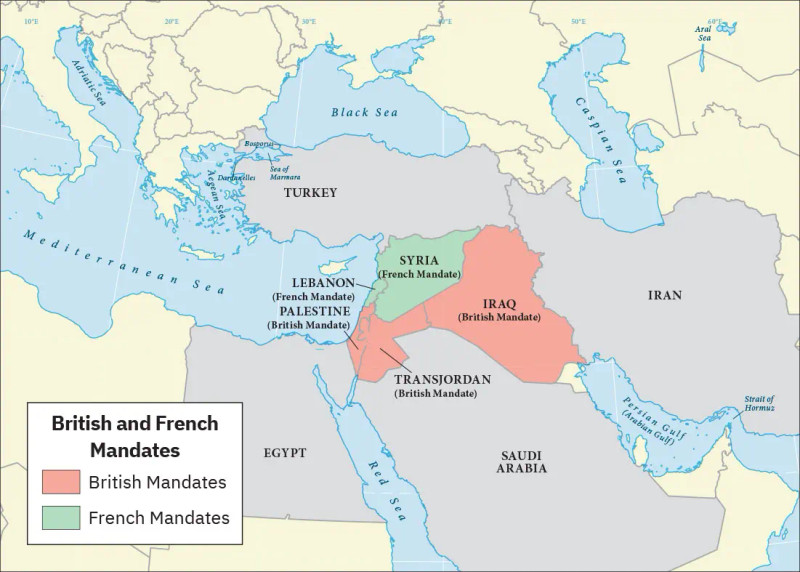
British and French mandates in the Middle East
In Europe the victors talked about self-determination. Outside Europe they expanded imperial control. That helped Britain and France gain strategic influence, especially where oil mattered.
Why the Settlement Failed to Secure Lasting Peace
The settlement satisfied almost nobody.
- Politically, Germany, Austria, Hungary, Italy, Soviet Russia, and colonial nationalists all had grievances.
- Economically, Europe depended on German recovery even while demanding heavy payments from Germany. The breakup of old imperial markets hurt the new states. John Maynard Keynes, in The Economic Consequences of the Peace, warned this would damage recovery.
- Diplomatically, the League lacked universal membership and enforcement. Revisionist states wanted borders changed, while France and its allies wanted them preserved.
The best judgment is that Versailles was too harsh to be accepted and too weak to stop future German power. It was a major source of interwar instability, but later forces mattered too, especially the Great Depression, fascism, appeasement, and failed diplomacy.
Key Takeaways
Paris Peace Conference
1919 meeting at which the victorious Allies negotiated the post–World War I treaties while excluding the defeated powers and Bolshevik Russia
Big Four
The principal Allied negotiators at Paris: Woodrow Wilson, Georges Clemenceau, David Lloyd George, and Vittorio Orlando
Woodrow Wilson
U.S. president and Paris negotiator who promoted the Fourteen Points, self-determination, and a League of Nations
Georges Clemenceau
French leader at Paris who prioritized reparations, German disarmament, and lasting French security against Germany
David Lloyd George
British leader at Paris who supported reparations and imperial gains but opposed permanently crippling Germany’s economy
Vittorio Orlando
Italian leader at Paris who sought the territories promised to Italy for joining the Allies in World War I.
Fourteen Points
Wilson’s 1918 program for open diplomacy, freer trade and seas, arms reduction, self-determination, and a general association of nations
Wilsonian Idealism
Wilson’s vision of a rules-based peace founded on self-determination, open diplomacy, collective security, and reconciliation
Collective Security
The principle that states should act together against aggression because an attack on one concerns all
Mutilated Victory
Italian nationalist claim that Italy had sacrificed greatly in World War I but had been denied the full territorial rewards of victory
Treaty of Versailles
The 1919 treaty with Germany that imposed territorial losses, military restrictions, war liability, reparations, and the League Covenant
Treaty of Saint-Germain
The 1919 treaty with Austria that recognized the Habsburg Empire’s breakup and prohibited an unapproved union with Germany
Treaty of Trianon
The 1920 treaty with Hungary that confirmed the loss of roughly two-thirds of the former kingdom’s territory and population
Treaty of Neuilly
The 1919 treaty with Bulgaria that imposed territorial losses and reparations
Treaty of Sèvres
The 1920 treaty proposing a severe partition of the Ottoman Empire, overturned by Turkish nationalist resistance
Treaty of Lausanne
The 1923 treaty that replaced Sèvres and recognized the modern Turkish state
National Self-Determination
The principle that national groups should govern themselves, applied selectively and imperfectly in the postwar settlement
Successor States
States formed or enlarged after the collapse of Europe’s empires; many began as democracies but faced minority disputes, weak economies, contested borders, and authoritarian challenges
Polish Corridor
Territory granted to Poland for Baltic access that separated East Prussia from the rest of Germany
Free City of Danzig
Predominantly German Baltic city placed under League supervision rather than incorporated into Germany or Poland
Saar Basin
German territory administered by the League for fifteen years while France controlled its coal production
Demilitarized Rhineland
German territory along the Rhine where Germany was forbidden to station troops or construct fortifications
Article 231 / War Guilt Clause
Versailles provision assigning Germany and its allies responsibility for Allied war losses, providing the legal basis for reparations
German Reparations
Payments imposed for Allied war damage, fixed in 1921 at 132 billion gold marks and linked to German economic and political instability
Diktat
German description of Versailles as a dictated peace imposed without meaningful German participation in negotiations
Stab-in-the-Back Myth
False nationalist claim that Germany’s undefeated army had been betrayed by socialists, democrats, and Jews at home
Weimar Republic
Germany’s postwar democratic government, weakened by association with defeat, Versailles, reparations, economic crises, and political extremism
Occupation of the Ruhr
French and Belgian seizure of Germany’s industrial Ruhr in 1923 after Germany fell behind on reparations deliveries
German Hyperinflation of 1923
Collapse of the German currency accelerated when the government printed money to support passive resistance during the Ruhr occupation
League of Nations
International organization created to prevent war through collective security, but weakened by major-power absences, unanimity rules, and reliance on members for enforcement
Article X of the League Covenant
Provision requiring League members to respect and preserve one another’s territorial integrity and political independence
Mandate System
League system placing former German and Ottoman territories under victorious powers, especially Britain and France, while presenting imperial rule as preparation for self-government
Class A Mandates
Former Ottoman territories judged comparatively close to independence but placed under foreign administration and League supervision
Czechoslovakia
Post-Habsburg successor state uniting the Czech lands with Slovakia and Subcarpathian Ruthenia; relatively industrialized and democratic but divided by ethnic tensions
Yugoslavia / Kingdom of Serbs, Croats, and Slovenes
South Slav successor state dominated politically by Serbia and strained by ethnic, religious, and national divisions
Notes
Paris Peace Conference
1919 meeting at which the victorious Allies negotiated the post–World War I treaties while excluding the defeated powers and Bolshevik Russia
Big Four
The principal Allied negotiators at Paris: Woodrow Wilson, Georges Clemenceau, David Lloyd George, and Vittorio Orlando
Woodrow Wilson
U.S. president and Paris negotiator who promoted the Fourteen Points, self-determination, and a League of Nations
Georges Clemenceau
French leader at Paris who prioritized reparations, German disarmament, and lasting French security against Germany
David Lloyd George
British leader at Paris who supported reparations and imperial gains but opposed permanently crippling Germany’s economy
Vittorio Orlando
Italian leader at Paris who sought the territories promised to Italy for joining the Allies in World War I.
Fourteen Points
Wilson’s 1918 program for open diplomacy, freer trade and seas, arms reduction, self-determination, and a general association of nations
Wilsonian Idealism
Wilson’s vision of a rules-based peace founded on self-determination, open diplomacy, collective security, and reconciliation
Collective Security
The principle that states should act together against aggression because an attack on one concerns all
Mutilated Victory
Italian nationalist claim that Italy had sacrificed greatly in World War I but had been denied the full territorial rewards of victory
Treaty of Versailles
The 1919 treaty with Germany that imposed territorial losses, military restrictions, war liability, reparations, and the League Covenant
Treaty of Saint-Germain
The 1919 treaty with Austria that recognized the Habsburg Empire’s breakup and prohibited an unapproved union with Germany
Treaty of Trianon
The 1920 treaty with Hungary that confirmed the loss of roughly two-thirds of the former kingdom’s territory and population
Treaty of Neuilly
The 1919 treaty with Bulgaria that imposed territorial losses and reparations
Treaty of Sèvres
The 1920 treaty proposing a severe partition of the Ottoman Empire, overturned by Turkish nationalist resistance
Treaty of Lausanne
The 1923 treaty that replaced Sèvres and recognized the modern Turkish state
National Self-Determination
The principle that national groups should govern themselves, applied selectively and imperfectly in the postwar settlement
Successor States
States formed or enlarged after the collapse of Europe’s empires; many began as democracies but faced minority disputes, weak economies, contested borders, and authoritarian challenges
Polish Corridor
Territory granted to Poland for Baltic access that separated East Prussia from the rest of Germany
Free City of Danzig
Predominantly German Baltic city placed under League supervision rather than incorporated into Germany or Poland
Saar Basin
German territory administered by the League for fifteen years while France controlled its coal production
Demilitarized Rhineland
German territory along the Rhine where Germany was forbidden to station troops or construct fortifications
Article 231 / War Guilt Clause
Versailles provision assigning Germany and its allies responsibility for Allied war losses, providing the legal basis for reparations
German Reparations
Payments imposed for Allied war damage, fixed in 1921 at 132 billion gold marks and linked to German economic and political instability
Diktat
German description of Versailles as a dictated peace imposed without meaningful German participation in negotiations
Stab-in-the-Back Myth
False nationalist claim that Germany’s undefeated army had been betrayed by socialists, democrats, and Jews at home
Weimar Republic
Germany’s postwar democratic government, weakened by association with defeat, Versailles, reparations, economic crises, and political extremism
Occupation of the Ruhr
French and Belgian seizure of Germany’s industrial Ruhr in 1923 after Germany fell behind on reparations deliveries
German Hyperinflation of 1923
Collapse of the German currency accelerated when the government printed money to support passive resistance during the Ruhr occupation
League of Nations
International organization created to prevent war through collective security, but weakened by major-power absences, unanimity rules, and reliance on members for enforcement
Article X of the League Covenant
Provision requiring League members to respect and preserve one another’s territorial integrity and political independence
Mandate System
League system placing former German and Ottoman territories under victorious powers, especially Britain and France, while presenting imperial rule as preparation for self-government
Class A Mandates
Former Ottoman territories judged comparatively close to independence but placed under foreign administration and League supervision
Czechoslovakia
Post-Habsburg successor state uniting the Czech lands with Slovakia and Subcarpathian Ruthenia; relatively industrialized and democratic but divided by ethnic tensions
Yugoslavia / Kingdom of Serbs, Croats, and Slovenes
South Slav successor state dominated politically by Serbia and strained by ethnic, religious, and national divisions
