Topic 3.2 Notes – The English Civil War and the Glorious Revolution
The Struggle Over Sovereignty in Stuart England
England already had a tradition that kings needed Parliament for taxation and legislation, so the Stuarts ran into limits that rulers like Louis XIV in France pushed past more successfully. Parliament was still an elite body, not a democracy.
- House of Lords included nobles and bishops.
- House of Commons was dominated by gentry, landowners, lawyers, and merchants.
- These elites cared about property, customary rights, and political influence. They feared arbitrary royal power because it threatened all three.
Three tensions kept feeding each other:
- Taxation and lawmaking: could the king rule and raise money without Parliament?
- Religion and power: the Church of England was tied to royal authority, so church disputes were also political disputes.
- The three kingdoms: England, Scotland, and Ireland had different religious systems, which made one-policy-for-all rule dangerous.
The names you need together are James I, Charles I, Oliver Cromwell, James II, and William III and Mary II. This sequence takes you from early Stuart claims of royal authority to civil war, republican rule, restoration, and the Glorious Revolution.
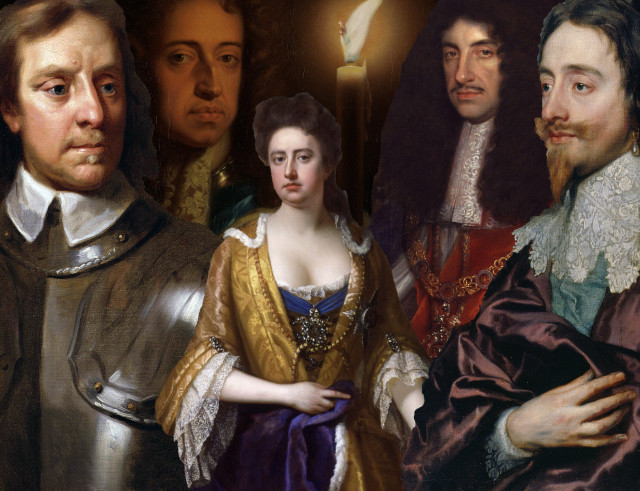
Cromwell, Charles I, and later Stuart monarchs
Why the English Civil War Happened
Political and constitutional causes
James I defended divine-right monarchy. Charles I pushed even harder and worked badly with Parliament.
The Petition of Right in 1628 said the king could not tax without Parliament, imprison people arbitrarily, quarter troops in homes, or use martial law in peacetime. Charles accepted it, then ignored its spirit.
His Personal Rule from 1629 to 1640, often called the Eleven Years’ Tyranny, convinced many that he wanted near-absolutist rule. The clearest example was ship money, a tax traditionally used for coastal defense in emergencies but extended inland during peacetime. John Hampden became the famous resister.
Religious causes
Religion made the constitutional fight feel urgent. Charles married the Catholic Henrietta Maria, and Archbishop William Laud promoted ceremonial Anglican worship that Puritans thought looked too Catholic. Puritans wanted a more thoroughly Protestant church.
Scotland made everything explode. Charles tried to impose Anglican-style worship on Presbyterian Scotland. Scots answered with the National Covenant in 1638, then the Bishops’ Wars forced Charles to recall Parliament because he needed money.
Breakdown into war
- Short Parliament met in 1640 and was dissolved quickly.
- Long Parliament attacked royal policies and advisers like Strafford and Laud.
- The Irish Rebellion of 1641 raised the key question of who controlled the army.
- In 1642 Charles tried to arrest five members of the Commons.
- Trust collapsed, and civil war began.
The English Civil War and the Revolutionary Experiment
The war pitted Royalists (Cavaliers) against Parliamentarians (Roundheads). Parliament had major advantages: London, the navy, and richer commercial regions.
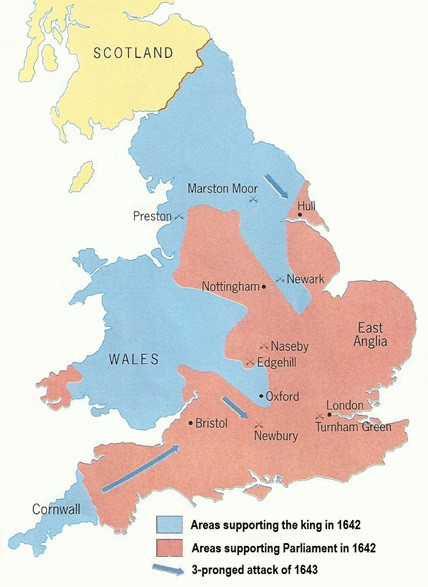
English Civil War support in 1642
This map makes those advantages easy to see. Parliament held London and much of the southeast and east, and those resources helped it outlast the king.
Oliver Cromwell helped build the New Model Army, a disciplined professional force. Its victory at Naseby in 1645 destroyed Charles’s main army.
Inside Parliament’s side, people disagreed sharply.
- Presbyterians wanted a more limited settlement.
- Independents backed more religious flexibility.
- Levellers pushed broader male participation, equality before the law, regular elections, and toleration.
The Putney Debates in 1647 show an AP favorite point: even the revolutionaries had limits. England did not become democratic.
The war turned revolutionary in this order:
- Charles kept negotiating and provoking new conflict.
- The Second Civil War broke out in 1648.
- Pride’s Purge removed MPs willing to keep bargaining.
- The Rump Parliament tried and executed Charles I in 1649.
That regicide was a direct rejection of divine-right monarchy.
Under the Commonwealth and later Protectorate, monarchy and the House of Lords were abolished. Cromwell’s brutal campaigns in Ireland, especially Drogheda and Wexford, mattered a lot. The Instrument of Government made him Lord Protector, but the regime looked more like military rule than stable liberty. The Restoration of Charles II in 1660 showed the republic did not last.
The Glorious Revolution and the Constitutional Settlement
Old tensions returned under Charles II. The Test Acts excluded Catholics from office, and the Exclusion Crisis produced Whigs and Tories.
Under James II, the fear came back fast. He was openly Catholic, kept a standing army, used dispensing power, issued Declarations of Indulgence by royal authority, and lost more support after the Trial of the Seven Bishops. The birth of a Catholic son raised fears of a Catholic dynasty.
The crisis of 1688 moved quickly:
- William of Orange was invited in.
- James II fled, and Parliament treated that as abdication.
- William III and Mary II took the throne.
- Jacobite resistance continued in Ireland and Scotland.
- Battle of the Boyne in 1690 helped secure William’s rule.
The settlement mattered more than the invasion itself.
- English Bill of Rights (1689) barred suspending laws, taxation, and a peacetime army without Parliament; it also protected free elections, petitioning, and speech in Parliament.
- Toleration Act (1689) gave limited freedom to Protestant dissenters.
- Act of Settlement (1701) secured Protestant succession.
The result was parliamentary sovereignty and constitutional monarchy.
Why This Topic Matters
The Civil War proved monarchy could be challenged and even overthrown, but Cromwell also proved that getting rid of a king did not automatically create liberty. The lasting defeat of absolutism came with the Glorious Revolution, when monarchy survived but became dependent on Parliament for taxation, law, and army funding.
This still was not democracy. Power stayed with propertied elites. Catholics, women, and most ordinary people remained excluded. England’s importance in AP Euro is that it became the seventeenth-century alternative to absolutist monarchy.
Key Takeaways
Divine Right of Kings
Doctrine that monarchs received authority from God and were not politically accountable to their subjects
Gentry
Substantial landowners below the titled nobility who dominated local government and helped lead Parliament’s defense of property and political rights
Puritans
English Protestants who sought further reform of the Church of England and often opposed Stuart religious policies
James I
First Stuart king of England, ruling from 1603 to 1625, who defended divine-right monarchy and clashed with Parliament over taxation and religion
Charles I
Stuart king whose nonparliamentary taxation, Personal Rule, and religious policies provoked civil war; executed in 1649
Petition of Right
Parliament’s 1628 assertion against taxation without consent, arbitrary imprisonment, forced quartering, and peacetime martial law
Personal Rule / Eleven Years’ Tyranny
Charles I’s government without Parliament from 1629 to 1640, financed through disputed uses of royal authority
Ship Money
Naval levy Charles I extended inland and collected in peacetime without Parliament, provoking resistance to nonparliamentary taxation
National Covenant
Scottish agreement of 1638 pledging to defend Presbyterianism against Charles I’s Anglican religious innovations
Bishops’ Wars
Wars of 1639–1640 caused by Scottish resistance to Charles I’s religious policies; their costs forced him to recall Parliament
Short Parliament
Parliament summoned in April 1640 and dissolved after about three weeks when it demanded reforms before granting Charles I money
Long Parliament
Parliament summoned in November 1640 that dismantled Personal Rule, challenged Charles I, and remained in changing forms until 1660
Irish Rebellion of 1641
Catholic uprising whose suppression required an army, creating a decisive dispute over whether the king or Parliament would control military force
Royalists (Cavaliers) vs. Parliamentarians (Roundheads)
Royalists supported Charles I, while Parliamentarians fought to defend Parliament against the king
Oliver Cromwell
Puritan Parliamentarian commander who led the New Model Army, established the Protectorate, and ruled as Lord Protector from 1653 to 1658
New Model Army
Centralized, disciplined Parliamentarian army created in 1645 that defeated the Royalists and became a powerful political institution
Battle of Naseby
Decisive Parliamentarian victory in 1645 that destroyed Charles I’s principal field army
Presbyterians vs. Independents
Presbyterians favored a national Presbyterian church and negotiated restoration, while Independents favored broader Protestant toleration and distrusted Charles I.
Levellers
Radical Parliamentarians who advocated broader male participation, equality before the law, regular elections, and greater religious toleration
Putney Debates
Army debates of 1647 between officers and Levellers over representation and voting rights; army leaders rejected broad political equality
Pride’s Purge
Army exclusion of Commons members favoring further negotiations with Charles I in December 1648
Rump Parliament
Members remaining after Pride’s Purge who authorized Charles I’s trial and governed the early Commonwealth until Cromwell dissolved them in 1653
Trial and Execution of Charles I
Charles I was convicted of treason against the English people and beheaded on January 30, 1649, establishing that a king could be held legally accountable
Commonwealth of England
Republic established after Charles I’s execution and the abolition of the monarchy and House of Lords, lasting until the Restoration in 1660
Cromwellian Conquest of Ireland
Brutal campaign begun in 1649 that crushed resistance, confiscated Catholic land, and strengthened English Protestant control of Ireland
Instrument of Government
Written constitution of 1653 that established the Protectorate with Oliver Cromwell as Lord Protector
Protectorate
Army-backed regime of 1653–1659 in which Cromwell ruled as Lord Protector with concentrated personal and military power
Restoration
Return of Charles II and restoration of the monarchy, House of Lords, and Church of England in 1660
Charles II
Restored Stuart king who ruled from 1660 to 1685 and faced parliamentary suspicion over Catholicism, toleration, and royal authority
Test Acts
Restoration laws requiring public officeholders to conform to Anglican practices, chiefly to exclude Catholics
Exclusion Crisis
Political struggle of 1679–1681 over efforts to prevent the Catholic James, duke of York, from succeeding Charles II.
Whigs vs. Tories
Whigs favored excluding Catholic James and parliamentary control of succession; Tories defended hereditary monarchy and the Anglican establishment
James II
Catholic Stuart king whose dispensing power, appointments, standing army, and Declarations of Indulgence provoked the Glorious Revolution
Royal Dispensing Power
James II’s claimed authority to exempt individuals from laws enacted by Parliament
Declarations of Indulgence
James II’s orders suspending penal laws against Catholics and Protestant dissenters through unilateral royal authority
Trial of the Seven Bishops
1688 trial of Anglican bishops who opposed James II’s religious declaration; their acquittal was celebrated as a defeat for arbitrary royal power
William III (William of Orange)
Dutch Protestant ruler invited to intervene against James II who became joint monarch with Mary II after the Glorious Revolution
Glorious Revolution
Overthrow of James II in 1688–1689 and parliamentary transfer of the crown to William III and Mary II under legal limits
Jacobites
Supporters of James II and the Stuart claim who resisted the Glorious Revolution, especially in Scotland and Ireland
Battle of the Boyne
William III’s 1690 victory over James II in Ireland, securing the new regime and strengthening Protestant dominance there
English Bill of Rights / Declaration of Rights
1689 settlement barring unilateral suspension of laws, taxation, or peacetime armies while affirming parliamentary elections, debate, petition, and frequent sessions
Toleration Act of 1689
Law granting limited worship rights to many Protestant dissenters but not political equality or toleration for Catholics
Act of Settlement of 1701
Law barring Catholics and those married to Catholics from the throne and securing a Protestant succession
Parliamentary Sovereignty
Principle that Parliament is the supreme lawmaking authority and that taxation, statutes, and peacetime military funding require its authorization
Constitutional Monarchy
Monarchy governed within legal and institutional limits, with the ruler subject to law and dependent on Parliament
English Civil War / English Civil Wars
Connected wars of 1642–1651 between Royalists and Parliamentarians over political and religious authority, extending across England, Scotland, and Ireland
Notes
Divine Right of Kings
Doctrine that monarchs received authority from God and were not politically accountable to their subjects
Gentry
Substantial landowners below the titled nobility who dominated local government and helped lead Parliament’s defense of property and political rights
Puritans
English Protestants who sought further reform of the Church of England and often opposed Stuart religious policies
James I
First Stuart king of England, ruling from 1603 to 1625, who defended divine-right monarchy and clashed with Parliament over taxation and religion
Charles I
Stuart king whose nonparliamentary taxation, Personal Rule, and religious policies provoked civil war; executed in 1649
Petition of Right
Parliament’s 1628 assertion against taxation without consent, arbitrary imprisonment, forced quartering, and peacetime martial law
Personal Rule / Eleven Years’ Tyranny
Charles I’s government without Parliament from 1629 to 1640, financed through disputed uses of royal authority
Ship Money
Naval levy Charles I extended inland and collected in peacetime without Parliament, provoking resistance to nonparliamentary taxation
National Covenant
Scottish agreement of 1638 pledging to defend Presbyterianism against Charles I’s Anglican religious innovations
Bishops’ Wars
Wars of 1639–1640 caused by Scottish resistance to Charles I’s religious policies; their costs forced him to recall Parliament
Short Parliament
Parliament summoned in April 1640 and dissolved after about three weeks when it demanded reforms before granting Charles I money
Long Parliament
Parliament summoned in November 1640 that dismantled Personal Rule, challenged Charles I, and remained in changing forms until 1660
Irish Rebellion of 1641
Catholic uprising whose suppression required an army, creating a decisive dispute over whether the king or Parliament would control military force
Royalists (Cavaliers) vs. Parliamentarians (Roundheads)
Royalists supported Charles I, while Parliamentarians fought to defend Parliament against the king
Oliver Cromwell
Puritan Parliamentarian commander who led the New Model Army, established the Protectorate, and ruled as Lord Protector from 1653 to 1658
New Model Army
Centralized, disciplined Parliamentarian army created in 1645 that defeated the Royalists and became a powerful political institution
Battle of Naseby
Decisive Parliamentarian victory in 1645 that destroyed Charles I’s principal field army
Presbyterians vs. Independents
Presbyterians favored a national Presbyterian church and negotiated restoration, while Independents favored broader Protestant toleration and distrusted Charles I.
Levellers
Radical Parliamentarians who advocated broader male participation, equality before the law, regular elections, and greater religious toleration
Putney Debates
Army debates of 1647 between officers and Levellers over representation and voting rights; army leaders rejected broad political equality
Pride’s Purge
Army exclusion of Commons members favoring further negotiations with Charles I in December 1648
Rump Parliament
Members remaining after Pride’s Purge who authorized Charles I’s trial and governed the early Commonwealth until Cromwell dissolved them in 1653
Trial and Execution of Charles I
Charles I was convicted of treason against the English people and beheaded on January 30, 1649, establishing that a king could be held legally accountable
Commonwealth of England
Republic established after Charles I’s execution and the abolition of the monarchy and House of Lords, lasting until the Restoration in 1660
Cromwellian Conquest of Ireland
Brutal campaign begun in 1649 that crushed resistance, confiscated Catholic land, and strengthened English Protestant control of Ireland
Instrument of Government
Written constitution of 1653 that established the Protectorate with Oliver Cromwell as Lord Protector
Protectorate
Army-backed regime of 1653–1659 in which Cromwell ruled as Lord Protector with concentrated personal and military power
Restoration
Return of Charles II and restoration of the monarchy, House of Lords, and Church of England in 1660
Charles II
Restored Stuart king who ruled from 1660 to 1685 and faced parliamentary suspicion over Catholicism, toleration, and royal authority
Test Acts
Restoration laws requiring public officeholders to conform to Anglican practices, chiefly to exclude Catholics
Exclusion Crisis
Political struggle of 1679–1681 over efforts to prevent the Catholic James, duke of York, from succeeding Charles II.
Whigs vs. Tories
Whigs favored excluding Catholic James and parliamentary control of succession; Tories defended hereditary monarchy and the Anglican establishment
James II
Catholic Stuart king whose dispensing power, appointments, standing army, and Declarations of Indulgence provoked the Glorious Revolution
Royal Dispensing Power
James II’s claimed authority to exempt individuals from laws enacted by Parliament
Declarations of Indulgence
James II’s orders suspending penal laws against Catholics and Protestant dissenters through unilateral royal authority
Trial of the Seven Bishops
1688 trial of Anglican bishops who opposed James II’s religious declaration; their acquittal was celebrated as a defeat for arbitrary royal power
William III (William of Orange)
Dutch Protestant ruler invited to intervene against James II who became joint monarch with Mary II after the Glorious Revolution
Glorious Revolution
Overthrow of James II in 1688–1689 and parliamentary transfer of the crown to William III and Mary II under legal limits
Jacobites
Supporters of James II and the Stuart claim who resisted the Glorious Revolution, especially in Scotland and Ireland
Battle of the Boyne
William III’s 1690 victory over James II in Ireland, securing the new regime and strengthening Protestant dominance there
English Bill of Rights / Declaration of Rights
1689 settlement barring unilateral suspension of laws, taxation, or peacetime armies while affirming parliamentary elections, debate, petition, and frequent sessions
Toleration Act of 1689
Law granting limited worship rights to many Protestant dissenters but not political equality or toleration for Catholics
Act of Settlement of 1701
Law barring Catholics and those married to Catholics from the throne and securing a Protestant succession
Parliamentary Sovereignty
Principle that Parliament is the supreme lawmaking authority and that taxation, statutes, and peacetime military funding require its authorization
Constitutional Monarchy
Monarchy governed within legal and institutional limits, with the ruler subject to law and dependent on Parliament
English Civil War / English Civil Wars
Connected wars of 1642–1651 between Royalists and Parliamentarians over political and religious authority, extending across England, Scotland, and Ireland
