Topic 9.11 Notes – Migration and Immigration
How Postwar Migration Reshaped Europe
Europe right after 1945 was full of movement, but not all of it was the same. There were refugees, displaced persons, expelled ethnic Germans, and people fleeing communist rule. For this topic, though, the defining pattern starts in the 1950s, when migration became tied to jobs and long-term settlement.
- Emigration means leaving a country.
- Immigration means entering a country.
- The same person can be both. A Turkish worker was an emigrant from Turkey and an immigrant in West Germany.
The main chain to remember goes like this:
- Postwar economic boom
- Labor shortages
- Recruitment of foreign workers
- Family reunification and permanent communities
- Backlash during downturns
Cold War migration still matters because politics also pushed movement. The Berlin Wall is a clear example of a government trying to stop migration at its source.
- Hungarian Revolt, 1956 → refugees fled Soviet repression.
- Prague Spring, 1968 → more refugees moved west.
- Berlin Wall, 1961 → East Germany built it to stop people from leaving for the West.
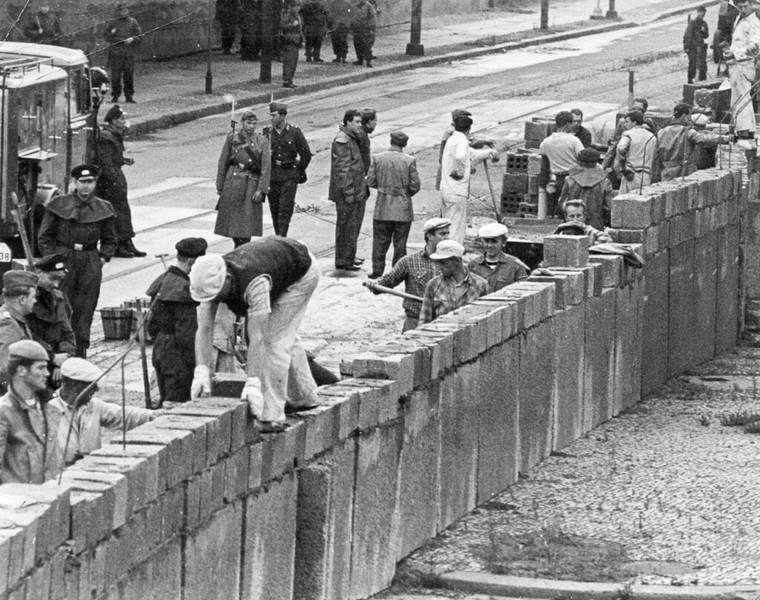
Berlin Wall under construction, 1961
Why Migrants Came and Where They Went
Western and central Europe had a postwar economic miracle. Factories, mines, construction sites, transport systems, and services all needed workers.
- Pull factors included higher wages, labor shortages, reconstruction, and industrial growth.
- Push factors included rural poverty, unemployment, political instability, decolonization, war, and persecution.
Migration within Europe
A huge share of migrants moved from poorer parts of Europe to richer ones.
- From Italy, Spain, Portugal, Greece, Yugoslavia, and Turkey
- To France, West Germany, Switzerland, Belgium, and the Netherlands
West Germany and Gastarbeiter
Gastarbeiter means “guest workers.” West Germany signed labor agreements with Italy in 1955 and Turkey in 1961, among others. These workers were supposed to stay temporarily, but many ended up building lives there.
Immigration from former colonies and beyond
Imperial ties shaped migration routes just as much as economics did.
- France received migrants from Algeria, Morocco, and Tunisia.
- Britain received migrants from the Caribbean and South Asia.
- Empire Windrush, 1948 became the symbol of Caribbean migration.
- British Nationality Act, 1948 kept movement within the Commonwealth relatively open.
- Commonwealth Immigrants Act, 1962 tightened controls.
- Netherlands received migrants from Indonesia, Suriname, and the Dutch Caribbean.
- Belgium and Portugal also received postcolonial migrants.
From Temporary Workers to Permanent Communities
Governments wanted workers, not new citizens. That was the contradiction.
- Family reunification brought spouses and children, turning male labor migration into settled communities.
- Migration networks kept movement going because earlier migrants helped relatives and friends find housing and jobs.
- Remittances sent money back home, linking European economies to migrants’ countries of origin.
This changed everyday politics:
- citizenship laws
- housing and schools
- language policy
- voting and political participation
The first generation often arrived as workers. The second generation grew up in Europe and pushed harder for full belonging. A classic AP point is this: ending labor recruitment did not end immigration.
Why Migration Became More Controversial After the 1970s
The oil crisis of 1973 ended the long boom and brought inflation, unemployment, and slower growth. West Germany stopped large-scale labor recruitment that same year.
Migrants then became easy scapegoats. People blamed them for:
- job competition
- welfare costs
- housing shortages
- crime
- cultural change
Anti-immigrant politics grew from both economics and nationalism.
| Party | Country | Leader | What it stood for |
|---|---|---|---|
| National Front | France | Jean-Marie Le Pen | Anti-immigration nationalism |
| Freedom Party | Austria | Jörg Haider | Populist nationalism and anti-immigrant politics |
Later migration kept the issue alive:
- Yugoslav Wars refugees in the 1990s
- East-to-west migration after 1989 and EU enlargement, especially from Poland
- migration fears feeding Euroskepticism and Brexit
- Syrian refugee crisis, 2015
- Ukrainian refugees after 2022
Keep these categories straight:
- labor migrants move for work
- refugees flee danger and receive protection
- asylum seekers are applying for that protection
- family migrants join relatives already settled
How Immigration Changed Religion, Identity, and Politics
Immigration changed Europe’s religious makeup, especially through the growth of Muslim communities from North Africa, Turkey, South Asia, the Balkans, and the Middle East. This happened at the same time western Europe was becoming more secular.
Big arguments centered on:
- mosques and minarets
- headscarves and religious symbols
- religious education
- secularism versus religious freedom
- what national identity meant
France and laïcité
In France, laïcité means a strongly secular public sphere. Headscarf controversies showed the tension between republican secularism and religious liberty.
Different national approaches
- France leaned toward assimilation into a secular public culture.
- Britain became more associated with multiculturalism.
- West Germany long treated migrants as temporary guests, even when they clearly were not.
Migration forced Europeans to rethink older ethnic ideas of the nation. The debate became bigger than immigration policy. It became a debate over citizenship, belonging, sovereignty, and what it means to be European.
Key Takeaways
Emigration vs. Immigration
Emigration is departure from a country; immigration is entry into one, so the same migrant can be both an emigrant and an immigrant
Push Factors vs. Pull Factors
Push factors drive people from their origins, such as poverty or persecution; pull factors attract them elsewhere, such as jobs and higher wages
Postwar Economic Miracle
Exceptional Western European growth in the 1950s and 1960s that created labor shortages and attracted migrant workers
South-to-North European Labor Migration
Movement of Italians, Spaniards, Portuguese, Greeks, and Yugoslavs to industrial jobs in northern and central Europe
Gastarbeiter (Guest Workers)
Foreign workers recruited by West Germany as a supposedly temporary labor force, including Italians and, after 1961, Turks
Family Reunification
Immigration by spouses, children, or other relatives joining migrants already settled in a destination country
Migration Networks
Connections through which earlier migrants help later arrivals find information, transportation, housing, and employment
Postcolonial Migration
Migration from former colonies to European metropoles along enduring imperial, linguistic, economic, and personal connections
Empire Windrush
Ship whose 1948 arrival with Caribbean migrants became a symbol of postwar Commonwealth immigration to Britain
British Nationality Act of 1948
Law creating the status of Citizen of the United Kingdom and Colonies and helping preserve relatively open Commonwealth migration
Commonwealth Immigrants Act of 1962
British law that began imposing tighter controls on immigration from the Commonwealth
French National Front (National Rally)
Nationalist party founded in 1972 that linked immigration, especially from North Africa, to unemployment, crime, and declining French identity
Austrian Freedom Party
Populist nationalist party prominent under Jörg Haider that opposed immigration and criticized aspects of European integration
Laïcité
The French republican principle of state secularism, central to disputes over religious expression in public institutions
Assimilation
An approach expecting immigrants to adopt the destination society’s language, civic culture, and public norms, often treating cultural or religious differences as private
Multiculturalism
An approach allowing or encouraging immigrant communities to retain distinct cultural practices within a shared political system
Integration
Immigrants’ social, economic, and political participation without necessarily abandoning all cultural differences
Post-1989 East-to-West Migration
Large-scale movement from central and eastern Europe toward higher wages and opportunities in western Europe after communist restrictions collapsed
European Union Free Movement
The principle allowing citizens of EU member states, under applicable rules, to live and work elsewhere in the union
Economic Downturn of the 1970s
The end of the postwar boom, marked by slower growth, inflation, and unemployment, which curtailed worker recruitment and intensified anti-immigrant politics
Anti-Immigrant Agitation
Organized opposition portraying immigrants as threats to jobs, welfare, public safety, culture, or national sovereignty
Postwar Growth of Muslim Communities in Europe
Immigration from North Africa, Turkey, South Asia, and elsewhere expanded Muslim communities in western and central Europe and intensified debates over religion in public life
Labor Migrant
A person who moves primarily to obtain employment
Refugee
A person who has fled persecution, war, or comparable danger and receives a defined form of legal protection
Asylum Seeker
A person who has requested protection from persecution or danger but has not yet received a final decision
Notes
Emigration vs. Immigration
Emigration is departure from a country; immigration is entry into one, so the same migrant can be both an emigrant and an immigrant
Push Factors vs. Pull Factors
Push factors drive people from their origins, such as poverty or persecution; pull factors attract them elsewhere, such as jobs and higher wages
Postwar Economic Miracle
Exceptional Western European growth in the 1950s and 1960s that created labor shortages and attracted migrant workers
South-to-North European Labor Migration
Movement of Italians, Spaniards, Portuguese, Greeks, and Yugoslavs to industrial jobs in northern and central Europe
Gastarbeiter (Guest Workers)
Foreign workers recruited by West Germany as a supposedly temporary labor force, including Italians and, after 1961, Turks
Family Reunification
Immigration by spouses, children, or other relatives joining migrants already settled in a destination country
Migration Networks
Connections through which earlier migrants help later arrivals find information, transportation, housing, and employment
Postcolonial Migration
Migration from former colonies to European metropoles along enduring imperial, linguistic, economic, and personal connections
Empire Windrush
Ship whose 1948 arrival with Caribbean migrants became a symbol of postwar Commonwealth immigration to Britain
British Nationality Act of 1948
Law creating the status of Citizen of the United Kingdom and Colonies and helping preserve relatively open Commonwealth migration
Commonwealth Immigrants Act of 1962
British law that began imposing tighter controls on immigration from the Commonwealth
French National Front (National Rally)
Nationalist party founded in 1972 that linked immigration, especially from North Africa, to unemployment, crime, and declining French identity
Austrian Freedom Party
Populist nationalist party prominent under Jörg Haider that opposed immigration and criticized aspects of European integration
Laïcité
The French republican principle of state secularism, central to disputes over religious expression in public institutions
Assimilation
An approach expecting immigrants to adopt the destination society’s language, civic culture, and public norms, often treating cultural or religious differences as private
Multiculturalism
An approach allowing or encouraging immigrant communities to retain distinct cultural practices within a shared political system
Integration
Immigrants’ social, economic, and political participation without necessarily abandoning all cultural differences
Post-1989 East-to-West Migration
Large-scale movement from central and eastern Europe toward higher wages and opportunities in western Europe after communist restrictions collapsed
European Union Free Movement
The principle allowing citizens of EU member states, under applicable rules, to live and work elsewhere in the union
Economic Downturn of the 1970s
The end of the postwar boom, marked by slower growth, inflation, and unemployment, which curtailed worker recruitment and intensified anti-immigrant politics
Anti-Immigrant Agitation
Organized opposition portraying immigrants as threats to jobs, welfare, public safety, culture, or national sovereignty
Postwar Growth of Muslim Communities in Europe
Immigration from North Africa, Turkey, South Asia, and elsewhere expanded Muslim communities in western and central Europe and intensified debates over religion in public life
Labor Migrant
A person who moves primarily to obtain employment
Refugee
A person who has fled persecution, war, or comparable danger and receives a defined form of legal protection
Asylum Seeker
A person who has requested protection from persecution or danger but has not yet received a final decision
