Topic 8.11 Notes – Continuity and Changes in an Age of Global Conflict
How Total War Changed the Relationship Between the Individual and the State
Total war meant states mobilized whole societies, not just soldiers. Before 1914, liberal governments usually stressed legal rights, property, and limited intervention. War changed that fast.
In World War I, governments reached deep into daily life:
- Conscription pulled millions into the army.
- Censorship and propaganda tried to control information and morale.
- Rationing, price controls, and economic planning managed food and industry.
- Taxes and war loans made civilians finance the war too.
Industrial warfare explains why states expanded so much. The trench fighting of World War I captures the scale and intensity of this new kind of war.
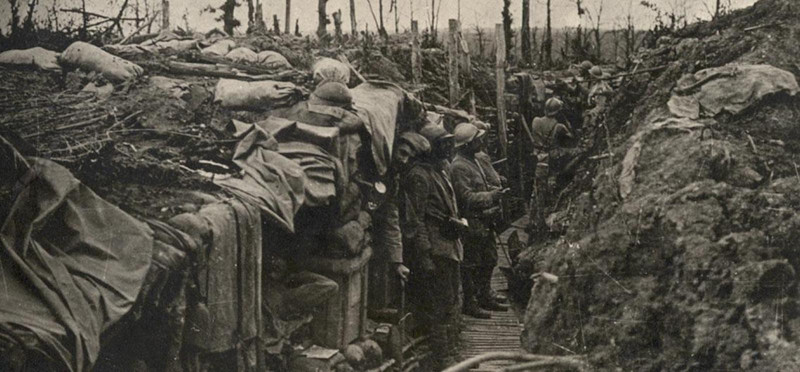
World War I trench warfare
Machine guns, poison gas, submarines, tanks, and airplanes made war more deadly and more dependent on factories, railroads, science, and mass production. Civilians mattered because farms, transport, factory work, and public morale all kept armies alive.
That changed expectations on both sides. States demanded obedience and sacrifice. Citizens increasingly expected voting rights, food security, veterans’ aid, and welfare in return.
World War II pushed this even further through strategic bombing, occupation, forced labor, resistance, and genocide. The key continuity-and-change point is huge: wartime state power did not vanish in 1918 or 1945. Modern European states kept much of that capacity.
Political and Economic Crises That Broke the Old Order
World War I came from several causes acting together:
- Nationalism
- Alliance systems
- Imperial rivalry
- Military plans
- Assassination of Archduke Franz Ferdinand in 1914
The result was catastrophe. Europe saw mass death, debt, inflation, hunger, and displacement. Four empires collapsed: German, Austro-Hungarian, Ottoman, and Russian.
The Treaty of Versailles
At Paris in 1919, Woodrow Wilson wanted self-determination and the League of Nations. France wanted Germany weakened.
Germany got:
- war guilt clause
- reparations
- territorial losses
- military restrictions
New states appeared, including Poland, Czechoslovakia, Yugoslavia, and Hungary. The postwar map helps you see how dramatically central and eastern Europe were redrawn. The problem was that borders rarely matched ethnic groups cleanly, so minorities were stranded inside new states.
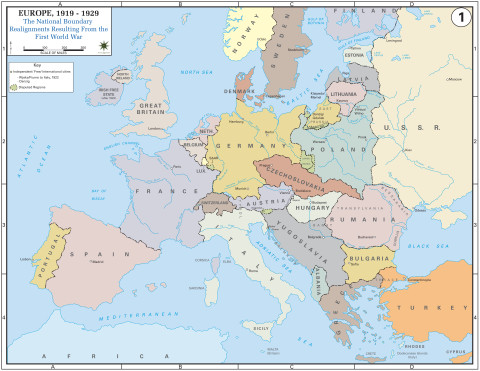
Europe after World War I, 1919 to 1929
The League of Nations started weak. The U.S. never joined, Germany was excluded at first, and the USSR stayed outside until 1934.
The Great Depression
The 1929 crash exposed deep weakness in the postwar economy:
- debts and reparations were tangled together
- banks were fragile
- tariffs hurt trade
- overproduction lowered prices
- Europe depended heavily on American loans
When U.S. money dried up, unemployment and political extremism exploded.
New ideas followed. John Maynard Keynes argued governments should spend during downturns, even with deficits. Scandinavian states moved toward welfare policies. Popular Fronts in France and Spain tried to unite the left. Even so, many Europeans came to see liberal democracy as weak because it failed to provide jobs and stability.
The Three Main Ideologies Competing for Europe
All three ideologies answered the same question. What does the individual owe the state, and what does the state owe the individual?
Liberal democracy
Liberal democracy defended constitutions, elections, pluralism, civil liberties, and legal equality. After World War I, suffrage expanded:
- Britain gave women over 30 the vote in 1918, then equal voting age in 1928
- Weimar Germany adopted universal suffrage including women
Its weakness was fragility. Coalition governments could fall apart, and economic crisis made democracy look indecisive.
Communism
In 1917, the February Revolution overthrew the tsar. The October Revolution brought Lenin and the Bolsheviks to power.
Marxism-Leninism taught class struggle, rule by a revolutionary party, and collective ownership. After War Communism, Lenin used the New Economic Policy to allow limited private trade.
Under Stalin, the USSR pushed Five-Year Plans, collectivization, and rapid industrialization. The cost was enormous:
- attacks on kulaks
- famine in Ukraine
- Gulag
- secret police
- show trials
- Great Purges
Communism claimed equality and modernization justified one-party rule and coercion.
Fascism
Fascism rejected democracy, socialism, and individual rights. It glorified the nation, hierarchy, discipline, violence, and the leader.
- Mussolini took power in Italy in 1922
- Hitler became chancellor in 1933 and destroyed Weimar democracy
Fascists used:
- propaganda
- rallies
- radio
- schools
- paramilitary intimidation
- terror
Joseph Goebbels and Leni Riefenstahl are classic propaganda examples. Nazism added racial ideology and antisemitism. The Nuremberg Laws of 1935 defined citizenship by race, not equal rights.
Fascism and Stalinism both used totalitarian methods. The major difference is the target. Stalinism centered class. Nazism centered race.
Why Europe Went Back to War and What the Wars Revealed
The League failed to stop aggression in Asia and Ethiopia, which told Hitler the system was weak. He remilitarized the Rhineland in 1936, carried out the Anschluss with Austria in 1938, and gained the Sudetenland at Munich through appeasement. Then came the Nazi-Soviet Pact in 1939 and the invasion of Poland, which began World War II.
Appeasement came from fear of another war, military weakness, some sympathy for German complaints, and fear of communism. World War II had multiple causes together: fascism, racism, nationalism, depression, and diplomatic failure.
The Holocaust
The Holocaust was the systematic murder of about six million Jews. It moved step by step from:
- exclusion
- ghettos
- shootings
- deportations
- extermination camps
The Wannsee Conference in 1942 coordinated the “Final Solution.” Auschwitz-Birkenau became the most infamous killing center. Other victims included Roma, disabled people, Soviet POWs, Poles, homosexuals, and political opponents.
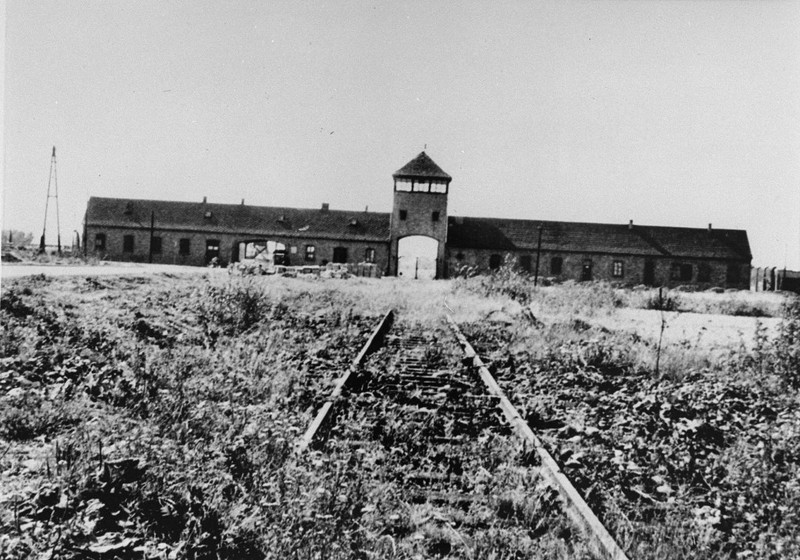
Auschwitz-Birkenau
Images like this one of the rail line into Auschwitz-Birkenau capture how the Holocaust depended on modern transport, bureaucracy, and industrial-scale killing.
These wars revealed a grim truth. Modern science, bureaucracy, and industry could create progress and also mass destruction. Europe came out weakened, and the U.S. and USSR emerged dominant. Nationalism, inequality, and patriarchy survived, but the modern state became far more powerful, interventionist, and dangerous.
