Topic 5.3 Notes – Britain’s Ascendency
How Britain Became the Leading Naval and Imperial Power
Britain’s ascendency means it overtook France in the struggle for European, commercial, and colonial power from the late 1600s to 1815. Historians often call this long rivalry the Second Hundred Years’ War. That does not mean one nonstop war. It means repeated wars with the same basic goal on both sides.
After the Glorious Revolution, Britain built a system that was better at paying for war than Bourbon France’s absolutist monarchy.
Britain’s strengths worked together:
- Royal Navy gave Britain control at sea, which meant it could protect trade, blockade enemies, and strike colonies far from Europe.
- Commercial empire and Atlantic trade brought in wealth from shipping, sugar, and overseas markets.
- Public credit let the government borrow huge sums.
- Parliament helped make taxes and loans more trustworthy, because lenders believed Parliament-backed promises would be repaid.
- Continental allies let Britain avoid matching France army-for-army on land. Britain often paid allies like Prussia to fight France in Europe.
France stayed a major land power, but Britain gained superiority in naval, financial, commercial, and imperial strength. That’s the core argument here. In this period, power depended on turning taxes + credit + trade + naval force into military success.
The Anglo-French Rivalry from 1689 to 1815
This rivalry kept returning in major wars:
- Nine Years’ War
- War of the Spanish Succession
- War of the Austrian Succession
- Seven Years’ War
- American Revolutionary War
- French Revolutionary and Napoleonic Wars
Britain wanted to:
- stop France from dominating Europe
- protect maritime trade
- seize colonies and naval bases
France wanted to:
- stay the leading continental power
- compete in Atlantic trade, North America, the Caribbean, and India
This was a global rivalry, not just a European one. A common AP pattern is commercial rivalry → imperial conflict → global war → shift in balance of power.
A key early gain came in the Peace of Utrecht in 1713. Britain got:
- Gibraltar and Minorca for naval strength in the Mediterranean
- the asiento, the right to supply enslaved Africans to Spanish America
That shows how European peace treaties could produce commercial and imperial gains.
Why Britain Could Outlast France
Britain became a fiscal-military state, meaning a government able to raise taxes, borrow money, and use both for war.
- Bank of England founded in 1694
- funded national debt meant the state paid regular interest instead of needing immediate repayment
- lenders trusted loans backed by Parliament
- Britain could borrow again and again at lower interest rates
The Royal Navy made that money count:
- protected merchant shipping
- blockaded enemies
- moved troops around the globe
- defended and expanded colonies
Empire added more strength:
- Caribbean sugar colonies produced major wealth
- the British East India Company linked trade to military expansion in India
France’s problem was not weakness everywhere. It had population, armies, and wealth. Its weakness was structural:
- inefficient tax collection
- tax farming
- nobles and clergy often exempt from taxes
- tax reform threatened privilege, so the monarchy kept borrowing instead
Britain also had huge debt, but its institutions made that debt manageable. France’s debt turned into a political crisis.
The Seven Years’ War and Britain’s Breakthrough
The Seven Years’ War (1756-1763) was the decisive conflict in Britain’s rise. In North America, fighting had already begun in 1754 in the French and Indian War.
Causes
- imperial rivalry in North America and India
- conflict over Silesia in central Europe
- Diplomatic Revolution of 1756
- Britain allied with Prussia
- France allied with Austria
Turning points
- William Pitt the Elder directed British strategy
- Robert Clive won at Plassey in 1757, boosting British power in Bengal
- Britain captured Louisbourg in 1758
- Battle of Quebec in 1759, James Wolfe defeated Montcalm
- 1759 became Britain’s annus mirabilis, a year of major victories
Treaty of Paris 1763
The map compares North America before the war and after the peace settlement, so focus on how much French territory passed to Britain and Spain by 1763.
- France lost Canada and lands east of the Mississippi except New Orleans
- Spain ceded Florida to Britain
- France kept valuable Caribbean sugar islands
- British influence in India strengthened, French political power there shrank
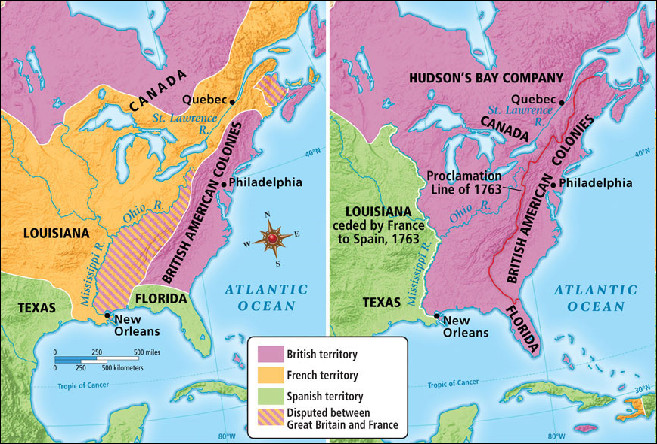
North America before and after the Treaty of Paris, 1763
This war made Britain the leading global naval and imperial power. It also left Britain with a huge war debt, which mattered right away.
The American Revolution and the Final Consequences of Rivalry
After 1763, Britain tried to make its colonies help pay imperial costs.
- Stamp Act (1765)
- Townshend duties
- Tea Act
- colonial protest centered on “no taxation without representation”
France saw colonial rebellion as a chance for revenge.
- Saratoga in 1777 convinced France the Americans could win
- France allied openly in 1778
- Spain joined in 1779
- at Yorktown in 1781, Washington, Rochambeau, and Admiral de Grasse trapped Cornwallis
- Treaty of Paris 1783 recognized U.S. independence
Britain lost the thirteen colonies, but kept Canada, Caribbean colonies, India, its navy, public credit, and trade. Its empire shifted more toward Asia.
France got revenge, but the cost deepened its debt crisis. Aid to America helped push the monarchy toward the crisis that led to the Estates-General and the French Revolution. Lafayette is the key name to remember here.
Key Takeaways
Britain’s Ascendency
Britain’s rise over France as the leading naval, commercial, financial, and imperial power, established in 1763 and secured by 1815
Second Hundred Years’ War
The continuing Anglo-French strategic rivalry from 1689 to 1815, fought through several separate European and colonial wars
Peace of Utrecht
The 1713 settlement that gave Britain Gibraltar, Minorca, and the asiento, strengthening its naval and commercial position
Fiscal-Military State
A state able to collect taxes, borrow dependably, and direct extensive financial resources toward sustained warfare
Public Credit
A government’s ability to borrow because lenders trust it to honor its debts and make regular interest payments
Bank of England
The institution founded in 1694 that helped the British government obtain loans and mobilize private wealth for war
Funded Debt
Long-term government debt supported by designated tax revenues and regular interest payments rather than immediate repayment
Royal Navy
Britain’s naval force, which protected commerce, blockaded enemies, transported troops, and supported colonial conquest
British East India Company
A chartered trading company that acquired military, political, and territorial power in India, especially after gaining a base in Bengal
French Fiscal Crisis
The monarchy’s inability to manage war debts or reform an inefficient, privilege-ridden tax system, contributing to the crisis of 1789
Seven Years’ War (French and Indian War in North America)
The global Anglo-French conflict begun in North America in 1754 and formally fought from 1756 to 1763, ending in decisive British victory
Diplomatic Revolution
The 1756 alliance reversal in which Britain joined Prussia while France allied with Austria and Russia against Prussia
Battle of Plassey
Robert Clive’s 1757 victory that gave the British East India Company a powerful territorial and financial base in Bengal
Battle of Quebec
The 1759 British victory under James Wolfe over Montcalm that led toward Britain’s conquest of Canada
Annus Mirabilis
Britain’s 1759 “year of miracles,” when victories across Europe, the seas, North America, and India displayed its global power
Treaty of Paris of 1763
The settlement ending the Seven Years’ War’s colonial and maritime conflict; Britain gained Canada and Florida, while French power in India was sharply reduced
Stamp Act
The 1765 parliamentary tax on the American colonies, imposed to raise postwar revenue and met with constitutional resistance
American Revolutionary War
The colonial rebellion that became a global Anglo-French war after French intervention and ended with Britain losing the thirteen colonies
Battle of Saratoga
The 1777 American victory that convinced France the rebellion could succeed and encouraged formal French intervention
French Intervention in the American Revolution
French financial, military, and naval support that helped defeat Britain but added heavily to the French monarchy’s debt
Battle of Yorktown
The 1781 American-French victory in which de Grasse’s fleet blocked British escape while allied forces trapped Cornwallis
Treaty of Paris of 1783
The settlement that ended the American Revolutionary War and recognized the independence of the United States
Notes
Britain’s Ascendency
Britain’s rise over France as the leading naval, commercial, financial, and imperial power, established in 1763 and secured by 1815
Second Hundred Years’ War
The continuing Anglo-French strategic rivalry from 1689 to 1815, fought through several separate European and colonial wars
Peace of Utrecht
The 1713 settlement that gave Britain Gibraltar, Minorca, and the asiento, strengthening its naval and commercial position
Fiscal-Military State
A state able to collect taxes, borrow dependably, and direct extensive financial resources toward sustained warfare
Public Credit
A government’s ability to borrow because lenders trust it to honor its debts and make regular interest payments
Bank of England
The institution founded in 1694 that helped the British government obtain loans and mobilize private wealth for war
Funded Debt
Long-term government debt supported by designated tax revenues and regular interest payments rather than immediate repayment
Royal Navy
Britain’s naval force, which protected commerce, blockaded enemies, transported troops, and supported colonial conquest
British East India Company
A chartered trading company that acquired military, political, and territorial power in India, especially after gaining a base in Bengal
French Fiscal Crisis
The monarchy’s inability to manage war debts or reform an inefficient, privilege-ridden tax system, contributing to the crisis of 1789
Seven Years’ War (French and Indian War in North America)
The global Anglo-French conflict begun in North America in 1754 and formally fought from 1756 to 1763, ending in decisive British victory
Diplomatic Revolution
The 1756 alliance reversal in which Britain joined Prussia while France allied with Austria and Russia against Prussia
Battle of Plassey
Robert Clive’s 1757 victory that gave the British East India Company a powerful territorial and financial base in Bengal
Battle of Quebec
The 1759 British victory under James Wolfe over Montcalm that led toward Britain’s conquest of Canada
Annus Mirabilis
Britain’s 1759 “year of miracles,” when victories across Europe, the seas, North America, and India displayed its global power
Treaty of Paris of 1763
The settlement ending the Seven Years’ War’s colonial and maritime conflict; Britain gained Canada and Florida, while French power in India was sharply reduced
Stamp Act
The 1765 parliamentary tax on the American colonies, imposed to raise postwar revenue and met with constitutional resistance
American Revolutionary War
The colonial rebellion that became a global Anglo-French war after French intervention and ended with Britain losing the thirteen colonies
Battle of Saratoga
The 1777 American victory that convinced France the rebellion could succeed and encouraged formal French intervention
French Intervention in the American Revolution
French financial, military, and naval support that helped defeat Britain but added heavily to the French monarchy’s debt
Battle of Yorktown
The 1781 American-French victory in which de Grasse’s fleet blocked British escape while allied forces trapped Cornwallis
Treaty of Paris of 1783
The settlement that ended the American Revolutionary War and recognized the independence of the United States
