Topic 5.2 Notes – The Rise of Global Markets
How Global Markets Turned Trade into State Rivalry
After 1648, Europe was part of a worldwide trade network linking Europe, Africa, the Americas, and Asia. This grew out of earlier Commercial Revolution tools like joint-stock companies, banks, insurance, and bills of exchange, which made huge long-distance ventures possible.
Governments saw commerce as power. More trade meant more taxes, more ships, more sailors, and stronger armies and navies. That is why mercantilism mattered so much.
- Mercantilism assumed world trade was a competition among states.
- A favorable balance of trade meant exporting more than importing so wealth stayed in the country.
- Bullion and customs revenue helped finance state power.
- Colonies were supposed to enrich the mother country.
- States used tariffs, monopolies, navigation laws, and colonial restrictions to keep rivals out.
This was not free trade. States tried to force trade through their own imperial systems.
Worldwide network
- Europe sent manufactured goods, ships, weapons, and capital.
- West Africa supplied enslaved Africans through the Atlantic slave trade.
- The Americas sent sugar, tobacco, coffee, indigo, cotton, and silver.
- Asia sent spices, tea, silk, porcelain, and especially Indian cotton textiles.
American silver helped Europeans buy Asian goods, since Asian producers often wanted silver more than European manufactures. The map ties those exchanges together, with Atlantic routes linking Europe, Africa, and the Americas and sea-lanes continuing across the Indian Ocean to Asian markets.
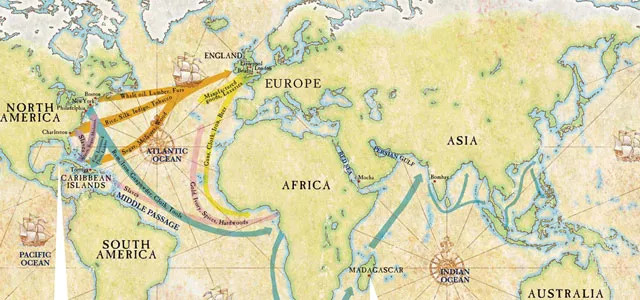
Early modern global trade routes
Why Maritime Competition Intensified
As Europeans consumed more overseas goods, small places became incredibly valuable. A sugar island, a trading fort, or an Indian port could be worth fighting over because it controlled profits.
- Sugar became a mass-consumption product.
- Coffee, tea, tobacco, chocolate, porcelain, spices, and cotton textiles all rose in value.
- Strategic spots included Caribbean sugar islands, West African forts, Indian ports, Indonesian spice islands, and naval resupply bases.
Shipping and war were tightly linked.
- A merchant marine trained sailors and supported wartime fleets.
- Navies protected trade, blockaded enemies, seized colonies, and moved troops.
Chartered companies
The VOC and the British East India Company were businesses with state power behind them.
- They held monopoly rights.
- They could build forts, make treaties, raise armies, collect taxes, and even wage war.
Causal chain
- Demand for overseas goods rose.
- States imposed mercantilist restrictions.
- Rivals smuggled and competed anyway.
- Governments used navies and diplomacy to defend trade.
- Conflicts turned into war.
- Treaties reassigned colonies and trade rights.
Atlantic Competition and the Rise of Britain
The main Atlantic rivals were the Dutch, British, and French, though Spain and Portugal still held huge empires. Atlantic wealth rested heavily on plantations and enslaved labor.
The Anglo-Dutch Wars show trade becoming war.
- Navigation Act of 1651 targeted Dutch shipping dominance.
- Wars followed in 1652 to 1654, 1665 to 1667, and 1672 to 1674.
- The Dutch stayed important financially, but English naval and commercial strength grew.
The Treaty of Utrecht in 1713 gave Britain the asiento, the right to supply enslaved Africans to Spanish America, plus an annual trading ship. Smuggling and access disputes then helped spark the War of Jenkins’ Ear in 1739.
By the 18th century, Britain and France were the main global rivals. The Seven Years’ War from 1756 to 1763 was the clearest case of global commercial warfare, fought in Europe, North America, the Caribbean, West Africa, and India. British naval and financial strength proved decisive.
- Treaty of Paris 1763
- Britain gained Canada and Florida
- France lost most mainland North American claims but kept profitable Caribbean islands
Competition in Asia
In Asia, Europeans entered regions with powerful states and existing trade networks. The Portuguese arrived first, but the Dutch and British eventually outmatched them.
Dutch control of the East Indies
The VOC, based at Batavia on Java, aimed to dominate the spice trade. The map below is useful for seeing how Batavia functioned as the hub of a wider Dutch Indian Ocean network, linking the spice islands to India, Ceylon, and routes back to Europe.
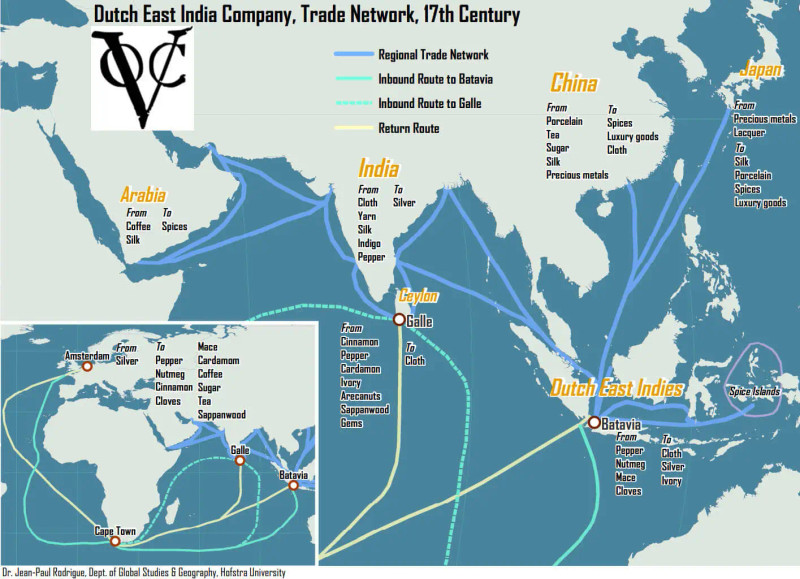
VOC trade network in Asia
- Capture of Malacca in 1641 weakened Portugal.
- The Dutch sought monopoly control over cloves, nutmeg, and mace in the Spice Islands.
- They used forced deliveries, plant destruction, and military violence.
- The VOC dissolved in 1799, but Dutch control continued.
British domination in India
British influence began through trade in cotton textiles, silk, indigo, and saltpeter under Mughal permission. After Aurangzeb died in 1707, Mughal decline opened space for intervention.
- The Carnatic Wars tied India to British-French rivalry.
- Sepoys were Indian soldiers trained in European style.
- Dupleix built early French influence.
- At Plassey in 1757, Robert Clive and the East India Company defeated Siraj ud-Daulah, helped by conspiracy and defections.
- At Buxar in 1764, the company won again.
- The diwani in 1765 gave it tax collection rights in Bengal, Bihar, and Orissa.
- Defeat of Tipu Sultan of Mysore in 1799 strengthened Britain further.
By 1815, Britain was the dominant European power in India.
Major Consequences of Maritime Rivalry
Commercial rivalry made warfare global. European conflicts spread overseas, and colonial disputes fed back into European politics.
- The Dutch declined from top commercial leadership.
- Britain emerged with the strongest navy, finance system, and imperial network.
- Capitalism expanded through public debt, credit, insurance, and joint-stock investment.
- Coercion expanded too through Atlantic slavery, Dutch monopoly violence, and East India Company taxation in India.
- Port cities such as London, Amsterdam, Liverpool, Bristol, Bordeaux, and Nantes grew through overseas trade.
- Imperial wars created debt and tax pressures that fed into the American Revolution and the French fiscal crisis.
Key Takeaways
Global Markets (Worldwide Economic Network)
The interconnected system linking European capital and manufactures, African enslaved labor, American silver and plantation goods, and Asian manufactured and luxury goods
Mercantilism
Policies intended to strengthen the state through bullion, favorable trade balances, protected manufacturing, colonial monopolies, tariffs, and navigation restrictions
Chartered Trading Companies
State-authorized joint-stock companies granted regional trade monopolies and powers such as governing settlements, taxing, negotiating treaties, and waging war
Dutch East India Company (VOC)
Dutch chartered company founded in 1602 that used monopoly rights, forts, armed forces, and coercion to dominate much of the East Indies spice trade
English East India Company (British East India Company)
English chartered company founded in 1600 that evolved from a coastal trading enterprise into the predominant European territorial and fiscal power in India
Navigation Act of 1651
English law requiring goods entering England or its colonies to travel in English ships or ships of the producing country, targeting Dutch carrying trade
Anglo-Dutch Wars
Three wars fought in 1652–1654, 1665–1667, and 1672–1674 over shipping, trade routes, colonies, and strategic power, contributing to England’s maritime rise
Treaty of Utrecht
The 1713 settlement ending the War of the Spanish Succession that granted Britain the asiento and an annual trading ship to Spanish America
Asiento
The contract to supply enslaved Africans to Spanish America, granted to Britain in 1713 and used to expand legal and illegal British trade
War of Jenkins’ Ear
War beginning in 1739 over British access to Spanish American markets and Spanish suppression of smuggling, later merging into the War of the Austrian Succession
Seven Years’ War
The 1756–1763 global conflict in which British naval and financial strength defeated France across North America, the Caribbean, West Africa, and India
Treaty of Paris of 1763
Settlement ending the Seven Years’ War that gave Britain Canada and Florida and ended France’s serious challenge to British political dominance in India
Dutch Control of the East Indies
VOC domination of strategic ports and spice-producing regions in the Indonesian archipelago through monopolies, coerced deliveries, political intervention, and military force
Carnatic Wars
Mid-eighteenth-century Indian conflicts in which British and French companies supported rival Indian rulers, ending with British predominance over France
Sepoys
Locally recruited Indian soldiers trained and commanded in European military styles by European trading companies
Battle of Plassey
The 1757 victory in which Robert Clive and the British East India Company, aided by conspiracy and defections, gained decisive influence over wealthy Bengal
Battle of Buxar
The East India Company’s 1764 victory that led to its acquisition of revenue-collecting authority in Bengal, Bihar, and Orissa
Diwani
The right to collect revenue in Bengal, Bihar, and Orissa, granted to the East India Company in 1765 and used to finance trade, armies, and expansion
British Domination in India
Britain’s position by 1815 as India’s predominant European political and military power, with extensive direct and indirect control but not complete conquest
Fiscal-Military State
A state capable of collecting substantial taxes, borrowing through public debt, and maintaining permanent armed forces for prolonged warfare
Notes
Global Markets (Worldwide Economic Network)
The interconnected system linking European capital and manufactures, African enslaved labor, American silver and plantation goods, and Asian manufactured and luxury goods
Mercantilism
Policies intended to strengthen the state through bullion, favorable trade balances, protected manufacturing, colonial monopolies, tariffs, and navigation restrictions
Chartered Trading Companies
State-authorized joint-stock companies granted regional trade monopolies and powers such as governing settlements, taxing, negotiating treaties, and waging war
Dutch East India Company (VOC)
Dutch chartered company founded in 1602 that used monopoly rights, forts, armed forces, and coercion to dominate much of the East Indies spice trade
English East India Company (British East India Company)
English chartered company founded in 1600 that evolved from a coastal trading enterprise into the predominant European territorial and fiscal power in India
Navigation Act of 1651
English law requiring goods entering England or its colonies to travel in English ships or ships of the producing country, targeting Dutch carrying trade
Anglo-Dutch Wars
Three wars fought in 1652–1654, 1665–1667, and 1672–1674 over shipping, trade routes, colonies, and strategic power, contributing to England’s maritime rise
Treaty of Utrecht
The 1713 settlement ending the War of the Spanish Succession that granted Britain the asiento and an annual trading ship to Spanish America
Asiento
The contract to supply enslaved Africans to Spanish America, granted to Britain in 1713 and used to expand legal and illegal British trade
War of Jenkins’ Ear
War beginning in 1739 over British access to Spanish American markets and Spanish suppression of smuggling, later merging into the War of the Austrian Succession
Seven Years’ War
The 1756–1763 global conflict in which British naval and financial strength defeated France across North America, the Caribbean, West Africa, and India
Treaty of Paris of 1763
Settlement ending the Seven Years’ War that gave Britain Canada and Florida and ended France’s serious challenge to British political dominance in India
Dutch Control of the East Indies
VOC domination of strategic ports and spice-producing regions in the Indonesian archipelago through monopolies, coerced deliveries, political intervention, and military force
Carnatic Wars
Mid-eighteenth-century Indian conflicts in which British and French companies supported rival Indian rulers, ending with British predominance over France
Sepoys
Locally recruited Indian soldiers trained and commanded in European military styles by European trading companies
Battle of Plassey
The 1757 victory in which Robert Clive and the British East India Company, aided by conspiracy and defections, gained decisive influence over wealthy Bengal
Battle of Buxar
The East India Company’s 1764 victory that led to its acquisition of revenue-collecting authority in Bengal, Bihar, and Orissa
Diwani
The right to collect revenue in Bengal, Bihar, and Orissa, granted to the East India Company in 1765 and used to finance trade, armies, and expansion
British Domination in India
Britain’s position by 1815 as India’s predominant European political and military power, with extensive direct and indirect control but not complete conquest
Fiscal-Military State
A state capable of collecting substantial taxes, borrowing through public debt, and maintaining permanent armed forces for prolonged warfare
