Topic 8.6 Notes – Fascism and Totalitarianism
What Fascism, Authoritarianism, and Totalitarianism Were
Europe’s interwar dictatorships were not all the same, so the distinctions matter.
- Fascism was extreme nationalism. It promised the nation would be reborn through a strong, charismatic leader who would sweep away weakness and division.
- Fascists rejected liberal democracy because elections, parliaments, compromise, and individual rights looked weak to them. They also hated communism, which they saw as class conflict tearing the nation apart.
- Fascism celebrated discipline, hierarchy, youth, sacrifice, violence, and war. Politics became emotional and militarized.
- Fascist movements used mass politics in modern ways:
- paramilitary violence
- propaganda
- symbols, uniforms, rallies
- radio and film
- a cult of personality around the leader
Authoritarianism was broader. An authoritarian ruler crushed opposition and limited political competition, but might still leave the church, business elites, or private life partly alone.
Totalitarianism aimed at much more. It tried to control politics, the economy, culture, education, media, and even belief itself.
That gives you the key distinction the AP loves:
- Not every dictatorship was fascist
- Not every fascist regime became fully totalitarian
A quick ideology comparison helps:
- Fascism put the nation or race above all
- Stalinism claimed to pursue class revolution, socialism, and state planning
Before 1914, some roots were already there: Social Darwinism, antisemitism, radical nationalism, the glorification of violence, futurism, and then World War I showed how powerful a fully mobilized state could be.
You can see several of those traits in fascist street politics, especially the uniforms, flags, and leader-centered spectacle associated with Mussolini’s movement.
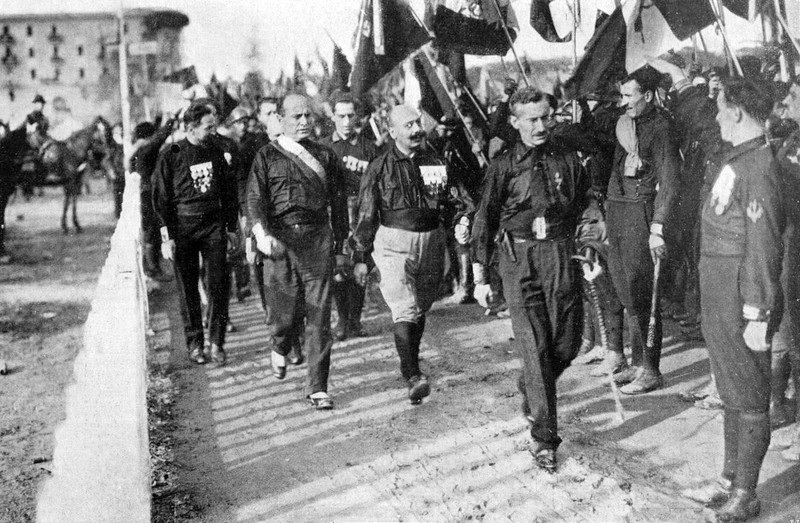
Mussolini with Blackshirt supporters
Why Dictatorships Gained Support After World War I
People did not turn to dictatorship for one reason. Several crises stacked on top of each other.
- Postwar bitterness and nationalism
- Germany hated the Treaty of Versailles and many believed the false stab-in-the-back myth, which blamed democrats, socialists, and Jews for defeat.
- Italy felt cheated by the peace settlement and called it a mutilated victory.
- In central and eastern Europe, new borders created minority tensions and border disputes.
- Fear of communism
- The Russian Revolution made revolution seem possible elsewhere.
- There were communist uprisings in Hungary and Bavaria in 1919.
- Italy’s Biennio Rosso brought strikes, factory occupations, and peasant unrest.
- Conservatives, landowners, business elites, and much of the middle class backed anti-left movements for protection.
- Weak democratic institutions
- The Weimar Republic was tied to defeat and Versailles.
- Coalition governments and proportional representation often looked unstable.
- Many states in central and eastern Europe had little democratic tradition, and old elites preferred order.
- Economic instability
- Postwar inflation wrecked savings. Germany’s hyperinflation of 1923 became a symbol of chaos.
- The Great Depression after 1929 was the biggest boost to extremist parties.
- Unemployment, bank failures, and paralysis made “strong leaders” attractive.
How Mussolini and Hitler Took Power
Mussolini and Fascist Italy
Mussolini built support by presenting Fascists as the force that could crush socialism and restore order.
- Fasci Italiani di Combattimento formed in 1919.
- The Blackshirts attacked socialists, unions, and peasant groups.
- The March on Rome in 1922 was pressure, not a true military conquest.
- King Victor Emmanuel III appointed Mussolini prime minister.
- Mussolini then turned legal power into dictatorship through the Acerbo Law, intimidation in 1924, and the fallout from Matteotti’s murder. By 1925 to 1926, dictatorship was in place.
- He promoted the corporate state, signed the Lateran Accords in 1929 with the Catholic Church, and built the Il Duce cult.
Hitler and Nazi Germany
Hitler copied some fascist methods but added far more radical racism.
- Nazi ideology mixed nationalism, antisemitism, anticommunism, anti-Versailles anger, and Volksgemeinschaft, a racially defined “people’s community.”
- After the failed Beer Hall Putsch in 1923, Hitler switched to a legal-electoral strategy.
- The Great Depression drove Nazi growth.
- Hindenburg appointed Hitler chancellor in January 1933.
- The Reichstag Fire Decree suspended liberties, and the Enabling Act destroyed Weimar democracy.
- Gleichschaltung brought institutions into line. The German Labor Front replaced unions. The Night of the Long Knives strengthened Hitler’s control. Germany became a Führer state.
Fascist propaganda and control
Modern media helped dictators turn politics into spectacle.
- Joseph Goebbels ran Nazi propaganda.
- Cheap radios like the Volksempfänger brought regime messages into homes.
- Leni Riefenstahl’s Triumph of the Will turned a party rally into a visual argument for unity and obedience.
- Architecture, rallies, uniforms, symbols, and leader worship made power feel permanent.
That spectacle mattered because it made authoritarian rule look disciplined, unified, and inevitable.
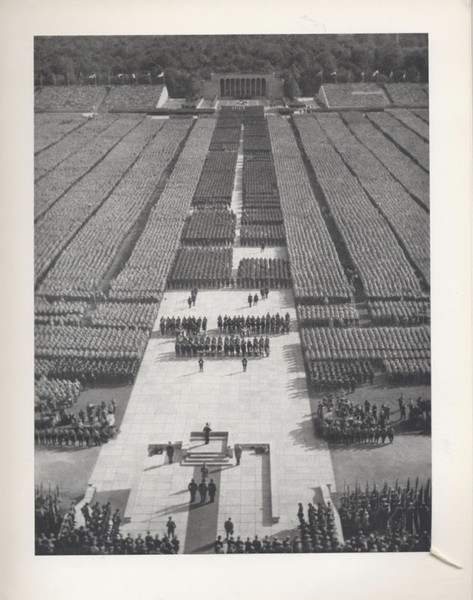
Nazi rally as political spectacle
Spain and the Spread of Authoritarian Rule
Spain shows how Europe’s political conflict was turning into something wider and more dangerous.
- In the Spanish Civil War (1936 to 1939), the left-wing Popular Front victory deepened conflict over the church, land, labor, and military power.
- Francisco Franco led the Nationalists.
- Hitler and Mussolini backed him. Germany’s Condor Legion bombed Guernica.
- The Soviet Union aided the Republic, and volunteers joined the International Brigades.
- Britain and France chose nonintervention, which helped Franco in practice.
- The war became a testing ground for World War II.
- Franco’s dictatorship lasted until 1975.
Picasso’s Guernica became one of the most famous artistic responses to that bombing and to the wider violence of the war.
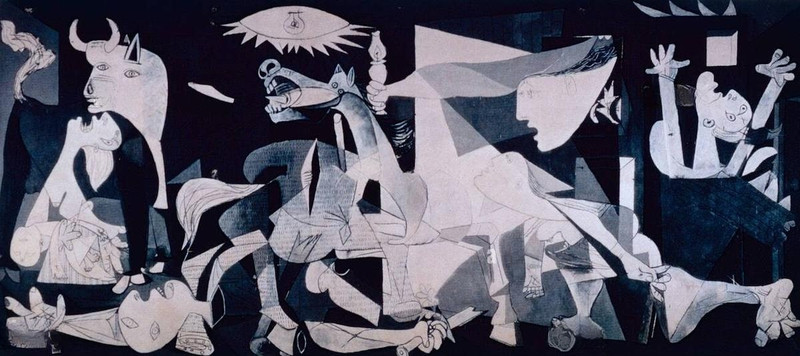
Pablo Picasso, Guernica (1937)
In central and eastern Europe, democracy also failed, but these regimes were usually authoritarian and conservative, not fully totalitarian mass movements.
| Country | Ruler or regime | Character |
|---|---|---|
| Poland | Józef Piłsudski and the Sanacja regime | authoritarian, nationalist |
| Hungary | Miklós Horthy | conservative, nationalist, anti-communist |
| Romania | Carol II, then Ion Antonescu with Iron Guard influence | authoritarian, ultranationalist |
How Stalin Remade the Soviet Union
Stalin’s system came from communist ideology, but in practice it shared many tools with fascist dictatorships.
- After Lenin died in 1924, Stalin outmaneuvered Trotsky, Zinoviev, Kamenev, and Bukharin.
- He ended the NEP and launched the First Five-Year Plan in 1928.
- Through Gosplan, the state pushed heavy industry, urbanization, and strict production targets.
- The result was real industrial growth and a stronger military-industrial base.
- The cost was huge. There were shortages, harsh labor discipline, fake output reports, and low consumer living standards.
Soviet propaganda celebrated the Five-Year Plans as a crushing victory over capitalism and backwardness.
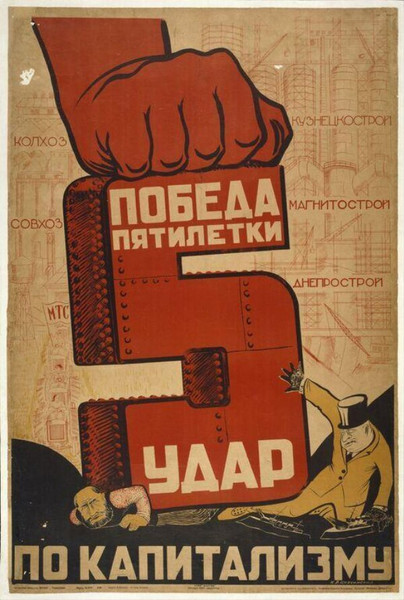
Soviet propaganda poster for the Five-Year Plan
Collectivization
- Peasants were forced onto collective farms.
- Stalin ordered the liquidation of the kulaks as a class.
- Resistance brought deportations, executions, and terror.
- Famine followed, especially in Ukraine. The Holodomor is the best-known example.
Totalitarian repression
- The NKVD, censorship, propaganda, and the Stalin cult enforced obedience.
- The Great Purges and show trials from 1936 to 1938 eliminated real and imagined enemies.
- The Gulag system used prison labor on a massive scale.
The comparison you want locked in is simple. Fascists usually kept private property but directed it toward state goals. Stalin nationalized and centrally planned the economy. Both systems used one-party rule, propaganda, and terror.
Key Takeaways
Fascism
Revolutionary extreme nationalism that rejected liberal democracy and communism, exalted a charismatic leader, glorified struggle and war, and subordinated individuals to the nation
Authoritarianism
Government that suppresses political competition and concentrates power in a ruler or elite while often leaving parts of private and social life independent
Totalitarianism
A system aspiring to control politics, economics, culture, communication, and private belief through one-party rule, ideology, propaganda, mobilization, and terror
Italian Futurism
Prewar artistic and intellectual movement that celebrated speed, machinery, youth, violence, and war while rejecting older conventions
Stab-in-the-Back Myth
False German nationalist claim that socialists, democrats, and Jews betrayed an undefeated army and caused Germany’s defeat in World War I.
Mutilated Victory
Italian nationalist claim that the postwar settlement denied Italy the territory and status it deserved despite its victory in World War I.
Biennio Rosso (Two Red Years)
Italian period of strikes, factory occupations, and peasant unrest in 1919–1920 that intensified elite and middle-class fear of socialism
Cult of Personality
Propaganda portraying a ruler as an extraordinary, infallible embodiment of the nation or revolution
Joseph Goebbels
Nazi propaganda minister who coordinated German radio, film, journalism, literature, theater, and the arts after 1933
Triumph of the Will
Leni Riefenstahl’s 1935 propaganda film presenting Hitler and the Nuremberg rally as expressions of a unified, disciplined German nation
Benito Mussolini
Italian Fascist leader who became prime minister in 1922 and gradually created a dictatorship centered on nationalism, violence, and the corporate state
Blackshirts (Squadristi)
Italian Fascist paramilitaries who violently attacked socialist parties, unions, cooperatives, and local governments
March on Rome
Fascist armed demonstration in October 1922 that pressured King Victor Emmanuel III to appoint Mussolini prime minister
Acerbo Law
1923 Italian law awarding a large parliamentary majority to the party or coalition receiving at least one-quarter of the vote
Giacomo Matteotti
Italian Socialist deputy murdered after denouncing Fascist violence and electoral fraud following the 1924 election
Corporate State
Fascist system organizing employers and workers into state-supervised economic corporations intended to replace class conflict with national cooperation
Lateran Accords
1929 agreements in which Italy recognized Vatican City and the papacy recognized the Italian state, increasing Mussolini’s prestige
Nazism (National Socialism)
German form of fascism combining extreme nationalism, dictatorship, antisemitism, biological racism, anticommunism, and rejection of Versailles
Adolf Hitler
Nazi leader appointed German chancellor in 1933 who used emergency powers, terror, and legal manipulation to create a racial totalitarian dictatorship
Nazi Party (National Socialist German Workers’ Party, NSDAP)
Hitler’s mass party, which combined electoral politics, propaganda, paramilitary violence, extreme nationalism, racism, and anticommunism
Volksgemeinschaft
Nazi ideal of a unified, racially defined national community that excluded groups labeled biological or political enemies
Sturmabteilung (SA or Brownshirts)
Nazi paramilitary organization that intimidated opponents, fought in the streets, and helped create Hitler’s mass movement
Beer Hall Putsch
Hitler’s failed 1923 attempt to seize power in Munich, after which he pursued power through elections combined with propaganda and violence
Paul von Hindenburg
German president who appointed Hitler chancellor on January 30, 1933, after conservatives claimed they could control him
Reichstag Fire Decree
February 1933 emergency decree suspending major German civil liberties and permitting mass arrests of communists and other Nazi opponents
Enabling Act
March 1933 law allowing Hitler’s government to enact laws without normal parliamentary approval
Gleichschaltung
Nazi process of bringing state governments, parties, unions, professions, and cultural organizations under centralized party control
Night of the Long Knives
Hitler’s June 1934 purge and murder of SA leaders and other enemies, which secured support from the army and conservative elites
Spanish Civil War
Conflict from 1936 to 1939 in which Franco’s German- and Italian-backed Nationalists defeated the Spanish Republic and established dictatorship
Falange
Spanish fascist movement incorporated into Franco’s Nationalist coalition and later into his authoritarian political system
Condor Legion
German air force unit sent to assist Franco and test aircraft and bombing tactics during the Spanish Civil War
Bombing of Guernica
1937 German aerial attack on a Basque town that demonstrated the destructive potential of bombing civilian populations
International Brigades
Foreign volunteers who fought on the Republican side during the Spanish Civil War
Nonintervention
British and French policy of avoiding involvement in the Spanish Civil War, which disadvantaged the Republic while Germany and Italy aided Franco
Miklós Horthy
Hungarian regent whose interwar regime was conservative, nationalist, anticommunist, revisionist, and protective of traditional elites
Carol II
Romanian king who established a royal dictatorship in 1938 amid political violence, economic strain, and ultranationalist growth
Iron Guard
Romanian ultranationalist, antisemitic, and fascist movement whose growth contributed to the country’s political violence and authoritarian turn
Joseph Stalin
Soviet dictator who gained supremacy after Lenin’s death and imposed forced industrialization, collectivization, purges, and totalitarian rule
Five-Year Plans
Stalin’s centralized economic programs beginning in 1928 that prioritized rapid growth in heavy industry, transportation, electricity, and armaments
Gosplan
Soviet state planning agency that set production targets and directed investment under the Five-Year Plans
Collectivization
Forced consolidation of individual peasant farms into state-controlled collective farms beginning on a mass scale in 1929
Kulaks
Supposedly prosperous peasants whom Stalin increasingly defined as anyone resisting collectivization or possessing property targeted for confiscation
Dekulakization (Liquidation of the Kulaks)
Stalinist campaign of confiscation, arrest, deportation, forced labor, and execution directed against alleged kulaks and their families
Holodomor
Catastrophic Ukrainian famine of 1932–1933 caused and worsened by collectivization, grain requisitions, movement restrictions, and state repression
Great Purges
Stalin’s mass arrests, executions, deportations, and political removals, reaching their height in 1936–1938
NKVD
Soviet secret police organization that arrested, interrogated, deported, and executed alleged enemies during the Stalinist terror
Show Trials
Staged public trials in which Old Bolsheviks and other defendants confessed under pressure to fabricated conspiracies before execution
Gulag
Soviet system of prisons, penal colonies, and forced-labor camps used for political repression and major economic projects
Francisco Franco
Nationalist general who won the Spanish Civil War with German and Italian assistance and ruled Spain as a dictator until 1975
Francoism
Repressive Spanish authoritarian system combining military rule, centralized nationalism, Catholic conservatism, monarchism, and fascist elements
Józef Piłsudski
Polish marshal who seized power in a 1926 coup and established the authoritarian Sanacja regime
Sanacja Regime
Polish authoritarian order that promised political cleansing but restricted parliamentary competition and concentrated power in the executive
Stalinism
Stalin’s system of one-party totalitarian rule combining central economic planning, forced collectivization, industrialization, leader worship, and political terror
Notes
Fascism
Revolutionary extreme nationalism that rejected liberal democracy and communism, exalted a charismatic leader, glorified struggle and war, and subordinated individuals to the nation
Authoritarianism
Government that suppresses political competition and concentrates power in a ruler or elite while often leaving parts of private and social life independent
Totalitarianism
A system aspiring to control politics, economics, culture, communication, and private belief through one-party rule, ideology, propaganda, mobilization, and terror
Italian Futurism
Prewar artistic and intellectual movement that celebrated speed, machinery, youth, violence, and war while rejecting older conventions
Stab-in-the-Back Myth
False German nationalist claim that socialists, democrats, and Jews betrayed an undefeated army and caused Germany’s defeat in World War I.
Mutilated Victory
Italian nationalist claim that the postwar settlement denied Italy the territory and status it deserved despite its victory in World War I.
Biennio Rosso (Two Red Years)
Italian period of strikes, factory occupations, and peasant unrest in 1919–1920 that intensified elite and middle-class fear of socialism
Cult of Personality
Propaganda portraying a ruler as an extraordinary, infallible embodiment of the nation or revolution
Joseph Goebbels
Nazi propaganda minister who coordinated German radio, film, journalism, literature, theater, and the arts after 1933
Triumph of the Will
Leni Riefenstahl’s 1935 propaganda film presenting Hitler and the Nuremberg rally as expressions of a unified, disciplined German nation
Benito Mussolini
Italian Fascist leader who became prime minister in 1922 and gradually created a dictatorship centered on nationalism, violence, and the corporate state
Blackshirts (Squadristi)
Italian Fascist paramilitaries who violently attacked socialist parties, unions, cooperatives, and local governments
March on Rome
Fascist armed demonstration in October 1922 that pressured King Victor Emmanuel III to appoint Mussolini prime minister
Acerbo Law
1923 Italian law awarding a large parliamentary majority to the party or coalition receiving at least one-quarter of the vote
Giacomo Matteotti
Italian Socialist deputy murdered after denouncing Fascist violence and electoral fraud following the 1924 election
Corporate State
Fascist system organizing employers and workers into state-supervised economic corporations intended to replace class conflict with national cooperation
Lateran Accords
1929 agreements in which Italy recognized Vatican City and the papacy recognized the Italian state, increasing Mussolini’s prestige
Nazism (National Socialism)
German form of fascism combining extreme nationalism, dictatorship, antisemitism, biological racism, anticommunism, and rejection of Versailles
Adolf Hitler
Nazi leader appointed German chancellor in 1933 who used emergency powers, terror, and legal manipulation to create a racial totalitarian dictatorship
Nazi Party (National Socialist German Workers’ Party, NSDAP)
Hitler’s mass party, which combined electoral politics, propaganda, paramilitary violence, extreme nationalism, racism, and anticommunism
Volksgemeinschaft
Nazi ideal of a unified, racially defined national community that excluded groups labeled biological or political enemies
Sturmabteilung (SA or Brownshirts)
Nazi paramilitary organization that intimidated opponents, fought in the streets, and helped create Hitler’s mass movement
Beer Hall Putsch
Hitler’s failed 1923 attempt to seize power in Munich, after which he pursued power through elections combined with propaganda and violence
Paul von Hindenburg
German president who appointed Hitler chancellor on January 30, 1933, after conservatives claimed they could control him
Reichstag Fire Decree
February 1933 emergency decree suspending major German civil liberties and permitting mass arrests of communists and other Nazi opponents
Enabling Act
March 1933 law allowing Hitler’s government to enact laws without normal parliamentary approval
Gleichschaltung
Nazi process of bringing state governments, parties, unions, professions, and cultural organizations under centralized party control
Night of the Long Knives
Hitler’s June 1934 purge and murder of SA leaders and other enemies, which secured support from the army and conservative elites
Spanish Civil War
Conflict from 1936 to 1939 in which Franco’s German- and Italian-backed Nationalists defeated the Spanish Republic and established dictatorship
Falange
Spanish fascist movement incorporated into Franco’s Nationalist coalition and later into his authoritarian political system
Condor Legion
German air force unit sent to assist Franco and test aircraft and bombing tactics during the Spanish Civil War
Bombing of Guernica
1937 German aerial attack on a Basque town that demonstrated the destructive potential of bombing civilian populations
International Brigades
Foreign volunteers who fought on the Republican side during the Spanish Civil War
Nonintervention
British and French policy of avoiding involvement in the Spanish Civil War, which disadvantaged the Republic while Germany and Italy aided Franco
Miklós Horthy
Hungarian regent whose interwar regime was conservative, nationalist, anticommunist, revisionist, and protective of traditional elites
Carol II
Romanian king who established a royal dictatorship in 1938 amid political violence, economic strain, and ultranationalist growth
Iron Guard
Romanian ultranationalist, antisemitic, and fascist movement whose growth contributed to the country’s political violence and authoritarian turn
Joseph Stalin
Soviet dictator who gained supremacy after Lenin’s death and imposed forced industrialization, collectivization, purges, and totalitarian rule
Five-Year Plans
Stalin’s centralized economic programs beginning in 1928 that prioritized rapid growth in heavy industry, transportation, electricity, and armaments
Gosplan
Soviet state planning agency that set production targets and directed investment under the Five-Year Plans
Collectivization
Forced consolidation of individual peasant farms into state-controlled collective farms beginning on a mass scale in 1929
Kulaks
Supposedly prosperous peasants whom Stalin increasingly defined as anyone resisting collectivization or possessing property targeted for confiscation
Dekulakization (Liquidation of the Kulaks)
Stalinist campaign of confiscation, arrest, deportation, forced labor, and execution directed against alleged kulaks and their families
Holodomor
Catastrophic Ukrainian famine of 1932–1933 caused and worsened by collectivization, grain requisitions, movement restrictions, and state repression
Great Purges
Stalin’s mass arrests, executions, deportations, and political removals, reaching their height in 1936–1938
NKVD
Soviet secret police organization that arrested, interrogated, deported, and executed alleged enemies during the Stalinist terror
Show Trials
Staged public trials in which Old Bolsheviks and other defendants confessed under pressure to fabricated conspiracies before execution
Gulag
Soviet system of prisons, penal colonies, and forced-labor camps used for political repression and major economic projects
Francisco Franco
Nationalist general who won the Spanish Civil War with German and Italian assistance and ruled Spain as a dictator until 1975
Francoism
Repressive Spanish authoritarian system combining military rule, centralized nationalism, Catholic conservatism, monarchism, and fascist elements
Józef Piłsudski
Polish marshal who seized power in a 1926 coup and established the authoritarian Sanacja regime
Sanacja Regime
Polish authoritarian order that promised political cleansing but restricted parliamentary competition and concentrated power in the executive
Stalinism
Stalin’s system of one-party totalitarian rule combining central economic planning, forced collectivization, industrialization, leader worship, and political terror
