Topic 9.1 Notes – Contextualizing Cold War and Contemporary Europe
How Europe Changed After 1945
The key date is 1945. Nazi Germany was defeated, but Europe did not recover its old global dominance. Instead, the war left Europe weak and divided, and the United States and Soviet Union emerged as the two superpowers.
Europe moved through three phases:
- Postwar devastation and displacement
- Cold War division between a Western bloc and an Eastern bloc
- Post-1989 integration, mixed with revived nationalism and conflict
WWII had wrecked almost everything a society needs to function. In places like Berlin, people had to rebuild daily life from streets full of rubble and shattered public buildings.
- Material destruction hit cities, factories, rail lines, bridges, ports, housing, and farmland.
- Human loss included tens of millions dead, plus refugees, displaced persons, Holocaust survivors, and people expelled when borders shifted.
- Moral shock came from the Holocaust, mechanized warfare, and mass state violence. A lot of Europeans lost faith in the old idea that science and progress automatically made life better.
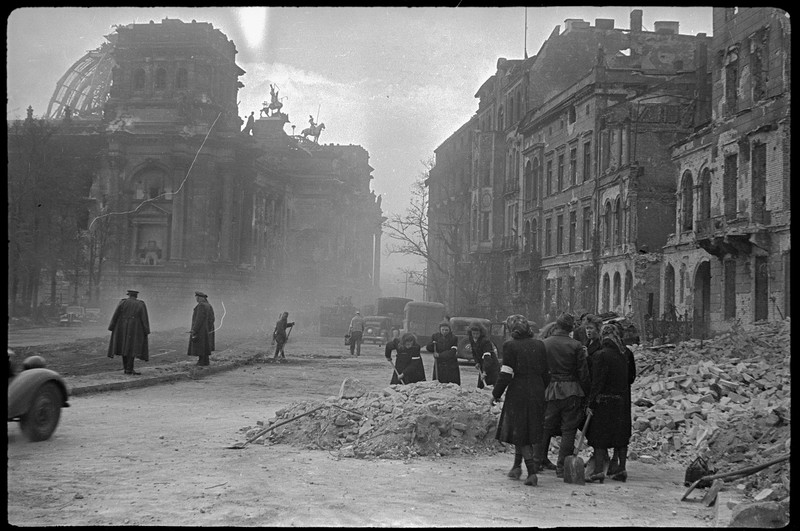
Ruined Berlin after World War II
Fascism was discredited by Nazi defeat. That matters because postwar Europe’s new commitment to democracy, human rights, and cooperation grew partly out of seeing where fascism had led.
Why the Wartime Alliance Turned Into the Cold War
The alliance during WWII was temporary. The U.S., Britain, and USSR worked together only because they all needed to defeat Hitler.
The basic clash
- The Soviet Union under Stalin was a one-party communist state with a centrally planned economy. After repeated invasions, especially in 1941, Stalin wanted a buffer zone in Eastern Europe.
- The United States and Western allies supported constitutional government, elections, private property, markets, and access to trade. They feared Soviet expansion.
Each side thought it was acting defensively. Each side saw the other as aggressive. That mutual suspicion is one of the most tested Cold War ideas.
Yalta, Potsdam, and Eastern Europe
At Yalta and Potsdam, the Allies argued over reparations, borders, Germany, and who would control Eastern European governments. After the war, Soviet-backed communist regimes took over:
- Poland
- Hungary
- Romania
- Bulgaria
- Czechoslovakia
Churchill captured the division in 1946 with the phrase Iron Curtain.
Berlin
Berlin became the most famous flashpoint. The map helps you see why. Germany was split into occupation zones, and Berlin itself was divided even though it lay deep inside the Soviet zone.
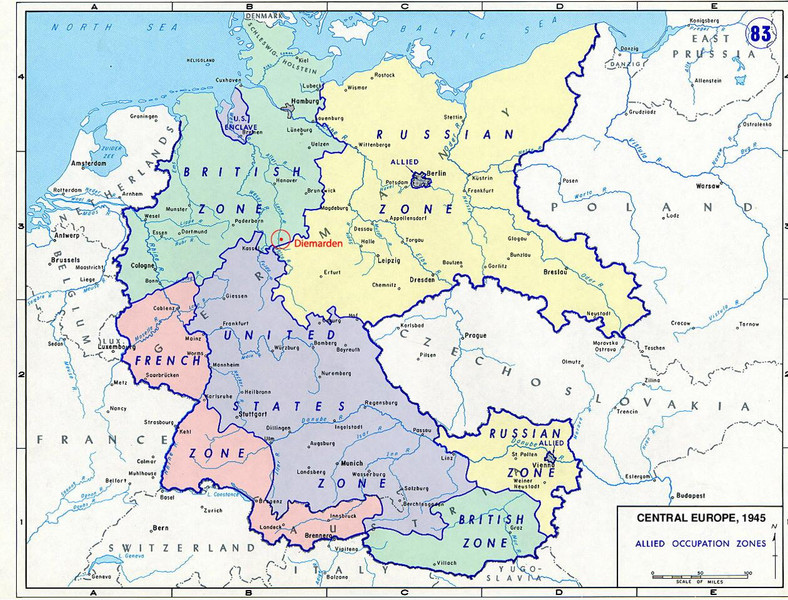
Allied occupation zones in Germany, 1945
- Germany was divided into four occupation zones
- Berlin was also divided, even though it sat inside the Soviet zone
- Berlin Blockade and Airlift, 1948-1949 showed the Cold War had become real
- In 1949, Germany split into the FRG (West Germany) and GDR (East Germany)
- The Berlin Wall in 1961 later became the clearest symbol of division
The Two Blocs and What They Stood For
Cold War Europe was organized around two rival systems.
| Bloc | Politics | Economy | Major ties |
|---|---|---|---|
| West | liberal democracy, parliaments, elections, civil liberties | capitalism, but usually mixed economies with welfare states and labor protections | Marshall Plan, NATO |
| East | communist one-party rule | central planning, state ownership, collectivized agriculture | COMECON, Warsaw Pact |
The West promised freedom and constitutional limits on government. The East promised equality, welfare, education, and employment. In practice, Eastern governments also used censorship, surveillance, and restrictions on religion and movement.
The background ideologies still matter:
- Liberal democracy stressed rights and constitutional government.
- Communism stressed class equality and collective ownership.
- Fascism stressed nation, hierarchy, militarism, and often race. It was defeated in 1945 but still shaped postwar fears and values.
AP likes the nuance here. Western Europe was not perfect democracy everywhere at all times, and Eastern bloc states were not all identical.
How the Cold War Shaped Europe and Why It Ended
Europe was the center of the Cold War, but the rivalry spread worldwide through proxy conflicts like Korea, Vietnam, the Yom Kippur War, and the Soviet invasion of Afghanistan.
Nuclear weapons changed politics completely.
- U.S. atomic bombs, 1945
- Soviet atomic bomb, 1949
- arms race, deterrence, espionage fears, antinuclear activism
Western Europe rebuilt through recovery and cooperation. Institutions like the ECSC, then the EEC, and eventually the EU were meant to make another Franco-German war less likely.
Eastern Europe rebuilt under communist planning, but later ran into stagnation, shortages, and technological lag.
Communism weakened because of:
- weak consumer economies
- repression and low legitimacy
- dissent, especially Solidarity in Poland
- Gorbachev’s reforms after 1985, glasnost and perestroika
- Soviet refusal to use force to save Eastern European regimes
Key end points:
- 1989 revolutions
- Berlin Wall opened/fell, 1989
- German reunification, 1990
- Soviet collapse, 1991
What Continued in Contemporary Europe
The Cold War ended, but Europe did not become simple or conflict-free.
Liberal democracy, capitalism, NATO, and the EU expanded eastward. At the same time, nationalism stayed powerful.
- Czechoslovakia split peacefully in 1993
- Yugoslavia broke apart violently, with ethnic cleansing and genocide in the Balkans
War and totalitarianism also shaped culture. Existentialism and later postmodernism questioned reason, certainty, and universal truth. Names to know are Jean-Paul Sartre and Simone de Beauvoir.
New voices became more visible in public life:
- second-wave feminism
- 1968 youth protest
- immigrants from former colonies and beyond
- gay and lesbian activism
- Green parties and environmentalism
The major continuity is this. Europe kept arguing over sovereignty, migration, identity, and who belongs.
Key Takeaways
Cold War
The post-1945 rivalry between the liberal capitalist West and communist Soviet East, fought through alliances, pressure, propaganda, espionage, proxy wars, and an arms race rather than direct full-scale superpower war
Iron Curtain
The political, military, economic, and ideological separation between the Soviet-dominated East and the Western states during the Cold War
European Integration / Transnational European Integration
The postwar pooling of economic and political authority across national borders to promote recovery, prevent renewed war, and build shared European institutions
Contextualization
Explaining how broader developments before or around an event made it possible, meaningful, or historically significant
Notes
Cold War
The post-1945 rivalry between the liberal capitalist West and communist Soviet East, fought through alliances, pressure, propaganda, espionage, proxy wars, and an arms race rather than direct full-scale superpower war
Iron Curtain
The political, military, economic, and ideological separation between the Soviet-dominated East and the Western states during the Cold War
European Integration / Transnational European Integration
The postwar pooling of economic and political authority across national borders to promote recovery, prevent renewed war, and build shared European institutions
Contextualization
Explaining how broader developments before or around an event made it possible, meaningful, or historically significant
