Topic 7.3 Notes – National Unification and Diplomatic Tensions
How Nationalism Reshaped Europe After 1815
The Congress of Vienna tried to restore order after Napoleon by protecting the balance of power and crushing revolution. The Concert of Europe kept the Great Powers cooperating, which mattered because that cooperation helped preserve a divided Italy and a fragmented German Confederation under strong Austrian influence.
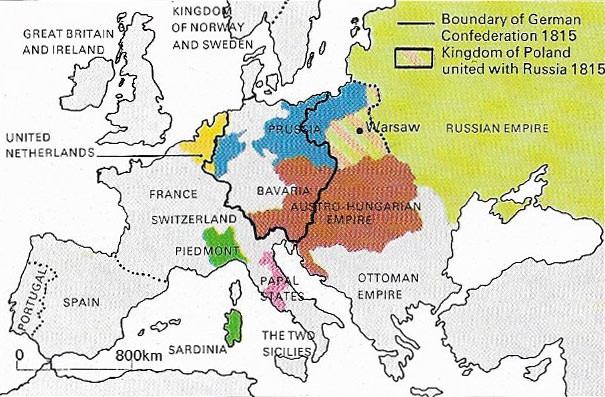
Europe after 1815
On the map, focus on the patchwork of Italian states and the loose German Confederation. That political fragmentation is the starting point for the nationalism that follows.
The 1848 revolutions showed that nationalism was powerful, but they failed. Italian revolutionaries were beaten, and the Frankfurt Parliament could not unite Germany. That failure changed the method of unification. Nationalism stayed important, but now monarchs and ministers would use it for their own states.
The Crimean War was the turning point.
- It exposed Ottoman weakness, since the empire needed British and French help against Russia.
- It exposed Russian weakness too, especially military and administrative problems.
- Austria angered Russia during the war but gained no dependable friends in return.
- That broke down conservative Great Power cooperation and weakened the system that had protected Austrian influence.
This exam chain matters a lot: weaker Concert of Europe → weaker Austria → more room for Italian and German unifiers.
Italian Unification and the Risorgimento
Before unification, Italy was a patchwork of separate states, and this map helps you track the pieces that were gradually brought together:
- Piedmont-Sardinia in the northwest under the House of Savoy
- Lombardy and Venetia under Austrian control
- Papal States in central Italy
- Kingdom of the Two Sicilies in the south
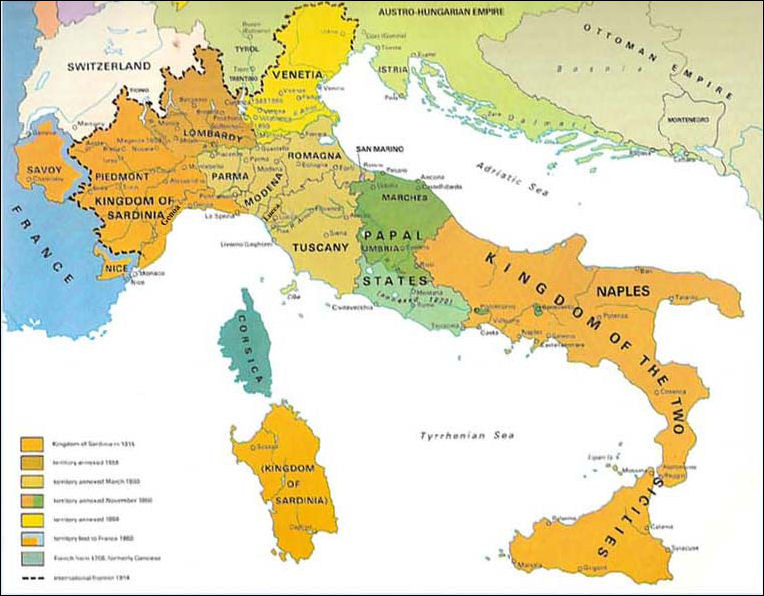
Italy during unification
Mazzini
Giuseppe Mazzini spread the dream of a united Italy through Young Italy. He believed in republican nationalism and popular revolution. He mattered because he inspired people, even though his actual uprisings failed.
Cavour
Count Camillo di Cavour, prime minister of Piedmont-Sardinia under Victor Emmanuel II, made unification practical.
- He strengthened Piedmont with railroads, economic growth, army reform, and diplomacy.
- He joined the Crimean War so Piedmont would matter in European diplomacy.
- In the Plombières agreement, he gained French support from Napoleon III.
- He provoked Austria into war in 1859.
- Victories at Magenta and Solferino brought Lombardy.
- Plebiscites added Parma, Modena, Tuscany, and Romagna.
- Piedmont gave Nice and Savoy to France.
Garibaldi
Giuseppe Garibaldi represented nationalism from below.
- His Red Shirts led the Expedition of the Thousand in 1860.
- He conquered Sicily and Naples and toppled Bourbon rule.
- At Teano, he handed his conquests to Victor Emmanuel II.
Italy unified through both elite diplomacy and popular military action. On the map, you can see how unification moved from Piedmont's base in the northwest to the south and finally to Venetia and Rome.
- 1861: Kingdom of Italy proclaimed
- 1866: Venetia gained through alliance with Prussia in the Austro-Prussian War
- 1870: Rome gained after French troops left during the Franco-Prussian War
German Unification Under Prussia
Prussia had the tools liberals lacked. It had a strong army, efficient bureaucracy, and growing industry. The Zollverein built economic unity among German states without Austria. The failed Frankfurt Parliament showed that liberal nationalism alone could not beat princes and armies.
Bismarck and Realpolitik
Appointed in 1862 by Wilhelm I, Otto von Bismarck practiced Realpolitik. He cared about power and results, not ideological purity.
- His “blood and iron” speech captured that mindset.
- He ignored the Landtag on army funding, then later used an indemnity bill and an elected Reichstag to legitimize what he had done.
- He used modern war tools like railroads, the General Staff, the needle gun, Moltke, and Roon.
The three wars
Danish War (1864)
Prussia and Austria defeated Denmark over Schleswig and Holstein.Austro-Prussian War (1866)
Prussia won at Königgrätz, dissolved the German Confederation, pushed Austria out of German affairs, and created the North German Confederation. Italy got Venetia.Franco-Prussian War (1870-1871)
Bismarck edited the Ems Dispatch to provoke France. Southern German states joined Prussia. After victory at Sedan, where Napoleon III was captured, the German Empire was proclaimed at Versailles in 1871. The Treaty of Frankfurt gave Germany Alsace-Lorraine, which made France want revenge.
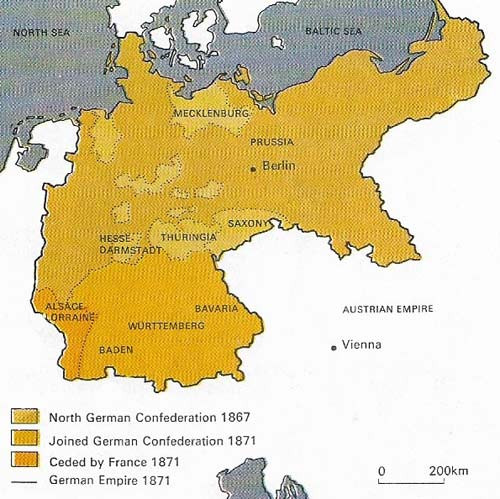
German unification, 1867-1871
This was the Kleindeutsch solution, a united Germany under Prussia without Austria.
Bismarck’s Alliances and the Road to Tension
After 1871, Germany was Europe’s strongest state. Bismarck wanted peace now because a united Germany had already been won. His main goal was to isolate France.
Bismarck’s alliance system
| Alliance | Date | Purpose |
|---|---|---|
| Three Emperors’ League | 1873 | Link Germany, Austria-Hungary, and Russia |
| Congress of Berlin | 1878 | Revise San Stefano and manage Balkan tension |
| Dual Alliance | 1879 | Germany + Austria-Hungary against Russian danger |
| Triple Alliance | 1882 | Germany + Austria-Hungary + Italy |
| Reinsurance Treaty | 1887 | Keep Russia friendly and avoid a two-front war |
At the Congress of Berlin, Bulgaria was reduced, Serbia, Romania, and Montenegro were recognized, and Austria-Hungary got to administer Bosnia-Herzegovina.
After Bismarck’s dismissal in 1890, the system hardened.
- The Reinsurance Treaty lapsed.
- France and Russia allied in 1891-1894.
- Britain moved closer through the Entente Cordiale in 1904 and the Anglo-Russian Convention in 1907.
- Europe split into the Triple Alliance and Triple Entente.
The Balkans became the danger zone because the Ottoman Empire was declining and national groups wanted land and independence.
- Serbia grew as a South Slav nationalist state and leaned toward Russia.
- The Bosnia-Herzegovina annexation crisis in 1908 intensified Serbian and Russian anger at Austria-Hungary.
- The First Balkan War in 1912 weakened Ottoman rule and strengthened Serbia.
- The Second Balkan War in 1913 left Serbia larger and Austria-Hungary more alarmed.
By 1914, you can see both developments on the map: the alliance blocs across Europe and the Balkan flashpoint in the southeast.
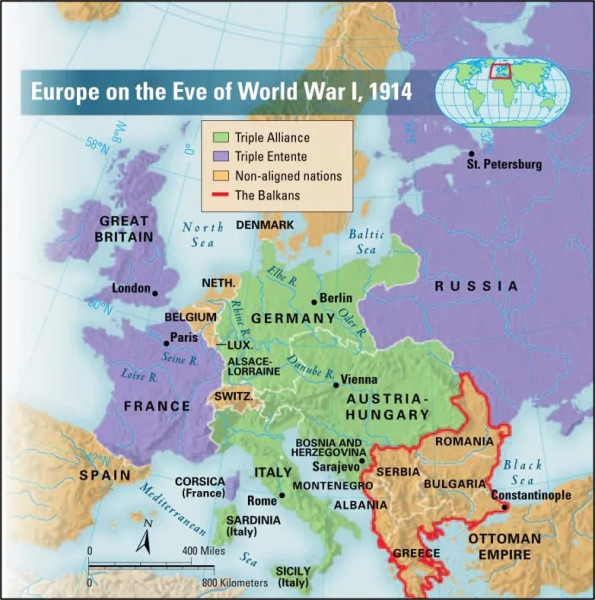
Europe on the eve of World War I, 1914
The full chain is the one AP questions love: unification changed the balance of power → alliances hardened after 1890 → Balkan nationalism tied local disputes to Great Power rivalry → Europe moved toward war by 1914.
Key Takeaways
Concert of Europe
Post-1815 system of Great Power consultation that defended the Vienna settlement until conflict among its members weakened it
Crimean War
1853–1856 war in which Britain, France, and Piedmont-Sardinia aided the Ottoman Empire against Russia, weakening the Concert of Europe and isolating Austria
Risorgimento
The nineteenth-century movement for Italian national unification, meaning Italy's resurgence or rebirth
Giuseppe Mazzini
Italian republican nationalist who promoted unification through popular revolution and helped spread nationalism through Young Italy
Young Italy
Mazzini's republican nationalist movement advocating a united Italy created through popular revolution
Piedmont-Sardinia
Constitutional northwestern Italian kingdom that led unification under Victor Emmanuel II and Cavour
Victor Emmanuel II
King of Piedmont-Sardinia who became the first king of a united Italy in 1861
Count Camillo di Cavour
Piedmontese prime minister who used modernization, diplomacy, French support, limited war, and plebiscites to unify northern and central Italy
Plombières Agreement
Secret 1858 understanding that France would aid Piedmont if Austria appeared to be the aggressor and expected Nice and Savoy in return
Giuseppe Garibaldi
Popular republican soldier whose volunteer campaign conquered Sicily and Naples before he transferred them to Victor Emmanuel II.
Expedition of the Thousand
Garibaldi's 1860 Red Shirt campaign that conquered Sicily and Naples and overthrew the Kingdom of the Two Sicilies
Kingdom of Italy
Unified Italian state proclaimed in 1861 under Victor Emmanuel II, later gaining Venetia in 1866 and Rome in 1870
German Confederation
Loose association of 39 German states dominated by Austria before Prussia dissolved it in 1866
Zollverein
Prussian-led customs union that removed trade barriers among most German states while excluding Austria
Frankfurt Parliament
Liberal elected assembly of 1848–1849 whose attempt to unify Germany failed after Frederick William IV rejected its imperial crown
Kleindeutsch vs. Large German Solutions
Kleindeutsch unified Germany under Prussia without Austria, while the large German alternative would have included Habsburg German lands
Wilhelm I
Prussian king who appointed Bismarck, backed army reform, and became German emperor in 1871
Otto von Bismarck
Prussian minister-president who unified Germany through Realpolitik, diplomatic isolation of opponents, warfare, and controlled representative institutions
Realpolitik
Politics based on practical calculations of power and national interest rather than consistent ideological principles
Blood and Iron Speech
Bismarck's 1862 declaration that major political questions would be settled through power rather than speeches and parliamentary votes alone
Industrialized Warfare
War conducted with railroads, modern weapons, telegraphs, mass production, detailed planning, and an industrial state's resources
Manipulation of Democratic Mechanisms
Bismarck's practice of bypassing or constraining parliament while using elections, suffrage, and nationalism to legitimate conservative rule
Danish War
1864 war in which Prussia and Austria defeated Denmark and took Schleswig and Holstein, creating a future dispute between the victors
Austro-Prussian War / Seven Weeks' War
1866 conflict ending in decisive Prussian victory, Austria's exclusion from German affairs, and creation of the North German Confederation
North German Confederation
Prussian-dominated federation formed in 1867 with an elected Reichstag but executive and military power controlled by the Prussian monarchy
Indemnity Bill
Measure granting retroactive parliamentary approval to Bismarck's unauthorized military spending after Prussia's victory in 1866
Ems Dispatch
Bismarck's edited publication of Wilhelm I's exchange with a French ambassador, which inflamed opinion and helped provoke France into war
Franco-Prussian War
1870–1871 war in which the German states defeated France, united under Prussia, and proclaimed the German Empire
German Empire
Prussian-dominated German state proclaimed at Versailles in 1871 with Wilhelm I as Kaiser
Treaty of Frankfurt
1871 peace requiring France to pay an indemnity and cede Alsace and part of Lorraine to Germany
Revanchism
French desire to avenge defeat in the Franco-Prussian War and recover Alsace-Lorraine
Bismarck's Alliance System
Post-1871 network designed to isolate France, preserve ties with Austria-Hungary and Russia, and prevent a coalition or two-front war against Germany
Three Emperors' League
1873 agreement among Germany, Austria-Hungary, and Russia intended to coordinate the conservative empires and deny France an ally
Russo-Turkish War
1877–1878 Russian victory over the Ottoman Empire that produced the disputed Treaty of San Stefano and a major Balkan crisis
Treaty of San Stefano
1878 Russian-imposed settlement creating a large Bulgaria under strong Russian influence, alarming Austria-Hungary and Britain
Congress of Berlin
1878 conference that reduced Bulgaria, recognized Serbia, Romania, and Montenegro, and allowed Austria-Hungary to administer Bosnia-Herzegovina
Dual Alliance
1879 defensive alliance between Germany and Austria-Hungary directed principally against Russia
Triple Alliance
Alliance formed in 1882 among Germany, Austria-Hungary, and Italy, although Italy remained an uncertain partner
Reinsurance Treaty
Secret 1887 agreement promising German-Russian neutrality in most wars and preserving cooperation despite Germany's alliance with Austria-Hungary
Dismissal of Bismarck
Wilhelm II's removal of Bismarck in 1890, followed by the lapse of the Reinsurance Treaty and the weakening of his flexible alliance system
Franco-Russian Alliance
Military alliance developed from 1891 to 1894 that ended France's isolation and confronted Germany with a possible two-front war
Entente Cordiale
1904 Anglo-French understanding that settled imperial disputes and drew Britain closer to France
Anglo-Russian Convention
1907 agreement resolving major imperial disputes between Britain and Russia and completing the powers associated with the Triple Entente
Triple Entente
Prewar diplomatic grouping linking France, Russia, and Britain through the Franco-Russian Alliance and Anglo-French and Anglo-Russian understandings
Eastern Question
The diplomatic problem of what would happen to Ottoman territories as Ottoman power declined
Pan-Slavism
Movement promoting solidarity among Slavic peoples, used by Russia to support influence among Orthodox Slavs in the Balkans
South Slav / Yugoslav Nationalism
Movement, increasingly led by Serbia, seeking to unite South Slavs including those living within Austria-Hungary
Bosnian Annexation Crisis
1908–1909 crisis caused by Austria-Hungary's annexation of Bosnia-Herzegovina, which angered Serbia and forced Russia to retreat under German pressure
Balkan League
Alliance of Serbia, Bulgaria, Greece, and Montenegro that attacked the Ottoman Empire in 1912
First Balkan War
1912–1913 war in which the Balkan League drove the Ottoman Empire from nearly all its remaining European territory and strengthened Serbia
Second Balkan War
1913 war in which Bulgaria attacked Serbia and Greece but was defeated, leaving Serbia larger and more closely aligned with Russia
Compromise of 1867
Settlement creating the Dual Monarchy of Austria-Hungary, with separate Austrian and Hungarian domestic governments but a shared monarch, foreign policy, and defense
Notes
Concert of Europe
Post-1815 system of Great Power consultation that defended the Vienna settlement until conflict among its members weakened it
Crimean War
1853–1856 war in which Britain, France, and Piedmont-Sardinia aided the Ottoman Empire against Russia, weakening the Concert of Europe and isolating Austria
Risorgimento
The nineteenth-century movement for Italian national unification, meaning Italy's resurgence or rebirth
Giuseppe Mazzini
Italian republican nationalist who promoted unification through popular revolution and helped spread nationalism through Young Italy
Young Italy
Mazzini's republican nationalist movement advocating a united Italy created through popular revolution
Piedmont-Sardinia
Constitutional northwestern Italian kingdom that led unification under Victor Emmanuel II and Cavour
Victor Emmanuel II
King of Piedmont-Sardinia who became the first king of a united Italy in 1861
Count Camillo di Cavour
Piedmontese prime minister who used modernization, diplomacy, French support, limited war, and plebiscites to unify northern and central Italy
Plombières Agreement
Secret 1858 understanding that France would aid Piedmont if Austria appeared to be the aggressor and expected Nice and Savoy in return
Giuseppe Garibaldi
Popular republican soldier whose volunteer campaign conquered Sicily and Naples before he transferred them to Victor Emmanuel II.
Expedition of the Thousand
Garibaldi's 1860 Red Shirt campaign that conquered Sicily and Naples and overthrew the Kingdom of the Two Sicilies
Kingdom of Italy
Unified Italian state proclaimed in 1861 under Victor Emmanuel II, later gaining Venetia in 1866 and Rome in 1870
German Confederation
Loose association of 39 German states dominated by Austria before Prussia dissolved it in 1866
Zollverein
Prussian-led customs union that removed trade barriers among most German states while excluding Austria
Frankfurt Parliament
Liberal elected assembly of 1848–1849 whose attempt to unify Germany failed after Frederick William IV rejected its imperial crown
Kleindeutsch vs. Large German Solutions
Kleindeutsch unified Germany under Prussia without Austria, while the large German alternative would have included Habsburg German lands
Wilhelm I
Prussian king who appointed Bismarck, backed army reform, and became German emperor in 1871
Otto von Bismarck
Prussian minister-president who unified Germany through Realpolitik, diplomatic isolation of opponents, warfare, and controlled representative institutions
Realpolitik
Politics based on practical calculations of power and national interest rather than consistent ideological principles
Blood and Iron Speech
Bismarck's 1862 declaration that major political questions would be settled through power rather than speeches and parliamentary votes alone
Industrialized Warfare
War conducted with railroads, modern weapons, telegraphs, mass production, detailed planning, and an industrial state's resources
Manipulation of Democratic Mechanisms
Bismarck's practice of bypassing or constraining parliament while using elections, suffrage, and nationalism to legitimate conservative rule
Danish War
1864 war in which Prussia and Austria defeated Denmark and took Schleswig and Holstein, creating a future dispute between the victors
Austro-Prussian War / Seven Weeks' War
1866 conflict ending in decisive Prussian victory, Austria's exclusion from German affairs, and creation of the North German Confederation
North German Confederation
Prussian-dominated federation formed in 1867 with an elected Reichstag but executive and military power controlled by the Prussian monarchy
Indemnity Bill
Measure granting retroactive parliamentary approval to Bismarck's unauthorized military spending after Prussia's victory in 1866
Ems Dispatch
Bismarck's edited publication of Wilhelm I's exchange with a French ambassador, which inflamed opinion and helped provoke France into war
Franco-Prussian War
1870–1871 war in which the German states defeated France, united under Prussia, and proclaimed the German Empire
German Empire
Prussian-dominated German state proclaimed at Versailles in 1871 with Wilhelm I as Kaiser
Treaty of Frankfurt
1871 peace requiring France to pay an indemnity and cede Alsace and part of Lorraine to Germany
Revanchism
French desire to avenge defeat in the Franco-Prussian War and recover Alsace-Lorraine
Bismarck's Alliance System
Post-1871 network designed to isolate France, preserve ties with Austria-Hungary and Russia, and prevent a coalition or two-front war against Germany
Three Emperors' League
1873 agreement among Germany, Austria-Hungary, and Russia intended to coordinate the conservative empires and deny France an ally
Russo-Turkish War
1877–1878 Russian victory over the Ottoman Empire that produced the disputed Treaty of San Stefano and a major Balkan crisis
Treaty of San Stefano
1878 Russian-imposed settlement creating a large Bulgaria under strong Russian influence, alarming Austria-Hungary and Britain
Congress of Berlin
1878 conference that reduced Bulgaria, recognized Serbia, Romania, and Montenegro, and allowed Austria-Hungary to administer Bosnia-Herzegovina
Dual Alliance
1879 defensive alliance between Germany and Austria-Hungary directed principally against Russia
Triple Alliance
Alliance formed in 1882 among Germany, Austria-Hungary, and Italy, although Italy remained an uncertain partner
Reinsurance Treaty
Secret 1887 agreement promising German-Russian neutrality in most wars and preserving cooperation despite Germany's alliance with Austria-Hungary
Dismissal of Bismarck
Wilhelm II's removal of Bismarck in 1890, followed by the lapse of the Reinsurance Treaty and the weakening of his flexible alliance system
Franco-Russian Alliance
Military alliance developed from 1891 to 1894 that ended France's isolation and confronted Germany with a possible two-front war
Entente Cordiale
1904 Anglo-French understanding that settled imperial disputes and drew Britain closer to France
Anglo-Russian Convention
1907 agreement resolving major imperial disputes between Britain and Russia and completing the powers associated with the Triple Entente
Triple Entente
Prewar diplomatic grouping linking France, Russia, and Britain through the Franco-Russian Alliance and Anglo-French and Anglo-Russian understandings
Eastern Question
The diplomatic problem of what would happen to Ottoman territories as Ottoman power declined
Pan-Slavism
Movement promoting solidarity among Slavic peoples, used by Russia to support influence among Orthodox Slavs in the Balkans
South Slav / Yugoslav Nationalism
Movement, increasingly led by Serbia, seeking to unite South Slavs including those living within Austria-Hungary
Bosnian Annexation Crisis
1908–1909 crisis caused by Austria-Hungary's annexation of Bosnia-Herzegovina, which angered Serbia and forced Russia to retreat under German pressure
Balkan League
Alliance of Serbia, Bulgaria, Greece, and Montenegro that attacked the Ottoman Empire in 1912
First Balkan War
1912–1913 war in which the Balkan League drove the Ottoman Empire from nearly all its remaining European territory and strengthened Serbia
Second Balkan War
1913 war in which Bulgaria attacked Serbia and Greece but was defeated, leaving Serbia larger and more closely aligned with Russia
Compromise of 1867
Settlement creating the Dual Monarchy of Austria-Hungary, with separate Austrian and Hungarian domestic governments but a shared monarch, foreign policy, and defense
