Topic 9.7 Notes – The Fall of Communism
Why Communist Rule Collapsed in Europe
After World War II, the USSR built a Soviet bloc of satellite states in Poland, East Germany, Czechoslovakia, Hungary, Romania, and Bulgaria. These were formally independent, but Moscow dominated them.
Their system shared the same core features:
- One-party rule meant communist parties controlled politics and crushed opposition.
- Central planning meant the state set production goals and prices instead of markets.
- Censorship and secret police kept people from criticizing the regime openly.
- COMECON tied their economies to the Soviet system.
- The Warsaw Pact tied them militarily to the USSR.
By the 1970s and 1980s, this system was stalling. Factories were inefficient, consumer goods were poor, shortages were common, and Soviet technology lagged behind Western Europe. Military spending and the war in Afghanistan made things worse. People could see that life in the West often meant more choice, better goods, and higher living standards, so communist governments lost legitimacy.
People had challenged Soviet rule before, but those efforts were crushed:
- Hungarian Revolt, 1956 → Soviet tanks restored control.
- Prague Spring, 1968 → reform in Czechoslovakia was ended by invasion.
That pattern changed under Mikhail Gorbachev. He stopped enforcing control the old way.
Gorbachev’s Reforms and Why They Backfired
Gorbachev became Soviet leader in 1985. He wanted to save communism by reforming it.
Perestroika
Perestroika means “restructuring.” It loosened central planning, gave managers more independence, and allowed limited private or cooperative activity. The problem was that old controls weakened before a real market system existed. That created confusion, deeper shortages, and more anger.
Glasnost
Glasnost means “openness.” People gained more freedom to speak, criticize, and learn what had been hidden. That exposed corruption, Stalinist terror, censorship, and economic failure. It also wrecked the Communist Party’s control over information.
The Chernobyl disaster in 1986 became a symbol of this. The explosion showed state incompetence, and the government’s secrecy made public distrust even worse.
Gorbachev also abandoned the old Brezhnev Doctrine in practice. Eastern European communist leaders could no longer assume the USSR would invade to save them. That was the turning point. Stagnation plus reform plus openness plus nonintervention broke communist authority.
The Revolutions of 1989
Once Soviet force was no longer guaranteed, communist regimes fell fast. The fall of the Berlin Wall became the clearest image of that collapse.
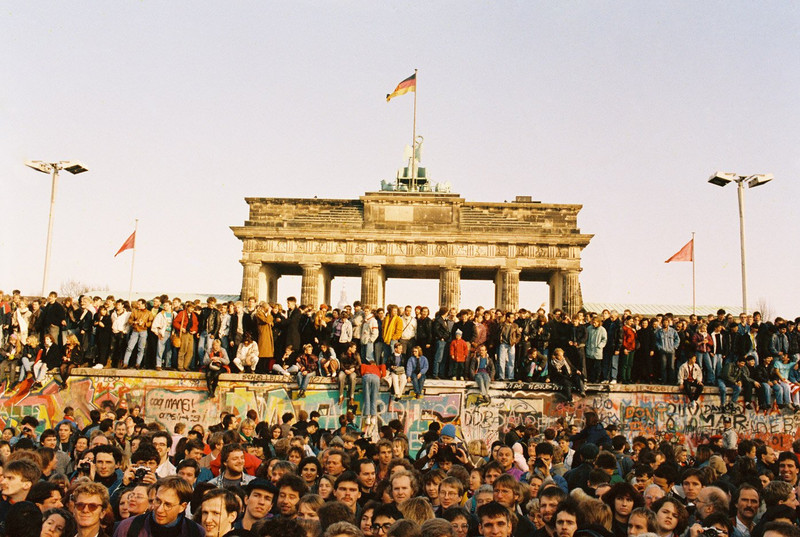
Crowds at the Berlin Wall, November 1989
Poland
Poland broke through first. Solidarity, led by Lech Wałęsa, united workers, intellectuals, and the Catholic Church. Pope John Paul II gave huge moral support. The Round Table Agreements legalized Solidarity, and in June 1989 it won overwhelmingly in contested seats. Tadeusz Mazowiecki became the first noncommunist head of government in the Soviet bloc.
Across Eastern Europe
- Hungary opened its border with Austria and moved toward multiparty politics.
- East Germany faced mass emigration and protests, especially in Leipzig.
- On November 9, 1989, the Berlin Wall fell, the clearest symbol that East German authority and Soviet enforcement were finished.
- Czechoslovakia had the peaceful Velvet Revolution. Civic Forum led mass protests, and Václav Havel became president.
- Romania was the violent exception. An uprising overthrew Nicolae Ceaușescu, and he and Elena Ceaușescu were executed.
A huge exam theme here is the demonstration effect. Success in one country encouraged people in the next.
The End of the USSR and the End of the Cold War
The fall of Eastern Europe fed directly into the Soviet collapse.
- 1990: Germany reunified after the Two Plus Four negotiations. Gorbachev accepted a united Germany in NATO.
- Nationalism surged inside the USSR, especially in Estonia, Latvia, and Lithuania, and also in Ukraine and the Caucasus.
- August 1991: a hard-line coup tried to stop reform and failed. Gorbachev was weakened, and Boris Yeltsin emerged as the leading figure, famously standing on a tank in Moscow.
- December 1991: the USSR dissolved into 15 independent states.
The Cold War ended because one of the two superpowers ceased to exist. The Warsaw Pact and COMECON also dissolved.
What Changed After Communism Fell
Former communist states moved toward capitalist market economies. That meant:
- Privatization of state industries
- Ending price controls
- More foreign investment
- Freer trade
Poland is the classic example of rapid shock therapy. These reforms could work long term, but they were painful at first. Many places saw unemployment, inflation, inequality, and insecurity.
Russia had an especially rough transition. Oligarchs gained huge wealth through privatization, corruption spread, and many people saw living standards fall in the 1990s.
The political map changed too:
- Czechoslovakia split peacefully into the Czech Republic and Slovakia in 1993.
- Yugoslavia dissolved violently, with wars, ethnic cleansing, and genocide.
European integration also expanded eastward. In 2004, the EU admitted Poland, Hungary, the Czech Republic, Slovakia, Slovenia, Estonia, Latvia, and Lithuania. Bulgaria and Romania joined in 2007.
Key Takeaways
Fall of Communism
Collapse of Soviet-dominated communist governments beginning in 1989 and of the USSR in 1991, ending Soviet control of Eastern Europe and the Cold War
Mikhail Gorbachev
Soviet leader from 1985 whose reforms and refusal to enforce communist rule militarily unintentionally accelerated the collapse of the Soviet bloc and USSR.
Perestroika
Gorbachev’s policy of “restructuring” the Soviet economy and administration through limited decentralization and market mechanisms
Glasnost
Gorbachev’s policy of “openness” permitting greater access to information, public criticism, and freedom of expression
Chernobyl Nuclear Disaster
The 1986 Soviet nuclear reactor catastrophe that exposed administrative and safety failures, secrecy, and the need for glasnost
Brezhnev Doctrine
Soviet claim to a right to intervene when communist rule was threatened in a bloc country, a policy Gorbachev effectively abandoned
Solidarity
Independent Polish trade union and opposition movement founded in 1980 that challenged communist rule and won the freely contested seats in the 1989 elections
Lech Wałęsa
Polish labor leader who led Solidarity’s challenge to communist rule
Round Table Agreements
1989 agreements between Poland’s communist government and opposition that legalized Solidarity and established partially free elections
Polish Elections of 1989
Partially free elections in which Solidarity’s overwhelming victory exposed the communist government’s lack of popular legitimacy
Revolutions of 1989
Rapid, mostly peaceful overthrow of communist governments across Central and Eastern Europe after the Soviet Union withdrew its military guarantee
Fall of the Berlin Wall
Opening of East Germany’s Berlin Wall crossings on November 9, 1989, symbolizing the collapse of communist authority and Europe’s Cold War division
Velvet Revolution
Overwhelmingly peaceful 1989 revolution in Czechoslovakia that ended the Communist Party’s monopoly and brought Václav Havel to the presidency
Václav Havel
Czechoslovak dissident playwright who became president after the Velvet Revolution ended communist rule
Nicolae Ceaușescu
Repressive Romanian communist dictator overthrown and executed during Romania’s violent December 1989 uprising
German Reunification
East Germany’s October 3, 1990, incorporation into the Federal Republic of Germany, extending West German democratic and capitalist institutions eastward
Two Plus Four Negotiations
Negotiations between East and West Germany and the four victorious World War II powers that secured international agreement for German reunification
Boris Yeltsin
Russian reform leader who resisted the August 1991 coup, displaced Gorbachev politically, and helped dissolve the Soviet Union
August 1991 Soviet Coup Attempt
Failed hard-line attempt to remove Gorbachev and restore central control that instead discredited the Communist Party and accelerated Soviet dissolution
Dissolution of the Soviet Union
December 1991 breakup of the USSR into fifteen independent states, definitively ending the Cold War’s Soviet superpower bloc
Commonwealth of Independent States
Organization created in December 1991 by Russia, Ukraine, and Belarus as they announced that the Soviet Union had ceased to exist
Postcommunist Transition to Capitalism
Replacement of central planning with private ownership, market prices, commercial institutions, foreign trade, and investment after communist rule
Shock Therapy
Rapid postcommunist liberalization of prices and privatization of state enterprises intended to create a market economy quickly
Oligarchs
Small group of wealthy business figures who acquired major former state assets during Russia’s poorly regulated privatization
Velvet Divorce
Peaceful January 1, 1993, division of Czechoslovakia into the Czech Republic and Slovakia
Dissolution of Yugoslavia
Breakup of the Yugoslav federation beginning in 1991, accompanied by nationalist wars, ethnic cleansing, and genocide
European Union Eastward Enlargement
Admission of former communist states to the EU, especially eight in 2004 and Bulgaria and Romania in 2007
Notes
Fall of Communism
Collapse of Soviet-dominated communist governments beginning in 1989 and of the USSR in 1991, ending Soviet control of Eastern Europe and the Cold War
Mikhail Gorbachev
Soviet leader from 1985 whose reforms and refusal to enforce communist rule militarily unintentionally accelerated the collapse of the Soviet bloc and USSR.
Perestroika
Gorbachev’s policy of “restructuring” the Soviet economy and administration through limited decentralization and market mechanisms
Glasnost
Gorbachev’s policy of “openness” permitting greater access to information, public criticism, and freedom of expression
Chernobyl Nuclear Disaster
The 1986 Soviet nuclear reactor catastrophe that exposed administrative and safety failures, secrecy, and the need for glasnost
Brezhnev Doctrine
Soviet claim to a right to intervene when communist rule was threatened in a bloc country, a policy Gorbachev effectively abandoned
Solidarity
Independent Polish trade union and opposition movement founded in 1980 that challenged communist rule and won the freely contested seats in the 1989 elections
Lech Wałęsa
Polish labor leader who led Solidarity’s challenge to communist rule
Round Table Agreements
1989 agreements between Poland’s communist government and opposition that legalized Solidarity and established partially free elections
Polish Elections of 1989
Partially free elections in which Solidarity’s overwhelming victory exposed the communist government’s lack of popular legitimacy
Revolutions of 1989
Rapid, mostly peaceful overthrow of communist governments across Central and Eastern Europe after the Soviet Union withdrew its military guarantee
Fall of the Berlin Wall
Opening of East Germany’s Berlin Wall crossings on November 9, 1989, symbolizing the collapse of communist authority and Europe’s Cold War division
Velvet Revolution
Overwhelmingly peaceful 1989 revolution in Czechoslovakia that ended the Communist Party’s monopoly and brought Václav Havel to the presidency
Václav Havel
Czechoslovak dissident playwright who became president after the Velvet Revolution ended communist rule
Nicolae Ceaușescu
Repressive Romanian communist dictator overthrown and executed during Romania’s violent December 1989 uprising
German Reunification
East Germany’s October 3, 1990, incorporation into the Federal Republic of Germany, extending West German democratic and capitalist institutions eastward
Two Plus Four Negotiations
Negotiations between East and West Germany and the four victorious World War II powers that secured international agreement for German reunification
Boris Yeltsin
Russian reform leader who resisted the August 1991 coup, displaced Gorbachev politically, and helped dissolve the Soviet Union
August 1991 Soviet Coup Attempt
Failed hard-line attempt to remove Gorbachev and restore central control that instead discredited the Communist Party and accelerated Soviet dissolution
Dissolution of the Soviet Union
December 1991 breakup of the USSR into fifteen independent states, definitively ending the Cold War’s Soviet superpower bloc
Commonwealth of Independent States
Organization created in December 1991 by Russia, Ukraine, and Belarus as they announced that the Soviet Union had ceased to exist
Postcommunist Transition to Capitalism
Replacement of central planning with private ownership, market prices, commercial institutions, foreign trade, and investment after communist rule
Shock Therapy
Rapid postcommunist liberalization of prices and privatization of state enterprises intended to create a market economy quickly
Oligarchs
Small group of wealthy business figures who acquired major former state assets during Russia’s poorly regulated privatization
Velvet Divorce
Peaceful January 1, 1993, division of Czechoslovakia into the Czech Republic and Slovakia
Dissolution of Yugoslavia
Breakup of the Yugoslav federation beginning in 1991, accompanied by nationalist wars, ethnic cleansing, and genocide
European Union Eastward Enlargement
Admission of former communist states to the EU, especially eight in 2004 and Bulgaria and Romania in 2007
