Topic 5.6 Notes – Napoleon’s Rise, Dominance, and Defeat
Napoleon as Revolutionary Reformer and Authoritarian Ruler
Napoleon rose because France was tired of the Directory. It had elections, but also corruption, instability, and dependence on the army. In 18 Brumaire in 1799, Napoleon seized power, became First Consul, then consul for life in 1802, and Emperor in 1804.
He kept major revolutionary changes:
- Legal equality for men replaced old noble privilege.
- Feudal dues stayed abolished.
- Property rights were protected, which mattered a lot to peasants and bourgeois buyers of former church land.
- Careers open to talent meant office and promotion depended more on ability and service than birth.
- Secular administration kept the state stronger than the church.
But he ended republican liberty. France still had constitutions, plebiscites, and assemblies, yet they mostly gave a façade of representation. Real power stayed with Napoleon. That’s the key exam point. He was neither a full revolutionary hero nor a simple return to the Old Regime.
Reforms and Controls Under Napoleon
Napoleon’s domestic rule mixed modernization with control.
Major reforms
| Reform | What it did |
|---|---|
| Careers open to talent | Army and bureaucracy promoted men for merit, education, and loyalty more than noble birth |
| Legion of Honor | Rewarded civil and military service with prestige |
| Centralized bureaucracy | Prefects, subprefects, and appointed mayors enforced Paris’s will locally |
| Educational system | Lycées trained officers and officials; University of France standardized curriculum under state supervision |
| Civil Code | Legal equality for men, protection of property and contracts, abolition of feudal privilege, uniform laws |
| Concordat of 1801 | Reconciled many Catholics to the regime while keeping church lands and state control over bishops |
| Economic stabilization | Bank of France, franc germinal, and better tax collection brought order after the 1790s |
Curtailment of rights
Those reforms came with heavy limits:
- Secret police under Joseph Fouché watched opponents, used surveillance, and made arrests.
- Censorship controlled newspapers, books, theater, and debate.
- Women’s rights were restricted by the Civil Code. Husbands and fathers gained authority, and women had weaker property and divorce rights.
- There was no real parliamentary accountability. Popular sovereignty existed mostly as a tool to legitimize authoritarian rule.
How Napoleon Dominated Europe and Spread Revolutionary Change
Napoleon’s empire rested on military innovation. He used conscription, huge armies, the corps system, fast movement, concentrated artillery, and a strategy of crushing the enemy in decisive battle.
Major victories and limits
At its height in 1812, French power stretched across much of the continent, as this map shows.
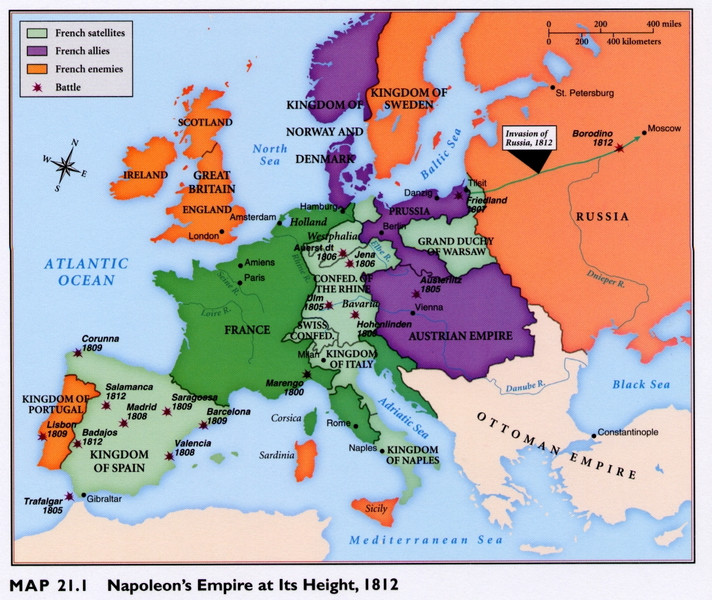
Napoleon’s Empire at its height, 1812
- Italian campaign made him famous.
- Marengo (1800) secured his position in France.
- Austerlitz (1805) broke Austria and Russia.
- Jena and Auerstedt (1806) crushed Prussia.
- Tilsit (1807) marked the high point of his dominance.
- Trafalgar (1805) was the big limit. Britain remained unbeatable at sea.
Empire structure
- Directly annexed territories became part of France.
- Satellite states included the Kingdom of Italy, Kingdom of Naples, Grand Duchy of Warsaw, and the Confederation of the Rhine.
- Allied but pressured states kept formal independence but followed French demands.
French rule spread:
- the Civil Code
- weaker feudalism and noble privilege
- less church power
- fewer internal tolls and old corporate barriers
In German and Italian lands, Napoleon simplified the political map, which made larger national identities easier to imagine. But people also paid taxes, supplied armies, faced censorship, and lived under foreign rule.
Resistance, Decline, and Defeat
Resistance grew because Napoleon’s empire was expensive and intrusive. The Continental System hurt Europe more than Britain, and occupation started to look like exploitation.
Nationalist responses to Napoleon
- Student protest in German states grew around writers like Fichte, whose Addresses to the German Nation helped define resistance in national terms.
- Guerilla war in Spain erupted after Napoleon placed Joseph Bonaparte on the throne. The Peninsular War mixed Catholic loyalty, dynastic resistance, local revolt, and British aid under Wellington.
- Russian scorched earth policy worked by retreating, destroying supplies, and refusing surrender. After Borodino, Napoleon entered a burning Moscow and then suffered the disastrous 1812 retreat.
Goya’s famous image of a firing squad in Spain captures the kind of anti-French violence and repression that turned resistance into a broader nationalist struggle.
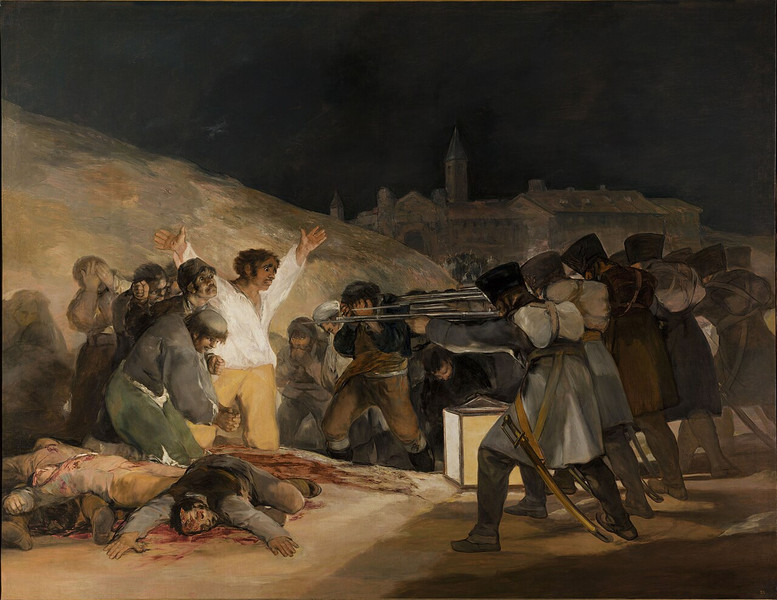
Goya, The Third of May 1808
Napoleon finally fell because of overextension, stronger coalitions, and British naval and financial power. He lost at Leipzig in 1813, abdicated in 1814, returned for the Hundred Days, then was defeated at Waterloo in 1815 and exiled to Saint Helena.
Key Takeaways
Napoleon Bonaparte
French general who overthrew the Directory, ruled as First Consul and emperor, preserved selected revolutionary reforms, built a continental empire, and was defeated in 1815
Directory
Unstable French government of 1795–1799, weakened by corruption, war, financial problems, and dependence on the army before Napoleon overthrew it
Coup of 18 Brumaire
Napoleon’s November 9, 1799 coup that overthrew the Directory and established the Consulate
Consulate
French regime established in 1799 that retained representative-looking institutions but placed real authority in Napoleon’s hands as First Consul
Napoleonic Plebiscites
Tightly managed popular votes used to approve decisions already made by Napoleon and claim national legitimacy for his rule
Authoritarian Popular Sovereignty
Napoleon’s claim that power came from the nation while citizens mainly approved decisions made by an unaccountable ruler
Coronation of Napoleon I
Napoleon’s 1804 creation of a hereditary empire, symbolized by his crowning himself rather than receiving the crown from the pope
Napoleonic Imperial Nobility
New titled elite rewarded for service, ability, military distinction, and loyalty, without restoring the old nobility’s legal privileges
Legion of Honor
Institution established in 1802 to reward distinguished civil and military service to Napoleon’s regime
Prefect System
Centralized administration in which appointed prefects supervised local government, taxation, policing, public works, and national policy
Careers Open to Talent
Principle that government and military advancement should depend on ability, education, service, and loyalty rather than noble birth
Lycées
State secondary schools established under Napoleon to provide disciplined education for future officers, officials, and loyal male elites
University of France
Administrative organization created in 1808 to supervise and standardize French secondary and higher education
Civil Code of 1804 / Napoleonic Code
Uniform secular civil code that confirmed legal equality for men, the abolition of feudal privilege, and protection of property while subordinating women and favoring employers over workers
Concordat of 1801
Agreement with Pope Pius VII that reconciled Catholics to the regime while preserving confiscated church lands and substantial state control over religion
Bank of France
Financial institution founded in 1800 to support government credit and monetary stability
Franc Germinal
Stable metallic-standard currency introduced in 1803 as part of Napoleon’s fiscal and monetary reforms
Napoleonic Military Tactics
Use of independently moving corps, rapid concentration, maneuver, massed artillery, and decisive battle to divide and destroy enemy armies
Battle of Trafalgar
British naval victory in 1805 that ended Napoleon’s immediate prospect of invading Britain and confirmed British superiority at sea
Battle of Austerlitz
Napoleon’s decisive 1805 victory over Austrian and Russian armies, demonstrating his mastery of maneuver and concentrated force
Dissolution of the Holy Roman Empire
Napoleon’s victories led to the Holy Roman Empire’s abolition in 1806 and a major reorganization of the German lands
Confederation of the Rhine
Association of German states organized under Napoleon’s protection after the Holy Roman Empire was dissolved
Treaties of Tilsit
Agreements concluded in 1807 after Napoleon defeated Russia that marked the height of his dominance over continental Europe
Continental System
Napoleon’s attempted blockade of British goods from continental ports, which failed because of British trade, smuggling, and resistance and alienated European allies
Addresses to the German Nation
Johann Gottlieb Fichte’s 1807–1808 speeches calling for German cultural and educational renewal in response to French occupation
Guerrilla Warfare
Irregular warfare in which small bands ambush enemy troops and supply lines and then disperse among the population
Peninsular War
War of 1808–1814 in which Spanish and Portuguese resistance, guerrillas, and British forces tied down French troops and weakened Napoleon
The Third of May 1808
Francisco Goya’s painting of a French firing squad executing Spanish civilians, emphasizing the violence and popular suffering of occupation
Scorched-Earth Policy
Russian strategy of retreating while removing or destroying food, fodder, and supplies that Napoleon’s invading army could use
Russian Campaign of 1812
Napoleon’s disastrous invasion of Russia, in which scorched earth, supply failures, disease, combat, desertion, and cold destroyed most of his army
Battle of Leipzig / Battle of the Nations
Major coalition victory over Napoleon in October 1813 that caused French control of Germany to collapse
Hundred Days
Napoleon’s brief return to power in 1815 after escaping Elba, ending with his defeat at Waterloo and second abdication
Battle of Waterloo
Napoleon’s decisive defeat on June 18, 1815 by Wellington’s Anglo-allied army and arriving Prussian forces under Blücher
Elba vs. Saint Helena
Napoleon was exiled to nearby Elba in 1814 and escaped, but after Waterloo he was sent to remote Saint Helena, where he died in 1821
Napoleonic Empire
System of directly annexed territories, dependent satellite states, and coerced allies through which Napoleon dominated much of continental Europe and spread selected revolutionary reforms
Notes
Napoleon Bonaparte
French general who overthrew the Directory, ruled as First Consul and emperor, preserved selected revolutionary reforms, built a continental empire, and was defeated in 1815
Directory
Unstable French government of 1795–1799, weakened by corruption, war, financial problems, and dependence on the army before Napoleon overthrew it
Coup of 18 Brumaire
Napoleon’s November 9, 1799 coup that overthrew the Directory and established the Consulate
Consulate
French regime established in 1799 that retained representative-looking institutions but placed real authority in Napoleon’s hands as First Consul
Napoleonic Plebiscites
Tightly managed popular votes used to approve decisions already made by Napoleon and claim national legitimacy for his rule
Authoritarian Popular Sovereignty
Napoleon’s claim that power came from the nation while citizens mainly approved decisions made by an unaccountable ruler
Coronation of Napoleon I
Napoleon’s 1804 creation of a hereditary empire, symbolized by his crowning himself rather than receiving the crown from the pope
Napoleonic Imperial Nobility
New titled elite rewarded for service, ability, military distinction, and loyalty, without restoring the old nobility’s legal privileges
Legion of Honor
Institution established in 1802 to reward distinguished civil and military service to Napoleon’s regime
Prefect System
Centralized administration in which appointed prefects supervised local government, taxation, policing, public works, and national policy
Careers Open to Talent
Principle that government and military advancement should depend on ability, education, service, and loyalty rather than noble birth
Lycées
State secondary schools established under Napoleon to provide disciplined education for future officers, officials, and loyal male elites
University of France
Administrative organization created in 1808 to supervise and standardize French secondary and higher education
Civil Code of 1804 / Napoleonic Code
Uniform secular civil code that confirmed legal equality for men, the abolition of feudal privilege, and protection of property while subordinating women and favoring employers over workers
Concordat of 1801
Agreement with Pope Pius VII that reconciled Catholics to the regime while preserving confiscated church lands and substantial state control over religion
Bank of France
Financial institution founded in 1800 to support government credit and monetary stability
Franc Germinal
Stable metallic-standard currency introduced in 1803 as part of Napoleon’s fiscal and monetary reforms
Napoleonic Military Tactics
Use of independently moving corps, rapid concentration, maneuver, massed artillery, and decisive battle to divide and destroy enemy armies
Battle of Trafalgar
British naval victory in 1805 that ended Napoleon’s immediate prospect of invading Britain and confirmed British superiority at sea
Battle of Austerlitz
Napoleon’s decisive 1805 victory over Austrian and Russian armies, demonstrating his mastery of maneuver and concentrated force
Dissolution of the Holy Roman Empire
Napoleon’s victories led to the Holy Roman Empire’s abolition in 1806 and a major reorganization of the German lands
Confederation of the Rhine
Association of German states organized under Napoleon’s protection after the Holy Roman Empire was dissolved
Treaties of Tilsit
Agreements concluded in 1807 after Napoleon defeated Russia that marked the height of his dominance over continental Europe
Continental System
Napoleon’s attempted blockade of British goods from continental ports, which failed because of British trade, smuggling, and resistance and alienated European allies
Addresses to the German Nation
Johann Gottlieb Fichte’s 1807–1808 speeches calling for German cultural and educational renewal in response to French occupation
Guerrilla Warfare
Irregular warfare in which small bands ambush enemy troops and supply lines and then disperse among the population
Peninsular War
War of 1808–1814 in which Spanish and Portuguese resistance, guerrillas, and British forces tied down French troops and weakened Napoleon
The Third of May 1808
Francisco Goya’s painting of a French firing squad executing Spanish civilians, emphasizing the violence and popular suffering of occupation
Scorched-Earth Policy
Russian strategy of retreating while removing or destroying food, fodder, and supplies that Napoleon’s invading army could use
Russian Campaign of 1812
Napoleon’s disastrous invasion of Russia, in which scorched earth, supply failures, disease, combat, desertion, and cold destroyed most of his army
Battle of Leipzig / Battle of the Nations
Major coalition victory over Napoleon in October 1813 that caused French control of Germany to collapse
Hundred Days
Napoleon’s brief return to power in 1815 after escaping Elba, ending with his defeat at Waterloo and second abdication
Battle of Waterloo
Napoleon’s decisive defeat on June 18, 1815 by Wellington’s Anglo-allied army and arriving Prussian forces under Blücher
Elba vs. Saint Helena
Napoleon was exiled to nearby Elba in 1814 and escaped, but after Waterloo he was sent to remote Saint Helena, where he died in 1821
Napoleonic Empire
System of directly annexed territories, dependent satellite states, and coerced allies through which Napoleon dominated much of continental Europe and spread selected revolutionary reforms
