Topic 2.2 Notes – Luther and the Protestant Reformation
What Luther Challenged in Christianity
Before the Reformation, western Europe was Latin Christendom. The pope stood at the top of the Roman Catholic Church. Religious authority came from scripture and church tradition, the church recognized seven sacraments, and salvation was tied to God’s grace working through faith, good works, and the sacramental life.
Luther’s attack grew into more than anger at corruption. He ended up challenging the whole system of how Christians reached salvation and who had the right to define truth.
Indulgences and the 1517 controversy
An indulgence was a remission of temporal punishment for sin after guilt had been forgiven. In theory, it was not buying salvation. In practice, preaching often made it sound that way.
- Johann Tetzel became the famous indulgence preacher linked to this abuse.
- Luther’s Ninety-Five Theses in 1517 attacked indulgence preaching and questioned papal claims tied to it.
- What started as an academic dispute exploded into a public controversy because people already distrusted many church practices.
That moment is often represented by Luther posting the theses at Wittenberg, which turned a dispute over indulgences into a public challenge to church authority.
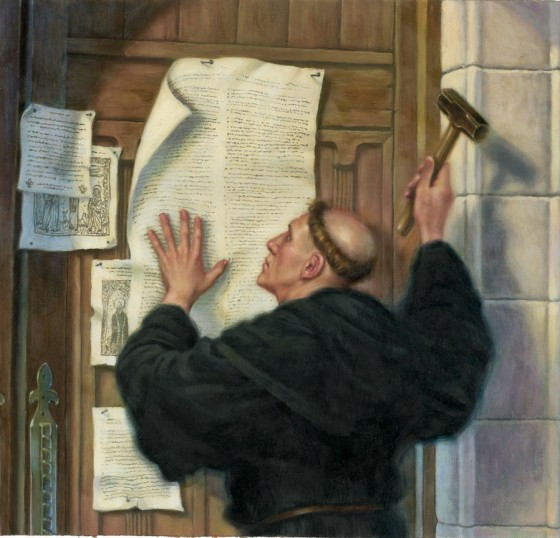
Martin Luther posting the Ninety-Five Theses
Why reform spread so fast
Different grievances were feeding the same fire:
- Simony meant buying church offices.
- Pluralism meant holding several offices at once.
- Absenteeism meant taking church income without doing the job.
- Nepotism and clerical immorality hurt the church’s moral authority.
- Erasmus and Christian humanists pushed ad fontes, “back to the sources,” and criticized superstition and empty ritual.
- In the Holy Roman Empire, many resented church wealth and papal interference.
- The printing press turned Luther from a local professor into a Europe-wide problem for the Church.
Luther’s Core Ideas and the Break with Rome
Luther’s ideas matter because they changed both belief and practice.
Justification by faith alone
Sola fide means salvation comes through faith alone.
- You could not earn salvation through indulgences, relics, pilgrimages, penance, or good works.
- Good works still mattered, but as the result of faith, not the cause of salvation.
Primacy of scripture
Sola scriptura means the Bible is the highest authority.
- Popes and councils could be wrong.
- This encouraged vernacular Bibles, including Luther’s German New Testament (1522) and full Bible (1534).
Priesthood of all believers
All Christians had direct access to God.
- Clergy still preached and taught.
- Priests were no longer spiritually superior middlemen.
Sacraments and worship
Luther kept baptism and the Eucharist and rejected the seven-sacrament system.
- He rejected transubstantiation, but still believed in the real presence of Christ in Communion.
- Worship shifted toward vernacular services, sermons, and hymns.
- He supported clerical marriage and married Katharina von Bora.
The formal break
- Leipzig Debate (1519) with Johann Eck pushed Luther to challenge church authority more openly.
- In 1520, Luther published major attacks on church structure and sacramental theology.
- Pope Leo X excommunicated him after Exsurge Domine.
- At the Diet of Worms (1521), before Charles V, Luther refused to recant.
- The Edict of Worms condemned him, but Frederick the Wise protected him. That protection helps explain why reform survived.
Protestantism Split into Different Movements
One protest became several Protestant churches.
Lutheran churches
Lutheranism was often organized by German princes and city governments.
- Protestant comes from the Protestation at Speyer (1529).
- Philip Melanchthon wrote the Augsburg Confession (1530).
- One major tension shows up here. Reform attacked papal power, but it often increased state control over religion.
Calvinism
John Calvin built another major Protestant system in the Institutes of the Christian Religion (1536).
- He agreed with Luther on grace, scripture, and rejection of papal authority.
- His distinctive doctrine was predestination. God had chosen the elect for salvation.
- Calvinism stressed vocation, discipline, thrift, and hard work.
- Some Calvinists saw prosperity and wealth accumulation as possible signs of God’s favor.
- Geneva became a model Protestant city, where the Consistory enforced moral discipline.
Anabaptists
The Anabaptists were radical reformers.
- They rejected infant baptism and practiced adult baptism.
- They wanted a voluntary church, separation of church and state, pacifism, and refusal of oaths.
- Both Catholics and Protestants persecuted them.
- Münster was the famous violent exception. Menno Simons and the Mennonites are the better-known peaceful tradition.
How Reformation Ideas Produced Conflict and Lasting Change
The Reformation did not stay theological. It spilled into politics and society.
- In the German Peasants’ War (1524-1525), peasants used reform language to justify social and economic demands.
- The Twelve Articles asked for relief from serfdom, dues, loss of common rights, and also choice of pastors.
- Luther condemned the revolt in Against the Murderous, Thieving Hordes of Peasants.
This shows a key split. Luther meant Christian freedom as spiritual freedom. Many peasants heard it as social freedom too.
The Reformation became permanent because theological disagreement ran too deep for easy compromise, print spread ideas fast, and the Holy Roman Empire was politically fragmented. This map helps you picture that fragmented setting, where many different princes, cities, and regional authorities could back or resist reform in their own territories. Western Christendom stayed Christian, but it no longer stayed united under one church.
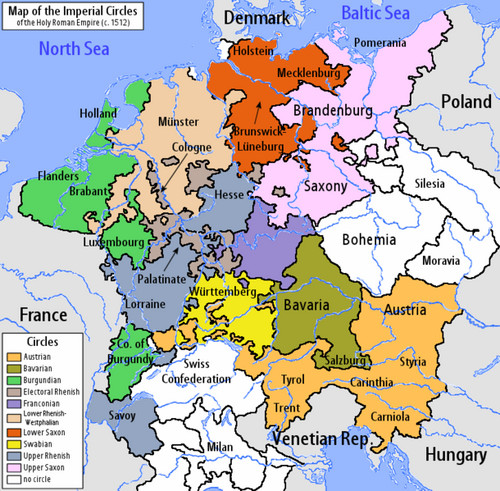
Holy Roman Empire imperial circles, c. 1512
Key Takeaways
Simony
The buying or selling of church offices, a clerical abuse criticized by reformers
Pluralism
The holding of multiple church offices at the same time, often to collect their incomes
Absenteeism
The practice of church officeholders collecting income without residing in or serving their dioceses or parishes
Nepotism
The use of church authority or offices to benefit relatives
Christian Humanism
Northern Renaissance movement that used original Christian sources and language study to criticize superstition, clerical ignorance, and empty ritual while generally seeking reform within Catholicism
Indulgence
A church-granted remission of temporal punishment remaining after the guilt of sin had been forgiven
Johann Tetzel
Dominican preacher whose dramatic promotion of an indulgence campaign near Wittenberg provoked Luther’s criticism
Pope Leo X
Pope who authorized the indulgence campaign connected to St. Peter’s Basilica and later excommunicated Luther
Martin Luther
German reformer whose attack on indulgences developed into Lutheran doctrines of faith alone, scripture alone, and the priesthood of all believers
Ninety-Five Theses
Luther’s 1517 propositions challenging indulgence preaching, false spiritual security, and claims of papal authority over purgatory
Leipzig Debate
The 1519 debate in which Johann Eck pushed Luther toward openly asserting that popes and church councils could err
Address to the Christian Nobility of the German Nation
Luther’s 1520 appeal for secular German rulers to undertake church reform
The Babylonian Captivity of the Church
Luther’s 1520 attack on the Catholic sacramental system
The Freedom of a Christian
Luther’s 1520 explanation that faith spiritually frees Christians while leading them to serve others in love
Exsurge Domine
The 1520 papal bull threatening Luther with excommunication unless he recanted; Luther publicly burned it
Diet of Worms
The 1521 imperial assembly where Luther refused to retract his writings unless disproved by scripture or clear reasoning
Edict of Worms
Charles V’s 1521 decree declaring Luther an outlaw and prohibiting his writings
Charles V
Holy Roman emperor who condemned Luther at Worms but could not enforce religious uniformity across the decentralized empire
Frederick the Wise
Elector of Saxony who protected Luther after the Diet of Worms by concealing him at Wartburg Castle
Justification by Faith Alone (Sola Fide)
Luther’s doctrine that people are counted righteous through faith in Christ as a gift of grace, not through the merit of good works
Primacy of Scripture (Sola Scriptura)
Luther’s doctrine that the Bible is the final authority in matters necessary for salvation, above popes, councils, and unsupported traditions
Priesthood of All Believers
The doctrine that all baptized Christians have direct spiritual access to God and that ordained priests possess no higher spiritual status
Transubstantiation
Catholic doctrine that the Eucharistic bread and wine become the body and blood of Christ
Sacramental Union
Lutheran teaching that Christ’s body and blood are truly present with the bread and wine in the Eucharist without the Catholic explanation of transubstantiation
Lutheranism
Protestant tradition based on Luther’s teachings of faith alone, scripture as final authority, two sacraments, and the priesthood of all believers
Protestation at Speyer
The 1529 protest by Lutheran princes and cities against imperial restrictions on religious reform, giving rise to the name Protestant
Protestantism
The diverse Western Christian movements that rejected papal authority and adopted reformed doctrines and worship
Philip Melanchthon
Luther’s Wittenberg colleague who systematized Lutheran theology and presented the Augsburg Confession
Augsburg Confession
The 1530 statement of Lutheran belief presented by Philip Melanchthon and adopted as Lutheranism’s foundational confession
German Peasants’ War
The 1524–1525 uprising in which German peasants combined social and economic grievances with appeals to scripture and Christian freedom
Twelve Articles
The peasants’ 1525 program demanding reforms such as chosen pastors, reduced dues, restored common rights, and an end to unjustified serfdom
Against the Murderous, Thieving Hordes of Peasants
Luther’s 1525 work condemning the violent peasant rebellion and urging princes to suppress it
John Calvin
French Protestant reformer who emphasized divine sovereignty, predestination, disciplined conduct, and biblically organized churches
Institutes of the Christian Religion
Calvin’s systematic presentation of Protestant theology, first published in 1536 and expanded in later editions
Reformed Protestantism (Calvinism)
Protestant tradition emphasizing scripture, God’s sovereignty, predestination, disciplined conduct, and structured church governance
Predestination
Calvinist doctrine that God has eternally determined who will be saved and that human actions cannot earn or alter election
Vocation (Calling)
The Calvinist idea that ordinary work is a God-given calling to be pursued through disciplined and responsible service
Calvinist View of Wealth
Prosperity and accumulated wealth could be viewed as possible signs of divine favor and rewards associated with disciplined labor, but not as causes or guarantees of salvation
Calvin’s Geneva
Disciplined Christian community where ministers and civic magistrates regulated conduct and trained ministers who carried Reformed Protestantism elsewhere
Consistory
Geneva’s body of ministers and lay elders that investigated conduct and enforced Calvinist moral discipline
Anabaptists
Radical reformers who rejected infant baptism for believers’ baptism; many also advocated voluntary churches, separation from secular government, pacifism, and strict discipline
Believers’ Baptism
Baptism administered to adults who consciously profess faith and voluntarily join the Christian community
Magisterial Protestantism vs. Radical Reformation
Magisterial reformers such as Luther and Calvin worked with governments, while radical reformers formed voluntary communities outside state-controlled churches
Münster Rebellion
The violent Anabaptist apocalyptic regime of 1534–1535, an exceptional episode unlike the generally pacifist Anabaptist tradition
Menno Simons
Anabaptist leader who organized nonviolent communities after Münster; his followers became known as Mennonites
Notes
Simony
The buying or selling of church offices, a clerical abuse criticized by reformers
Pluralism
The holding of multiple church offices at the same time, often to collect their incomes
Absenteeism
The practice of church officeholders collecting income without residing in or serving their dioceses or parishes
Nepotism
The use of church authority or offices to benefit relatives
Christian Humanism
Northern Renaissance movement that used original Christian sources and language study to criticize superstition, clerical ignorance, and empty ritual while generally seeking reform within Catholicism
Indulgence
A church-granted remission of temporal punishment remaining after the guilt of sin had been forgiven
Johann Tetzel
Dominican preacher whose dramatic promotion of an indulgence campaign near Wittenberg provoked Luther’s criticism
Pope Leo X
Pope who authorized the indulgence campaign connected to St. Peter’s Basilica and later excommunicated Luther
Martin Luther
German reformer whose attack on indulgences developed into Lutheran doctrines of faith alone, scripture alone, and the priesthood of all believers
Ninety-Five Theses
Luther’s 1517 propositions challenging indulgence preaching, false spiritual security, and claims of papal authority over purgatory
Leipzig Debate
The 1519 debate in which Johann Eck pushed Luther toward openly asserting that popes and church councils could err
Address to the Christian Nobility of the German Nation
Luther’s 1520 appeal for secular German rulers to undertake church reform
The Babylonian Captivity of the Church
Luther’s 1520 attack on the Catholic sacramental system
The Freedom of a Christian
Luther’s 1520 explanation that faith spiritually frees Christians while leading them to serve others in love
Exsurge Domine
The 1520 papal bull threatening Luther with excommunication unless he recanted; Luther publicly burned it
Diet of Worms
The 1521 imperial assembly where Luther refused to retract his writings unless disproved by scripture or clear reasoning
Edict of Worms
Charles V’s 1521 decree declaring Luther an outlaw and prohibiting his writings
Charles V
Holy Roman emperor who condemned Luther at Worms but could not enforce religious uniformity across the decentralized empire
Frederick the Wise
Elector of Saxony who protected Luther after the Diet of Worms by concealing him at Wartburg Castle
Justification by Faith Alone (Sola Fide)
Luther’s doctrine that people are counted righteous through faith in Christ as a gift of grace, not through the merit of good works
Primacy of Scripture (Sola Scriptura)
Luther’s doctrine that the Bible is the final authority in matters necessary for salvation, above popes, councils, and unsupported traditions
Priesthood of All Believers
The doctrine that all baptized Christians have direct spiritual access to God and that ordained priests possess no higher spiritual status
Transubstantiation
Catholic doctrine that the Eucharistic bread and wine become the body and blood of Christ
Sacramental Union
Lutheran teaching that Christ’s body and blood are truly present with the bread and wine in the Eucharist without the Catholic explanation of transubstantiation
Lutheranism
Protestant tradition based on Luther’s teachings of faith alone, scripture as final authority, two sacraments, and the priesthood of all believers
Protestation at Speyer
The 1529 protest by Lutheran princes and cities against imperial restrictions on religious reform, giving rise to the name Protestant
Protestantism
The diverse Western Christian movements that rejected papal authority and adopted reformed doctrines and worship
Philip Melanchthon
Luther’s Wittenberg colleague who systematized Lutheran theology and presented the Augsburg Confession
Augsburg Confession
The 1530 statement of Lutheran belief presented by Philip Melanchthon and adopted as Lutheranism’s foundational confession
German Peasants’ War
The 1524–1525 uprising in which German peasants combined social and economic grievances with appeals to scripture and Christian freedom
Twelve Articles
The peasants’ 1525 program demanding reforms such as chosen pastors, reduced dues, restored common rights, and an end to unjustified serfdom
Against the Murderous, Thieving Hordes of Peasants
Luther’s 1525 work condemning the violent peasant rebellion and urging princes to suppress it
John Calvin
French Protestant reformer who emphasized divine sovereignty, predestination, disciplined conduct, and biblically organized churches
Institutes of the Christian Religion
Calvin’s systematic presentation of Protestant theology, first published in 1536 and expanded in later editions
Reformed Protestantism (Calvinism)
Protestant tradition emphasizing scripture, God’s sovereignty, predestination, disciplined conduct, and structured church governance
Predestination
Calvinist doctrine that God has eternally determined who will be saved and that human actions cannot earn or alter election
Vocation (Calling)
The Calvinist idea that ordinary work is a God-given calling to be pursued through disciplined and responsible service
Calvinist View of Wealth
Prosperity and accumulated wealth could be viewed as possible signs of divine favor and rewards associated with disciplined labor, but not as causes or guarantees of salvation
Calvin’s Geneva
Disciplined Christian community where ministers and civic magistrates regulated conduct and trained ministers who carried Reformed Protestantism elsewhere
Consistory
Geneva’s body of ministers and lay elders that investigated conduct and enforced Calvinist moral discipline
Anabaptists
Radical reformers who rejected infant baptism for believers’ baptism; many also advocated voluntary churches, separation from secular government, pacifism, and strict discipline
Believers’ Baptism
Baptism administered to adults who consciously profess faith and voluntarily join the Christian community
Magisterial Protestantism vs. Radical Reformation
Magisterial reformers such as Luther and Calvin worked with governments, while radical reformers formed voluntary communities outside state-controlled churches
Münster Rebellion
The violent Anabaptist apocalyptic regime of 1534–1535, an exceptional episode unlike the generally pacifist Anabaptist tradition
Menno Simons
Anabaptist leader who organized nonviolent communities after Münster; his followers became known as Mennonites
