Topic 5.9 Notes – Continuity and Change in 18th-Century States
Political Order and Sovereignty from 1648 to 1815
The Peace of Westphalia in 1648 helped lock in Europe as a system of sovereign territorial states. That meant rulers claimed final authority inside their own borders. The map below gives you a snapshot of the political order at that starting point.
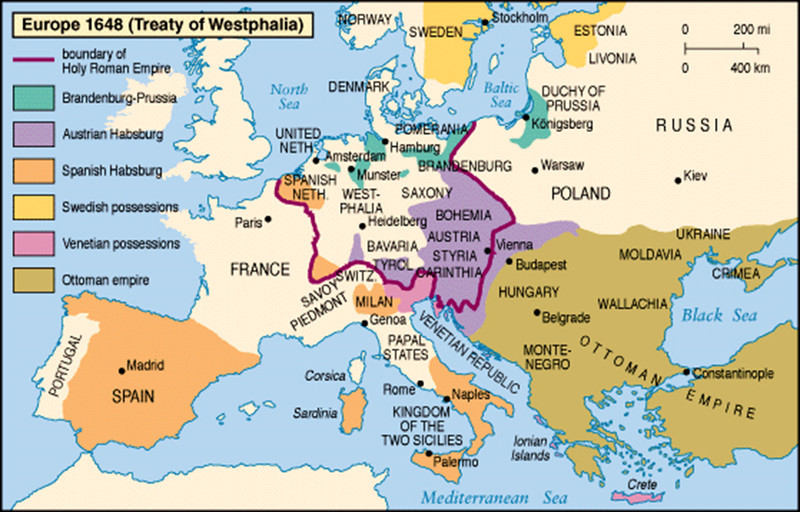
Europe in 1648 after the Peace of Westphalia
Most people were subjects, not citizens. Your status depended on birth.
- Dynastic rule meant states were tied to ruling families. Legitimacy came from inheritance, divine right, and tradition.
- Established churches supported rulers, and rulers often controlled religion inside the state.
- Nobles and clergy had legal privileges such as tax exemptions and special offices.
- Serfdom and manorial dues still shaped peasant life, especially in eastern Europe.
One huge continuity runs through the whole period. State centralization kept growing. Whether the ruler was a king or a revolutionary assembly, governments wanted better taxes, bigger armies, and tighter control.
Absolutism in France
Louis XIV became the classic absolutist ruler. He built a stronger centralized monarchy in Bourbon France and made royal power the center of politics.
Constitutional alternatives
The Dutch Republic and post-1688 Britain showed another path. Kings could be limited by representative institutions.
- The Glorious Revolution removed James II and brought in William and Mary.
- The English Bill of Rights limited monarchy and strengthened Parliament.
- Britain was still not a full democracy. Voting stayed limited by property, class, and gender.
By 1815, dynastic legitimacy still existed, but national sovereignty and citizenship had become lasting rivals.
What Challenged the Old Order
The old order came under pressure from ideas, war, and money problems.
Enlightenment criticism
Enlightenment thinkers attacked arbitrary rule, religious intolerance, and inherited privilege. Their key ideas show up everywhere on AP questions:
- Natural rights means people have rights by being human.
- Social contract means government exists through an agreement with the people.
- Legal equality means the law should not favor estates or birth.
- Religious toleration means states should ease persecution.
- Government by consent means authority should rest on the people’s approval.
Enlightened absolutism
Some rulers borrowed Enlightenment ideas without giving up power.
| Ruler | What they tried to do |
|---|---|
| Frederick the Great | improved administration, law, and efficiency in Prussia |
| Joseph II | pushed toleration, church reform, and administrative centralization |
| Catherine the Great | used Enlightenment language while keeping autocratic control |
These reforms aimed at rational administration, taxation, education, and church control, but monarchy stayed intact.
Empire and war
Commercial expansion made states richer and more competitive. The clearest case is the Seven Years’ War.
- It was fought in Europe, North America, the Caribbean, West Africa, and India.
- It shows how European wars had become global.
- Britain emerged as the leading maritime and colonial power.
The American Revolution mattered here because French aid to the colonies worsened French debt. It also gave French critics a working example of rights language and representative government.
How the French Revolution Remade Politics
The French Revolution is the biggest turning point in this topic because it attacked both privilege and the basis of sovereignty.
Causes
Long-term causes and short-term crisis came together:
- Estate privilege angered commoners.
- The bourgeoisie wanted more status and opportunity.
- Peasants hated feudal dues.
- Enlightenment ideas challenged old authority.
- Debt, tax inequality, bad harvests, and high bread prices pushed the monarchy into collapse.
Fundamental changes
- In August 1789, the National Assembly abolished feudal privileges.
- The Declaration of the Rights of Man and of the Citizen proclaimed natural rights, legal equality, and national sovereignty.
- The Constitution of 1791 created a constitutional monarchy.
- Departments replaced old provinces, making administration more uniform.
- The Civil Constitution of the Clergy put the church under state control.
Mass politics and citizenship
Politics spilled into the streets.
- Crowds, clubs, newspapers, petitions, elections, and demonstrations now mattered.
- The October March on Versailles showed ordinary people, especially women, shaping events.
- The levée en masse turned people into citizens defending the nation, not just subjects obeying a king.
Limits and radicalization
The revolution became more extreme under pressure.
- 1792 brought the republic.
- 1793 brought the execution of Louis XVI.
- The Jacobins and Committee of Public Safety led the Reign of Terror.
- The government used de-Christianization and economic controls.
- Olympe de Gouges demanded women’s rights in the Declaration of the Rights of Woman.
- Women were politically active, but they were still denied equal citizenship.
International impact
The revolution’s ideals spread beyond France.
- The Haitian Revolution began in 1791 in Saint-Domingue.
- Toussaint L’Ouverture became its best-known leader.
- Haiti was the sharpest test of whether “universal rights” applied to enslaved people and colonies.
A major conservative answer came from Edmund Burke in Reflections on the Revolution in France, which defended tradition and warned that abstract rights could destroy order.
Napoleon and Nationalist Reaction
Napoleon carried the revolution across Europe, but he also built an authoritarian state.
Reforms he preserved
- The Napoleonic Code gave legal equality for men, protected property, and removed feudal remnants.
- Careers open to talent weakened old birth privilege.
- He expanded a centralized bureaucracy and state education.
- The Concordat of 1801 restored relations with the church while keeping the state dominant.
Authoritarian rule
- He used censorship, secret police, plebiscites, and controlled elections.
- He crowned himself emperor in 1804.
- Women’s legal status got worse under the Code.
French expansion spread reform, but people also saw it as foreign domination. That triggered nationalist reactions. The map shows how far Napoleon’s control and influence reached across Europe by 1812.
- Spain resisted through guerrilla warfare.
- German students and thinkers promoted national identity.
- Russia used scorched-earth tactics in 1812, helping destroy the Grand Army.
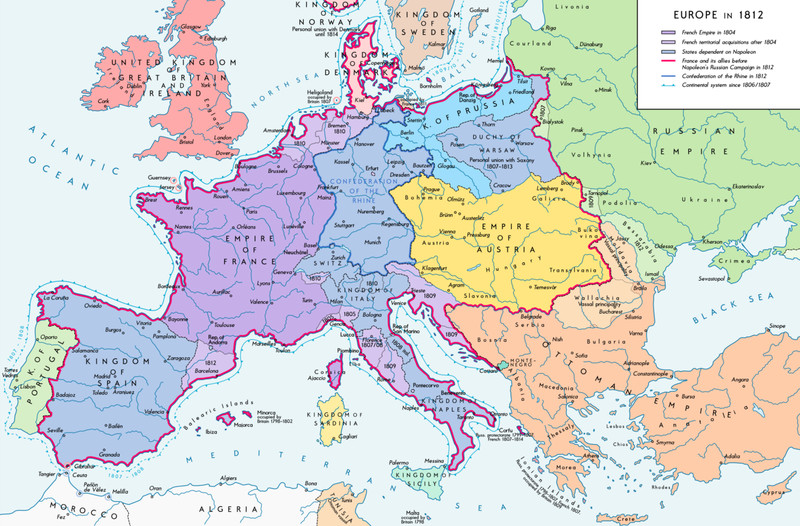
Europe under Napoleon, 1812
At the same time, Romanticism challenged pure Enlightenment reason. Rousseau helped inspire this turn toward emotion, culture, memory, and national feeling.
What Stayed the Same and What Changed by 1815
After Napoleon’s defeat, the Congress of Vienna tried to rebuild order. Metternich became the symbol of this settlement. The map below shows the postwar arrangement the diplomats were trying to create.
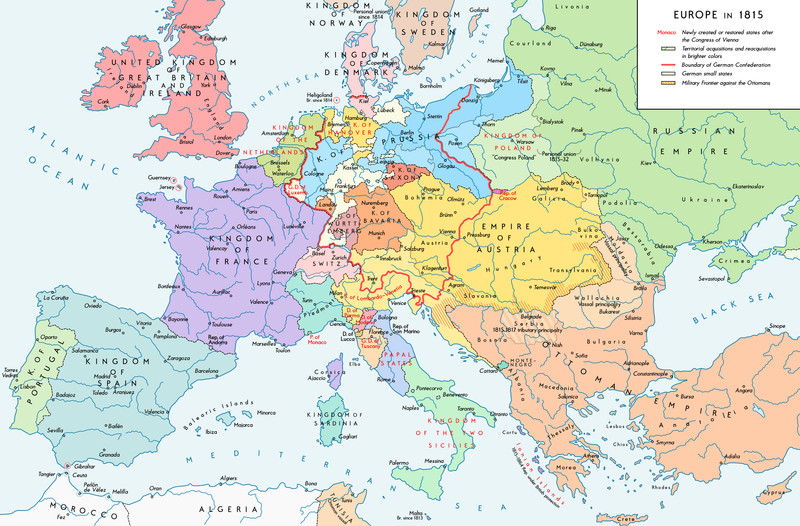
Europe after the Congress of Vienna, 1815
Its goals were clear:
- Legitimacy for old dynasties
- Balance of power
- Containment of revolution and nationalism
Results you should know:
- Bourbons restored in France
- Netherlands strengthened
- German Confederation created
- Austria and Prussia remained major powers
Continuities by 1815
Monarchy, church influence, patriarchy, interstate rivalry, warfare, centralized states, and social inequality all survived.
Changes by 1815
Feudal privilege had been weakened or abolished in France and many French-controlled lands. Legal equality, citizenship, popular sovereignty, and nationalism could be pushed back, but not erased.
The best judgment is this. The old order survived institutionally, but it no longer had a monopoly on legitimacy. Europe was still mostly monarchical, yet politics had been permanently changed by rights, the nation, and mass mobilization.
