Topic 9.2 Notes – Rebuilding Europe
How Western Europe Recovered After World War II
In 1945, Western Europe had wrecked cities, factories, rail lines, ports, farms, and power systems. People also faced food and fuel shortages, housing crises, unstable currencies, and a shortage of U.S. dollars needed to buy imports. That made recovery more than cleanup. It was about restarting entire economies.
This was also a Cold War problem. If misery continued, communist parties could gain support, especially in France and Italy, where they had prestige from resisting fascism.
The core chain looks like this:
- Wartime destruction wrecked production and trade.
- Europe needed capital, supplies, and dollars.
- The U.S. sent aid through the Marshall Plan.
- Reconstruction restarted industry and modernized economies.
- Western Europe entered a long postwar boom.
One exam trap is saying the Marshall Plan did everything. It mattered a lot, but recovery was multi-causal. European workers rebuilt. Governments used planning and investment. Currency reforms restored confidence. Factories modernized. Consumers had pent-up demand after years of war and rationing. Trade expanded again.
The Marshall Plan
The Marshall Plan, officially the European Recovery Program, was proposed by George C. Marshall in 1947, authorized in 1948, and ran mainly from 1948 to 1952. It gave about $13 billion in grants and loans to Western and Central European participants.
What it was supposed to do
These goals worked together:
- Relieve shortages and restart production by sending food, fuel, machinery, and raw materials.
- Stabilize democratic capitalist governments so they could survive the postwar crisis.
- Contain communism, especially where communist parties were strong.
- Restore markets for U.S. goods, since a richer Europe could buy American products.
- Promote European cooperation instead of each country trying to recover alone.
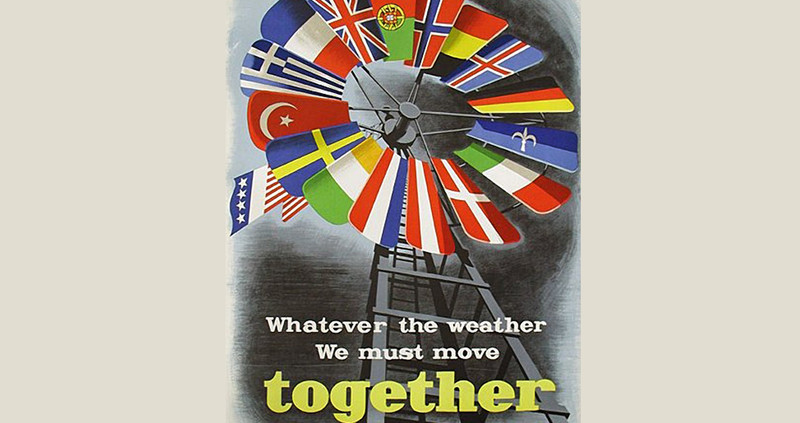
Marshall Plan propaganda poster
How the aid worked
Aid was not just cash.
- The U.S. paid American suppliers in dollars.
- European governments received goods like coal, petroleum, machinery, transport equipment, farm equipment, and food.
- Those governments sold the goods at home for local currency.
- The local money became counterpart funds, used for reconstruction, loans, and currency stabilization.
The OEEC was created in 1948 to coordinate aid and encourage cooperation, trade-barrier reduction, and information-sharing.
Stalin rejected the plan and forced Eastern European states, including Czechoslovakia, to refuse. Finland also stayed out under Soviet pressure. Spain under Franco did not participate. Participating countries clustered in the west, which already resembled the emerging Iron Curtain divide.
The Economic Miracle in Western Europe
The economic miracle means rapid growth in production, trade, productivity, income, and living standards. By the early 1950s, many countries had passed prewar production levels, and growth kept going after Marshall aid ended.
| Country | Example | Why it mattered |
|---|---|---|
| West Germany | Wirtschaftswunder | Ludwig Erhard, currency reform, social market economy, refugee labor force, export success in cars, machinery, chemicals |
| France | Trente Glorieuses | Jean Monnet’s state-directed modernization in coal, steel, electricity, transport, cement |
| Italy | postwar boom | Northern industry expanded; many moved from the rural south to the industrial north; inequality remained |
| Britain | largest aid recipient | Grew more slowly because of older industry, debt, overseas commitments, and balance-of-payments problems |
The big point is that the same aid produced different outcomes because domestic conditions mattered. Recovery was usually a mixed economy, not pure laissez-faire. Capitalism stayed, but governments planned, regulated, and invested heavily.
Political Stabilization and the East-West Divide
As economies improved, parliamentary democracy looked more effective. Communist parties had real strength after the war, but recovery helped Christian Democrats, social democrats, centrists, and moderate conservatives show that capitalist democracy could deliver jobs and rising living standards.
This became the postwar consensus: private enterprise plus state regulation, welfare measures, and social protections.
Keep one distinction clear for tests. The Marshall Plan was economic aid, not NATO. Still, prosperity and anti-communism pulled Western Europe closer to the United States. Rebuilding West Germany also became central to Western recovery, which later supported European cooperation.
Eastern Europe followed a different path:
- Rejected Marshall aid
- Used central planning and nationalization
- Focused on heavy industry
- Coordinated through COMECON
- Offered less consumer abundance
The West advertised prosperity. The East emphasized production and employment.
Consumerism and the Limits of Recovery
As recovery turned into prosperity, consumerism became a major part of life. Rising wages, productivity, credit, advertising, and mass media encouraged people to buy more mass-produced goods.
Common symbols of the boom:
- Automobiles and scooters
- Refrigerators and washing machines
- Radios and televisions
- Synthetic fabrics, plastics, packaged foods
Postwar kitchens and other domestic spaces became a visible sign of this new standard of living.
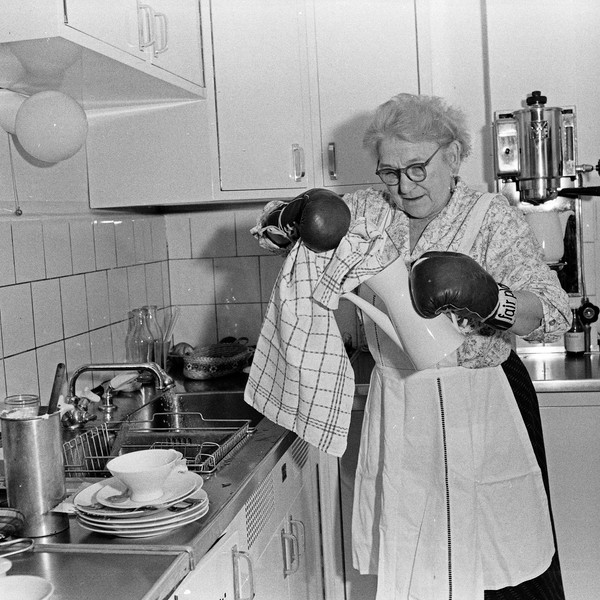
Postwar consumer goods in everyday life
These goods changed daily life. Household labor got easier. Leisure and tourism grew. Youth culture, cinema, fashion, and popular music expanded. Americanization also spread through U.S. brands, films, music, and advertising.
Recovery still had limits. Britain kept rationing longer than many students expect. Housing shortages stayed serious. North-south inequality in Italy persisted. Women and migrant laborers did not share equally in prosperity.
Key Takeaways
Marshall Plan / European Recovery Program (ERP)
1948–1952 U.S. program that supplied about $13 billion in grants, loans, goods, and technical aid to reconstruct Western and Central Europe, stimulate growth, and contain communism
Counterpart Funds
Local currency raised by selling Marshall Plan goods within recipient countries, then used for approved reconstruction, industrial investment, loans, and currency stabilization
Organisation for European Economic Co-operation (OEEC)
Organization founded in 1948 by Marshall Plan participants to coordinate recovery plans, distribute aid, share economic information, and reduce trade barriers
Economic Miracle
The prolonged postwar surge in Western and Central European industrial production, productivity, trade, incomes, and living standards
Trente Glorieuses / Thirty Glorious Years
France’s long postwar period of rapid economic growth, modernization, and rising living standards
Wirtschaftswunder / German Economic Miracle
West Germany’s rapid postwar recovery and export-led industrial growth, supported by aid, currency reform, investment, skilled labor, and the social market economy
Social Market Economy
West German system combining private enterprise and market competition with government regulation and social protections
Monnet Plan
French state-directed modernization plan that concentrated investment in coal, steel, electricity, transportation, and cement while retaining private enterprise
Consumerism / Mass Consumption
The growing economic and cultural importance of purchasing and possessing mass-produced goods, driven by rising wages, productivity, credit, advertising, and mass media
Notes
Marshall Plan / European Recovery Program (ERP)
1948–1952 U.S. program that supplied about $13 billion in grants, loans, goods, and technical aid to reconstruct Western and Central Europe, stimulate growth, and contain communism
Counterpart Funds
Local currency raised by selling Marshall Plan goods within recipient countries, then used for approved reconstruction, industrial investment, loans, and currency stabilization
Organisation for European Economic Co-operation (OEEC)
Organization founded in 1948 by Marshall Plan participants to coordinate recovery plans, distribute aid, share economic information, and reduce trade barriers
Economic Miracle
The prolonged postwar surge in Western and Central European industrial production, productivity, trade, incomes, and living standards
Trente Glorieuses / Thirty Glorious Years
France’s long postwar period of rapid economic growth, modernization, and rising living standards
Wirtschaftswunder / German Economic Miracle
West Germany’s rapid postwar recovery and export-led industrial growth, supported by aid, currency reform, investment, skilled labor, and the social market economy
Social Market Economy
West German system combining private enterprise and market competition with government regulation and social protections
Monnet Plan
French state-directed modernization plan that concentrated investment in coal, steel, electricity, transportation, and cement while retaining private enterprise
Consumerism / Mass Consumption
The growing economic and cultural importance of purchasing and possessing mass-produced goods, driven by rising wages, productivity, credit, advertising, and mass media
