Topic 4.6 Notes – Enlightened and Other Approaches to Power
What Enlightened Absolutism Was
Enlightened absolutism meant absolute or highly centralized monarchs adopted some Enlightenment reforms without giving up sovereignty. The ruler still ruled from the top down. No elections, no popular sovereignty, no right of the people to remove the monarch.
Frederick II of Prussia summed it up with “the first servant of the state.” That sounds modern, but notice what it means. The monarch claimed to serve the public good through reason and efficiency, yet the monarch alone decided what that good was.
What they usually supported
- Codified laws so justice looked more uniform and less arbitrary.
- Regular courts and some limits on torture or brutal punishments, partly because philosophes attacked cruelty.
- Religious toleration for at least some minorities, since persecution was seen as wasteful and irrational.
- State control over churches because rulers wanted religion to serve the state, not act independently.
- Education, bureaucracy, and economic improvement to create productive subjects, better tax collection, and stronger armies.
- Some limits on serfdom or noble abuses when peasant productivity or state power was at stake.
What they usually rejected
- Consent of the governed
- Democracy or broad representation
- Free political opposition
- Full equality before the law and in society
- A total attack on noble privilege
Monarchs adopted these ideas because Enlightenment writers criticized irrational laws and intolerance, but also because states needed money, soldiers, and efficient administration. In central Europe, cameralism pushed rulers to manage resources directly for state strength.
Central Europe After Westphalia
The Peace of Westphalia in 1648 ended the Thirty Years’ War and confirmed that the Holy Roman Empire was a patchwork, not a centralized state like France.
The map helps you see that fragmentation, with dozens of territories inside the empire and especially important powers like Brandenburg-Prussia and the Austrian Habsburg lands standing out.
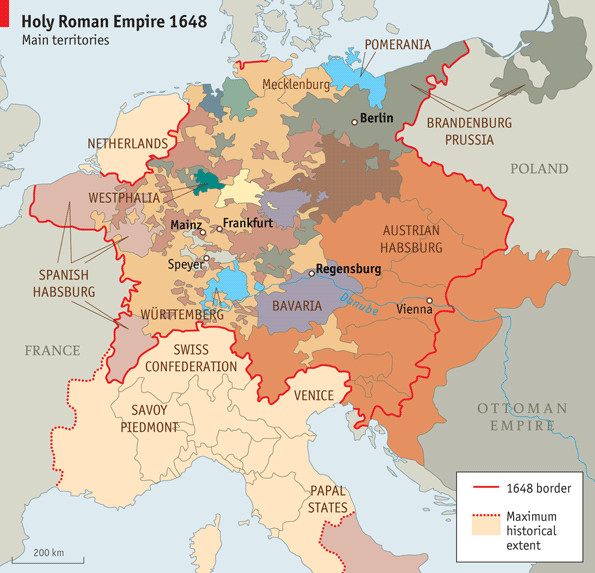
Holy Roman Empire after the Peace of Westphalia, 1648
- The imperial estates kept major autonomy, so the emperor’s power stayed limited.
- Catholicism, Lutheranism, and Calvinism were all recognized within the empire.
- The old dream of one united Christian Europe lost more ground.
This mattered because:
- Brandenburg-Prussia had room to rise as a centralized military state.
- The Habsburgs focused more on their hereditary lands in Austria, Bohemia, Hungary, and southeastern Europe.
This is about dynastic state-building, not nationalism. Prussia and Austria were building stronger ruling states, not trying to unite peoples into nations.
Prussia and Austria as the Main Cases
Prussia and Austria both used reform to strengthen the state, but they did it in different settings.
Prussia
Frederick William I, the “Soldier King,” built the machinery.
- Expanded the standing army
- Enforced strict fiscal discipline
- Created the General Directory in 1723 to coordinate administration and military affairs
- Worked with the Junkers, who kept power over serfs and served as army officers
Frederick II is the main AP example of enlightened absolutism.
- Read and wrote in French Enlightenment culture and corresponded with Voltaire
- Supported religious toleration, judicial reform, limits on torture, education, and economic development
- Preserved Junker privilege, kept censorship, and did not abolish serfdom on noble estates
- Jews still faced restrictions
- Strengthened Prussia through war by seizing Silesia, keeping it after the Seven Years’ War, and joining the First Partition of Poland in 1772
Austria
Maria Theresa was not deeply Enlightenment-minded, but military defeat pushed reform.
- Improved taxation, army, bureaucracy, and education
- Issued 1774 schooling regulations
- Reduced torture and regulated some peasant obligations
Joseph II was the most ambitious enlightened absolutist.
- Josephinism meant stronger state control over the church and less papal influence
- Dissolved contemplative monasteries
- Issued the Patent of Toleration in 1781
- Eased some Jewish restrictions in 1782
- Issued the Serfdom Patent in 1781
- Tried tax reform, legal uniformity, and centralization
His problem was resistance. Nobles, clergy, Hungarians, and the Austrian Netherlands pushed back, and many reforms were later revoked. The lasting pieces were greater toleration and a partial end to personal serfdom.
Religious Toleration and Jewish Civil Equality
By 1800, many states were moving from enforcing religious unity to managing diversity.
Toleration did not mean full liberty or equality.
| Example | What changed |
|---|---|
| England, Toleration Act 1689 | Tolerated many Protestant dissenters |
| Prussia under Frederick II | Broad Christian toleration, but Jews still restricted |
| Joseph II, 1781 | Toleration for Protestants and Orthodox Christians |
| Louis XVI, Edict of Versailles 1787 | Restored civil recognition to French Protestants |
| France, 1791 | Granted Jews full citizenship |
| Batavian Republic, 1796 | Granted Jews full citizenship |
Motives were mixed. Enlightenment criticism mattered, but rulers also wanted peaceful, productive, taxable subjects.
Why This Topic Matters
The biggest continuity is simple. Monarchs stayed powerful. Armies, taxes, bureaucracy, and noble cooperation still mattered.
The biggest change is in how power was justified and used. Rulers talked more about reason, utility, welfare, and reform. Law, education, and toleration became normal state concerns.
Westphalia, confessional pluralism, and the Prussian-Austrian rivalry weakened the idea of one Christian political order. Europe still shared diplomacy, dynastic ties, and Enlightenment culture, but political unity was weaker than before.
Key Takeaways
Enlightened Absolutism / Enlightened Despotism
Centralized monarchy that imposed selected Enlightenment reforms from above while preserving the ruler’s sovereignty and autocratic power
Fiscal-Military State
Government organized to raise reliable revenue, administer society, and maintain strong armed forces
Peace of Westphalia
1648 settlement ending the Thirty Years’ War that confirmed imperial estates’ autonomy and recognized Calvinism, limiting centralization of the Holy Roman Empire
Holy Roman Empire
Fragmented central European polity of principalities, church territories, and free cities whose emperor had limited authority over its constituent states
Brandenburg-Prussia / Prussia
Scattered Hohenzollern territories unified through centralized administration and a powerful standing army into a major European state
Frederick William I / The Soldier King
Prussian ruler who strengthened the army, bureaucracy, and finances while preserving Junker control over land and serfs
Junkers
Prussian landowning nobles who retained authority over serfs and supplied the monarchy’s leading army officers
Frederick II / Frederick the Great
Prussian enlightened absolutist who promoted toleration, education, legal reform, and economic development while preserving autocracy, Junker privilege, and serfdom
Habsburg Monarchy
Multinational collection of Austrian, Bohemian, Hungarian, and southeastern European hereditary lands that became the main basis of Habsburg power
Maria Theresa
Habsburg ruler who, after losing Silesia, strengthened central administration, reformed taxation and the army, and expanded state involvement in education despite limited commitment to Enlightenment toleration
Joseph II
Habsburg enlightened absolutist who pursued toleration, reduced serfdom, rationalized law, and centralized administration but provoked resistance and revoked many reforms
Josephinism
Joseph II’s policy of subordinating the Catholic Church to state supervision and directing religious institutions toward socially useful purposes
Patent of Toleration
Joseph II’s 1781 decree permitting limited private worship and wider civil opportunities for Lutherans, Calvinists, and Orthodox Christians
Serfdom Patent
Joseph II’s 1781 decree giving peasants greater freedom to marry, move, learn trades, and educate children without a lord’s permission
Catherine II / Catherine the Great
Russian ruler who embraced Enlightenment rhetoric and limited reforms while preserving autocracy, expanding serfdom, confirming noble privilege, and enlarging Russia
Instruction / Nakaz
Catherine II’s 1767 Enlightenment-influenced statement on law, punishment, and government prepared for a proposed new Russian legal code
Pugachev Rebellion
1773–1775 Cossack and peasant revolt after which Catherine II relied more heavily on nobles and maintained serfdom
Charter to the Nobility
Catherine II’s 1785 measure confirming the privileges of Russia’s nobility
Religious Toleration
Government permission for a religious group to exist or worship without necessarily granting it equal legal status
Religious Liberty
Treatment of religious belief and practice as a protected sphere of individual or communal choice
Civil Equality
Equal access regardless of religion to ordinary rights such as property, residence, education, professions, legal standing, and public office
Jewish Emancipation
Removal of legal disabilities imposed on Jews so that they receive civil rights equal to those of other subjects or citizens
Cameralism
Central European use of administrative expertise and state-directed economic development to increase population, revenue, and military power
Prussian-Austrian Dualism
Long-term rivalry between Prussia and the Habsburg monarchy as separate power centers within German-speaking central Europe
Notes
Enlightened Absolutism / Enlightened Despotism
Centralized monarchy that imposed selected Enlightenment reforms from above while preserving the ruler’s sovereignty and autocratic power
Fiscal-Military State
Government organized to raise reliable revenue, administer society, and maintain strong armed forces
Peace of Westphalia
1648 settlement ending the Thirty Years’ War that confirmed imperial estates’ autonomy and recognized Calvinism, limiting centralization of the Holy Roman Empire
Holy Roman Empire
Fragmented central European polity of principalities, church territories, and free cities whose emperor had limited authority over its constituent states
Brandenburg-Prussia / Prussia
Scattered Hohenzollern territories unified through centralized administration and a powerful standing army into a major European state
Frederick William I / The Soldier King
Prussian ruler who strengthened the army, bureaucracy, and finances while preserving Junker control over land and serfs
Junkers
Prussian landowning nobles who retained authority over serfs and supplied the monarchy’s leading army officers
Frederick II / Frederick the Great
Prussian enlightened absolutist who promoted toleration, education, legal reform, and economic development while preserving autocracy, Junker privilege, and serfdom
Habsburg Monarchy
Multinational collection of Austrian, Bohemian, Hungarian, and southeastern European hereditary lands that became the main basis of Habsburg power
Maria Theresa
Habsburg ruler who, after losing Silesia, strengthened central administration, reformed taxation and the army, and expanded state involvement in education despite limited commitment to Enlightenment toleration
Joseph II
Habsburg enlightened absolutist who pursued toleration, reduced serfdom, rationalized law, and centralized administration but provoked resistance and revoked many reforms
Josephinism
Joseph II’s policy of subordinating the Catholic Church to state supervision and directing religious institutions toward socially useful purposes
Patent of Toleration
Joseph II’s 1781 decree permitting limited private worship and wider civil opportunities for Lutherans, Calvinists, and Orthodox Christians
Serfdom Patent
Joseph II’s 1781 decree giving peasants greater freedom to marry, move, learn trades, and educate children without a lord’s permission
Catherine II / Catherine the Great
Russian ruler who embraced Enlightenment rhetoric and limited reforms while preserving autocracy, expanding serfdom, confirming noble privilege, and enlarging Russia
Instruction / Nakaz
Catherine II’s 1767 Enlightenment-influenced statement on law, punishment, and government prepared for a proposed new Russian legal code
Pugachev Rebellion
1773–1775 Cossack and peasant revolt after which Catherine II relied more heavily on nobles and maintained serfdom
Charter to the Nobility
Catherine II’s 1785 measure confirming the privileges of Russia’s nobility
Religious Toleration
Government permission for a religious group to exist or worship without necessarily granting it equal legal status
Religious Liberty
Treatment of religious belief and practice as a protected sphere of individual or communal choice
Civil Equality
Equal access regardless of religion to ordinary rights such as property, residence, education, professions, legal standing, and public office
Jewish Emancipation
Removal of legal disabilities imposed on Jews so that they receive civil rights equal to those of other subjects or citizens
Cameralism
Central European use of administrative expertise and state-directed economic development to increase population, revenue, and military power
Prussian-Austrian Dualism
Long-term rivalry between Prussia and the Habsburg monarchy as separate power centers within German-speaking central Europe
