Topic 6.6 Notes – Reactions and Revolutions
Why Europeans Kept Revolting After 1815
The Congress of Vienna rebuilt Europe after Napoleon by restoring monarchies, protecting the balance of power, and creating the Concert of Europe, where great powers cooperated to stop revolution and keep order. The map below shows the political settlement they created in 1815. The face of this system was Metternich of Austria, who treated liberalism and nationalism as dangerous because both could tear apart empires and weaken kings.
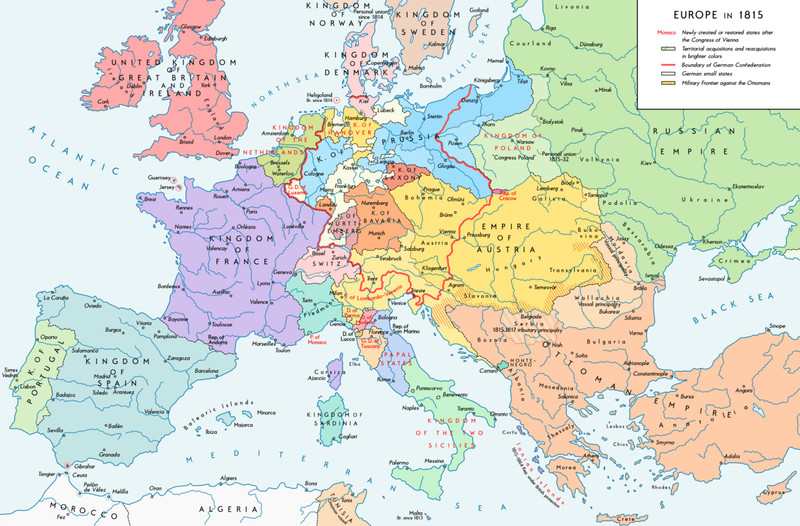
Europe after the Congress of Vienna, 1815
But the old order could not erase what the French Revolution had spread. People had now seen ideas like popular sovereignty, constitutionalism, and national self-rule.
Different groups wanted different things:
- Liberals wanted constitutions, civil liberties, and representative government.
- Nationalists wanted independence, autonomy, or unification.
- Republicans and radicals wanted broader suffrage, stronger democracy, and often an end to monarchy.
- Peasants and workers wanted relief from dues, poverty, unemployment, and inequality.
Governments answered with censorship, police surveillance, restrictions on universities, and crackdowns on dissent. That set up the pattern for the whole topic: revolution from below versus reform from above.
Early Revolts Against the Conservative Order
These revolts were local, but together they showed the Vienna settlement was under pressure.
War of Greek Independence
Greece rebelled against the Ottoman Empire in 1821. Greek nationalism drew strength from shared language, Orthodox Christianity, and pride in classical Greece. The key turning point was the Battle of Navarino in 1827, when Britain, France, and Russia destroyed the Ottoman-Egyptian fleet. Greece won recognition in 1830, and the Kingdom of Greece was established in 1832.
This mattered because Greek success depended on great-power intervention. Nationalism alone was not enough.
Decembrist Revolt in Russia
In 1825, Russian army officers challenged Nicholas I during a succession crisis. They wanted constitutional reform, and some wanted to end serfdom. The revolt was crushed fast, and leaders were executed or exiled to Siberia. It inspired later Russian revolutionaries and pushed Nicholas toward harsher autocracy.
July Revolution in France
In 1830, Charles X issued the July Ordinances, restricting the press and suffrage. Paris rose up in the Three Glorious Days, forcing him out. Louis-Philippe became “King of the French,” which sounded more national and constitutional, but power still stayed mostly with the bourgeoisie.
Belgian Revolution
Also in 1830, Belgium revolted against union with the Netherlands. Belgium was recognized as independent and neutral in 1839. Another Vienna border had been revised.
Polish November Uprising
Poles rebelled against Russian rule in 1830, briefly taking Warsaw. Nicholas I crushed the revolt in 1831. Poland showed a pattern AP loves to test: nationalism often failed without foreign help.
The Revolutions of 1848
In 1848, revolt spread across France, the German states, the Austrian Empire, and Italy. This map highlights how widely the uprisings spread, from Paris to Berlin, Vienna, Budapest, and northern Italy. The causes piled up at once:
- Hungry Forties crisis, with bad harvests, potato blight, bread prices, and unemployment
- political frustration over censorship, autocracy, and limited suffrage
- nationalist and constitutional demands
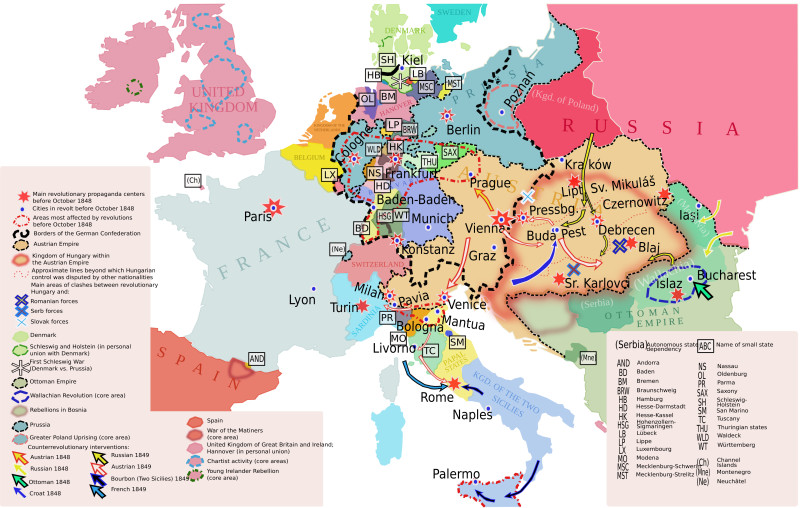
Revolutions of 1848 in Europe
France
The February Revolution overthrew Louis-Philippe and created the Second Republic with universal male suffrage and National Workshops. The June Days then exposed a major split. Workers wanted social reform; middle-class liberals feared radicalism. Louis-Napoleon Bonaparte won the presidency, seized power in 1851, and became Napoleon III.
German states
The Frankfurt Parliament tried to build a united constitutional Germany. Delegates argued over Greater Germany including Austria or Lesser Germany led by Prussia. Frederick William IV refused the crown. The parliament had no army or real state power, so it failed.
Austrian Empire and Italy
Metternich fell in Vienna. Lajos Kossuth led Hungarian nationalism, but different national groups inside the empire clashed with each other. Russia helped Austria crush Hungary. In Italy, Mazzini was tied to the Roman Republic, but Austrian and French intervention restored conservative order.
Most revolutions failed because liberals split from workers, nationalists fought each other, peasants left once feudal burdens ended, and monarchs regained military control. Even so, serfdom ended in much of the Habsburg lands, nationalism and constitutionalism survived, and the Concert of Europe broke down as a united system.
Russia and Reform From Above
Russia followed a different path. The tsars tried to modernize without surrendering autocracy.
Alexander II
Russia’s defeat in the Crimean War exposed weakness. Alexander II answered with the Emancipation Edict of 1861, freeing the serfs. But peasants still faced redemption payments, land shortages, the mir village commune, and poverty. Other Great Reforms included zemstvos, judicial reform, military reform, and some educational expansion. Reform changed Russia, but it satisfied almost nobody.
Revolutionary response
Populists or narodniks looked to peasants as the force for change. People’s Will turned to terrorism and assassinated Alexander II in 1881.
Sergei Witte
Witte pushed state-sponsored industrialization through tariffs, foreign investment, the gold standard, and the Trans-Siberian Railroad. Heavy industry grew, but so did an exploited urban working class.
1905 Revolution and Stolypin
Defeat in the Russo-Japanese War, peasant poverty, labor unrest, liberal demands, and nationalism all fed the 1905 Revolution. Bloody Sunday, led by Father Georgy Gapon, triggered strikes, soviets, and the Potemkin mutiny. The October Manifesto created the Duma, but the Fundamental Laws of 1906 kept the tsar dominant. Peter Stolypin mixed repression with land reform to create loyal private farmers. Russia’s pattern stayed the same. Reform was meant to save autocracy, but it created new pressures against it.
Key Takeaways
Concert of Europe (Congress System)
Post-1815 cooperation among Europe’s great powers to preserve the balance of power and suppress revolution; divisions and the Revolutions of 1848 ultimately broke it down
Klemens von Metternich
Austrian statesman and leading defender of monarchy and the Concert of Europe whose flight during Vienna’s 1848 revolution symbolized the weakening conservative order
War of Greek Independence
Greek nationalist revolt against Ottoman rule begun in 1821; British, French, and Russian intervention helped secure Greek independence by 1830
Decembrist Revolt
Failed 1825 uprising by Russian army officers seeking constitutional government, a republic, or an end to serfdom; Nicholas I suppressed it and intensified repression
Nicholas I
Reactionary Russian tsar who suppressed the Decembrists and Polish and Hungarian revolts while defending autocracy through censorship, surveillance, and military force
July Revolution (Three Glorious Days)
Paris uprising in July 1830 that followed Charles X’s restrictive ordinances, forced his abdication, and placed Louis-Philippe on the throne
July Monarchy
Louis-Philippe’s 1830–1848 constitutional monarchy, more liberal than the Bourbon restoration but dominated by wealthy property owners and opposed by republicans and workers
Belgian Revolution
Revolt begun in 1830 that separated Catholic Belgium from the Kingdom of the Netherlands and produced an internationally recognized neutral Belgium
Polish November Uprising
Unsuccessful 1830–1831 nationalist rebellion against Russian rule; defeat brought tighter Russian control and sent Polish revolutionary exiles into western Europe
Revolutions of 1848 (Springtime of the Peoples)
Europe-wide uprisings driven by economic crisis, political exclusion, nationalism, and demands for reform; most failed but weakened the conservative order and Concert of Europe
Hungry Forties
Mid-1840s crisis of poor harvests, potato blight, rising food prices, unemployment, and rural distress that helped trigger the Revolutions of 1848
French Revolution of 1848
February uprising that overthrew Louis-Philippe and established the Second Republic, followed by class conflict, the June Days, and an eventual authoritarian reaction
French Second Republic
French regime established in February 1848 with universal male suffrage; class conflict weakened it before Louis-Napoleon’s 1851 coup ended republican government
National Workshops
State-supported employment program for unemployed Parisian men created in 1848; its closure provoked the June Days uprising
June Days
June 1848 Paris workers’ uprising against the closure of the National Workshops, violently crushed by General Cavaignac’s forces
Louis-Napoleon Bonaparte (Napoleon III)
Elected president of the Second Republic in 1848; he seized power in 1851 and founded the authoritarian Second Empire as Napoleon III in 1852
Frankfurt Parliament
Elected 1848 German assembly that drafted a liberal constitution and sought national unification but collapsed without an army, revenue, or princely support
Greater German vs. Lesser German Solutions
Competing unification plans: Greater Germany would include Austria, while Lesser Germany would exclude Austria and place Prussia at the new state’s head
Revolutions of 1848 in the Austrian Empire
Uprisings in Vienna, Prague, Hungary, and Italian lands that drove out Metternich and ended manorial obligations but were largely defeated by imperial forces
Hungarian Revolution of 1848–1849
Hungarian movement for self-government under Lajos Kossuth, defeated by Habsburg forces with Russian aid after divisions among the empire’s nationalities
Italian Revolutions of 1848–1849
Uprisings seeking constitutions, an end to Austrian rule, and Italian unity; Austrian and French military intervention defeated the divided revolutionary movements
Roman Republic of 1849
Short-lived republic established after Pope Pius IX fled Rome; Giuseppe Mazzini helped lead it before French troops restored papal rule
Orthodoxy, Autocracy, and Nationality
Nicholas I’s doctrine defending the Orthodox Church, absolute tsarist rule, and Russian national loyalty against western liberal and revolutionary ideas
Alexander II’s Great Reforms
Post-Crimean War reforms intended to strengthen Russia, including emancipation, elected local councils, judicial and military changes, education, and economic modernization
Emancipation Edict of 1861
Alexander II’s decree legally freeing about 23 million privately owned serfs, though land shortages, communal control, and redemption payments preserved peasant hardship
Redemption Payments
Long-term payments imposed on emancipated Russian peasants to compensate landowners for land transferred to village communities
Mir
Russian village commune that allocated peasant land and imposed collective responsibilities, limiting the independence promised by emancipation
Zemstvos
Elected local councils established in 1864 to manage roads, schools, and public health, offering limited participation while remaining under tsarist authority
Narodniks (Populists)
Russian radicals who looked to the peasantry as the basis of social transformation; after efforts to mobilize peasants failed, some turned to terrorism
People’s Will
Russian revolutionary organization whose members used terrorism and assassinated Tsar Alexander II in 1881
Alexander III
Russian tsar who answered Alexander II’s assassination with censorship, police repression, Russification, and renewed defense of autocratic authority
Sergei Witte
Russian finance minister who promoted protective tariffs, foreign investment, the gold standard, heavy industry, and railroads to modernize and strengthen the autocratic state
Russian Revolution of 1905
Mass unrest involving workers, peasants, liberals, national minorities, and mutineers that forced limited concessions but failed to end tsarist autocracy
Bloody Sunday
January 1905 massacre in which imperial troops fired on Georgy Gapon’s peaceful petitioners in St. Petersburg, triggering widespread revolutionary unrest
Soviets
Workers’ councils formed during the 1905 Revolution to coordinate strikes and political action, most notably the St. Petersburg Soviet
October Manifesto
Nicholas II’s 1905 promise of civil liberties and an elected legislature, which divided the opposition and helped the government survive the revolution
Duma
Elected Russian legislature promised in 1905 but repeatedly dissolved or restricted by Nicholas II, leaving ministers and major state powers under tsarist control
Fundamental Laws of 1906
Laws reaffirming the tsar’s authority over ministers, foreign policy, the military, decrees, and dissolution of the Duma, preventing full constitutional monarchy
Peter Stolypin and the Stolypin Reforms
Russian minister who combined repression with reforms allowing peasants to leave the mir and consolidate private farms, hoping to create loyal prosperous landowners
Notes
Concert of Europe (Congress System)
Post-1815 cooperation among Europe’s great powers to preserve the balance of power and suppress revolution; divisions and the Revolutions of 1848 ultimately broke it down
Klemens von Metternich
Austrian statesman and leading defender of monarchy and the Concert of Europe whose flight during Vienna’s 1848 revolution symbolized the weakening conservative order
War of Greek Independence
Greek nationalist revolt against Ottoman rule begun in 1821; British, French, and Russian intervention helped secure Greek independence by 1830
Decembrist Revolt
Failed 1825 uprising by Russian army officers seeking constitutional government, a republic, or an end to serfdom; Nicholas I suppressed it and intensified repression
Nicholas I
Reactionary Russian tsar who suppressed the Decembrists and Polish and Hungarian revolts while defending autocracy through censorship, surveillance, and military force
July Revolution (Three Glorious Days)
Paris uprising in July 1830 that followed Charles X’s restrictive ordinances, forced his abdication, and placed Louis-Philippe on the throne
July Monarchy
Louis-Philippe’s 1830–1848 constitutional monarchy, more liberal than the Bourbon restoration but dominated by wealthy property owners and opposed by republicans and workers
Belgian Revolution
Revolt begun in 1830 that separated Catholic Belgium from the Kingdom of the Netherlands and produced an internationally recognized neutral Belgium
Polish November Uprising
Unsuccessful 1830–1831 nationalist rebellion against Russian rule; defeat brought tighter Russian control and sent Polish revolutionary exiles into western Europe
Revolutions of 1848 (Springtime of the Peoples)
Europe-wide uprisings driven by economic crisis, political exclusion, nationalism, and demands for reform; most failed but weakened the conservative order and Concert of Europe
Hungry Forties
Mid-1840s crisis of poor harvests, potato blight, rising food prices, unemployment, and rural distress that helped trigger the Revolutions of 1848
French Revolution of 1848
February uprising that overthrew Louis-Philippe and established the Second Republic, followed by class conflict, the June Days, and an eventual authoritarian reaction
French Second Republic
French regime established in February 1848 with universal male suffrage; class conflict weakened it before Louis-Napoleon’s 1851 coup ended republican government
National Workshops
State-supported employment program for unemployed Parisian men created in 1848; its closure provoked the June Days uprising
June Days
June 1848 Paris workers’ uprising against the closure of the National Workshops, violently crushed by General Cavaignac’s forces
Louis-Napoleon Bonaparte (Napoleon III)
Elected president of the Second Republic in 1848; he seized power in 1851 and founded the authoritarian Second Empire as Napoleon III in 1852
Frankfurt Parliament
Elected 1848 German assembly that drafted a liberal constitution and sought national unification but collapsed without an army, revenue, or princely support
Greater German vs. Lesser German Solutions
Competing unification plans: Greater Germany would include Austria, while Lesser Germany would exclude Austria and place Prussia at the new state’s head
Revolutions of 1848 in the Austrian Empire
Uprisings in Vienna, Prague, Hungary, and Italian lands that drove out Metternich and ended manorial obligations but were largely defeated by imperial forces
Hungarian Revolution of 1848–1849
Hungarian movement for self-government under Lajos Kossuth, defeated by Habsburg forces with Russian aid after divisions among the empire’s nationalities
Italian Revolutions of 1848–1849
Uprisings seeking constitutions, an end to Austrian rule, and Italian unity; Austrian and French military intervention defeated the divided revolutionary movements
Roman Republic of 1849
Short-lived republic established after Pope Pius IX fled Rome; Giuseppe Mazzini helped lead it before French troops restored papal rule
Orthodoxy, Autocracy, and Nationality
Nicholas I’s doctrine defending the Orthodox Church, absolute tsarist rule, and Russian national loyalty against western liberal and revolutionary ideas
Alexander II’s Great Reforms
Post-Crimean War reforms intended to strengthen Russia, including emancipation, elected local councils, judicial and military changes, education, and economic modernization
Emancipation Edict of 1861
Alexander II’s decree legally freeing about 23 million privately owned serfs, though land shortages, communal control, and redemption payments preserved peasant hardship
Redemption Payments
Long-term payments imposed on emancipated Russian peasants to compensate landowners for land transferred to village communities
Mir
Russian village commune that allocated peasant land and imposed collective responsibilities, limiting the independence promised by emancipation
Zemstvos
Elected local councils established in 1864 to manage roads, schools, and public health, offering limited participation while remaining under tsarist authority
Narodniks (Populists)
Russian radicals who looked to the peasantry as the basis of social transformation; after efforts to mobilize peasants failed, some turned to terrorism
People’s Will
Russian revolutionary organization whose members used terrorism and assassinated Tsar Alexander II in 1881
Alexander III
Russian tsar who answered Alexander II’s assassination with censorship, police repression, Russification, and renewed defense of autocratic authority
Sergei Witte
Russian finance minister who promoted protective tariffs, foreign investment, the gold standard, heavy industry, and railroads to modernize and strengthen the autocratic state
Russian Revolution of 1905
Mass unrest involving workers, peasants, liberals, national minorities, and mutineers that forced limited concessions but failed to end tsarist autocracy
Bloody Sunday
January 1905 massacre in which imperial troops fired on Georgy Gapon’s peaceful petitioners in St. Petersburg, triggering widespread revolutionary unrest
Soviets
Workers’ councils formed during the 1905 Revolution to coordinate strikes and political action, most notably the St. Petersburg Soviet
October Manifesto
Nicholas II’s 1905 promise of civil liberties and an elected legislature, which divided the opposition and helped the government survive the revolution
Duma
Elected Russian legislature promised in 1905 but repeatedly dissolved or restricted by Nicholas II, leaving ministers and major state powers under tsarist control
Fundamental Laws of 1906
Laws reaffirming the tsar’s authority over ministers, foreign policy, the military, decrees, and dissolution of the Duma, preventing full constitutional monarchy
Peter Stolypin and the Stolypin Reforms
Russian minister who combined repression with reforms allowing peasants to leave the mir and consolidate private farms, hoping to create loyal prosperous landowners
