Topic 4.4 Notes – 18th-Century Society and Demographics
How Europe’s Demographic Pattern Changed in the 18th Century
In the 1600s, Europe still lived under an old demographic regime. Most people depended on local harvests, so a bad crop could turn into a disaster fast.
- Small landholdings and open-field farming meant peasants worked scattered strips, often under village rules that made innovation hard.
- A lot of land had to lie fallow, so output stayed low.
- Poor transportation meant food in one region could not easily reach another.
- The Little Ice Age brought colder, less predictable weather, which hurt harvests.
That made food supply fragile. A bad harvest pushed up grain prices, poor families ate less, malnutrition made disease deadlier, and death rates shot up. That is a subsistence crisis or demographic crisis.
By the mid-1700s, this pattern started to change. Food became more dependable, mortality fell, and population grew more steadily. Europe rose from about 120 million people in 1700 to about 190 million by 1800.
The exam loves this chain:
- Agricultural improvement
- Better transportation
- Lower disease mortality
- Fewer demographic crises
- Sustained population growth
This change was uneven. Britain and the Dutch Republic moved earlier. Eastern and southern Europe changed more slowly. The map gives you a quick visual of that uneven pattern by the early 1800s, with the densest population concentrated in western and central Europe.
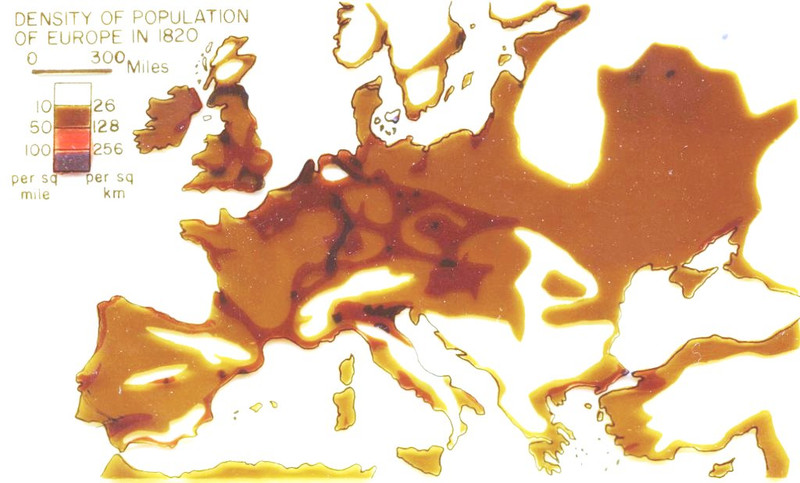
Population density in Europe, 1820
Why Food Supply Became More Stable
The Agricultural Revolution was a long, gradual shift toward more productive, commercial farming. It was not one invention or one moment.
Crop rotation and less fallow land
The key example is the Norfolk four-course rotation, linked to Charles “Turnip” Townshend.
- Wheat
- Turnips
- Barley
- Clover
This mattered because turnips fed animals in winter, clover restored soil, and more surviving livestock meant more manure, which improved yields. Farmers could use more land every year instead of leaving so much fallow.
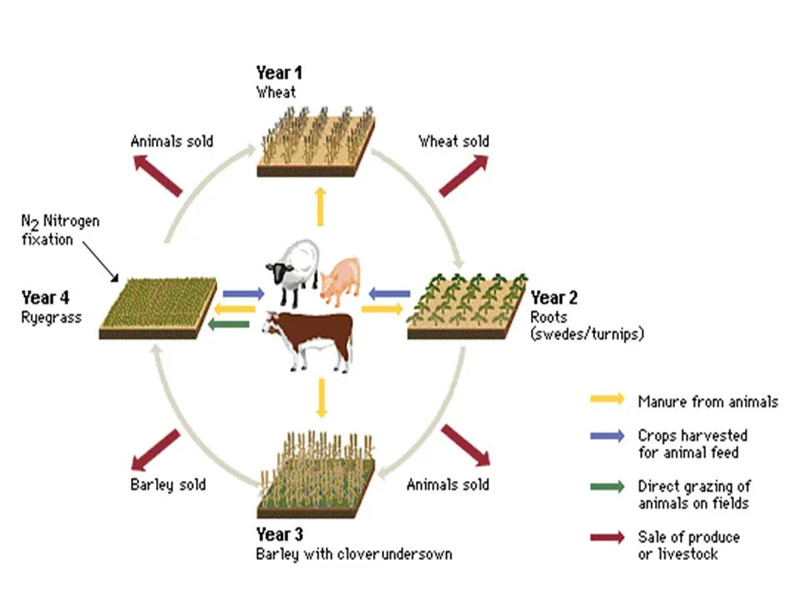
Norfolk four-course crop rotation
New crops
- Potatoes mattered most. They produced lots of calories on small plots and supported population growth.
- Maize spread in parts of southern and eastern Europe.
Selective breeding and new tools
- Robert Bakewell used selective breeding to improve livestock.
- Jethro Tull’s seed drill planted seeds more efficiently.
These show farming becoming more market-oriented and productive.
Enclosure
Enclosure meant consolidating scattered strips and common land, especially in Britain.
- It helped innovation, drainage, crop rotation, and larger commercial farms.
- It also had a social cost. Smallholders lost common rights and many became wage laborers.
Better transportation
Improved roads, canals, bridges, and river navigation tied markets together. Food could move from surplus areas to shortage areas, so a local bad harvest was less likely to become famine.
Overall effect: more food with fewer farm workers, which helped both population growth and migration.
Why Mortality Fell and What Still Limited Population Growth
A stronger food supply helped people survive, but lower mortality also mattered.
- Plague stopped being a major recurring epidemic in most of Europe during the 1700s.
- Know these examples:
- Great Plague of London, 1665
- Marseille, 1720-1721
- Moscow, 1770-1772
So plague faded gradually, not all at once.
Smallpox still killed many people, but inoculation lowered mortality. Lady Mary Wortley Montagu promoted variolation after seeing it in the Ottoman Empire. Be careful here: variolation is not Jenner’s vaccination. Edward Jenner’s vaccination came in 1796 and is later in method, even if still in the period.
Population growth still had limits because births were restrained by the European marriage pattern:
- People often married late
- They usually waited for economic independence
- A significant number never married
Since most births happened inside marriage, late marriage meant fewer total births. Some regions also used abstinence, withdrawal, and prolonged breastfeeding. Illegitimacy increased in the 18th century, especially in mobile urban settings, which shows older community controls were weakening.
How Population Growth Changed Family Life and Urban Society
As agriculture needed fewer workers, many rural people headed to towns. Cities offered jobs in:
- Domestic service
- Trade
- Artisan work
- Ports
- Construction
- Government
Urbanization grew most in Britain, the Dutch Republic, London, and Paris. City life put people among strangers, so traditional village oversight weakened.
City governments struggled with:
- Policing
- Sanitation
- Street lighting
- Waste removal
- Poor relief
- Public health
Poverty became highly visible. Crime, prostitution, begging, and vagrancy drew more attention, and governments responded with policing, workhouses, houses of correction, poor relief, and foundling hospitals.
Family life changed too. Lower infant and child mortality, plus rising commercial wealth, led families to invest more in children and private home life.
- Rousseau’s Émile treated childhood as a distinct stage needing nurture and education.
- Maria Theresa’s Austrian school reforms of 1774 show growing state interest in education.
- Napoleonic lycées in France did the same for secondary schooling.
- Painting and portraiture increasingly showed affectionate parents, age-specific childhood, and more domestic privacy.
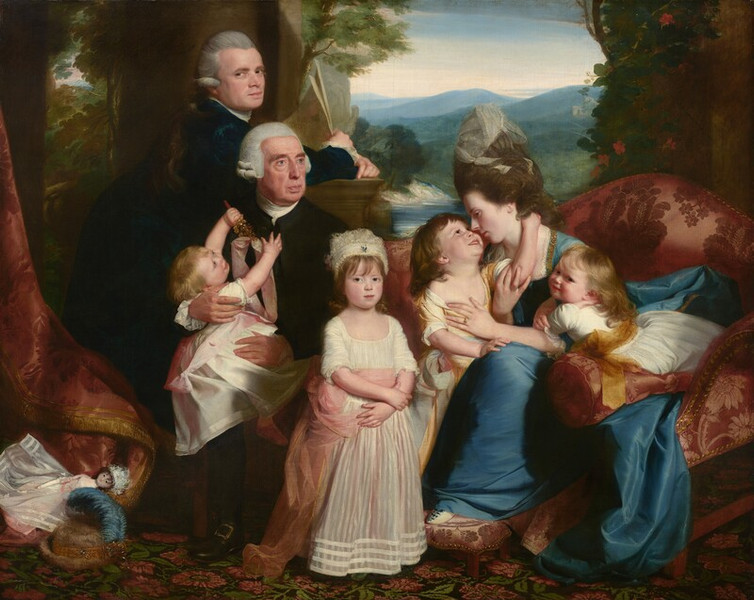
Eighteenth-century family portrait
This kind of portrait fits that shift toward affectionate parenting, a clearer idea of childhood, and a more private domestic world.
The big point is that demographic change reshaped society and helped create conditions for later industrialization, even though Europe was still preindustrial by 1815.
Key Takeaways
Demographic Crisis (Subsistence Crisis)
A harvest failure that caused food shortages, soaring grain prices, malnutrition, disease, and unusually high mortality
Open-Field System
Village farming system in which households cultivated scattered strips in shared fields under communal rules and used common lands
Little Ice Age
A period of colder, more variable European weather that contributed to harvest failures and subsistence crises
Agricultural Revolution
The long, uneven transformation that increased agricultural productivity and commercialization through improved rotations, crops, breeding, tools, landholding, and transportation
Crop Rotation
Planting different crops in sequence, including fodder and soil-restoring crops, to reduce fallow land and maintain fertility
Norfolk Four-Course Rotation
Rotation associated with Charles “Turnip” Townshend that alternated wheat, turnips, barley, and clover to reduce fallow land, restore soil, and provide winter fodder
Potato
A Columbian Exchange crop that produced substantial nutrition on small or marginal plots and helped support European population growth
Selective Breeding
Choosing livestock with desired traits to reproduce, exemplified by Robert Bakewell’s breeding of larger, more commercially valuable sheep and cattle
Seed Drill
Jethro Tull’s implement for planting seeds in regular rows at controlled depths, reducing waste and making cultivation more efficient
Enclosure
Consolidation of scattered strips and common lands into private farms, enabling agricultural innovation while weakening customary rights and displacing some rural people
Retreat of Plague
The 18th-century disappearance of plague as a major recurring epidemic across most of Europe, removing a severe check on population
Smallpox Inoculation (Variolation)
Deliberately introducing material from a smallpox sore to cause a usually milder infection and subsequent immunity
Lady Mary Wortley Montagu
British aristocrat who observed smallpox inoculation in the Ottoman Empire and promoted its adoption in Britain
European Marriage Pattern
Northwestern European pattern of relatively late marriage, independent household formation, and a significant minority who never married, limiting fertility
Rise in Illegitimate Births
An 18th-century increase in births outside legal marriage associated with delayed or prevented marriages, migration, abandonment, and weakened communal supervision
Rural-to-Urban Migration
Movement from the countryside to cities as agricultural change and land pressure displaced workers while urban employment attracted them
Urbanization
Growth in the share of the population living in towns and cities, sustained in the 18th century largely by rural migration
Birth Control
Abstinence, withdrawal, prolonged breastfeeding, and other methods used in some regions to limit births, supplementing late marriage as a restraint on population growth
New Conception of Childhood
Growing treatment of childhood as a distinct stage requiring specialized nurture and education as child mortality fell and family resources increased
Domestic Privacy and Comfort
Prosperous and middling families increasingly devoted specialized rooms, goods, and resources to private family life and household comfort
Policing of Marginal Groups
Urban concentration of poverty and disorder prompted increased policing, registration, institutional confinement, and regulation of beggars, vagrants, prostitutes, and other marginal groups
Notes
Demographic Crisis (Subsistence Crisis)
A harvest failure that caused food shortages, soaring grain prices, malnutrition, disease, and unusually high mortality
Open-Field System
Village farming system in which households cultivated scattered strips in shared fields under communal rules and used common lands
Little Ice Age
A period of colder, more variable European weather that contributed to harvest failures and subsistence crises
Agricultural Revolution
The long, uneven transformation that increased agricultural productivity and commercialization through improved rotations, crops, breeding, tools, landholding, and transportation
Crop Rotation
Planting different crops in sequence, including fodder and soil-restoring crops, to reduce fallow land and maintain fertility
Norfolk Four-Course Rotation
Rotation associated with Charles “Turnip” Townshend that alternated wheat, turnips, barley, and clover to reduce fallow land, restore soil, and provide winter fodder
Potato
A Columbian Exchange crop that produced substantial nutrition on small or marginal plots and helped support European population growth
Selective Breeding
Choosing livestock with desired traits to reproduce, exemplified by Robert Bakewell’s breeding of larger, more commercially valuable sheep and cattle
Seed Drill
Jethro Tull’s implement for planting seeds in regular rows at controlled depths, reducing waste and making cultivation more efficient
Enclosure
Consolidation of scattered strips and common lands into private farms, enabling agricultural innovation while weakening customary rights and displacing some rural people
Retreat of Plague
The 18th-century disappearance of plague as a major recurring epidemic across most of Europe, removing a severe check on population
Smallpox Inoculation (Variolation)
Deliberately introducing material from a smallpox sore to cause a usually milder infection and subsequent immunity
Lady Mary Wortley Montagu
British aristocrat who observed smallpox inoculation in the Ottoman Empire and promoted its adoption in Britain
European Marriage Pattern
Northwestern European pattern of relatively late marriage, independent household formation, and a significant minority who never married, limiting fertility
Rise in Illegitimate Births
An 18th-century increase in births outside legal marriage associated with delayed or prevented marriages, migration, abandonment, and weakened communal supervision
Rural-to-Urban Migration
Movement from the countryside to cities as agricultural change and land pressure displaced workers while urban employment attracted them
Urbanization
Growth in the share of the population living in towns and cities, sustained in the 18th century largely by rural migration
Birth Control
Abstinence, withdrawal, prolonged breastfeeding, and other methods used in some regions to limit births, supplementing late marriage as a restraint on population growth
New Conception of Childhood
Growing treatment of childhood as a distinct stage requiring specialized nurture and education as child mortality fell and family resources increased
Domestic Privacy and Comfort
Prosperous and middling families increasingly devoted specialized rooms, goods, and resources to private family life and household comfort
Policing of Marginal Groups
Urban concentration of poverty and disorder prompted increased policing, registration, institutional confinement, and regulation of beggars, vagrants, prostitutes, and other marginal groups
