Topic 3.1 Notes – Contextualizing State Building
What Sovereignty and State Building Meant After 1648
After the Peace of Westphalia in 1648, Europeans increasingly treated the state as the highest political authority inside a territory. That meant rulers claimed the right to make laws, collect taxes, administer justice, wage war, and conduct diplomacy without outside control.
In the medieval world, authority overlapped. A person could answer to a local lord, a town, a king, the pope, and maybe the emperor too. Westphalia mattered because it weakened those universal claims, especially from the pope and Holy Roman emperor, and strengthened territorial rulers instead.
It also:
- ended the Thirty Years’ War
- recognized Dutch independence
- recognized Swiss independence
- confirmed more authority for rulers inside the Holy Roman Empire
- recognized Calvinism alongside Catholicism and Lutheranism in the empire
The political map of 1648 helps show both sides of this change. Territorial rulers gained authority, but central Europe still remained highly fragmented, especially inside the Holy Roman Empire.
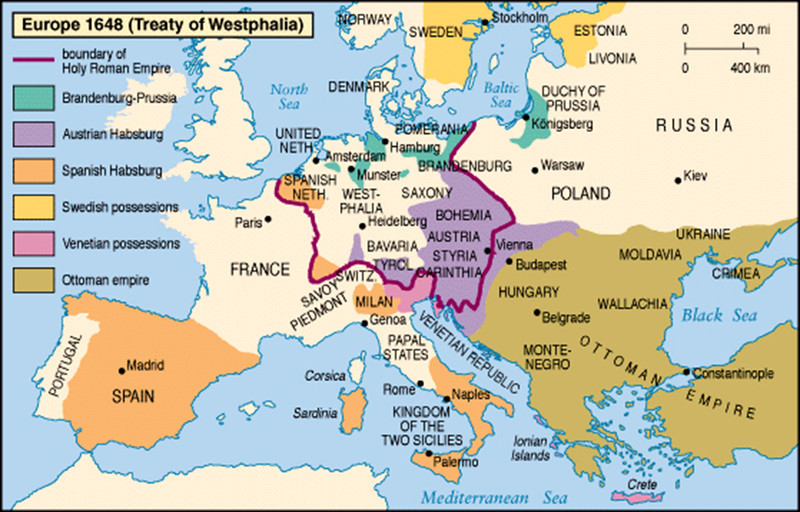
Europe in 1648 after the Peace of Westphalia
This did not instantly create modern nation-states. Many states were still composite monarchies, which means one ruler governed several territories that kept their own laws, taxes, languages, and privileges. People usually saw themselves as subjects of a dynasty, not equal citizens of one nation.
State building meant turning claims into actual power through institutions:
- royal courts and appeals let the crown shape justice
- councils and bureaucracies made rule more permanent
- provincial officials carried central orders outward
- taxation and public finance paid for government and war
- diplomatic services handled state-to-state relations
- standing armies gave rulers force they controlled more directly
Secular law meant political authority rested more in territorial governments than in the church, though rulers still used religion to justify their power.
A great example of raison d’état is Cardinal Richelieu. He was a Catholic minister serving Catholic France, but he backed Protestant powers against the Catholic Habsburgs in the Thirty Years’ War because French state interest mattered more than religious unity.
The Main Political Models in Europe
Europe did not land on one model. It developed different ways of distributing sovereignty.
| Model | What it meant | Main example |
|---|---|---|
| Absolute monarchy | Ruler claimed undivided sovereign authority | France |
| Constitutional monarchy | Monarchy limited by law and representative institutions | England/Britain |
| Oligarchic republic | No absolute monarch; narrow elite ruled | Dutch Republic |
| Decentralized or composite states | Territories kept separate laws and privileges | Spain, Holy Roman Empire |
A few key reminders:
- Absolute monarchy was strong in much of Europe, but never meant total control. Custom, noble privilege, weak communication, and money problems all limited rulers.
- Constitutional monarchy in England grew out of the English Civil War and Glorious Revolution. Parliament gained lasting power and protected elite property rights.
- The Dutch Republic built a strong state without absolutism. Merchants, regents, provincial estates, and landholders shared power.
- These alternatives were not modern democracy. Political power still belonged mostly to elites.
Why Centralization Caused Conflict
Centralization means concentrating decision-making in the central government. Monarchs wanted it because war was expensive. You needed regular taxes, officials, and armies, not just loose feudal loyalty.
Elites resisted because they wanted to keep:
- tax exemptions
- regional autonomy
- access to office
- traditional shared governance
Louis XIII and Richelieu
Richelieu strengthened the French crown by weakening Huguenot political strongholds, reducing noble independence, and expanding royal officials in the provinces. This is early French centralization in action.
The Fronde
The Fronde in France, 1648 to 1653, was resistance by the Parlement of Paris, officeholders, and nobles against taxation and centralization. It was not a united popular revolution. It was mostly elite self-interest. Its failure cleared the way for stronger absolutism under Louis XIV.
The Catalan Revolt
In 1640, Catalonia rebelled against Philip IV of Spain. Wartime taxes, the quartering of troops, and attacks on Catalan laws and privileges pushed the revolt. This shows the weakness of a composite monarchy trying to impose uniform control.
Regional and Cultural Resistance to State Power
Resistance came from more than nobles. Distinct language and cultural groups also pushed back. This was not always full modern nationalism, but it still had political force.
Celtic regions
- Ireland resisted English rule through a mix of Catholicism, land conflict, and cultural difference.
- Scottish Highlands kept a Gaelic identity, and later Stuart loyalty made integration into Britain harder.
- Brittany held onto a distinct identity and privileges inside France.
Dutch resistance in the Spanish Netherlands
The Dutch revolted against Habsburg Spain over taxation, centralization, repression, Calvinism, and provincial rights. The Union of Utrecht in 1579 united the northern provinces, and the Dutch Republic was formally recognized in 1648.
Czech identity in the Habsburg lands
Czech identity drew on the legacy of Jan Hus and the Hussite tradition. The Defenestration of Prague in 1618 launched the Bohemian Revolt and helped trigger the Thirty Years’ War.
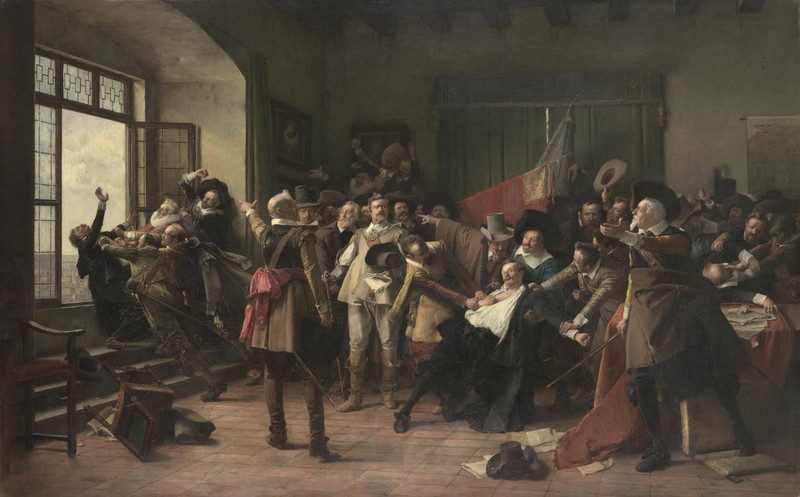
Defenestration of Prague, 1618
After White Mountain in 1620, the Habsburgs crushed the estates, confiscated lands, and centralized rule. State building was uneven because rulers had to fight both privileged elites and distinct regional communities.
Key Takeaways
State Building
The process of expanding a territorial government's institutions, administrative capacity, and control over taxation, law, and military power
Peace of Westphalia
The 1648 settlement ending the Thirty Years’ War that reinforced territorial sovereignty and recognized Dutch, Swiss, and German territorial autonomy
Sovereignty
The highest recognized authority within a territory, including final control over law, taxation, justice, diplomacy, and war
Composite Monarchy
Territories united under one ruler while retaining separate laws, institutions, tax systems, languages, and privileges
Secular Systems of Law
Legal and political authority based increasingly on territorial governments rather than the church or a universal Christian order
Raison d’État (Reason of State)
The principle that preserving and strengthening the state could outweigh religious alliances or ordinary moral expectations
Political Centralization
The concentration of taxation, law, administration, military power, and decision-making in a central government
Absolute Monarchy (Absolutism)
A system in which a monarch claimed final sovereign authority unshared with representative institutions, despite practical limits and preserved elite privileges
Constitutional Monarchy (Constitutionalism)
A system in which law and representative institutions constrain monarchical authority, usually to protect propertied elites rather than establish democracy
Oligarchic Republic
A republic in which political power is exercised by a narrow group of urban, commercial, or landed elites
Parliamentary Sovereignty
The principle that Parliament, rather than the monarch alone, possesses supreme lawmaking authority
Dutch Republic
The oligarchic, commercially oriented republic created by the northern Netherlands and governed through provincial institutions dominated by elites
Corporate Group
A legally recognized body, such as an estate, town, church, guild, or noble order, possessing collective rights and privileges
Cardinal Richelieu
Louis XIII’s chief minister from 1624 to 1642, who strengthened the French crown against nobles, Huguenot strongholds, and the Habsburgs
The Fronde
French revolts from 1648 to 1653 by officeholders, princes, and nobles resisting royal taxation and centralization; their failure strengthened the monarchy
Catalan Revolt (Reapers’ War)
The 1640 revolt against Spanish taxation, troop quartering, and centralization that defended Catalonia’s laws and institutions but failed by 1652
Celtic-Language Regions
Regions such as Ireland, the Scottish Highlands, and Brittany whose languages, customs, religions, or privileges encouraged resistance to English or French centralization
Dutch Revolt
The revolt against Habsburg Spain over provincial privileges, taxation, centralized rule, and religious repression that created the Dutch Republic and won recognition of its independence in 1648
Czech Identity in the Habsburg Lands
Bohemian linguistic, religious, and estate traditions that supported resistance to Habsburg rule even after Habsburg victory weakened local autonomy
Historical Contextualization
Explaining how broader developments surrounding an event or process made it possible or historically significant
Sovereign State
A territorial state whose government claims final political authority within its borders without legal subordination to an outside power
Notes
State Building
The process of expanding a territorial government's institutions, administrative capacity, and control over taxation, law, and military power
Peace of Westphalia
The 1648 settlement ending the Thirty Years’ War that reinforced territorial sovereignty and recognized Dutch, Swiss, and German territorial autonomy
Sovereignty
The highest recognized authority within a territory, including final control over law, taxation, justice, diplomacy, and war
Composite Monarchy
Territories united under one ruler while retaining separate laws, institutions, tax systems, languages, and privileges
Secular Systems of Law
Legal and political authority based increasingly on territorial governments rather than the church or a universal Christian order
Raison d’État (Reason of State)
The principle that preserving and strengthening the state could outweigh religious alliances or ordinary moral expectations
Political Centralization
The concentration of taxation, law, administration, military power, and decision-making in a central government
Absolute Monarchy (Absolutism)
A system in which a monarch claimed final sovereign authority unshared with representative institutions, despite practical limits and preserved elite privileges
Constitutional Monarchy (Constitutionalism)
A system in which law and representative institutions constrain monarchical authority, usually to protect propertied elites rather than establish democracy
Oligarchic Republic
A republic in which political power is exercised by a narrow group of urban, commercial, or landed elites
Parliamentary Sovereignty
The principle that Parliament, rather than the monarch alone, possesses supreme lawmaking authority
Dutch Republic
The oligarchic, commercially oriented republic created by the northern Netherlands and governed through provincial institutions dominated by elites
Corporate Group
A legally recognized body, such as an estate, town, church, guild, or noble order, possessing collective rights and privileges
Cardinal Richelieu
Louis XIII’s chief minister from 1624 to 1642, who strengthened the French crown against nobles, Huguenot strongholds, and the Habsburgs
The Fronde
French revolts from 1648 to 1653 by officeholders, princes, and nobles resisting royal taxation and centralization; their failure strengthened the monarchy
Catalan Revolt (Reapers’ War)
The 1640 revolt against Spanish taxation, troop quartering, and centralization that defended Catalonia’s laws and institutions but failed by 1652
Celtic-Language Regions
Regions such as Ireland, the Scottish Highlands, and Brittany whose languages, customs, religions, or privileges encouraged resistance to English or French centralization
Dutch Revolt
The revolt against Habsburg Spain over provincial privileges, taxation, centralized rule, and religious repression that created the Dutch Republic and won recognition of its independence in 1648
Czech Identity in the Habsburg Lands
Bohemian linguistic, religious, and estate traditions that supported resistance to Habsburg rule even after Habsburg victory weakened local autonomy
Historical Contextualization
Explaining how broader developments surrounding an event or process made it possible or historically significant
Sovereign State
A territorial state whose government claims final political authority within its borders without legal subordination to an outside power
