Topic 3.6 Notes – Balance of Power
What the Balance of Power Was
After the Peace of Westphalia in 1648, diplomacy revolved around stopping hegemony, meaning one state or dynasty dominating Europe. That did not mean all states were equal. It meant the strongest states would combine to block any power that got too strong.
This post-1648 map helps you picture the fragmented political order, especially inside the Holy Roman Empire.
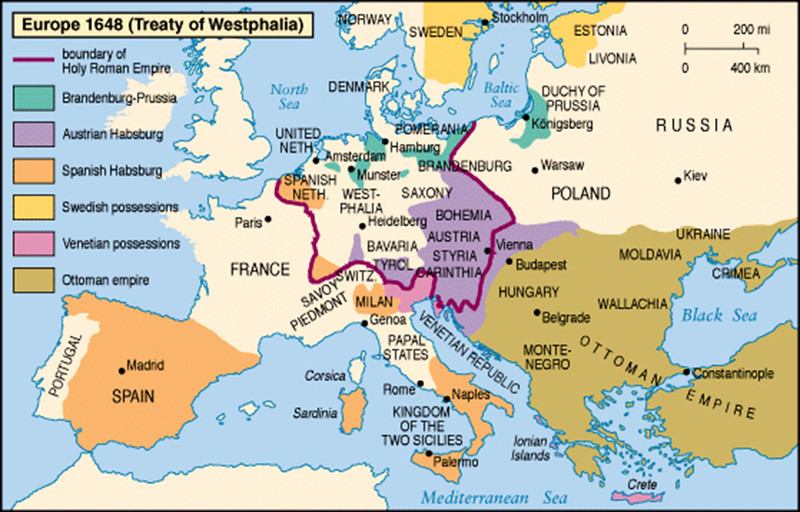
Europe after the Peace of Westphalia, 1648
A few things changed after Westphalia:
- Religion mattered less as the main cause of interstate war. States still cared about religion, but rulers increasingly acted by raison d’état, or state interest.
- Sovereignty got stronger, especially for princes in the Holy Roman Empire. The emperor had less power to impose unity.
- Alliances became flexible. Catholic and Protestant states could work together if a bigger threat appeared.
What rulers wanted usually fit into three motives:
- Dynastic interests like marriages, inheritance, and disputed successions.
- State interests like strong borders, buffer zones, ports, trade routes, and avoiding encirclement.
- Imperial interests like colonies, naval power, and overseas trade.
The exam loves this distinction. The balance of power limited conquest more than it prevented war.
Louis XIV and How Anti-French Coalitions Worked
France became Europe’s strongest continental power after 1648. It had a huge population, a centralized state, a strong economy, and a large army. Under Louis XIV, that strength kept triggering coalitions against France.
Dutch War
In 1672 to 1678, Louis attacked the Dutch Republic to weaken a commercial rival and push French power toward the Rhine.
- William of Orange led Dutch resistance.
- The Dutch flooded land to slow the French invasion.
- Spain, the emperor, and German states joined against France.
- The Treaties of Nijmegen gave France gains such as Franche-Comté, but also showed that expansion would bring opposition.
Nine Years’ War
In 1688 to 1697, France fought the League of Augsburg, also called the Grand Alliance.
- Coalition members included England, the Dutch Republic, Spain, the emperor, and German princes.
- William of Orange became William III of England after the Glorious Revolution, which strengthened the anti-French side.
- The Treaty of Ryswick checked French expansion.
War of the Spanish Succession
This was the clearest balance-of-power crisis. When Charles II of Spain died childless in 1700, Philip of Anjou, Louis XIV’s grandson, inherited Spain. Europe feared a Bourbon union of France and Spain.
- War lasted 1701 to 1714.
- Grand Alliance included England, the Dutch Republic, Austria, and German states.
- Key commanders were Duke of Marlborough and Prince Eugene of Savoy.
The settlements at Utrecht, Rastatt, and Baden reshaped the map of western and central Europe.
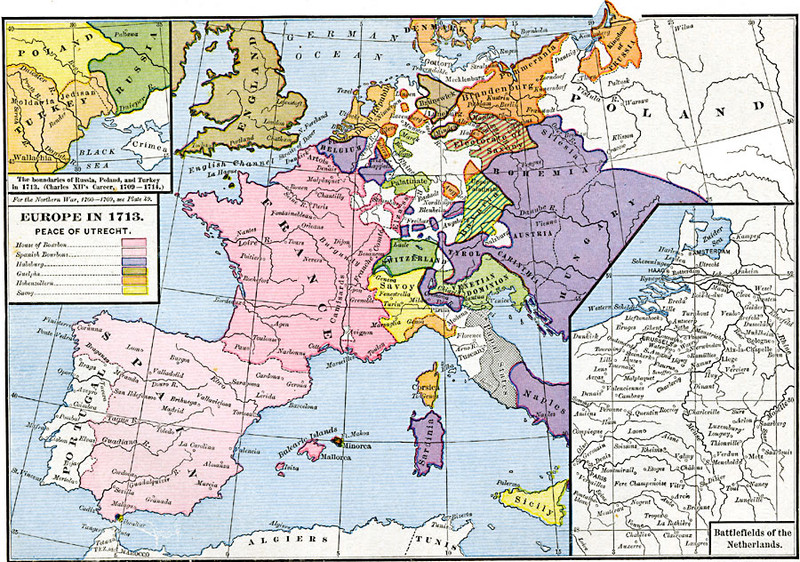
Europe after the Peace of Utrecht, 1713
They did three major things:
- Philip V kept Spain, but the French and Spanish crowns could not unite.
- Austria gained the Spanish Netherlands, Milan, Naples, and Sardinia.
- Britain gained Gibraltar, Minorca, Acadia, Newfoundland, Hudson Bay claims, and the asiento.
Utrecht is the classic balance-of-power treaty because it accepted a dynasty but blocked hegemony.
Shifting Alliances and Great-Power Rivalry in the Eighteenth Century
After Louis XIV, the main powers were Britain, France, Austria, Prussia, and Russia.
- War of the Austrian Succession (1740 to 1748) began when Frederick II of Prussia seized Silesia after Maria Theresa inherited Habsburg lands. The Treaty of Aix-la-Chapelle confirmed Prussian control. That made Prussia a major power.
- The Diplomatic Revolution of 1756 flipped alliances. Austria allied with France, Britain allied with Prussia, and Russia opposed Prussia. This is a great example of strategy beating ideology.
- In the Seven Years’ War (1756 to 1763), Prussia fought Austria, France, Russia, and others in Europe. It survived partly because Peter III pulled Russia out.
- Globally, Britain and France fought in North America, India, the Caribbean, West Africa, and at sea. The Treaty of Hubertusburg kept Silesia Prussian. The Treaty of Paris made Britain the top colonial and naval power.
In the north and east:
- The Great Northern War weakened Sweden and raised Russia. Poltava and the Peace of Nystad were key.
- The Battle of Vienna in 1683 stopped Ottoman westward expansion. The Treaty of Karlowitz gave Austria major gains in Hungary.
Military Revolution and Why Some States Won
Diplomacy only worked if states had the power to back it up. The military revolution changed who could compete.
- Infantry and firearms became more important than armored cavalry.
- Pike-and-shot formations gave way to flintlock muskets and socket bayonets.
- Mobile cannon and coordinated fire made armies deadlier.
- Trace italienne star forts made sieges central. Vauban is the key name here.
- States built larger standing armies with drill, uniforms, officers, and supply systems.
A star fort plan like this helps show why fortifications became such a big part of early modern warfare.
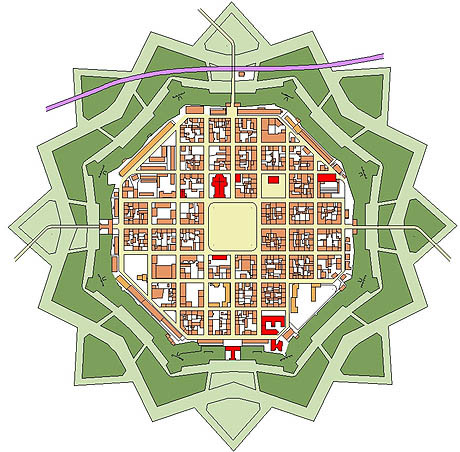
Trace italienne star fort
This favored fiscal-military states, governments able to tax, borrow, and build bureaucracy.
| State | Why it mattered |
|---|---|
| Spain | Early success with tercios and silver, then relative decline |
| Sweden | Gustavus Adolphus used discipline and mobile artillery well |
| France | Population and centralized taxation supported huge wars |
| Britain | Parliament, Bank of England, public credit, and navy financed long wars |
| Prussia | Efficient administration supported a very large army |
Poland-Lithuania shows the opposite. Its elected monarchy, powerful nobility, Sejm, and liberum veto blocked reform, taxation, and military strength. Russia, Prussia, and Austria partitioned it in 1772, 1793, and 1795, wiping Poland off the map.
Key Takeaways
Balance of Power
Post-1648 principle that states should use shifting alliances, war, and negotiated settlements to prevent any one power from dominating Europe
Raison d’État
The principle that rulers should pursue the strategic interests of the state rather than religious solidarity
Dynastic Interests vs. State Interests
Dynastic interests advanced a ruling family’s inheritance and claims; state interests pursued strategic security, territory, commerce, and resources
Dutch War
Louis XIV’s 1672–1678 invasion of the Dutch Republic, which provoked a wider anti-French coalition and ended with French territorial gains
Treaties of Nijmegen
The 1678–1679 settlements ending the Dutch War; France gained Franche-Comté and fortified towns in the Spanish Netherlands
Nine Years’ War / War of the League of Augsburg / War of the Grand Alliance
The 1688–1697 war in which a broad European alliance checked Louis XIV’s expansion along the Rhine
Treaty of Ryswick
The 1697 settlement ending the Nine Years’ War; France surrendered several acquisitions and recognized William III as king of England
War of the Spanish Succession
The 1701–1714 war fought to prevent Philip V’s inheritance of Spain from producing a union of the French and Spanish crowns
Treaties of Utrecht
The 1713 settlement that kept Philip V in Spain but barred a Franco-Spanish union and redistributed European and colonial territories among the victors
Asiento
The contractual right, granted to Britain at Utrecht, to supply enslaved Africans to Spanish America
Pragmatic Sanction
Charles VI’s measure permitting his daughter Maria Theresa to inherit the Habsburg lands
War of the Austrian Succession
The 1740–1748 conflict over Maria Theresa’s inheritance in which Prussia seized Silesia and emerged as a major Central European power
Treaty of Aix-la-Chapelle
The 1748 settlement recognizing Maria Theresa’s control of most Habsburg lands while confirming Prussia’s possession of Silesia
Diplomatic Revolution
The 1756 alliance reversal in which Austria allied with France while Britain allied with Prussia
Seven Years’ War
The 1756–1763 global conflict in which Prussia survived a European coalition while Britain defeated France in major colonial and naval theaters
Treaty of Hubertusburg
The 1763 settlement ending the central European phase of the Seven Years’ War and confirming Prussia’s possession of Silesia
Treaty of Paris of 1763
The settlement ending much of the Seven Years’ War’s colonial conflict; Britain gained Canada and emerged as the leading naval and colonial power
Great Northern War
The 1700–1721 war in which a Russian-led coalition defeated Sweden, ending Swedish Baltic supremacy and establishing Russia as a leading power
Battle of Poltava
Russia’s 1709 victory over Sweden during the Great Northern War, contributing to Sweden’s decline and Russia’s rise
Peace of Nystad
The 1721 settlement ending the Great Northern War and confirming Russia’s territorial gains along the Baltic
Battle of Vienna
The 1683 defeat of the Ottoman siege of Vienna by a relief force led by John III Sobieski, ending sustained Ottoman expansion into Central Europe
Great Turkish War
The war following the Battle of Vienna in which the Habsburgs and their allies pushed the Ottomans back and gained much of Hungary
Treaty of Karlowitz
The 1699 settlement confirming major Habsburg territorial gains from the Ottoman Empire, including much of Hungary
Szlachta
The politically privileged Polish-Lithuanian nobility that defended its liberties against stronger royal authority
Sejm
The representative assembly of Poland-Lithuania in which the nobility exercised extensive political power
Liberum Veto
The Polish rule allowing one Sejm deputy to block legislation and dissolve the assembly’s session
Constitution of May 3, 1791
Polish reform constitution that limited the liberum veto and sought a stronger central government but was undermined by conservative opposition and Russian intervention
Partitions of Poland
The 1772, 1793, and 1795 divisions of Poland-Lithuania by Russia, Prussia, and Austria, ending its independence after the Third Partition
Military Revolution
The transformation toward infantry, firearms, mobile artillery, elaborate fortifications, standing armies, drill, and military administration requiring greater state resources
Pike-and-Shot Formation
An infantry formation combining pikemen, who protected the unit, with firearm-equipped soldiers whose weapons reloaded slowly
Tercio
The prominent Spanish pike-and-shot formation that supported Habsburg military power in the sixteenth and early seventeenth centuries
Flintlock Musket
A more reliable, faster-firing musket that helped make firearm-equipped infantry the core of European armies
Socket Bayonet
A bayonet fitted around a musket barrel so the weapon could still fire, allowing musketeers to replace separate pikemen
Trace Italienne / Star Fort
A low, thick, angled fortress with projecting bastions that provided overlapping defensive fire against artillery and assault
Sébastien Le Prestre de Vauban
French military engineer who improved star fortifications and developed systematic siege methods along France’s frontiers
Gustavus Adolphus
Swedish king noted for coordinating disciplined infantry fire, cavalry, and mobile artillery to make Sweden a major military power
Standing Army
A permanent state-maintained army with regular pay, standardized weapons, uniforms, drill, and command structures
Fiscal-Military State
A government organized to raise taxes and credit and convert them through bureaucracy into sustained military power
Notes
Balance of Power
Post-1648 principle that states should use shifting alliances, war, and negotiated settlements to prevent any one power from dominating Europe
Raison d’État
The principle that rulers should pursue the strategic interests of the state rather than religious solidarity
Dynastic Interests vs. State Interests
Dynastic interests advanced a ruling family’s inheritance and claims; state interests pursued strategic security, territory, commerce, and resources
Dutch War
Louis XIV’s 1672–1678 invasion of the Dutch Republic, which provoked a wider anti-French coalition and ended with French territorial gains
Treaties of Nijmegen
The 1678–1679 settlements ending the Dutch War; France gained Franche-Comté and fortified towns in the Spanish Netherlands
Nine Years’ War / War of the League of Augsburg / War of the Grand Alliance
The 1688–1697 war in which a broad European alliance checked Louis XIV’s expansion along the Rhine
Treaty of Ryswick
The 1697 settlement ending the Nine Years’ War; France surrendered several acquisitions and recognized William III as king of England
War of the Spanish Succession
The 1701–1714 war fought to prevent Philip V’s inheritance of Spain from producing a union of the French and Spanish crowns
Treaties of Utrecht
The 1713 settlement that kept Philip V in Spain but barred a Franco-Spanish union and redistributed European and colonial territories among the victors
Asiento
The contractual right, granted to Britain at Utrecht, to supply enslaved Africans to Spanish America
Pragmatic Sanction
Charles VI’s measure permitting his daughter Maria Theresa to inherit the Habsburg lands
War of the Austrian Succession
The 1740–1748 conflict over Maria Theresa’s inheritance in which Prussia seized Silesia and emerged as a major Central European power
Treaty of Aix-la-Chapelle
The 1748 settlement recognizing Maria Theresa’s control of most Habsburg lands while confirming Prussia’s possession of Silesia
Diplomatic Revolution
The 1756 alliance reversal in which Austria allied with France while Britain allied with Prussia
Seven Years’ War
The 1756–1763 global conflict in which Prussia survived a European coalition while Britain defeated France in major colonial and naval theaters
Treaty of Hubertusburg
The 1763 settlement ending the central European phase of the Seven Years’ War and confirming Prussia’s possession of Silesia
Treaty of Paris of 1763
The settlement ending much of the Seven Years’ War’s colonial conflict; Britain gained Canada and emerged as the leading naval and colonial power
Great Northern War
The 1700–1721 war in which a Russian-led coalition defeated Sweden, ending Swedish Baltic supremacy and establishing Russia as a leading power
Battle of Poltava
Russia’s 1709 victory over Sweden during the Great Northern War, contributing to Sweden’s decline and Russia’s rise
Peace of Nystad
The 1721 settlement ending the Great Northern War and confirming Russia’s territorial gains along the Baltic
Battle of Vienna
The 1683 defeat of the Ottoman siege of Vienna by a relief force led by John III Sobieski, ending sustained Ottoman expansion into Central Europe
Great Turkish War
The war following the Battle of Vienna in which the Habsburgs and their allies pushed the Ottomans back and gained much of Hungary
Treaty of Karlowitz
The 1699 settlement confirming major Habsburg territorial gains from the Ottoman Empire, including much of Hungary
Szlachta
The politically privileged Polish-Lithuanian nobility that defended its liberties against stronger royal authority
Sejm
The representative assembly of Poland-Lithuania in which the nobility exercised extensive political power
Liberum Veto
The Polish rule allowing one Sejm deputy to block legislation and dissolve the assembly’s session
Constitution of May 3, 1791
Polish reform constitution that limited the liberum veto and sought a stronger central government but was undermined by conservative opposition and Russian intervention
Partitions of Poland
The 1772, 1793, and 1795 divisions of Poland-Lithuania by Russia, Prussia, and Austria, ending its independence after the Third Partition
Military Revolution
The transformation toward infantry, firearms, mobile artillery, elaborate fortifications, standing armies, drill, and military administration requiring greater state resources
Pike-and-Shot Formation
An infantry formation combining pikemen, who protected the unit, with firearm-equipped soldiers whose weapons reloaded slowly
Tercio
The prominent Spanish pike-and-shot formation that supported Habsburg military power in the sixteenth and early seventeenth centuries
Flintlock Musket
A more reliable, faster-firing musket that helped make firearm-equipped infantry the core of European armies
Socket Bayonet
A bayonet fitted around a musket barrel so the weapon could still fire, allowing musketeers to replace separate pikemen
Trace Italienne / Star Fort
A low, thick, angled fortress with projecting bastions that provided overlapping defensive fire against artillery and assault
Sébastien Le Prestre de Vauban
French military engineer who improved star fortifications and developed systematic siege methods along France’s frontiers
Gustavus Adolphus
Swedish king noted for coordinating disciplined infantry fire, cavalry, and mobile artillery to make Sweden a major military power
Standing Army
A permanent state-maintained army with regular pay, standardized weapons, uniforms, drill, and command structures
Fiscal-Military State
A government organized to raise taxes and credit and convert them through bureaucracy into sustained military power
