Topic 1.8 Notes – Colonial Expansion and Columbian Exchange
What Colonial Expansion and the Columbian Exchange Were
From the late 1400s to early 1600s, Europeans turned exploration into lasting overseas systems. They built colonies, meaning territories under European control for settlement, extraction, plantation farming, or military advantage. They also built commercial networks, linked chains of ports, sea routes, merchants, warehouses, and trading posts.
The Columbian Exchange was the large-scale movement of crops, animals, diseases, people, and cultural practices after 1492.
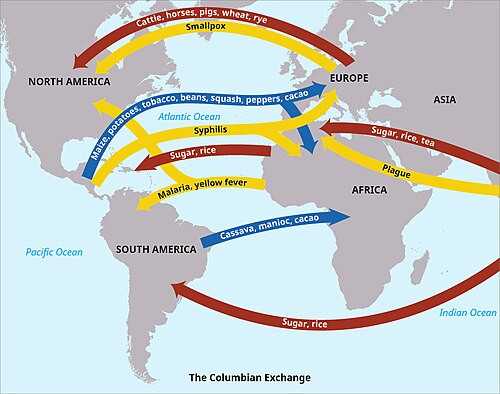
Map of the Columbian Exchange
This map gives you the big picture. Goods, animals, and diseases moved in both directions across the Atlantic, but the effects were very uneven.
What ties the whole topic together is this chain:
- Overseas expansion created new routes and colonies.
- Those routes created global exchange.
- Atlantic trade grew fast and made some European states richer.
- Disease and conquest shattered many Indigenous societies in the Americas.
- Labor demand rose, especially on plantations.
- The trade in enslaved Africans expanded.
A few distinctions matter a lot on tests:
- The exchange was reciprocal in movement, but its effects were unequal.
- Disease helped conquest, but Spanish victories also depended on warfare, alliances, and political divisions.
- European dominance was gradual.
- European control was strongest in the Americas, much less complete in Africa and Asia.
The Portuguese Commercial Network
Portugal built the first major European oceanic trade network. Its empire in Africa and Asia was mostly a trading-post empire, not a giant inland empire. Portugal controlled key coastal spots, used naval guns, and tried to dominate sea lanes.
A famous feature was the cartaz system. Ships in some Indian Ocean waters had to buy Portuguese passes.
The map below is a good way to picture that system as a chain of coastal ports stretching from West Africa around the Cape to India and Southeast Asia, with Brazil tied in across the Atlantic.
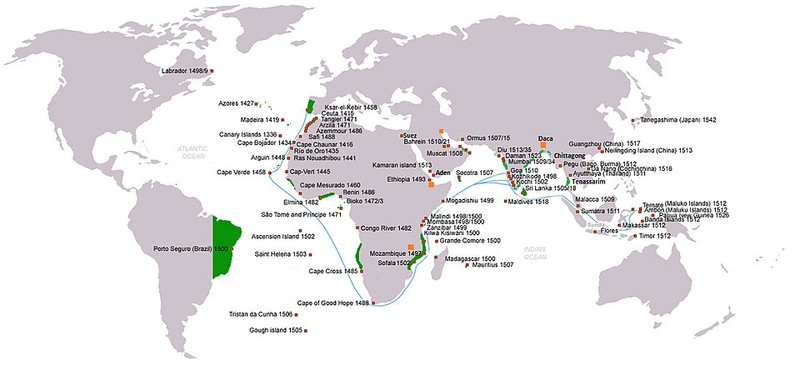
Portuguese maritime trade network, c. 1400s to early 1500s
Major Portuguese positions
- Elmina on the West African coast, important for gold and later enslaved people.
- Mozambique on the East African coast, linking Atlantic and Indian Ocean trade.
- Goa, the administrative center of the Estado da Índia.
- Malacca, controlling a major strait in Southeast Asia.
- Hormuz, near the Persian Gulf entrance.
- Macao, linking trade with China and Japan.
- Brazil, which became very different from the Asian network.
Portugal wanted gold, ivory, spices, textiles, and luxury goods. The key pattern is a chain of coastal nodes, not solid territorial control.
Brazil
Brazil, claimed by Pedro Álvares Cabral in 1500, first supplied brazilwood. Later it became a major sugar plantation colony. That shows how transferred crops, seized land, plantation farming, and coerced labor all fit together.
Portugal did not fully control African or Asian trade. It inserted itself into existing systems where local rulers and merchants still had major power.
How Trade Shifted Power to the Atlantic
As overseas trade expanded, Europe’s economic center moved relatively away from Venice and Genoa and toward Atlantic and North Sea powers.
Why?
- Sea routes around Africa gave direct access to Asian trade.
- American silver and colonial goods entered Europe.
- Colonies bought European products.
- States collected customs revenue and backed trade.
- Shipping, insurance, warehousing, and credit expanded.
Port cities to know
| City | What to remember |
|---|---|
| Antwerp | Leading 16th-century commercial entrepôt |
| Amsterdam | Rose after turmoil in the Netherlands; linked Baltic, Atlantic, Mediterranean, and Asian trade |
| London | Major English commercial and political center |
| Bristol | Important English Atlantic port |
Mercantilism treated colonies and trade as tools of state power. Governments tried to control shipping and keep colonial markets for themselves.
The Mediterranean did not die off. The shift was gradual and relative.
What Moved Across the Atlantic and What It Caused
Old World to the Americas
- Wheat, sugarcane
- Cattle, horses, pigs, sheep
- Smallpox, measles
Sugarcane drove plantation growth in Brazil and the Caribbean. Livestock changed land use. Horses helped conquistadors and were later adopted by Indigenous peoples.
Americas to Europe
- Tomatoes, potatoes, squash, corn (maize), tobacco, turkeys
Potatoes and maize mattered most long term because they helped support population growth. Tobacco became a profitable cash crop.
Disease and conquest worked together. Cortés used Tlaxcalan allies in taking Tenochtitlán in 1521. Pizarro took advantage of an Inca crisis tied to disease and captured Atahualpa.
Demographic collapse weakened resistance, disrupted leadership and food production, and made colonization easier. Europeans also spread Christianity, languages, and legal systems, but Indigenous peoples resisted, adapted, and blended practices. Bartolomé de las Casas is key evidence of colonial violence and forced labor.
Why Colonial Expansion Created Wealth and More Enslaved Labor
Colonial expansion brought Europeans wealth through sugar, tobacco, silver, land, shipping, customs revenue, and colonial markets. American silver also linked Europe to Asian trade, so Atlantic expansion fed a wider global economy.
Labor systems mattered:
- Encomienda in Spanish America gave colonists control over Indigenous labor and tribute.
- Plantation labor in Brazil depended on coercion and export farming.
As Indigenous populations fell and plantations demanded huge labor forces, Europeans expanded the trade in enslaved Africans. Slavery already existed before this period, but colonial expansion made the Atlantic system much larger.
Key Takeaways
Portuguese Commercial Network
Late-15th- and 16th-century network linking Portugal to coastal Africa, the Indian Ocean, South and East Asia, and Brazil through ports, sea routes, trade, and colonies
Trading-Post Empire
An empire based on controlling strategic ports and sea lanes rather than extensive inland territory, as in Portugal’s African and Asian possessions
Feitorias (Fortified Trading Factories)
Portuguese fortified trading posts that functioned as warehouses, customs stations, diplomatic centers, and defensive positions
Cartaz System
Portuguese system requiring many ships in Portuguese-controlled Indian Ocean waters to purchase passes, though enforcement remained incomplete
Shift from the Mediterranean to the Atlantic
Gradual relative movement of European wealth and commercial importance toward Atlantic and North Sea states and ports as overseas trade expanded
Columbian Exchange
Large-scale transfer of plants, animals, diseases, people, and cultural practices between the Americas and Europe, Africa, and Asia after 1492
Indigenous American Demographic Catastrophe
Massive post-contact population decline caused by disease, warfare, famine, forced labor, displacement, and falling birth rates, which facilitated European conquest
Encomienda
Spanish colonial system granting colonists claims to Indigenous tribute and labor in return for supposed protection and Christianization, often resulting in coercion and abuse
Expansion of the Atlantic Trade in Enslaved Africans
Colonial labor demand, especially on sugar plantations after Indigenous population collapse, increased the forced transport of enslaved Africans to the Americas and tied slavery to European commercial profit
Shift Toward European Global Dominance
Gradual, uneven growth of European control over global trade routes, resources, and markets—strongest in the Americas and more limited to coastal positions in Africa and Asia
Notes
Portuguese Commercial Network
Late-15th- and 16th-century network linking Portugal to coastal Africa, the Indian Ocean, South and East Asia, and Brazil through ports, sea routes, trade, and colonies
Trading-Post Empire
An empire based on controlling strategic ports and sea lanes rather than extensive inland territory, as in Portugal’s African and Asian possessions
Feitorias (Fortified Trading Factories)
Portuguese fortified trading posts that functioned as warehouses, customs stations, diplomatic centers, and defensive positions
Cartaz System
Portuguese system requiring many ships in Portuguese-controlled Indian Ocean waters to purchase passes, though enforcement remained incomplete
Shift from the Mediterranean to the Atlantic
Gradual relative movement of European wealth and commercial importance toward Atlantic and North Sea states and ports as overseas trade expanded
Columbian Exchange
Large-scale transfer of plants, animals, diseases, people, and cultural practices between the Americas and Europe, Africa, and Asia after 1492
Indigenous American Demographic Catastrophe
Massive post-contact population decline caused by disease, warfare, famine, forced labor, displacement, and falling birth rates, which facilitated European conquest
Encomienda
Spanish colonial system granting colonists claims to Indigenous tribute and labor in return for supposed protection and Christianization, often resulting in coercion and abuse
Expansion of the Atlantic Trade in Enslaved Africans
Colonial labor demand, especially on sugar plantations after Indigenous population collapse, increased the forced transport of enslaved Africans to the Americas and tied slavery to European commercial profit
Shift Toward European Global Dominance
Gradual, uneven growth of European control over global trade routes, resources, and markets—strongest in the Americas and more limited to coastal positions in Africa and Asia
