Topic 8.1 Notes – Contextualizing 20th-Century Global Conflicts
How Europe’s 20th-Century Global Conflicts Developed
Europe entered the 1900s carrying the legacy of the late 1800s. The key point is that WWI and WWII were connected to long-term pressures, not random explosions.
- Nationalism helped unify Germany and Italy, but it also tore at multinational empires like Austria-Hungary, the Ottoman Empire, and Russia. In places like the Balkans, different national groups wanted their own states, which made the region dangerous.
- German unification in 1871 changed everything. A powerful new Germany sat in the middle of Europe. France wanted revenge for losing Alsace-Lorraine, Britain feared German naval growth, and Russia and Austria-Hungary competed for influence in the Balkans.
- Europe hardened into two rival alliance blocs:
- Triple Alliance = Germany, Austria-Hungary, Italy
- Triple Entente = Britain, France, Russia
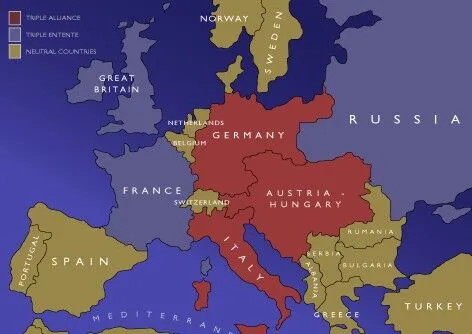
Europe’s alliance blocs before World War I
- Industrialization made states richer and stronger, but it also made war far deadlier. Railroads moved troops fast, factories produced weapons in huge numbers, and new technology like machine guns, heavy artillery, poison gas, tanks, and submarines made combat industrial.
- Militarism meant leaders trusted military solutions too much. Rigid war plans, especially the Schlieffen Plan, made crises harder to slow down because once mobilization started, diplomacy had little room.
- Imperial rivalry spread conflict beyond Europe. The Moroccan Crises showed how colonial competition fed mistrust.
- Mass politics mattered too. Newspapers, schools, political parties, and propaganda helped governments rally huge populations behind national causes.
Why World War I Became a Total and Global War
All those long-term causes came together in 1914. The assassination of Archduke Franz Ferdinand by Gavrilo Princip at Sarajevo was the trigger, but the exam loves the distinction that it was the catalyst, not the whole cause.
The July Crisis
- Austria-Hungary moved against Serbia.
- Germany backed Austria-Hungary.
- Russia mobilized to support Serbia.
- Germany declared war on Russia and France.
- Germany invaded Belgium.
- Britain entered the war.
A regional crisis became a continental war, then a global one because the empires and alliances pulled in colonies, overseas resources, and more states.
Total war
Total war meant whole societies were mobilized, not just armies.
- Governments used conscription, rationing, censorship, propaganda, taxes, borrowing, labor controls, and state-directed industry.
- Civilians became targets through blockades, shortages, bombing, occupation, and deportation.
- A key WWI genocide example is the Ottoman genocide of Armenians.
- Trench warfare showed that new weapons favored defense, causing stalemate and enormous casualties.
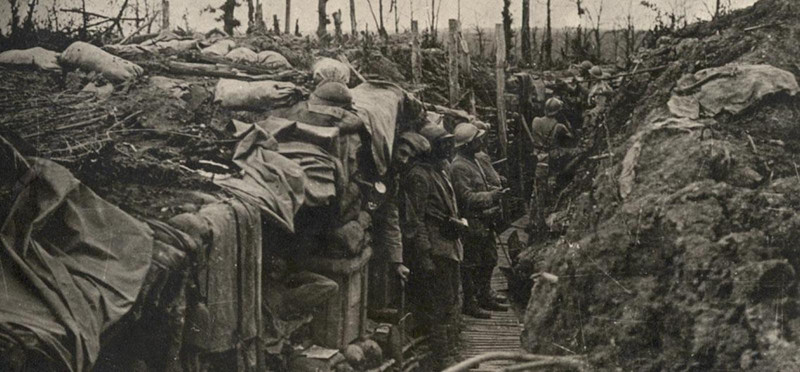
World War I trench warfare
Scenes like this help explain why the war became so deadly and difficult to break. By 1918, the German, Austro-Hungarian, Russian, and Ottoman Empires had collapsed or been transformed.
The Peace Settlement and the Interwar Crisis
After WWI, leaders tried to rebuild Europe, but they wanted different things. That tension made the peace unstable from the start.
- Woodrow Wilson’s Fourteen Points pushed self-determination, open diplomacy, and the League of Nations.
- France wanted security from Germany.
- Britain wanted balance of power and to protect imperial interests.
- Italy wanted territory it had been promised.
Versailles and its problems
- The Treaty of Versailles placed war guilt on Germany, imposed reparations, limited its military, and took territory.
- New states included Poland, Czechoslovakia, and Yugoslavia.
- Self-determination was inconsistent. Ethnic groups were mixed together, so new borders still left minorities and disputes.
- The League of Nations was weak because the U.S. never joined and it had no real enforcement power.
- Middle Eastern mandates kept British and French imperial control alive under a new name.
Weimar Germany inherited defeat, resentment, inflation, and instability. Europe also stayed economically shaky because of war debts, reparations, and reliance on U.S. loans. After 1929, the Great Depression discredited many parliamentary governments and boosted extremist movements.
Democracy, Communism, Fascism, and the Road to World War II
The interwar years became a fight among three political models.
| System | Core idea | Example |
|---|---|---|
| Liberal democracy | elections, civil liberties, constitutional rule | Britain, France |
| Communism | one-party rule, planned economy, collectivization | Soviet Union under Stalin |
| Fascism | ultranationalist, authoritarian, anti-liberal, anti-communist, militarist | Mussolini’s Italy |
Nazism was fascism with biological racism and antisemitism at its core. Hitler became chancellor in 1933 and destroyed Weimar democracy.
Fascism gained support because many people feared communism, wanted national strength, distrusted weak democracies, and suffered through economic crisis.
The interwar order then broke down:
- Japanese expansion
- Italian invasion of Ethiopia
- German rearmament
- remilitarization of the Rhineland
- Anschluss with Austria
- Sudetenland crisis
Appeasement reached its peak at the Munich Agreement in 1938. Britain and France hoped concessions would prevent war. Hitler’s takeover of the rest of Czechoslovakia and the Nazi-Soviet Pact showed expansion would continue. Germany’s invasion of Poland in 1939 began WWII.
What Total War Did to Europe and What It Led To
WWII intensified everything WWI had started. Blitzkrieg, strategic bombing, forced labor, occupation, and genocide pushed total war to a new level.
- The Holocaust was the systematic murder of about six million Jews. Other victim groups included Roma, disabled people, Poles, Soviet POWs, homosexuals, and political opponents.
- Science and technology brought real gains like medicine, electricity, and transport, but also poison gas, rockets, and the atomic bombs dropped on Hiroshima and Nagasaki.
- These wars shattered faith in easy progress and helped create the disillusionment of the lost generation and modernist culture.
- Total war expanded state power and changed daily life through women’s labor, broader suffrage, weaker aristocratic hierarchy, and mass suffering.
- The century’s contrast matters. Europe saw genocide and devastation, but also rising long-term productivity and living standards.
By 1945, Europe was exhausted. The United States and Soviet Union emerged as superpowers, leading to the Cold War and later efforts at European cooperation.
