Topic 5.1 Notes – Contextualizing 18th-Century States
How Europe’s Political Order Worked After 1648
The Peace of Westphalia in 1648 ended the Thirty Years’ War and confirmed that Europe would be made up of many sovereign states, not one universal Christian empire. Sovereignty means the highest political authority inside a territory.
The map below helps you see the key result in political terms. Central Europe, especially the Holy Roman Empire, remained divided into many separate territories instead of becoming one unified state.
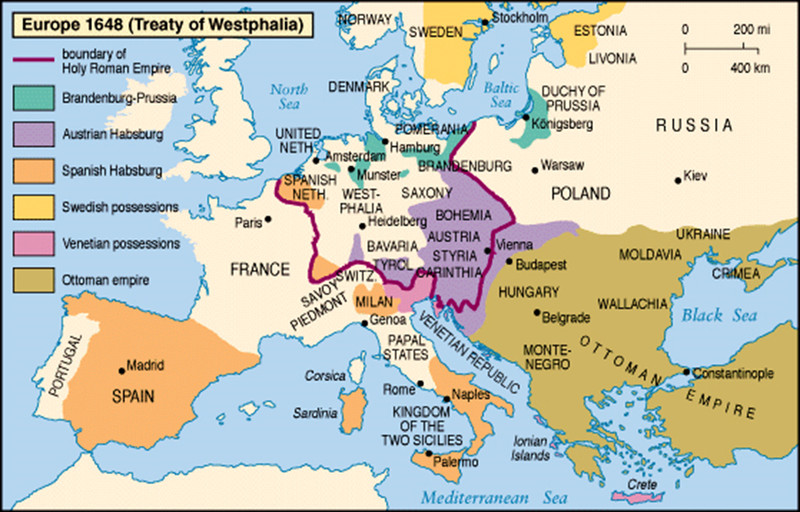
Europe after the Peace of Westphalia, 1648
A few things defined this system:
- No single ruler over Europe. That matters most in the Holy Roman Empire, which stayed highly fragmented into many semi-independent states.
- Balance of power became the goal of diplomacy. States tried to stop any one power from dominating the continent.
- Raison d’état means rulers acted for the interests of the state, even over religion. That is a big shift from the Reformation era.
- Europe still ran on dynastic states. Royal families, inherited privilege, and rival monarchies shaped politics.
- The Old Regime joined monarchy with nobles, clergy, legal privilege, and corporate rights held by towns, guilds, and provinces.
- Most people were still subjects, not equal citizens. That continuity is huge.
Models of Sovereignty and State Power
Europe did not agree on where authority should live. That disagreement sits behind a lot of the conflict in this period.
Absolutist and enlightened absolutist rule
Louis XIV is the classic absolutist ruler. His government showed what absolutism looked like in practice:
- Versailles helped him control nobles by making royal favor depend on court life.
- Centralized administration let royal officials carry out policy more directly.
- A standing army gave the crown permanent military power.
- Divine right claimed the king’s authority came from God.
Still, absolutism did not mean unlimited real power. Kings needed nobles, tax collectors, and local institutions to make the state work.
Enlightened absolutists kept monarchy but borrowed Enlightenment ideas:
| Ruler | State | Reforms |
|---|---|---|
| Frederick II | Prussia | legal and administrative reform, religious toleration |
| Catherine II | Russia | some legal reform, interest in education |
| Joseph II | Austria | toleration, education, centralization, reform from above |
They wanted a stronger, more efficient state. They did not support rule by the people.
Constitutional monarchy in Britain
Britain followed a different path after the Glorious Revolution of 1688-1689 and the English Bill of Rights in 1689. The monarch ruled under law and shared power with Parliament.
- Britain was not a democracy. Voting stayed limited.
- Parliament’s control of taxation made the state more credible to lenders.
- The Bank of England (1694) helped Britain borrow money and fund wars better than many rivals.
Popular sovereignty
This idea said government rests on the consent of the governed, not divine right.
- Locke argued for natural rights.
- Montesquieu argued for separation of powers.
- Rousseau argued that sovereignty rests in the general will.
The American Revolution gave these ideas a working example before 1789. The French Revolution brought the challenge directly into Europe by attacking monarchy, privilege, and subject status.
War, Commerce, and the Fiscal Crisis of States
States grew stronger by fighting wars, but wars also pushed them into crisis. A fiscal-military state could tax, borrow, manage debt, and support big armies and navies.
Mercantilism tied state power to trade, colonies, and protected markets. That helped make overseas competition a cause of war.
The key rivalry was Britain vs. France:
- They fought in North America, the Caribbean, India, West Africa, and at sea.
- The Seven Years’ War (1756-1763) was the clearest global conflict.
- The Treaty of Paris (1763) gave Britain major gains, including Canada and a stronger position in India.
War created a chain reaction. War → debt → taxation pressure → conflict over privilege and representation.
France had a weak tax system because nobles often had exemptions. That made reform hard. French support for the American Revolution deepened debt, and by 1789 the monarchy’s financial crisis exposed the weaknesses of the Old Regime.
Enlightenment Ideas and the Challenge to the Old Regime
The Enlightenment applied reason to politics, law, religion, and society. Thinkers criticized arbitrary power and inherited privilege with ideas like:
- natural rights
- social contract
- religious toleration
- legal reform
- attacks on monopoly and old restrictions
These ideas spread through salons, pamphlets, newspapers, academies, coffeehouses, and Masonic lodges.
The crucial point is that Enlightenment ideas gave people a language of criticism. They did not automatically create revolution. Many philosophes wanted reform, not democracy, and many applied “universal” rights unevenly. Ideas became explosive when they connected to taxation, privilege, and representation.
Revolution, Napoleon, and the Rise of Nationalism
The French Revolution turned a French crisis into a European one. Sovereignty shifted from king to nation, and subjects became citizens.
One early symbol of that shift was the storming of the Bastille in 1789.
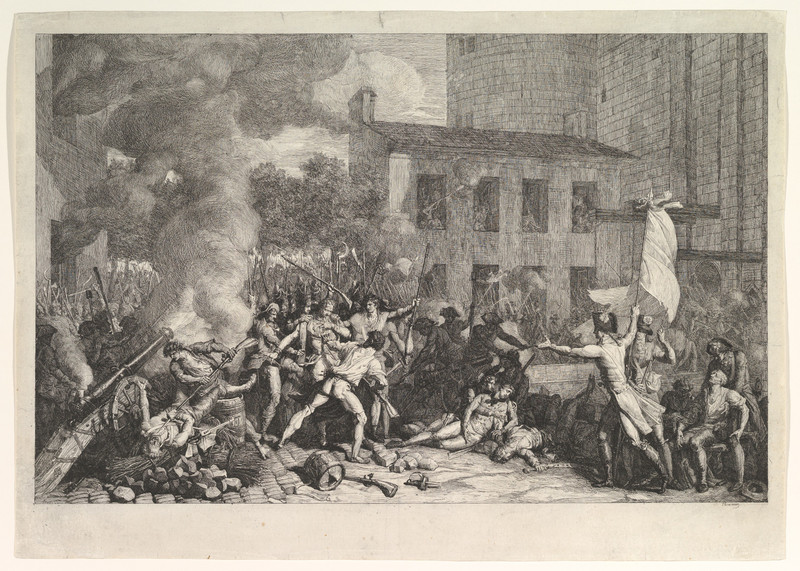
Storming of the Bastille, 1789
Key changes:
- abolition of feudal privilege
- Declaration of the Rights of Man and of the Citizen
- war from 1792 onward, which radicalized the revolution
- levée en masse in 1793, mass conscription tied to citizenship and national survival
Napoleon Bonaparte rose from these wars, seized power in 1799, and became emperor in 1804. He spread major reforms such as legal equality for men, the end of many feudal privileges, the Napoleonic Code, centralized administration, and careers open to talent. He was also authoritarian, using censorship and secret police.
French conquest sparked nationalist resistance:
- Spain used guerrilla warfare.
- German thinkers promoted cultural and political nationalism.
- Russia resisted the 1812 invasion.
Emotion mattered here too. Patriotism, fear, sacrifice, symbols, religious revival, early Romanticism, and Methodism under John Wesley all helped create mass politics. The Congress of Vienna in 1814-1815 restored dynasties and the balance of power, but nationalism and popular sovereignty did not disappear.
