Topic 4.2 Notes – The Scientific Revolution
What Changed in the Scientific Revolution
This topic is less about a pile of discoveries and more about a new way of proving things. Europeans had long relied on Aristotle, Ptolemy, and Galen, but their ideas stopped being untouchable.
- People in this period usually called their work natural philosophy, not modern science.
- Authority shifted toward observation, experiment, mathematics, and reasoning.
- Ancient texts still mattered, but now they could be corrected.
- This was not a clean break from religion. Many thinkers were Christian and still accepted astrology, alchemy, or spiritual forces.
A few background changes made this possible:
- Printing press spread ideas and criticism faster.
- Renaissance humanism recovered old texts and encouraged comparing versions instead of blindly trusting them.
- Exploration exposed Europeans to new plants, animals, and maps that challenged old knowledge.
- Better tools like the telescope and microscope let people see what earlier writers could not.
How Astronomy Replaced the Old Cosmos
Before the new astronomy, Europeans pictured a geocentric universe. Earth sat still at the center. The heavens were thought to be perfect, unchanging, and moving in circles. Ptolemy used epicycles to explain strange planetary motion.
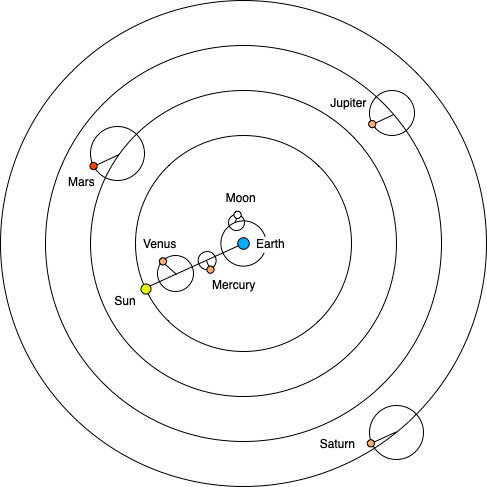
Ptolemaic geocentric model
Copernicus
In On the Revolutions of the Heavenly Spheres (1543), Copernicus proposed heliocentrism. Earth rotates daily and revolves around the Sun.
- This explained retrograde motion more simply. Planets only seem to move backward because Earth passes them.
- He still kept circular orbits and epicycles, so he did not fully break with older ideas.
Tycho Brahe
Brahe mattered because he produced the best observations before the telescope.
- His 1572 new star and 1577 comet showed the heavens changed.
- He proposed a geoheliocentric model, a compromise with Earth still central.
- His precise data later let Kepler fix Copernicus’s model.
Johannes Kepler
Using Brahe’s data, Kepler created the three laws of planetary motion in New Astronomy (1609) and The Harmony of the World (1619).
- Planets move in ellipses, not circles.
- They sweep out equal areas in equal times.
- Planets farther from the Sun take longer to orbit.
Kepler is a classic continuity example because he also practiced astrology.
Galileo Galilei
Galileo gave heliocentrism visible evidence in The Starry Messenger (1610).
- Mountains on the Moon and sunspots challenged perfect heavens.
- Moons of Jupiter proved not everything orbited Earth.
- Phases of Venus supported a Sun-centered arrangement.
- His inclined-plane experiments challenged Aristotle’s ideas about motion.
Church conflict matters here because it shows the stakes of changing knowledge:
- 1616 warning not to defend heliocentrism as truth
- 1632 Dialogue Concerning the Two Chief World Systems
- 1633 trial and house arrest
Isaac Newton
In the Principia (1687), Newton pulled the whole story together.
- Three laws of motion
- Universal gravitation with
- Same laws govern heaven and Earth
The famous apple story is more legend than proof, but it captures the big idea that gravity works on ordinary objects and on planets too.
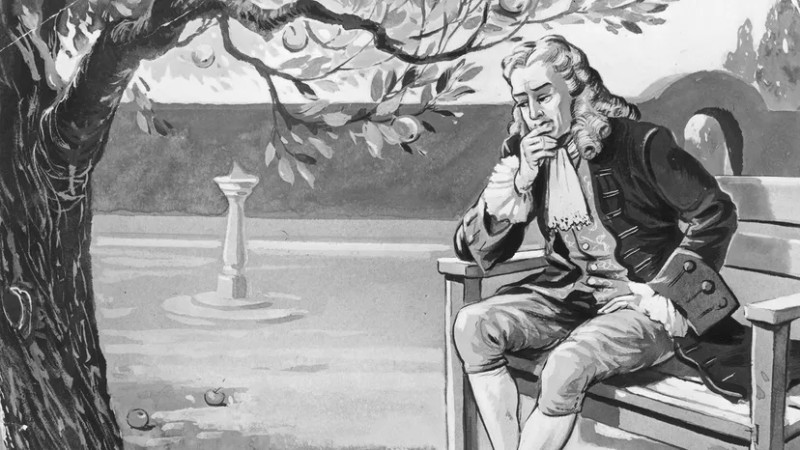
Newton and the apple legend
This created a mechanical universe ruled by universal laws. Newton also studied alchemy, which is another key continuity.
How Medicine and Anatomy Challenged Galen
In medicine, the old model came from Galen. He taught humoral theory with four humors, and disease meant imbalance. Treatments included bloodletting and purging.
Andreas Vesalius
In On the Fabric of the Human Body (1543), Vesalius used human dissection to correct Galen’s animal-based mistakes.
- The method shift matters most. Look at the body itself, not just the book.
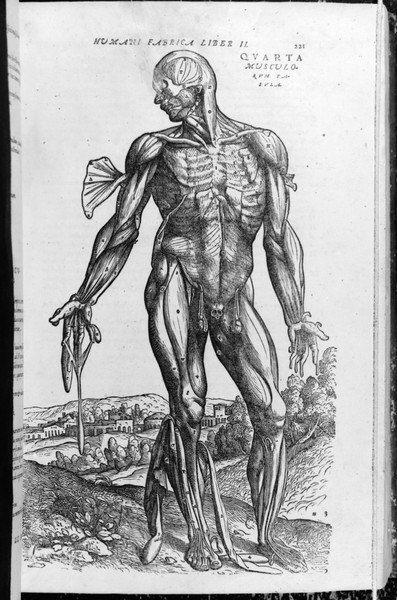
Vesalius, On the Fabric of the Human Body
Paracelsus
Paracelsus rejected much traditional university medicine.
- Diseases could have specific causes
- Favored chemical and mineral remedies
- Still mixed medicine with alchemy, astrology, and religion
William Harvey
In On the Motion of the Heart and Blood (1628), Harvey argued that the heart is a pump and blood circulates.
- He observed valves in veins.
- He used ligatures to show blood moved in one direction.
- He estimated blood flow and showed the body could not constantly create that much new blood.
Marcello Malpighi later saw capillaries with a microscope in 1661, filling the missing link.
Bacon, Descartes, and the New Way of Knowing
Francis Bacon
In Novum Organum (1620), Bacon pushed empiricism and inductive reasoning.
- Start with repeated observations
- Build toward general conclusions
- Do not trust authority without evidence
René Descartes
In Discourse on Method (1637), Descartes emphasized rationalism and deductive reasoning.
- Begin with doubt
- Use logic and mathematics
- “I think, therefore I am”
- Cartesian dualism separated mind from matter
Together, Bacon and Descartes helped shape the scientific method, though there was no single fixed version. On the exam, evidence usually supports, modifies, or refutes a claim rather than merely repeating authority.
Change, Continuity, and Why It Matters
The biggest change was epistemological. People increasingly asked, What evidence proves this?
- Changes included heliocentrism, laws of motion, universal gravitation, improved anatomy, and circulation of blood.
- Continuities included religion, providence, astrology, alchemy, and gradual acceptance of new ideas.
- Named continuity examples you should know are Kepler and astrology and Newton and alchemy.
This matters because success in finding laws of nature encouraged later thinkers to look for laws of society, politics, and economics, which leads straight into the Enlightenment.
Key Takeaways
Scientific Revolution
Mid-16th- to late-17th-century transformation that elevated observation, experimentation, mathematics, and tested claims over inherited authority in explaining nature
Natural Philosophy
The period’s term for the investigation of nature, encompassing fields later separated into sciences such as astronomy, physics, anatomy, and chemistry
Aristotelian-Ptolemaic Cosmos (Geocentric Model)
Traditional model with a stationary Earth at the center, concentric heavenly spheres, and celestial bodies moving in supposedly perfect circles
Heliocentric Model (Copernican System)
Sun-centered model in which Earth rotates on its axis and, like the other planets, travels around the Sun
Nicolaus Copernicus
Polish cleric who proposed the heliocentric system in 1543, making Earth a moving planet while retaining circular orbits and epicycles
Tycho Brahe
Danish astronomer whose precise observations and evidence of celestial change aided Kepler, though Brahe favored a geoheliocentric compromise
Johannes Kepler
Astronomer who used Brahe’s data to formulate mathematical laws of planetary motion and replace circular orbits with ellipses
Kepler’s Laws of Planetary Motion
Planets follow elliptical orbits, sweep equal areas in equal times, and have orbital periods mathematically related to their distances from the Sun
Galileo Galilei
Used telescopic evidence, experiments, and mathematics to challenge Aristotelian-Ptolemaic ideas; forced to recant heliocentrism in 1633
Isaac Newton
Author of the 1687 Principia who synthesized earlier work through three laws of motion and universal gravitation, uniting earthly and celestial physics
Law of Universal Gravitation
Newton’s principle that every body attracts every other body, so the same force explains falling objects, lunar orbits, and planetary motion
Mechanical Universe
Conception of nature as an orderly, integrated machine governed by universal laws discoverable through observation, reason, and mathematics
Galen
Ancient medical authority whose humoral theory, account of blood, and animal-derived anatomical errors were challenged by observation and experiment
Humoral Theory
Galenic belief that health depended on balancing blood, phlegm, yellow bile, and black bile and that imbalance caused disease
Andreas Vesalius
Anatomist whose direct human dissections exposed errors in Galen; his 1543 anatomical work made observed anatomy more authoritative than ancient texts
Paracelsus
Physician who rejected much humoral medicine, proposed particular causes of disease, and promoted chemical and mineral remedies while retaining alchemical and astrological ideas
William Harvey
Physician whose 1628 work used observation, ligatures, and quantitative reasoning to show that the heart pumps blood continuously through an integrated circulatory system
Francis Bacon
Advocate of systematic observation, controlled investigation, and inductive reasoning who criticized unsupported reliance on ancient authority
Empiricism
The position that knowledge is rooted in sensory experience, observation, and evidence
Inductive Reasoning
Drawing a broader generalization from numerous particular observations and experiments
René Descartes
Rationalist who used methodological doubt, deduction, and mathematics to seek certainty and describe the physical universe mechanically
Rationalism
Confidence in reason and logical analysis as sources of reliable knowledge
Deductive Reasoning
Deriving particular conclusions through logical steps from general principles or premises accepted as true
Cartesian Dualism
Descartes’s distinction between fundamentally different thinking mind and extended matter, allowing the material world to be studied mechanically
Scientific Method
Gradually developed systematic use of observation, hypotheses, experimentation, measurement, mathematical analysis, testing, and revision
Alchemy
Study and attempted transformation of matter, including transmuting metals and creating medicines, practiced alongside the new science
Astrology
Belief that mathematically calculated celestial configurations influence earthly events and human lives
Methodological Doubt
Descartes’s procedure of withholding acceptance from beliefs that could not be established with certainty
Notes
Scientific Revolution
Mid-16th- to late-17th-century transformation that elevated observation, experimentation, mathematics, and tested claims over inherited authority in explaining nature
Natural Philosophy
The period’s term for the investigation of nature, encompassing fields later separated into sciences such as astronomy, physics, anatomy, and chemistry
Aristotelian-Ptolemaic Cosmos (Geocentric Model)
Traditional model with a stationary Earth at the center, concentric heavenly spheres, and celestial bodies moving in supposedly perfect circles
Heliocentric Model (Copernican System)
Sun-centered model in which Earth rotates on its axis and, like the other planets, travels around the Sun
Nicolaus Copernicus
Polish cleric who proposed the heliocentric system in 1543, making Earth a moving planet while retaining circular orbits and epicycles
Tycho Brahe
Danish astronomer whose precise observations and evidence of celestial change aided Kepler, though Brahe favored a geoheliocentric compromise
Johannes Kepler
Astronomer who used Brahe’s data to formulate mathematical laws of planetary motion and replace circular orbits with ellipses
Kepler’s Laws of Planetary Motion
Planets follow elliptical orbits, sweep equal areas in equal times, and have orbital periods mathematically related to their distances from the Sun
Galileo Galilei
Used telescopic evidence, experiments, and mathematics to challenge Aristotelian-Ptolemaic ideas; forced to recant heliocentrism in 1633
Isaac Newton
Author of the 1687 Principia who synthesized earlier work through three laws of motion and universal gravitation, uniting earthly and celestial physics
Law of Universal Gravitation
Newton’s principle that every body attracts every other body, so the same force explains falling objects, lunar orbits, and planetary motion
Mechanical Universe
Conception of nature as an orderly, integrated machine governed by universal laws discoverable through observation, reason, and mathematics
Galen
Ancient medical authority whose humoral theory, account of blood, and animal-derived anatomical errors were challenged by observation and experiment
Humoral Theory
Galenic belief that health depended on balancing blood, phlegm, yellow bile, and black bile and that imbalance caused disease
Andreas Vesalius
Anatomist whose direct human dissections exposed errors in Galen; his 1543 anatomical work made observed anatomy more authoritative than ancient texts
Paracelsus
Physician who rejected much humoral medicine, proposed particular causes of disease, and promoted chemical and mineral remedies while retaining alchemical and astrological ideas
William Harvey
Physician whose 1628 work used observation, ligatures, and quantitative reasoning to show that the heart pumps blood continuously through an integrated circulatory system
Francis Bacon
Advocate of systematic observation, controlled investigation, and inductive reasoning who criticized unsupported reliance on ancient authority
Empiricism
The position that knowledge is rooted in sensory experience, observation, and evidence
Inductive Reasoning
Drawing a broader generalization from numerous particular observations and experiments
René Descartes
Rationalist who used methodological doubt, deduction, and mathematics to seek certainty and describe the physical universe mechanically
Rationalism
Confidence in reason and logical analysis as sources of reliable knowledge
Deductive Reasoning
Deriving particular conclusions through logical steps from general principles or premises accepted as true
Cartesian Dualism
Descartes’s distinction between fundamentally different thinking mind and extended matter, allowing the material world to be studied mechanically
Scientific Method
Gradually developed systematic use of observation, hypotheses, experimentation, measurement, mathematical analysis, testing, and revision
Alchemy
Study and attempted transformation of matter, including transmuting metals and creating medicines, practiced alongside the new science
Astrology
Belief that mathematically calculated celestial configurations influence earthly events and human lives
Methodological Doubt
Descartes’s procedure of withholding acceptance from beliefs that could not be established with certainty
