Topic 1.9 Notes – The Slave Trade
How the Atlantic Slave Trade Worked
Atlantic slavery grew out of older kinds of slavery, but it became something more extreme. Slavery had existed in Africa, Europe, and the Mediterranean long before Columbus. What changed after 1450 was the scale, the Atlantic ocean crossing, and the way colonial law made slavery racialized, hereditary chattel slavery. That meant enslaved people were treated as property, and children inherited status through the mother.
The system expanded with European colonization of the Americas, especially from 1450 to 1648. The biggest volume came later, so for this topic you’re looking at the early growth of the system, not its eighteenth-century peak.
One useful way to picture that early growth is to follow sugar. This map traces how sugar cultivation moved westward into the Atlantic islands, including Madeira and São Tomé, which became key stepping stones in the plantation system.
- The core chain matters a lot on tests
plantation labor demand + Indigenous demographic collapse = increased importation of enslaved Africans - Portugal led early. Portuguese traders built coastal forts, bought captives through African trade networks, and connected Africa to Atlantic plantations.
- Elmina Castle on the Gold Coast became a major Portuguese trading post.
- São Tomé helped create the sugar plantation model using enslaved African labor.
- Portuguese Brazil turned that model into a huge plantation zone.
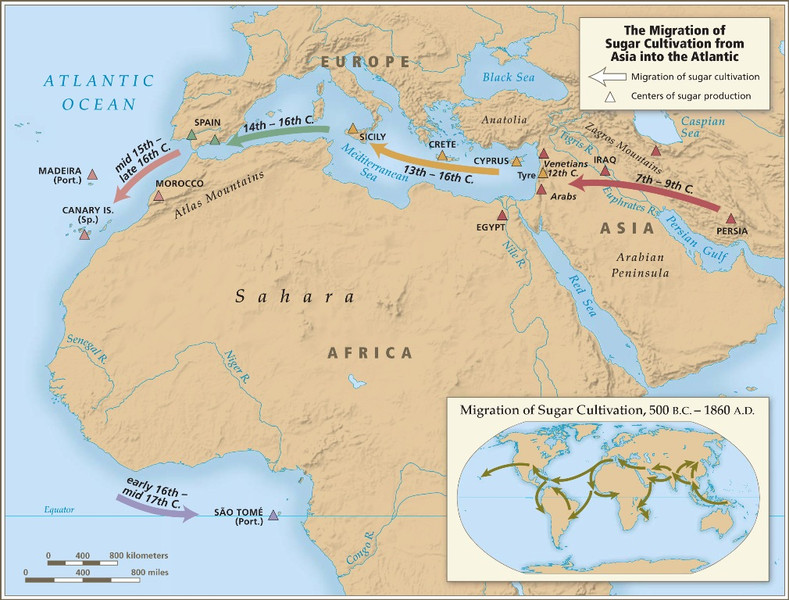
Spread of sugar cultivation into the Atlantic
Why Colonizers Expanded Enslaved African Labor
The plantation economy explains the labor demand. A plantation was large-scale farming for export and profit, not local subsistence.
Major cash crops
- Sugar was the biggest early driver. It needed labor at every stage: planting cane, cutting it, crushing it, boiling juice, and refining sugar. Brazil and the Caribbean became the main centers.
- Tobacco mattered in English colonies like Virginia in the early 1600s. It increased demand for bound labor, though the Chesapeake’s full shift to enslaved African labor came more after 1648.
Planters kept demanding labor because plantation crops sold well in Europe, work was brutal, mortality was high, and some plantation populations did not grow naturally fast enough to replace losses.
Indigenous population collapse made that labor crisis even worse.
- Diseases like smallpox and measles devastated Native peoples.
- Warfare, displacement, hunger, and forced labor deepened the catastrophe.
- Encomienda shows Indigenous labor did not disappear immediately under Spanish rule.
- That’s a common trap. Africans did not instantly replace Indigenous labor. Different coercive labor systems overlapped.
How Captives Were Obtained and Transported
Europeans usually stayed on the African coast in this period. They did not control most of the interior. They relied on trade with African rulers, merchants, and intermediaries.
Captives came from:
- warfare
- raids and kidnapping
- judicial punishment
- debt
- tribute
Some African states traded captives for firearms, textiles, metal goods, and alcohol. That does not mean the partnership was equal. European demand expanded the scale of violence, and “African” was not one unified identity. Sellers and captives often came from different peoples or states.
European roles
- Portugal dominated early trade.
- Spain used the asiento, a contract giving suppliers the right to deliver enslaved Africans to Spanish America.
- The Dutch, English, and French entered more strongly in the seventeenth century.
The Middle Passage
The Middle Passage was the forced voyage from Africa to the Americas.
- Captives were packed into crowded holds, chained, underfed, and exposed to disease, beatings, and sexual violence.
- About 12 to 15 percent died during the crossing.
- Resistance never stopped. People refused food, revolted, attacked crews, communicated across language barriers, and sometimes chose suicide.
- Most captives went to Brazil and the Caribbean, not mainland North America.
The famous Brookes diagram became one of the clearest visual symbols of these conditions. Focus on the deck plans and cross-sections, which show how slave traders treated human beings as cargo.
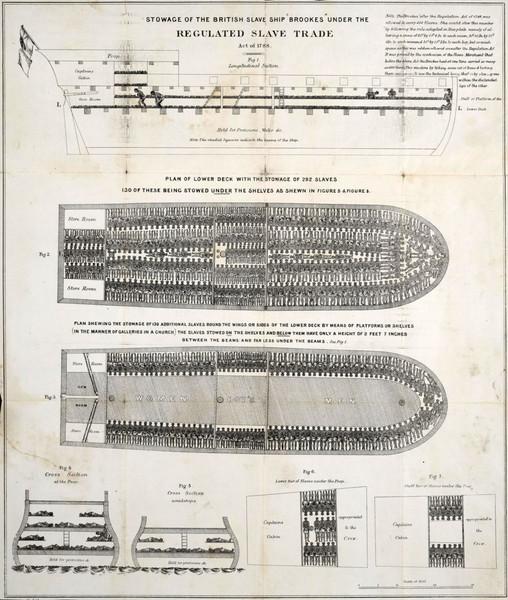
Slave ship Brookes diagram
How the Trade Fit into the Atlantic Economy
The slave trade made sense inside a larger Atlantic commercial system often called triangular trade.
| Leg | Main movement |
|---|---|
| Europe to Africa | manufactured goods, firearms, textiles, alcohol |
| Africa to Americas | enslaved captives via the Middle Passage |
| Americas to Europe | sugar, tobacco, dyestuffs, later coffee and cotton |
That triangle is a simplified model. Not every voyage literally made a triangle, but the pattern shows how the regions were tied together.
Important ports included Lisbon, Seville, Amsterdam, London, and Bristol. This trade helped shift wealth toward Atlantic states and fed the Commercial Revolution, though slavery alone did not “create capitalism.”
Planter Society and Major Effects
A planter society was a colonial order built around big plantations and coerced labor.
- Top: wealthy planters
- Then: officials, merchants, clergy, professionals
- Then: small farmers, artisans, overseers, sailors
- Then: free people of African or mixed ancestry
- Bottom: enslaved laborers, often the majority in sugar colonies
Race hardened over time. African ancestry became more closely tied to permanent enslavement, and European ancestry to freedom and privilege. Racism grew with the system and helped justify it. It was not the single original cause.
Enslaved people still resisted through slowdowns, sabotage, escape, rebellion, and maroon communities. They also preserved and adapted African cultural practices, creating new diasporic cultures in the Americas.
Regional effects:
- Africa saw more warfare and raiding in some regions, demographic loss, and stronger coastal trading states.
- Americas depended heavily on enslaved labor for wealth and agriculture.
- Europe gained customs revenue, growing port cities, and access to profitable tropical goods.
Key Takeaways
Atlantic Slave Trade / Transatlantic Slave Trade
Forced transportation and enslavement of Africans in the Americas, expanded as plantation labor demand grew and Indigenous populations were devastated
Plantation Economy
Commercial system centered on large estates producing export cash crops with a controlled labor force, especially enslaved Africans
Indigenous Demographic Catastrophe
Catastrophic Indigenous population decline from disease, warfare, displacement, and forced labor, encouraging colonizers to import enslaved Africans
Chattel Slavery
A system treating enslaved people as legally transferable property, with permanent status increasingly made racial and hereditary
Atlantic Economy
Commercial network linking European shipping and finance, African captives, and American plantation production and commodities
Middle Passage
Forced Atlantic voyage carrying enslaved Africans from Africa to the Americas under crowded, violent, and deadly conditions
Asiento
Spanish royal contract granting an individual or company the right to supply enslaved Africans to Spain’s American colonies
Triangular Trade
Simplified Atlantic circuit exchanging European goods in Africa, carrying captives to the Americas, and shipping colonial commodities to Europe
Planter Society
Colonial social order dominated by plantation owners whose wealth and political power rested on land, export crops, and enslaved labor
Notes
Atlantic Slave Trade / Transatlantic Slave Trade
Forced transportation and enslavement of Africans in the Americas, expanded as plantation labor demand grew and Indigenous populations were devastated
Plantation Economy
Commercial system centered on large estates producing export cash crops with a controlled labor force, especially enslaved Africans
Indigenous Demographic Catastrophe
Catastrophic Indigenous population decline from disease, warfare, displacement, and forced labor, encouraging colonizers to import enslaved Africans
Chattel Slavery
A system treating enslaved people as legally transferable property, with permanent status increasingly made racial and hereditary
Atlantic Economy
Commercial network linking European shipping and finance, African captives, and American plantation production and commodities
Middle Passage
Forced Atlantic voyage carrying enslaved Africans from Africa to the Americas under crowded, violent, and deadly conditions
Asiento
Spanish royal contract granting an individual or company the right to supply enslaved Africans to Spain’s American colonies
Triangular Trade
Simplified Atlantic circuit exchanging European goods in Africa, carrying captives to the Americas, and shipping colonial commodities to Europe
Planter Society
Colonial social order dominated by plantation owners whose wealth and political power rested on land, export crops, and enslaved labor
