Topic 6.3 Notes – Second Wave Industrialization and Its Effects
What the Second Industrial Revolution Was
This phase built on the first Industrial Revolution’s factories, coal, steam, and railroads. The change came in the leading sectors. Steel, chemicals, electricity, petroleum, and heavy engineering drove growth.
- Continuity stayed strong. Europe still relied on the factory system, capitalist investment, urbanization, and machine production.
- Change came in scale and complexity. Firms grew larger, machinery became more specialized, goods became standardized, and science, banks, and governments got pulled much more directly into industry.
- By 1914, mechanization and factories dominated industrial Europe, though southern and eastern Europe remained less industrialized.
Manchester and Essen show the shift clearly.
- Manchester, England = the classic earlier industrial city, built around textiles, steam power, and factory labor.
- Krupp family at Essen, Germany = second-wave heavy industry, especially steel and armaments, with huge concentrated plants and close ties to the state.
The Essen works make that second-wave scale easy to picture.
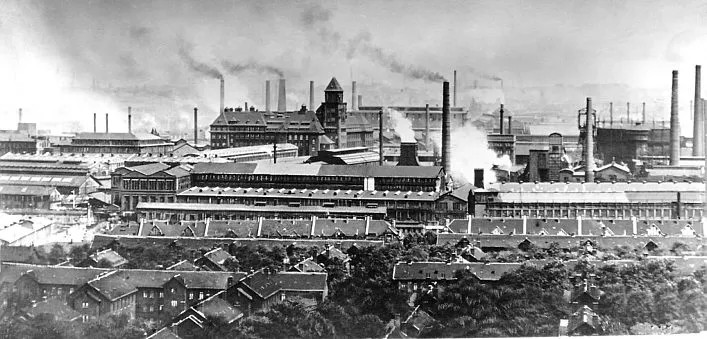
Krupp works at Essen
The New Industries and Technologies
Second-wave industry matters because each new sector boosted several others at once.
Steel and heavy industry
The Bessemer process made steel cheaper and faster to produce. That mattered because steel was used for railroads, bridges, ships, machinery, construction, and weapons. One innovation had a multiplier effect across the whole economy.
Chemicals and applied science
The chemical industry produced synthetic dyes, fertilizers, explosives, soaps, and medicines. This was one of the best examples of science driving industry.
- Firms hired trained chemists and built laboratories.
- Technical education became economically valuable.
- Germany led here.
- The Haber-Bosch process made industrial ammonia possible, which meant more fertilizer and more explosives.
Electricity and internal combustion
Electricity gave factories flexible power, lit streets and homes, and created utility companies. The internal combustion engine made the automobile possible and later supported the airplane.
Mass production and the mature factory
Mass production meant specialized machinery, interchangeable parts, standardized goods, and a sharper division of labor. It lowered unit costs, but it also required huge markets and managerial hierarchies because one owner could no longer oversee everything.
How Transportation and Communication Integrated Economies
These technologies tied local markets into national and global ones. Europe’s dense rail lines and steamship routes help show how industrial economies became more connected by the late nineteenth century.
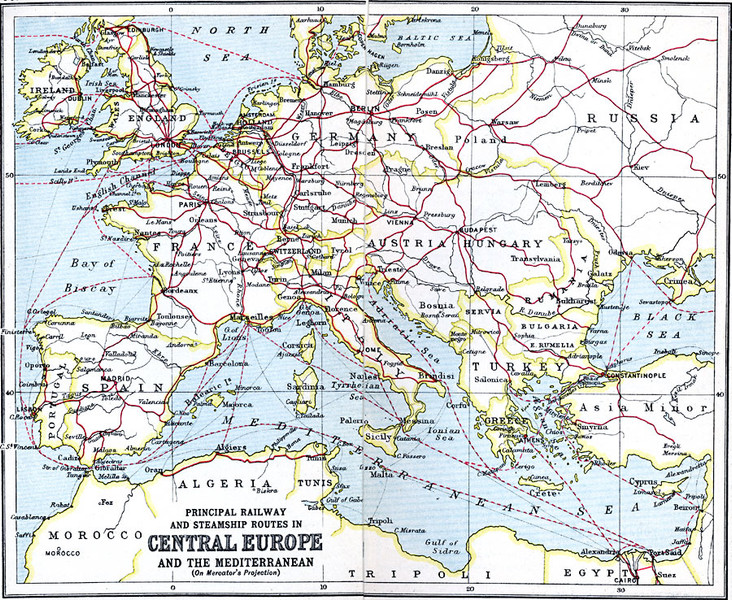
European railways and steamship routes before World War I
- Railroads moved raw materials, workers, food, and finished goods. They integrated national economies, encouraged regional specialization, and increased urbanization.
- Steamships lowered overseas shipping costs and expanded global trade.
- Refrigerated rail cars and ice boxes improved food preservation and distribution.
- Streetcars or trolley cars expanded cities.
- Bicycles increased personal mobility and became a leisure product.
- Telegraph, telephones, and radio sped up communication. On tests, remember that pre-1914 radio mattered mainly for wireless signaling, not mass broadcasting.
- The internal combustion engine and airplane added new transport possibilities, even though airplanes were still limited before 1914.
New industries grew out of these systems, including electricity and utilities, the automobile, leisure travel, and professional and leisure sport.
Consumer Society and Changes in Daily Life
Industrialization increased both supply and demand. People had more access to ready-made clothing, processed foods, and labor-saving devices like sewing machines and ice boxes.
Mass marketing pushed consumption further:
- Advertising linked products to status and convenience.
- Department stores turned shopping into leisure. Le Bon Marché is the classic example.
- Catalogs let people order standardized goods from far away.
- Brand names and packaging encouraged repeat buying.
Tourism, excursion travel, seaside resorts, and spectator sports all grew. Quality of life improved for many through better food supply and distribution, and industrialization plus commercialized agriculture helped population growth, longer life expectancy, and lower infant mortality. Those gains were uneven. Pollution, overcrowding, and class inequality remained.
Economic Volatility, State Action, and German Industrial Power
Industrial capitalism did not grow smoothly. The 1873 crisis and the Long Depression showed how overproduction, falling prices, and recession could destabilize the system.
Firms tried to control markets through:
- Monopolies
- Cartels
- Horizontal combination = controlling firms in the same stage of production
- Vertical integration = controlling several stages from raw materials to sales
- Joint-stock companies, limited liability, and professional managers
Banks became crucial, especially German universal banks, which financed large industry.
Governments moved away from pure laissez-faire. They used tariffs, infrastructure spending, contracts, and support for corporations.
Prussia and Germany are the key political example:
- Zollverein created a larger internal market.
- The state invested in a transportation network.
- Industry adopted improved manufacturing methods.
- Friedrich List’s National System argued for protective tariffs and state-supported development.
Prussian industrial strength helped it lead German unification. After 1871, Germany industrialized rapidly under government sponsorship and became Britain’s main industrial challenger.
Key Takeaways
Second Industrial Revolution / Second Wave of Industrialization
The c. 1870–1914 phase of larger-scale, science-based industrialization centered on steel, chemicals, electricity, petroleum, and integrated markets, with growth concentrated unevenly across Europe
Bessemer Process
A method patented in 1856 that forced air through molten iron, removing impurities and enabling faster, cheaper mass production of steel
Multiplier Effect
The process by which an innovation in one industry lowers costs or expands capabilities across many related industries
Krupp
The immense German steel and armaments firm at Essen that exemplified industrial concentration, heavy industry, and close ties between business and the state
Chemical Industry
A science-based second-wave industry producing synthetic dyes, fertilizers, explosives, medicines, soaps, and other commercial chemicals, led especially by Germany
Haber-Bosch Process
A process developed before World War I for industrially producing ammonia used in both chemical fertilizers and explosives
Electricity
A flexible form of power distributed through electrical networks to operate machinery, lighting, transportation, businesses, and homes
Utility Company
A company that generated and distributed electricity through costly power stations, cables, meters, and coordinated urban networks
Internal Combustion Engine
An engine that burns fuel within itself to produce mechanical motion, making petroleum-powered automobiles and airplanes possible
Mass Production
Manufacturing large quantities of standardized goods at low unit cost through specialized machinery, interchangeable parts, and predictable processes
Managerial Hierarchy
An organization of salaried managers, engineers, accountants, and office workers who coordinated the specialized operations of large industrial firms
National Railway Networks
Interconnected rail systems that lowered transport costs, linked resources and factories to consumers, and transformed regional markets into national economies
Integrated National Economy
An economy in which transportation and communication connect regional producers and consumers to national prices, demand, and markets
Steamships
Steam-powered vessels whose improved engines, steel hulls, and cargo capacity made overseas shipping faster, cheaper, and more reliable
Refrigerated Transportation
Refrigerated railway cars and ships that allowed meat, dairy products, and other perishables to travel long distances without spoiling
Global Economic Network
A worldwide system linking European producers, consumers, banks, and merchants to overseas food, raw materials, markets, and financial flows
Telegraph
A system transmitting coded electrical messages over wires, allowing governments, railways, newspapers, and merchants to communicate rapidly across long distances
Telephone
A technology commercialized from the 1870s that enabled direct voice communication, initially chiefly for businesses, governments, and wealthy households
Radio / Wireless Telegraphy
Technology developed in the 1890s for transmitting signals without wires, used before 1914 mainly for communication between ships and land
Electric Streetcars / Trolley Cars
Electrically powered urban transit that increased mobility and allowed residential districts to expand beyond convenient walking distance from city centers
Consumerism / Consumer Society
An economic and cultural pattern in which acquiring and using commercially produced goods became increasingly important to everyday life and personal identity
Mass Marketing
The large-scale creation and direction of consumer demand through advertising, catalogs, brand names, packaging, displays, and sales promotions
Department Store
A large urban retailer offering diverse goods at fixed prices while using displays, advertising, and sales to make shopping a leisure activity
Commercial Leisure Industries
Profit-making activities such as tourism, resorts, theaters, music halls, exhibitions, bicycling, and spectator sports created for mass urban audiences
Demographic Transition
The shift toward lower mortality and eventually lower birth rates, with population initially growing because death rates fell faster than births
Business Cycles
Alternating periods of economic expansion, overinvestment, falling prices, recession, unemployment, and renewed growth
Long Depression
The prolonged period of economic difficulty and price deflation beginning with the financial crisis of 1873, despite continued growth in some industries
Horizontal Combination
The merger or coordination of firms operating at the same stage of production to reduce competition and increase control over prices
Vertical Integration
The control of multiple stages of production and distribution, from raw materials through manufacturing, transportation, and sales, by one enterprise
Cartel
An agreement among nominally independent firms to coordinate prices, divide markets, or limit production, especially common in German heavy industry
Monopoly
Dominant control of a market by one firm or a closely coordinated group, allowing it to restrict competition and influence prices
Joint-Stock Investment
A method of raising large amounts of capital by dividing ownership of an enterprise into shares purchased by investors
Limited Liability
The principle restricting an investor's potential loss to the amount invested, encouraging investment in large and risky enterprises
Universal Banks
Banks, especially important in Germany, that combined ordinary banking with long-term industrial investment and close relationships with major firms
Protective Tariff
A tax on imported goods intended to make foreign products more expensive and protect domestic producers, employment, and developing industries
Zollverein
The Prussian-led customs union established in 1834 that removed many internal German tariffs, maintained a common external tariff, and strengthened Prussian leadership
Friedrich List and National System of Political Economy
List's 1841 argument that developing states should use protective tariffs, national infrastructure, and government support rather than simply adopt British free trade
Prussian and German Industrialization
Prussian industrial strength aided German unification, after which government support, banks, railways, technical education, and a unified market accelerated German heavy industry
Notes
Second Industrial Revolution / Second Wave of Industrialization
The c. 1870–1914 phase of larger-scale, science-based industrialization centered on steel, chemicals, electricity, petroleum, and integrated markets, with growth concentrated unevenly across Europe
Bessemer Process
A method patented in 1856 that forced air through molten iron, removing impurities and enabling faster, cheaper mass production of steel
Multiplier Effect
The process by which an innovation in one industry lowers costs or expands capabilities across many related industries
Krupp
The immense German steel and armaments firm at Essen that exemplified industrial concentration, heavy industry, and close ties between business and the state
Chemical Industry
A science-based second-wave industry producing synthetic dyes, fertilizers, explosives, medicines, soaps, and other commercial chemicals, led especially by Germany
Haber-Bosch Process
A process developed before World War I for industrially producing ammonia used in both chemical fertilizers and explosives
Electricity
A flexible form of power distributed through electrical networks to operate machinery, lighting, transportation, businesses, and homes
Utility Company
A company that generated and distributed electricity through costly power stations, cables, meters, and coordinated urban networks
Internal Combustion Engine
An engine that burns fuel within itself to produce mechanical motion, making petroleum-powered automobiles and airplanes possible
Mass Production
Manufacturing large quantities of standardized goods at low unit cost through specialized machinery, interchangeable parts, and predictable processes
Managerial Hierarchy
An organization of salaried managers, engineers, accountants, and office workers who coordinated the specialized operations of large industrial firms
National Railway Networks
Interconnected rail systems that lowered transport costs, linked resources and factories to consumers, and transformed regional markets into national economies
Integrated National Economy
An economy in which transportation and communication connect regional producers and consumers to national prices, demand, and markets
Steamships
Steam-powered vessels whose improved engines, steel hulls, and cargo capacity made overseas shipping faster, cheaper, and more reliable
Refrigerated Transportation
Refrigerated railway cars and ships that allowed meat, dairy products, and other perishables to travel long distances without spoiling
Global Economic Network
A worldwide system linking European producers, consumers, banks, and merchants to overseas food, raw materials, markets, and financial flows
Telegraph
A system transmitting coded electrical messages over wires, allowing governments, railways, newspapers, and merchants to communicate rapidly across long distances
Telephone
A technology commercialized from the 1870s that enabled direct voice communication, initially chiefly for businesses, governments, and wealthy households
Radio / Wireless Telegraphy
Technology developed in the 1890s for transmitting signals without wires, used before 1914 mainly for communication between ships and land
Electric Streetcars / Trolley Cars
Electrically powered urban transit that increased mobility and allowed residential districts to expand beyond convenient walking distance from city centers
Consumerism / Consumer Society
An economic and cultural pattern in which acquiring and using commercially produced goods became increasingly important to everyday life and personal identity
Mass Marketing
The large-scale creation and direction of consumer demand through advertising, catalogs, brand names, packaging, displays, and sales promotions
Department Store
A large urban retailer offering diverse goods at fixed prices while using displays, advertising, and sales to make shopping a leisure activity
Commercial Leisure Industries
Profit-making activities such as tourism, resorts, theaters, music halls, exhibitions, bicycling, and spectator sports created for mass urban audiences
Demographic Transition
The shift toward lower mortality and eventually lower birth rates, with population initially growing because death rates fell faster than births
Business Cycles
Alternating periods of economic expansion, overinvestment, falling prices, recession, unemployment, and renewed growth
Long Depression
The prolonged period of economic difficulty and price deflation beginning with the financial crisis of 1873, despite continued growth in some industries
Horizontal Combination
The merger or coordination of firms operating at the same stage of production to reduce competition and increase control over prices
Vertical Integration
The control of multiple stages of production and distribution, from raw materials through manufacturing, transportation, and sales, by one enterprise
Cartel
An agreement among nominally independent firms to coordinate prices, divide markets, or limit production, especially common in German heavy industry
Monopoly
Dominant control of a market by one firm or a closely coordinated group, allowing it to restrict competition and influence prices
Joint-Stock Investment
A method of raising large amounts of capital by dividing ownership of an enterprise into shares purchased by investors
Limited Liability
The principle restricting an investor's potential loss to the amount invested, encouraging investment in large and risky enterprises
Universal Banks
Banks, especially important in Germany, that combined ordinary banking with long-term industrial investment and close relationships with major firms
Protective Tariff
A tax on imported goods intended to make foreign products more expensive and protect domestic producers, employment, and developing industries
Zollverein
The Prussian-led customs union established in 1834 that removed many internal German tariffs, maintained a common external tariff, and strengthened Prussian leadership
Friedrich List and National System of Political Economy
List's 1841 argument that developing states should use protective tariffs, national infrastructure, and government support rather than simply adopt British free trade
Prussian and German Industrialization
Prussian industrial strength aided German unification, after which government support, banks, railways, technical education, and a unified market accelerated German heavy industry
