Topic 7.1 Notes – Contextualizing 19th-Century Perspectives and Political Developments
How Europe Changed Between 1815 and 1914
The whole period is a shift from restoration to modern power politics. After Napoleon fell, rulers tried to rebuild a conservative Europe. But the ideas released by the French Revolution did not disappear.
The Revolution and Napoleon had spread legal equality, citizenship, popular sovereignty, and national feeling. Even people who hated French rule often absorbed nationalism from resisting it.
Here’s the pattern to lock in:
- Congress of Vienna tried to restore stability after 1815.
- Liberalism and nationalism kept challenging that settlement.
- Repeated revolutions weakened the old order.
- Italy and Germany unified, changing the balance of power.
- Industrialization made states richer, stronger, and more organized.
- National rivalry pushed imperial expansion.
- After 1848, realism and materialism gained prestige.
The key AP point is that conservatism adapted. It did not vanish. Leaders like Bismarck used nationalism to strengthen states instead of resisting it.
Start with the post-Napoleonic map of Europe. It captures the conservative settlement that reformers and nationalists kept pushing against across the nineteenth century.
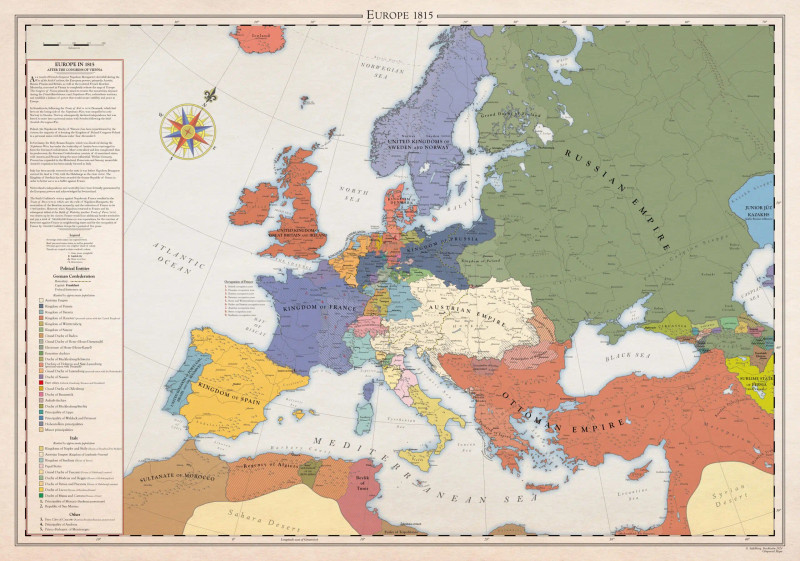
Europe after the Congress of Vienna, 1815
The Vienna Settlement and the Pressure Against It
After years of war, the major powers wanted order more than liberty.
Congress of Vienna
Austria, Russia, Prussia, and Britain dominated the congress, and France was later readmitted. The settlement rested on three ideas:
- Legitimacy meant restoring traditional rulers where possible.
- Balance of power meant preventing any one state, especially France, from dominating Europe.
- Compensation meant rewarding victors with territory.
Territorial results you should know together:
- Kingdom of the Netherlands was strengthened north of France.
- Prussia gained the Rhineland.
- Austria dominated northern Italy.
- The German Confederation grouped 39 states under Austrian influence.
Metternich became the symbol of this conservative system.
Concert of Europe
This was cooperation among Great Powers, not a permanent organization. Through congresses, conferences, and alliances, rulers tried to suppress revolution and preserve the Vienna order.
- Success: it prevented a general European war for decades.
- Weakness: the powers disagreed about intervention and competed in the Balkans, Mediterranean, and Ottoman Empire.
Liberalism and nationalism under the surface
By the later 1800s, many of the pressures that the Vienna settlement tried to contain had reshaped the map, especially in Italy and Germany.
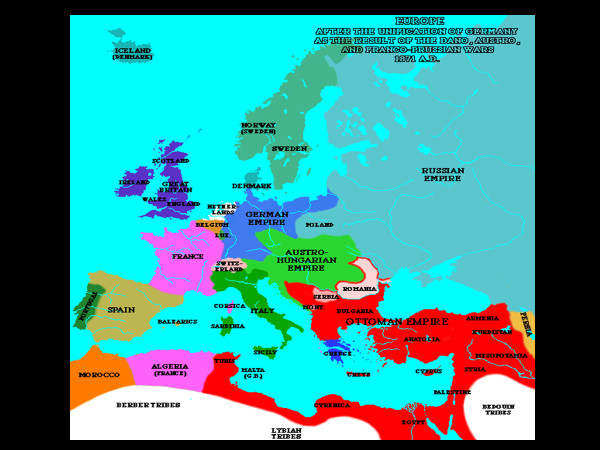
Europe after Italian and German unification, c. 1871
- Liberalism pushed for constitutions, representative government, civil equality, property rights, and limits on arbitrary rule.
- Nationalism said a people with shared identity should have unity and self-government.
Nationalism worked in two directions:
- Unifying in Italy and Germany
- Separatist in Austria-Hungary, the Ottoman Empire, and Russia
Romanticism fed nationalism by celebrating folklore, language, history, and national culture. Mazzini is the classic early nationalist idealist to recognize.
Revolutions, Reform, and the Breakdown of the Concert
Pressure kept bursting through in the 1820s, 1830, and especially 1848.
- Belgium won independence from the Netherlands in 1830.
- A Polish revolt against Russia failed.
- In 1848, revolutions spread across France, the German states, the Italian states, and the Austrian Empire.
Why 1848 matters so much:
- It showed liberal and nationalist demands were powerful.
- It also showed revolutionary coalitions were divided. Liberals, workers, peasants, socialists, and national groups wanted different things.
- Organized states and armies usually won.
After 1848, politics shifted toward Realpolitik. Practical power mattered more than idealism. Reform could also replace revolution:
- Britain expanded suffrage gradually.
- France kept cycling through monarchy, republic, empire, and republic.
The Crimean War (1853-1856), fought by Britain, France, and the Ottoman Empire against Russia, exposed the breakdown of Great Power cooperation and centered on the Eastern Question over Ottoman decline. It also opened room for Italian and German unification.
Unification, New Power Politics, and Imperial Expansion
Before unification, Italy was divided and Germany was a 39-state confederation.
Italy
- Cavour used diplomacy through Piedmont-Sardinia.
- Garibaldi led popular military campaigns.
- Kingdom of Italy was proclaimed in 1861.
- Venetia joined in 1866 and Rome in 1870.
Germany
- Bismarck used Realpolitik, industry, diplomacy, and limited wars.
- The Franco-Prussian War helped produce the German Empire in 1871.
These unifications mattered because Austria lost influence, and Germany became a major industrial and military power. Europe now needed a new diplomatic order, and Bismarck built alliances to isolate France. Austria reorganized as Austria-Hungary in 1867.
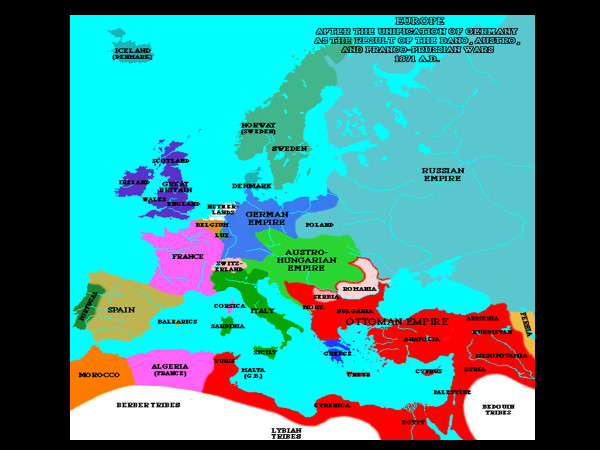
Europe after Italian and German unification, c. 1871
This map helps you picture the new balance of power after unification, with the German Empire and Italy reshaping central and southern Europe.
Industrialization made this new politics more powerful. The Second Industrial Revolution brought steel, chemicals, electricity, petroleum, and engineering. States used:
- railroads
- telegraph
- mass press
- public education
- conscription
After 1870, new imperialism expanded in Africa and Asia. Motives included raw materials, markets, strategic routes, prestige, rivalry, missionaries, and “civilizing” claims. It was enabled by steamships, railways, telegraph cables, breech-loading rifles, machine guns, and quinine. Social Darwinism gave it a racial justification.
The Turn Toward Realism and Materialism
After 1848, many Europeans trusted observable reality, science, and practical results more than romantic idealism.
- Realism in art and literature showed ordinary life, work, poverty, and cities.
- Realpolitik meant power over ideology.
- Materialism explained society through physical and economic causes.
- Positivism, linked to Auguste Comte, argued true knowledge comes from scientific observation.
Darwin is essential. His theory of evolution by natural selection increased the prestige of scientific explanation. People then twisted it into Social Darwinism to justify hierarchy, militarism, and imperialism.
Romantic feeling never disappeared. The century kept a tension between objectivity, science, realism and emotion, identity, intuition, individual expression.
