Topic 1.3 Notes – Northern Renaissance
What the Northern Renaissance Was
The Northern Renaissance spread into the Low Countries, German states, France, and England in the late 1400s and 1500s. You should picture it as adaptation, not a new movement starting from scratch.
- It kept major Italian Renaissance features:
- humanism = studying human beings, language, history, and moral choices
- individualism = interest in the dignity and uniqueness of each person
- classical learning = Greek and Roman texts still mattered
- observation and reason = people trusted close study of the world
- It changed those ideas by stressing:
- Christianity and biblical study
- moral reform
- criticism of corruption in the Church
- everyday people and daily life as worthy subjects
The northern focus is usually summed up as Christian humanism plus human-centered naturalism.
Italy and the North
| Italian Renaissance | Northern Renaissance |
|---|---|
| more classical models, ideal anatomy, perspective | more detailed realism, texture, individuality |
| more civic and secular themes | more religious and moral themes |
| princes and popes as major patrons | merchants, civic groups, urban elites also important |
| grand figures and classical settings | domestic life, labor, landscape, lay piety |
The exam loves the nuance here. Italy was not simply secular, and the North was not anti-classical. The difference is about emphasis.
How Renaissance Ideas Spread and Changed in Northern Europe
These ideas moved north because Europe was connected.
- Travel carried scholars and artists across the Alps.
- Trade linked Italian and northern cities.
- Universities spread humanist methods.
- Courts and patronage gave artists and scholars money and status.
- Printing widened circulation of texts and images, though the full printing story belongs more to Topic 1.4.
A map of fifteenth-century printing towns makes that network visible, especially in northern Italy, the German states, the Low Countries, France, and England.
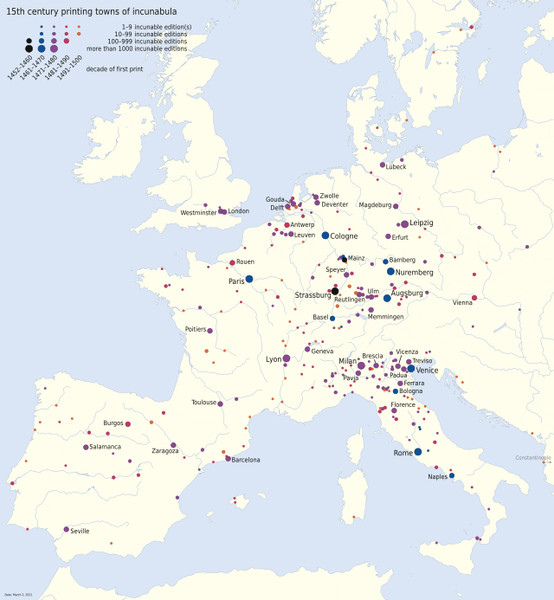
15th-century printing towns in Europe
Three patterns show up again and again:
- Maintained
Classical languages, rhetoric, history, and moral philosophy stayed central.
- Developed
Scholars built wider international networks, produced new scholarship, and made portraits and individuals look more realistic.
- Changed
Classical learning got redirected toward scripture, Christian ethics, Church reform, labor, domestic life, and landscape.
Christian Humanism and Erasmus
Christian humanism meant using Renaissance learning to improve Christianity. The goal was moral and religious reform through education and better biblical study.
Ad fontes
The phrase ad fontes means “to the sources.” Humanists wanted scripture and early Church writings in older, more accurate forms.
- They used philology, the close study of language.
- They compared manuscripts, checked word meanings, and found mistranslations.
- That mattered because it made even the Vulgate open to criticism.
Christian humanists attacked:
- clerical corruption
- superstition and empty ritual
- ignorance among clergy and laypeople
- overly technical scholastic theology
Their solution was usually reform within the Church, centered on sincere inner faith.
Erasmus and Thomas More
Erasmus of Rotterdam was the leading northern Christian humanist.
- His “philosophy of Christ” stressed inner piety over ceremony.
- The Praise of Folly (1509, pub. 1511) used satire to mock vanity, corrupt clergy, hypocrisy, and pointless scholarly disputes.
- His Greek New Testament (1516) printed the Greek text with a revised Latin translation and notes. That strengthened textual criticism and biblical scholarship.
- He criticized abuses but did not support schism. That distinction matters a lot when you connect him to Luther.
Thomas More brought Christian humanism into England.
- Utopia (1516) described an imaginary society to criticize greed, inequality, corruption, war, and injustice in Europe.
- It used a classical literary form to make a Christian moral argument.
Human-Centered Naturalism in Northern Art
Northern art shows how Renaissance realism got redirected toward ordinary life.
Naturalism meant close, realistic representation of people and settings. In the North, that often meant:
- individual faces
- clothing and tools
- domestic interiors
- labor and village life
- landscape
A lot of this art was still deeply religious. Sacred scenes often appear in familiar northern homes or towns, with ordinary objects carrying symbolic meaning.
That same attention to everyday settings also appears in secular scenes like Bruegel's peasant festivals and village gatherings.
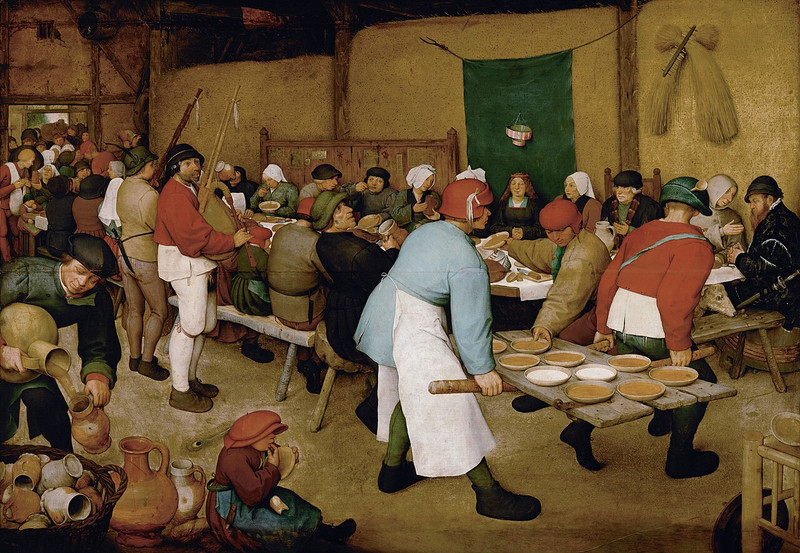
Pieter Bruegel the Elder, The Peasant Wedding
Important traits:
- oil painting
- minute detail and texture
- realistic light and surfaces
- strong portraiture and individuality
- Albrecht Dürer blended Italian perspective and proportion with northern detail and religious intensity.
- The Four Horsemen of the Apocalypse (1498) shows dramatic Christian subject matter and precision.
- Self-Portrait (1500) shows Renaissance individualism and the dignity of the artist.
- Pieter Bruegel the Elder treated ordinary life as serious art.
- The Peasant Wedding shows peasant society and communal life.
- Hunters in the Snow shows how landscape shapes human activity.
- Rembrandt came later, in the Dutch Golden Age, but continued the same northern naturalist tradition.
- The Anatomy Lesson of Dr. Nicolaes Tulp (1632) shows individualized faces, civic life, empirical observation, and professional identity.
Why the Northern Renaissance Mattered
The Northern Renaissance connected Renaissance learning to religious reform. It encouraged educated laypeople to compare Church practice with scripture and early Christianity. It also changed ideas about authority, because sacred texts themselves could be studied critically. In art, it widened serious subject matter beyond saints and elites to include workers, families, professionals, and everyday settings.
Key Takeaways
Northern Renaissance
Late-fifteenth- and sixteenth-century adaptation of Renaissance humanism and naturalism north of the Alps, marked by Christian reform, moral improvement, and attention to ordinary life
Christian Humanism
Application of Renaissance learning and textual scholarship to Christianity to promote educated faith, moral renewal, and reform of the Church
Ad Fontes (“To the Sources”)
Humanist principle of studying foundational texts in their earliest accessible forms rather than relying on inherited summaries or commentaries
Philology
Critical study of language and texts through manuscript comparison, grammar, and word meanings to identify errors and reconstruct reliable texts
Desiderius Erasmus
Dutch Christian humanist who used classical learning, satire, education, and biblical philology to seek moral reform within the Catholic Church
Philosophy of Christ
Erasmus’s ideal of an inward, educated Christianity modeled on Christ’s ethical teachings rather than empty ritual or scholastic dispute
The Praise of Folly
Erasmus’s 1511 satire exposing vanity, superstition, clerical worldliness, and hypocrisy in order to encourage Christian reform
Thomas More
English Christian humanist who used classical learning and moral criticism, most notably in Utopia, to question European social and political institutions
Utopia
Thomas More’s 1516 dialogue about an ambiguous imaginary society that criticizes European greed, inequality, punishment, warfare, and political corruption
Northern Renaissance Naturalism / Human-Centered Naturalism
Closely observed representation of individualized people, objects, landscape, labor, domestic settings, and everyday life, often joined with religious meaning
Albrecht Dürer
German artist who combined Italian perspective, proportion, and anatomy with northern detail, landscape, individuality, and Christian imagery, especially in prints
Pieter Bruegel the Elder
Northern artist who made peasant labor, festivals, village customs, seasonal landscapes, and biblical scenes in contemporary settings subjects of serious art
Rembrandt van Rijn
Seventeenth-century Dutch artist whose individualized faces, emotional realism, religious introspection, and observed daily life continued the northern naturalist tradition
Notes
Northern Renaissance
Late-fifteenth- and sixteenth-century adaptation of Renaissance humanism and naturalism north of the Alps, marked by Christian reform, moral improvement, and attention to ordinary life
Christian Humanism
Application of Renaissance learning and textual scholarship to Christianity to promote educated faith, moral renewal, and reform of the Church
Ad Fontes (“To the Sources”)
Humanist principle of studying foundational texts in their earliest accessible forms rather than relying on inherited summaries or commentaries
Philology
Critical study of language and texts through manuscript comparison, grammar, and word meanings to identify errors and reconstruct reliable texts
Desiderius Erasmus
Dutch Christian humanist who used classical learning, satire, education, and biblical philology to seek moral reform within the Catholic Church
Philosophy of Christ
Erasmus’s ideal of an inward, educated Christianity modeled on Christ’s ethical teachings rather than empty ritual or scholastic dispute
The Praise of Folly
Erasmus’s 1511 satire exposing vanity, superstition, clerical worldliness, and hypocrisy in order to encourage Christian reform
Thomas More
English Christian humanist who used classical learning and moral criticism, most notably in Utopia, to question European social and political institutions
Utopia
Thomas More’s 1516 dialogue about an ambiguous imaginary society that criticizes European greed, inequality, punishment, warfare, and political corruption
Northern Renaissance Naturalism / Human-Centered Naturalism
Closely observed representation of individualized people, objects, landscape, labor, domestic settings, and everyday life, often joined with religious meaning
Albrecht Dürer
German artist who combined Italian perspective, proportion, and anatomy with northern detail, landscape, individuality, and Christian imagery, especially in prints
Pieter Bruegel the Elder
Northern artist who made peasant labor, festivals, village customs, seasonal landscapes, and biblical scenes in contemporary settings subjects of serious art
Rembrandt van Rijn
Seventeenth-century Dutch artist whose individualized faces, emotional realism, religious introspection, and observed daily life continued the northern naturalist tradition
