Topic 2.4 Notes – Wars of Religion
How Religion and Politics Fed Each Other in Early Modern Europe
The Reformation divided western Christendom into Catholic, Lutheran, Calvinist/Reformed, and Anglican communities. For this topic, the key issue is what that did to politics. Once rulers and subjects disagreed about religion, they also disagreed about who should control churches, schools, law, and public life.
- Rulers often believed religious unity helped produce obedience and order. If everyone followed one church, the state could better control education, appoint clergy, collect taxes tied to church lands, and shape marriage and moral law.
- Nobles, cities, and minorities could use religion to push back. A noble who backed Protestantism might also be defending local privilege against a centralizing monarch.
- Religion was sincere and powerful. People cared deeply about salvation and worship. Still, these wars were never only about belief. Dynastic rivalry, trade, taxes, and territory kept shaping events.
The pattern you want to keep seeing is the same across the whole topic:
- Religious division made conflicts between monarchs and nobles worse.
- Rulers used religion to strengthen authority.
- Foreign powers exploited religious conflict to weaken enemies.
- Some states accepted limited toleration because forcing unity caused more chaos.
This map gives you the big picture before the case studies start. Notice the mixed religious zones in places like the Holy Roman Empire, France, and the eastern borderlands. Those are the areas where politics and religion most often collided.
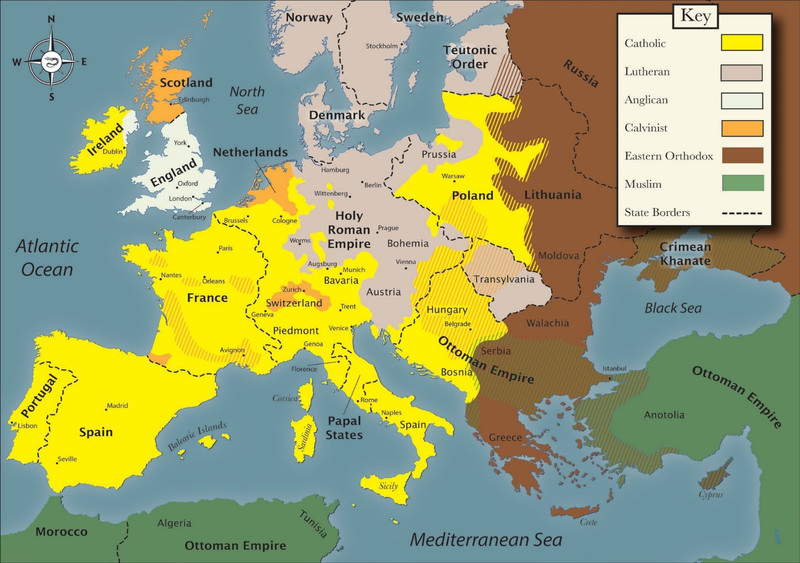
Religious divisions in early modern Europe
Charles V and the Failure to Restore Catholic Unity
Charles V was the main Habsburg ruler trying to keep Europe Catholic. He ruled Spain, the Netherlands, Habsburg lands, and served as Holy Roman Emperor. That sounds powerful, but his lands were scattered and hard to govern as one unit.
Lutheran princes in the Holy Roman Empire challenged him. Many gained power by taking control of local churches and seizing church lands. In 1531 they formed the Schmalkaldic League to resist imperial pressure.
- Schmalkaldic War 1546-1547 ended in Charles's military victory.
- He still failed to restore unity because Protestantism was too established in German territories.
- He also had to fight France, which drained money and attention.
- The Ottoman Empire pressured the Habsburgs from the east under Suleiman the Magnificent.
- Battle of Mohács 1526 crushed Hungary
- Siege of Vienna 1529 threatened central Europe
- France even cooperated with the Ottomans against the Habsburgs. That is a classic example of state interest beating religious solidarity.
Peace of Augsburg
The Peace of Augsburg in 1555 admitted that religious unity was gone.
- cuius regio, eius religio meant the ruler chose the religion of the territory
- only Catholicism and Lutheranism were recognized
- Calvinists were left out
This matters because it gave territorial rulers major control over religion and confirmed lasting division.
France, Spain, England, and the Netherlands
France gives the clearest example of religion deepening a struggle between monarchy and nobles. The Huguenots were French Calvinists, and some powerful nobles backed them. After Henry II died, the monarchy was weak, and Catherine de' Medici tried to keep rival factions from tearing France apart.
French Wars of Religion
- Massacre at Vassy 1562 helped start the civil wars.
- St. Bartholomew's Day Massacre 1572 followed an attempted assassination of Admiral Coligny. Thousands of Huguenots were killed.
- War of the Three Henrys
- Henry III
- Henry of Guise
- Henry of Navarre
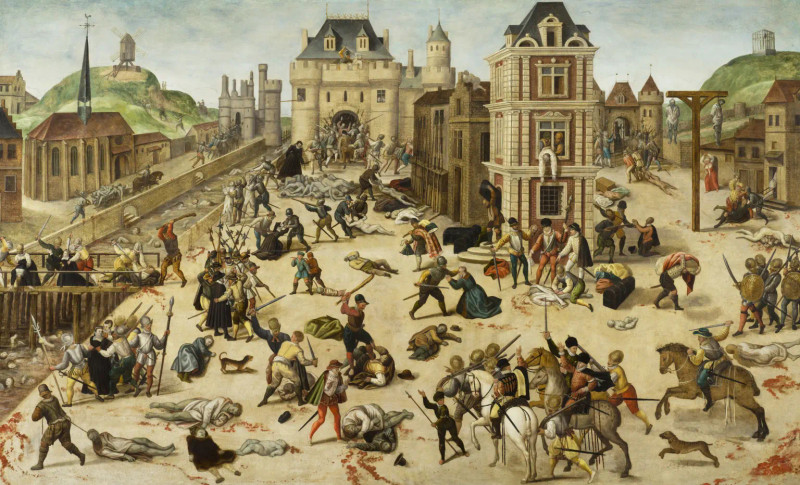
St. Bartholomew's Day Massacre
Henry of Navarre became Henry IV and converted to Catholicism in 1593. He is the best example of a politique, a ruler who put state peace ahead of strict confessional loyalty.
Edict of Nantes
The Edict of Nantes in 1598 kept Catholicism dominant but gave Huguenots limited rights and toleration. France chose pluralism because peace mattered more than total religious victory.
Spain, England, and the Dutch Revolt
Spain and England fought over religion, but also over trade, empire, and security.
- Philip II of Spain vs Elizabeth I of England
- English privateering and aid to Dutch rebels mattered as much as religion
- Spanish Armada failed in 1588 and became a symbol of Protestant resistance
In the Netherlands, Philip II tried to centralize rule, raise taxes, and crush Calvinism. Resistance grew after iconoclasm in 1566 and harsh repression by the duke of Alba.
- William of Orange and the Sea Beggars led resistance
- Union of Utrecht 1579 united northern provinces
- Act of Abjuration 1581 rejected Philip II
- north became the Dutch Republic
- south stayed Spanish and Catholic
The Dutch Republic privileged the Dutch Reformed Church but often tolerated Catholics, Jews, and dissenters in practice.
Poland-Lithuania showed the same pattern from a Catholic monarchy. After the Warsaw Confederation of 1573, nobles, Orthodox Christians, Protestants, and Jews could coexist more peacefully than in France or the Holy Roman Empire.
The Thirty Years’ War and the Peace of Westphalia
What began inside the Holy Roman Empire as a religious and constitutional struggle turned into a Europe-wide power contest.
Four phases
- Bohemian phase
Defenestration of Prague 1618 began the conflict. Ferdinand II defeated rebels at White Mountain in 1620.
- Danish phase
Christian IV intervened and was defeated by Tilly and Wallenstein. The Edict of Restitution in 1629 scared many rulers.
- Swedish phase
Gustavus Adolphus entered in 1630 and won at Breitenfeld in 1631. France subsidized Sweden, showing politics mattered more than shared religion.
- French phase
In 1635, Cardinal Richelieu brought Catholic France directly into war against the Catholic Habsburgs. That is raison d'état in action, state interest above confessional loyalty.
German lands were devastated by mercenary armies, looting, famine, and disease. This is one of the most destructive wars in early modern Europe.
Peace of Westphalia
The Peace of Westphalia in 1648:
- ended the Thirty Years' War
- recognized Dutch independence
- added Calvinism to legal recognition beside Catholicism and Lutheranism
- strengthened the rights of princes and local rulers over religion
- weakened hopes for a centralized Holy Roman Empire
- marked the effective end of universal Christendom
The map helps you see the political result. The Holy Roman Empire remained a patchwork of many territories, and the Dutch Republic appears outside imperial control.
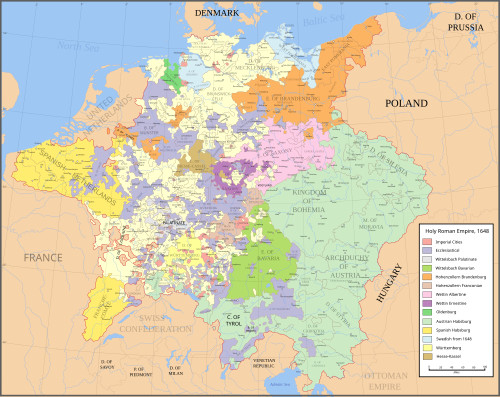
Holy Roman Empire in 1648
France restored monarchy through limited toleration. The Dutch won independence with pluralism. The Holy Roman Empire became more decentralized under territorial rulers.
Key Takeaways
Wars of Religion
Conflicts from the Reformation through 1648 in which confessional divisions combined with struggles over dynastic power, noble privilege, territory, taxation, and commerce
Universal Christendom
The medieval ideal of a single western Christian community under shared religious authority, made impracticable by the Reformation and effectively ended at Westphalia
Charles V
Habsburg ruler and Holy Roman emperor whose efforts to restore Catholic unity failed amid Protestant resistance, war with France, and Ottoman pressure
Schmalkaldic League
Alliance formed by Protestant princes in 1531 to defend themselves against Charles V's efforts to restore Catholicism in the Holy Roman Empire
Schmalkaldic War
Charles V's 1546–1547 war against the Schmalkaldic League; his victory failed to eliminate Protestantism or restore lasting Catholic unity
Suleiman the Magnificent
Ottoman sultan whose expansion into Hungary and toward Vienna forced the Habsburgs to divide resources between eastern defense and religious conflict
Battle of Mohács
The 1526 Ottoman defeat of Hungary that opened the way for Ottoman expansion toward Habsburg central Europe
Siege of Vienna
Suleiman's unsuccessful 1529 siege that demonstrated the Ottoman threat to the Habsburg lands and central Europe
Peace of Augsburg / Cuius Regio, Eius Religio
The 1555 settlement allowing each imperial ruler to choose Catholicism or Lutheranism for the territory, while excluding Calvinists and individual religious freedom
Huguenots
French Calvinists whose support among nobles and towns made them a major political and military faction during the French Wars of Religion
French Wars of Religion
The 1562–1598 civil wars in which conflict between Catholics and Huguenots combined with noble factionalism and the weakness of the monarchy
Catherine de’ Medici
French queen mother and regent who alternated between compromise and repression to preserve the vulnerable Valois monarchy against rival confessional factions
Massacre at Vassy
The 1562 killing of Protestant worshippers by followers of the duke of Guise that helped initiate the French Wars of Religion
St. Bartholomew’s Day Massacre
The 1572 killing of thousands of Huguenots in Paris and elsewhere, which intensified confessional hatred and damaged trust in the French monarchy
War of the Three Henrys
The 1585–1589 struggle among Henry III, Catholic League leader Henry of Guise, and Huguenot heir Henry of Navarre for control of France
Politique
A leader, exemplified by Henry IV, who placed the peace and interests of the state above uncompromising religious uniformity
Edict of Nantes
Henry IV's 1598 edict maintaining Catholic predominance while granting Huguenots limited worship, civil rights, freedom of conscience, and security towns
Philip II
Catholic king of Spain who defended Catholicism while fighting England and suppressing Dutch resistance to Spanish taxation, centralization, and religious policy
Spanish Armada
Philip II's failed 1588 invasion fleet against England, defeated through English tactics, coordination problems, and severe weather
Dutch Revolt
The Netherlands' rebellion against Philip II over Protestant persecution, taxation, centralization, provincial liberties, and commercial interests
Council of Troubles
The repressive tribunal established by the duke of Alba to punish opposition to Spanish authority in the Netherlands
Sea Beggars
Dutch rebels who attacked Spanish authority from coastal bases and helped sustain the revolt in the Netherlands
William of Orange
The principal political leader of Dutch resistance to Philip II and Spanish rule in the Netherlands
Union of Utrecht
The 1579 alliance of northern Dutch provinces that became the political foundation of the independent Dutch Republic
Act of Abjuration
The 1581 declaration by the northern Dutch provinces repudiating Philip II as their sovereign
Dutch Republic
Independent federation of the northern Netherlands with a privileged Reformed Church but limited practical toleration for other religious communities
Warsaw Confederation
The 1573 agreement protecting religious peace among Poland-Lithuania's politically privileged nobility
Thirty Years’ War
The 1618–1648 war that began as a religious and constitutional struggle in the Holy Roman Empire and became a European contest over Habsburg power
Bohemian Phase
The 1618–1625 phase in which Protestant Bohemian nobles rebelled against Habsburg religious and political centralization but were defeated
Defenestration of Prague
The 1618 incident in which Protestant Bohemian nobles threw imperial officials from a castle window, symbolically beginning the Thirty Years’ War
Ferdinand II
Catholic Habsburg emperor who defeated the Bohemian revolt, promoted Catholic restoration, and attempted to strengthen imperial authority
Battle of White Mountain
The 1620 Habsburg victory over the Bohemian rebels, followed by Catholic restoration and reduced Bohemian political autonomy
Danish Phase
The 1625–1629 phase in which Lutheran Christian IV intervened to defend Protestantism and expand Danish influence in northern Germany but was defeated
Edict of Restitution
Ferdinand II's 1629 order restoring Catholic church property acquired by Protestants since 1552, alarming Protestant and Catholic princes alike
Swedish Phase
The 1630–1635 phase in which Sweden defended German Protestants while seeking Baltic power, aided by subsidies from Catholic France
Gustavus Adolphus
Swedish king who intervened for Protestantism and Baltic influence, won at Breitenfeld, and died at Lützen in 1632
Peace of Prague
The 1635 settlement reconciling the emperor with many German princes but failing to end the wider war because France and Sweden continued fighting
French or Franco-Swedish Phase
The 1635–1648 phase in which Catholic France and Protestant Sweden fought the Habsburgs primarily to prevent Habsburg domination of Europe
Cardinal Richelieu
Catholic chief minister of France who supported Protestant powers and fought the Habsburgs to protect French security and power
Raison d’État
The principle that the security and power of the state could take precedence over religious allegiance
Peace of Westphalia
The 1648 settlements that ended the Thirty Years’ War, recognized Calvinism and Dutch and Swiss independence, strengthened imperial estates, and marked the effective end of universal Christendom
Sovereignty
Supreme political authority within a territory and independence from outside control, strengthened by Westphalia's confirmation of territorial rulers' rights
Henry of Navarre / Henry IV
Huguenot heir who became king of France, converted to Catholicism to secure the kingdom, and issued the Edict of Nantes
Notes
Wars of Religion
Conflicts from the Reformation through 1648 in which confessional divisions combined with struggles over dynastic power, noble privilege, territory, taxation, and commerce
Universal Christendom
The medieval ideal of a single western Christian community under shared religious authority, made impracticable by the Reformation and effectively ended at Westphalia
Charles V
Habsburg ruler and Holy Roman emperor whose efforts to restore Catholic unity failed amid Protestant resistance, war with France, and Ottoman pressure
Schmalkaldic League
Alliance formed by Protestant princes in 1531 to defend themselves against Charles V's efforts to restore Catholicism in the Holy Roman Empire
Schmalkaldic War
Charles V's 1546–1547 war against the Schmalkaldic League; his victory failed to eliminate Protestantism or restore lasting Catholic unity
Suleiman the Magnificent
Ottoman sultan whose expansion into Hungary and toward Vienna forced the Habsburgs to divide resources between eastern defense and religious conflict
Battle of Mohács
The 1526 Ottoman defeat of Hungary that opened the way for Ottoman expansion toward Habsburg central Europe
Siege of Vienna
Suleiman's unsuccessful 1529 siege that demonstrated the Ottoman threat to the Habsburg lands and central Europe
Peace of Augsburg / Cuius Regio, Eius Religio
The 1555 settlement allowing each imperial ruler to choose Catholicism or Lutheranism for the territory, while excluding Calvinists and individual religious freedom
Huguenots
French Calvinists whose support among nobles and towns made them a major political and military faction during the French Wars of Religion
French Wars of Religion
The 1562–1598 civil wars in which conflict between Catholics and Huguenots combined with noble factionalism and the weakness of the monarchy
Catherine de’ Medici
French queen mother and regent who alternated between compromise and repression to preserve the vulnerable Valois monarchy against rival confessional factions
Massacre at Vassy
The 1562 killing of Protestant worshippers by followers of the duke of Guise that helped initiate the French Wars of Religion
St. Bartholomew’s Day Massacre
The 1572 killing of thousands of Huguenots in Paris and elsewhere, which intensified confessional hatred and damaged trust in the French monarchy
War of the Three Henrys
The 1585–1589 struggle among Henry III, Catholic League leader Henry of Guise, and Huguenot heir Henry of Navarre for control of France
Politique
A leader, exemplified by Henry IV, who placed the peace and interests of the state above uncompromising religious uniformity
Edict of Nantes
Henry IV's 1598 edict maintaining Catholic predominance while granting Huguenots limited worship, civil rights, freedom of conscience, and security towns
Philip II
Catholic king of Spain who defended Catholicism while fighting England and suppressing Dutch resistance to Spanish taxation, centralization, and religious policy
Spanish Armada
Philip II's failed 1588 invasion fleet against England, defeated through English tactics, coordination problems, and severe weather
Dutch Revolt
The Netherlands' rebellion against Philip II over Protestant persecution, taxation, centralization, provincial liberties, and commercial interests
Council of Troubles
The repressive tribunal established by the duke of Alba to punish opposition to Spanish authority in the Netherlands
Sea Beggars
Dutch rebels who attacked Spanish authority from coastal bases and helped sustain the revolt in the Netherlands
William of Orange
The principal political leader of Dutch resistance to Philip II and Spanish rule in the Netherlands
Union of Utrecht
The 1579 alliance of northern Dutch provinces that became the political foundation of the independent Dutch Republic
Act of Abjuration
The 1581 declaration by the northern Dutch provinces repudiating Philip II as their sovereign
Dutch Republic
Independent federation of the northern Netherlands with a privileged Reformed Church but limited practical toleration for other religious communities
Warsaw Confederation
The 1573 agreement protecting religious peace among Poland-Lithuania's politically privileged nobility
Thirty Years’ War
The 1618–1648 war that began as a religious and constitutional struggle in the Holy Roman Empire and became a European contest over Habsburg power
Bohemian Phase
The 1618–1625 phase in which Protestant Bohemian nobles rebelled against Habsburg religious and political centralization but were defeated
Defenestration of Prague
The 1618 incident in which Protestant Bohemian nobles threw imperial officials from a castle window, symbolically beginning the Thirty Years’ War
Ferdinand II
Catholic Habsburg emperor who defeated the Bohemian revolt, promoted Catholic restoration, and attempted to strengthen imperial authority
Battle of White Mountain
The 1620 Habsburg victory over the Bohemian rebels, followed by Catholic restoration and reduced Bohemian political autonomy
Danish Phase
The 1625–1629 phase in which Lutheran Christian IV intervened to defend Protestantism and expand Danish influence in northern Germany but was defeated
Edict of Restitution
Ferdinand II's 1629 order restoring Catholic church property acquired by Protestants since 1552, alarming Protestant and Catholic princes alike
Swedish Phase
The 1630–1635 phase in which Sweden defended German Protestants while seeking Baltic power, aided by subsidies from Catholic France
Gustavus Adolphus
Swedish king who intervened for Protestantism and Baltic influence, won at Breitenfeld, and died at Lützen in 1632
Peace of Prague
The 1635 settlement reconciling the emperor with many German princes but failing to end the wider war because France and Sweden continued fighting
French or Franco-Swedish Phase
The 1635–1648 phase in which Catholic France and Protestant Sweden fought the Habsburgs primarily to prevent Habsburg domination of Europe
Cardinal Richelieu
Catholic chief minister of France who supported Protestant powers and fought the Habsburgs to protect French security and power
Raison d’État
The principle that the security and power of the state could take precedence over religious allegiance
Peace of Westphalia
The 1648 settlements that ended the Thirty Years’ War, recognized Calvinism and Dutch and Swiss independence, strengthened imperial estates, and marked the effective end of universal Christendom
Sovereignty
Supreme political authority within a territory and independence from outside control, strengthened by Westphalia's confirmation of territorial rulers' rights
Henry of Navarre / Henry IV
Huguenot heir who became king of France, converted to Catholicism to secure the kingdom, and issued the Edict of Nantes
