Topic 8.2 Notes – World War I
How World War I Became a Global Industrial War
The assassination in Sarajevo mattered, but AP loves this distinction: it was the trigger, not the whole cause. Europe was already tense and unstable.
- Nationalism pushed states and peoples in different directions:
- France wanted revenge for losing Alsace-Lorraine to Germany in 1871.
- Germany wanted prestige and a bigger global role.
- Russia backed Pan-Slavism, so it saw itself as protector of Slavic Serbia.
- Serbia wanted to unite South Slavs, which threatened Austria-Hungary, a multinational empire full of restless ethnic groups.
- Alliances made any local crisis bigger:
- Triple Alliance = Germany, Austria-Hungary, Italy
- Triple Entente = France, Russia, Britain
- On a map of Europe in 1914, you can see how these blocs turned a regional dispute into a wider crisis, especially once the Balkans were involved.
- These alliances raised the stakes, but war was still a choice. They did not force automatic fighting.
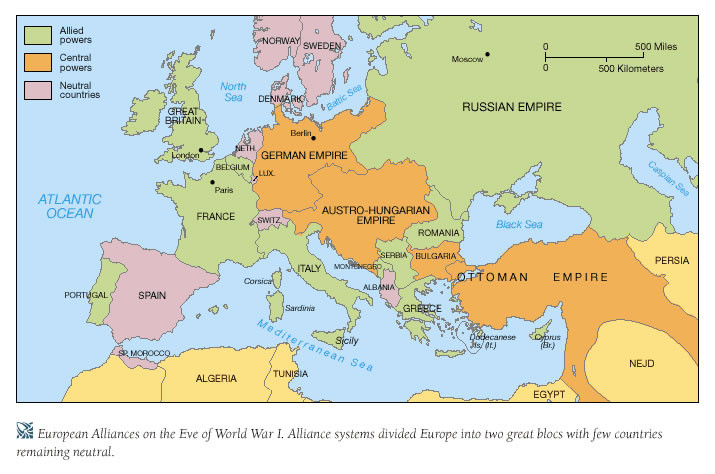
Europe’s alliance blocs in 1914
- Militarism and war plans made diplomacy harder:
- Europe had mass conscript armies, rail schedules for mobilization, and a naval arms race.
- Germany feared a two-front war, so it built the Schlieffen Plan to beat France fast, then turn east to Russia.
- Once mobilization started, leaders felt they had to move quickly or fall behind.
- Imperial rivalry added distrust:
- Germany’s Weltpolitik aimed at a larger world empire.
- The Moroccan Crises of 1905 and 1911 deepened tension with France and Britain.
- Ottoman decline and the Balkan Wars made southeastern Europe especially explosive.
The July Crisis and the Outbreak of War
A Balkan crisis became a continental war because leaders escalated it step by step.
- June 28, 1914: Archduke Franz Ferdinand was assassinated in Sarajevo by Gavrilo Princip, a Young Bosnia assassin. The plot had connections to members of the Black Hand, but Princip himself belonged to Young Bosnia.
- Germany gave Austria-Hungary a blank check of support.
- Austria-Hungary sent Serbia a harsh ultimatum.
- Serbia accepted most demands but rejected ones that violated its sovereignty.
- July 28: Austria-Hungary declared war on Serbia.
- Russia mobilized for Serbia.
- Germany declared war on Russia and France.
- Germany invaded Belgium.
- Britain entered over Belgian neutrality and the balance of power.
Belligerents
- Central Powers = Germany, Austria-Hungary, Ottoman Empire, Bulgaria
- Allied Powers = France, Russia, Britain, later Italy, the United States, and colonial troops
How Technology Turned War into Stalemate and Attrition
After the First Battle of the Marne in 1914, the quick war failed. The Western Front hardened into trenches from the North Sea to Switzerland. The trench scene below is the kind of front-line environment that made the war so deadly and so hard to move.
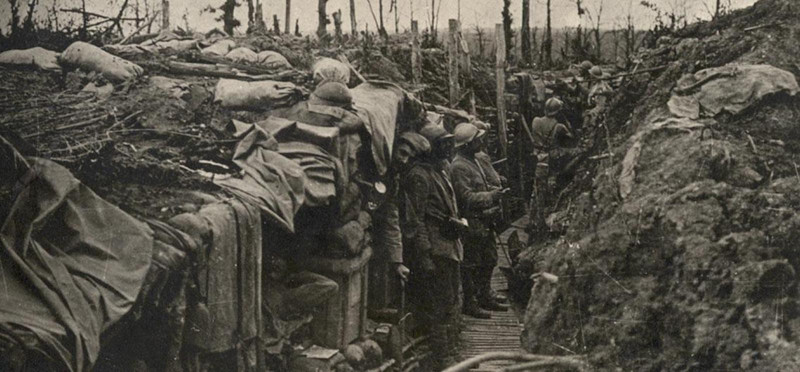
World War I trench warfare on the Western Front
The Eastern Front stayed more mobile, with Tannenberg as the key German victory over Russia.
- Machine guns and heavy artillery favored defenders and caused huge casualties.
- Barbed wire and trench systems made breakthroughs extremely hard.
- Poison gas at Second Ypres in 1915 terrified soldiers but did not win the war.
- Tanks appeared at the Somme in 1916. Early tanks were clumsy, but by 1918 they helped more.
- Airplanes were used for scouting, dogfights, and bombing.
- Submarines attacked shipping and civilians. The Lusitania is the example you need to know.
Attrition battles
- Verdun = bleed France white
- Somme = massive losses for tiny gains
- Gallipoli = failed Allied attack on the Ottoman Empire
Total War, Social Upheaval, and Revolution
Stalemate forced governments to mobilize everything. Total war meant armies, economies, and civilians were all part of the war effort.
- Governments used conscription, censorship, propaganda, rationing, war bonds, and economic control.
- Britain’s Defence of the Realm Act expanded state power.
- Germany’s Hindenburg Program pushed the economy harder for war production.
Home life changed fast:
- Women entered factories, transport, nursing, and clerical jobs.
- Shortages, inflation, and hunger grew worse.
- Suffrage advanced, especially in Britain and Germany.
Discontent followed the same pattern across Europe:
- French army mutinies after the failed Nivelle Offensive
- Easter Rising in Ireland in 1916
- Russian Revolution in 1917, then Brest-Litovsk in 1918
- German naval mutinies and revolution in 1918
How the War Reshaped the World
The war spread through empires and overseas fronts.
- Armenian Genocide in the Ottoman Empire
- Arab Revolt under Sharif Hussein with British backing
- Japan seized German possessions in China and the Pacific and issued the Twenty-One Demands
The United States entered in 1917 because Germany resumed unrestricted submarine warfare and sent the Zimmermann Telegram. The sinking of the Lusitania in 1915 had already angered Americans, but it did not bring the U.S. into the war at the time.
Germany’s 1918 spring offensive failed, the Allies counterattacked, and the armistice took effect on November 11, 1918.
The war shattered old empires:
- German, Russian, Austro-Hungarian, and Ottoman Empires collapsed
- New states included Poland, Czechoslovakia, and Yugoslavia
- The mandate system replaced some German and Ottoman rule
- Modern Turkey emerged from Ottoman collapse
- Europe was weakened, and the United States became a major world power
Key Takeaways
World War I
The 1914–1918 global conflict in which industrialized warfare and total mobilization caused immense losses, revolutions, and the collapse of four European empires
Nationalism as a Cause of World War I
National prestige, territorial ambitions, and separatist movements intensified rivalries among great powers and destabilized multinational empires, especially in the Balkans
Pan-Slavism
The movement promoting solidarity among Slavic peoples, which supported Serbian ambitions and encouraged Russia to defend Serbia
Alliance System
Europe's rival alliances enlarged local crises by encouraging states to support partners and mobilize against perceived threats
Triple Alliance
The alliance of Germany, Austria-Hungary, and Italy formed in 1882; Italy remained neutral in 1914 and joined the Allies in 1915
Triple Entente
The strategic alignment of Britain, France, and Russia that opposed the Triple Alliance before World War I.
Militarism
The elevation of military values, armed strength, and preparedness in politics and culture, encouraging arms races and rapid mobilization
Schlieffen Plan
Germany's plan to avoid a two-front war by rapidly defeating France through neutral Belgium before turning against Russia
Imperial Competition as a Cause of World War I
Colonial, naval, and global rivalries increased distrust, linked prestige to military power, and reinforced Europe's hostile blocs
Weltpolitik
Germany's policy of seeking a larger global and imperial role, challenging the established positions of Britain and France
Moroccan Crises
German confrontations with France over Morocco in 1905 and 1911 that strengthened Anglo-French cooperation and isolated Germany
Bosnian Annexation Crisis
Austria-Hungary's 1908 annexation of Bosnia-Herzegovina, which angered Serbia and made Russia determined not to retreat in another Balkan crisis
Balkan Wars
The 1912–1913 wars that weakened Ottoman authority, enlarged Serbia, and intensified hostility between Serbia and Austria-Hungary
Assassination of Archduke Franz Ferdinand
The June 28, 1914 killing in Sarajevo of Austria-Hungary's heir by Bosnian Serb nationalist Gavrilo Princip, triggering the July Crisis
July Crisis
The 1914 crisis in which Austria-Hungary's ultimatum and attack on Serbia, followed by Russian mobilization and German declarations of war, turned a Balkan dispute into World War I.
Blank Check
Germany's promise of unconditional support to Austria-Hungary against Serbia, even if Austro-Hungarian action caused war with Russia
Central Powers vs. Allied Powers
The Central Powers centered on Germany, Austria-Hungary, the Ottoman Empire, and Bulgaria; the Allies centered on France, Russia, and Britain and later included Italy and the United States
First Battle of the Marne
The September 1914 battle in which French and British forces stopped Germany near Paris, helping produce stalemate on the Western Front
Western Front vs. Eastern Front
The Western Front became a nearly fixed trench line, while the larger distances and lower troop density of the Eastern Front allowed more mobile warfare
Trench Warfare
Defensive warfare from interconnected trenches in which machine guns, artillery, and barbed wire made attacks across no man's land extremely costly
War of Attrition
A strategy of exhausting an enemy's manpower and material through prolonged losses rather than winning an immediate decisive victory
Battle of Verdun
Germany's 1916 attack on a symbolically important French position, which France held despite immense losses on both sides
Battle of the Somme
The 1916 British and French offensive that caused devastating casualties while achieving no decisive breakthrough
Gallipoli Campaign
The failed 1915 Allied attempt to force the Dardanelles, weaken the Ottoman Empire, and open a supply route to Russia
Machine Guns in World War I
Rapid-fire defensive weapons that allowed small forces to inflict severe losses on infantry advancing across open ground
Heavy Artillery in World War I
Long-range guns whose explosive, shrapnel, and gas shells caused most battlefield casualties and devastated trenches and terrain
Barbed Wire in World War I
An inexpensive defensive obstacle that slowed and concentrated attacking infantry under machine-gun and artillery fire
Poison Gas in World War I
Chemical weapons such as chlorine, phosgene, and mustard gas that caused choking, burns, blindness, and lasting injury but did not break the stalemate
Tanks in World War I
Armored vehicles designed to cross trenches and crush wire; unreliable at first, they aided coordinated Allied offensives by 1918
Military Aviation in World War I
Aircraft first used for reconnaissance and artillery direction and later developed for air combat and bombing
U-Boats
German submarines used to attack Allied shipping and threaten Britain's dependence on overseas supplies
Sinking of the Lusitania
The 1915 German sinking of a British passenger liner that killed nearly 1,200 people, including 128 Americans, and angered U.S. opinion
Unrestricted Submarine Warfare
Germany's policy of sinking ships without warning, resumed in 1917 in an attempt to defeat Britain before U.S. forces could intervene
British Blockade of the Central Powers
Britain's naval restriction of food and raw materials to the Central Powers, contributing to shortages, malnutrition, and declining civilian morale
Total War
War in which governments mobilize armies, economies, labor, public opinion, and imperial resources while weakening the distinction between battlefield and home front
French Army Mutinies of 1917
Refusals by French soldiers to continue suicidal offensives after the failed Nivelle Offensive, while generally remaining willing to defend France
Easter Rising
The 1916 Irish republican rebellion against British rule whose suppression and executions increased support for Irish independence
Russian Revolution of 1917
Revolutions driven partly by wartime defeat and shortages that overthrew the tsar and brought the Bolsheviks to power, removing Russia from the Allied coalition
Treaty of Brest-Litovsk
The March 1918 treaty in which Bolshevik Russia surrendered extensive territory to the Central Powers and left World War I.
German Revolution of 1918
The uprising begun amid military defeat and sailors' mutinies that forced Kaiser Wilhelm II to abdicate and made Germany a republic
Globalization of World War I
The extension of the war through imperial manpower, resources, and fighting across Africa, the Middle East, Asia, and the Pacific
Armenian Genocide
The Ottoman state's deportations, massacres, starvation, and forced marches that killed approximately 1 million to 1.5 million Armenians beginning in 1915
Arab Revolt
The British-supported 1916 rebellion led by Sharif Hussein and his sons against Ottoman rule, encouraged by promises of postwar Arab independence
Japan in World War I
Japan joined the Allies in 1914 and seized German possessions in the Pacific and the German-leased territory at Qingdao
Twenty-One Demands
Japan's 1915 demands for expanded political and economic privileges in China
Zimmermann Telegram
Germany's intercepted proposal for an alliance with Mexico if the United States entered the war, which inflamed American opinion
United States Entry into World War I
The April 6, 1917 U.S. declaration of war on Germany after unrestricted submarine warfare and the Zimmermann Telegram; American credit, industry, naval aid, and troops strengthened the Allies
German Spring Offensive
Germany's major 1918 Western Front offensive after Russia's withdrawal, which gained territory but failed after heavy losses and supply problems
Armistice of November 11, 1918
The agreement that ended fighting between Germany and the Allies but did not constitute the final peace settlement
Collapse of the Four Empires
World War I brought down the Russian, German, Austro-Hungarian, and Ottoman empires and produced new governments and states
United States Emergence as a World Power
Wartime credit, industrial production, military intervention, and diplomacy made the United States a major creditor and central participant in global affairs
Military Mobilization
The activation of reserves and railroad timetables to deploy armies, creating pressure to act quickly and leaving less time for diplomacy
Notes
World War I
The 1914–1918 global conflict in which industrialized warfare and total mobilization caused immense losses, revolutions, and the collapse of four European empires
Nationalism as a Cause of World War I
National prestige, territorial ambitions, and separatist movements intensified rivalries among great powers and destabilized multinational empires, especially in the Balkans
Pan-Slavism
The movement promoting solidarity among Slavic peoples, which supported Serbian ambitions and encouraged Russia to defend Serbia
Alliance System
Europe's rival alliances enlarged local crises by encouraging states to support partners and mobilize against perceived threats
Triple Alliance
The alliance of Germany, Austria-Hungary, and Italy formed in 1882; Italy remained neutral in 1914 and joined the Allies in 1915
Triple Entente
The strategic alignment of Britain, France, and Russia that opposed the Triple Alliance before World War I.
Militarism
The elevation of military values, armed strength, and preparedness in politics and culture, encouraging arms races and rapid mobilization
Schlieffen Plan
Germany's plan to avoid a two-front war by rapidly defeating France through neutral Belgium before turning against Russia
Imperial Competition as a Cause of World War I
Colonial, naval, and global rivalries increased distrust, linked prestige to military power, and reinforced Europe's hostile blocs
Weltpolitik
Germany's policy of seeking a larger global and imperial role, challenging the established positions of Britain and France
Moroccan Crises
German confrontations with France over Morocco in 1905 and 1911 that strengthened Anglo-French cooperation and isolated Germany
Bosnian Annexation Crisis
Austria-Hungary's 1908 annexation of Bosnia-Herzegovina, which angered Serbia and made Russia determined not to retreat in another Balkan crisis
Balkan Wars
The 1912–1913 wars that weakened Ottoman authority, enlarged Serbia, and intensified hostility between Serbia and Austria-Hungary
Assassination of Archduke Franz Ferdinand
The June 28, 1914 killing in Sarajevo of Austria-Hungary's heir by Bosnian Serb nationalist Gavrilo Princip, triggering the July Crisis
July Crisis
The 1914 crisis in which Austria-Hungary's ultimatum and attack on Serbia, followed by Russian mobilization and German declarations of war, turned a Balkan dispute into World War I.
Blank Check
Germany's promise of unconditional support to Austria-Hungary against Serbia, even if Austro-Hungarian action caused war with Russia
Central Powers vs. Allied Powers
The Central Powers centered on Germany, Austria-Hungary, the Ottoman Empire, and Bulgaria; the Allies centered on France, Russia, and Britain and later included Italy and the United States
First Battle of the Marne
The September 1914 battle in which French and British forces stopped Germany near Paris, helping produce stalemate on the Western Front
Western Front vs. Eastern Front
The Western Front became a nearly fixed trench line, while the larger distances and lower troop density of the Eastern Front allowed more mobile warfare
Trench Warfare
Defensive warfare from interconnected trenches in which machine guns, artillery, and barbed wire made attacks across no man's land extremely costly
War of Attrition
A strategy of exhausting an enemy's manpower and material through prolonged losses rather than winning an immediate decisive victory
Battle of Verdun
Germany's 1916 attack on a symbolically important French position, which France held despite immense losses on both sides
Battle of the Somme
The 1916 British and French offensive that caused devastating casualties while achieving no decisive breakthrough
Gallipoli Campaign
The failed 1915 Allied attempt to force the Dardanelles, weaken the Ottoman Empire, and open a supply route to Russia
Machine Guns in World War I
Rapid-fire defensive weapons that allowed small forces to inflict severe losses on infantry advancing across open ground
Heavy Artillery in World War I
Long-range guns whose explosive, shrapnel, and gas shells caused most battlefield casualties and devastated trenches and terrain
Barbed Wire in World War I
An inexpensive defensive obstacle that slowed and concentrated attacking infantry under machine-gun and artillery fire
Poison Gas in World War I
Chemical weapons such as chlorine, phosgene, and mustard gas that caused choking, burns, blindness, and lasting injury but did not break the stalemate
Tanks in World War I
Armored vehicles designed to cross trenches and crush wire; unreliable at first, they aided coordinated Allied offensives by 1918
Military Aviation in World War I
Aircraft first used for reconnaissance and artillery direction and later developed for air combat and bombing
U-Boats
German submarines used to attack Allied shipping and threaten Britain's dependence on overseas supplies
Sinking of the Lusitania
The 1915 German sinking of a British passenger liner that killed nearly 1,200 people, including 128 Americans, and angered U.S. opinion
Unrestricted Submarine Warfare
Germany's policy of sinking ships without warning, resumed in 1917 in an attempt to defeat Britain before U.S. forces could intervene
British Blockade of the Central Powers
Britain's naval restriction of food and raw materials to the Central Powers, contributing to shortages, malnutrition, and declining civilian morale
Total War
War in which governments mobilize armies, economies, labor, public opinion, and imperial resources while weakening the distinction between battlefield and home front
French Army Mutinies of 1917
Refusals by French soldiers to continue suicidal offensives after the failed Nivelle Offensive, while generally remaining willing to defend France
Easter Rising
The 1916 Irish republican rebellion against British rule whose suppression and executions increased support for Irish independence
Russian Revolution of 1917
Revolutions driven partly by wartime defeat and shortages that overthrew the tsar and brought the Bolsheviks to power, removing Russia from the Allied coalition
Treaty of Brest-Litovsk
The March 1918 treaty in which Bolshevik Russia surrendered extensive territory to the Central Powers and left World War I.
German Revolution of 1918
The uprising begun amid military defeat and sailors' mutinies that forced Kaiser Wilhelm II to abdicate and made Germany a republic
Globalization of World War I
The extension of the war through imperial manpower, resources, and fighting across Africa, the Middle East, Asia, and the Pacific
Armenian Genocide
The Ottoman state's deportations, massacres, starvation, and forced marches that killed approximately 1 million to 1.5 million Armenians beginning in 1915
Arab Revolt
The British-supported 1916 rebellion led by Sharif Hussein and his sons against Ottoman rule, encouraged by promises of postwar Arab independence
Japan in World War I
Japan joined the Allies in 1914 and seized German possessions in the Pacific and the German-leased territory at Qingdao
Twenty-One Demands
Japan's 1915 demands for expanded political and economic privileges in China
Zimmermann Telegram
Germany's intercepted proposal for an alliance with Mexico if the United States entered the war, which inflamed American opinion
United States Entry into World War I
The April 6, 1917 U.S. declaration of war on Germany after unrestricted submarine warfare and the Zimmermann Telegram; American credit, industry, naval aid, and troops strengthened the Allies
German Spring Offensive
Germany's major 1918 Western Front offensive after Russia's withdrawal, which gained territory but failed after heavy losses and supply problems
Armistice of November 11, 1918
The agreement that ended fighting between Germany and the Allies but did not constitute the final peace settlement
Collapse of the Four Empires
World War I brought down the Russian, German, Austro-Hungarian, and Ottoman empires and produced new governments and states
United States Emergence as a World Power
Wartime credit, industrial production, military intervention, and diplomacy made the United States a major creditor and central participant in global affairs
Military Mobilization
The activation of reserves and railroad timetables to deploy armies, creating pressure to act quickly and leaving less time for diplomacy
