Topic 6.1 Notes – Contextualizing Industrialization and Its Origins and Effects
What Industrialization Was
Before factories, most Europeans lived in villages and worked in agriculture. Manufacturing often happened through the putting-out system, where merchants gave raw materials to households, and families spun or wove at home.
Industrialization changed that whole setup together. Instead of production being spread across many homes, more work moved through a connected chain from raw materials to finished goods:
- Mechanization meant machines did work once done by hand.
- The factory system gathered workers and machines in one place under supervision.
- Coal and steam replaced muscle, wind, and water as the main power sources.
- Wage labor expanded because more people worked for employers instead of producing independently.
- Large markets linked producers, workers, raw materials, and consumers across nations and the world.
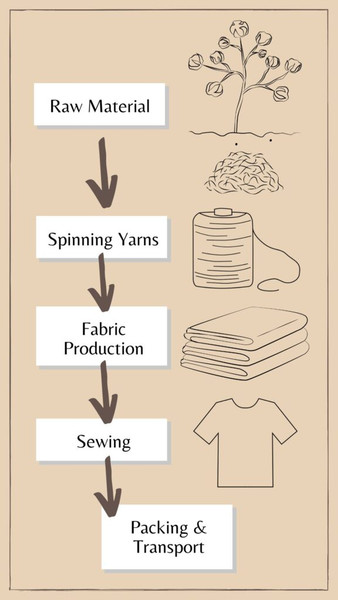
Stages of textile production
This was a process, not one invention or one year. Agriculture, population growth, capital, technology, transport, and markets all reinforced each other. One continuity students forget is that farms, workshops, and cottage industry did not disappear overnight. They existed alongside factories through the 1800s.
Why Great Britain Industrialized First
Britain went first because several advantages came together in one place.
- Agricultural productivity and enclosure increased food supply and pushed some rural people into wage work.
- Population growth created both more workers and more consumers.
- Coal and iron gave Britain the fuel and materials for machines, engines, rails, and tools.
- Capital and banking helped investors fund mines, mills, and transport.
- Overseas trade and empire brought in raw cotton and provided huge export markets.
- Political stability and property rights made investment safer.
- A unified domestic market meant fewer internal trade barriers than in much of continental Europe.
- Inventors, artisans, and entrepreneurs turned ideas into working machines and profitable businesses.
Mechanized textiles
Textiles show the process most clearly.
- The spinning jenny and water frame sped up spinning.
- Later mechanized weaving increased cloth production too.
- Machines were large and expensive, so work moved from homes into mills.
- Early mills used waterpower. Later steam power let factories move away from rivers.
- Cotton tied Britain to empire because mills used imported raw cotton and sold finished cloth widely.
Reinforcing industries
Textiles pulled other sectors forward:
- Iron, and later steel, supplied machinery and rails.
- James Watt’s steam engine improvements made steam power much more useful.
- Canals, turnpikes, railroads, and steamships cut transport costs and widened markets.
By the mid-1800s, Britain could present that industrial strength on a global stage. The Great Exhibition of 1851 in the Crystal Palace showed Britain’s industrial power to the world. That is why Britain got called the “workshop of the world.”
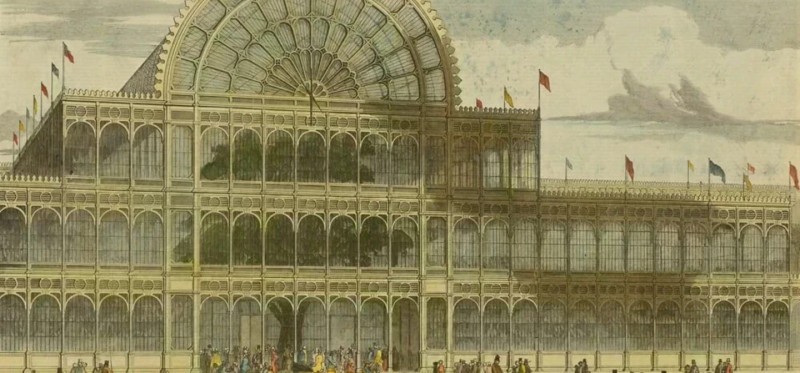
Crystal Palace, Great Exhibition of 1851
How Industrialization Spread Across Europe
Once Britain showed what was possible, other regions followed unevenly, often with more state help.
| Region | Pattern |
|---|---|
| Belgium | First major industrializer on the continent; had coal, textiles, good transport, and easy access to British methods. |
| France | Industrialized more gradually; kept a larger rural population and more small-scale production. |
| German states and Prussia | The Zollverein reduced internal tariffs; railroads and state-backed growth built strong industry. |
| Southern and eastern Europe | Slower because of weak transport, less capital, low farm productivity, powerful landed elites, and in the east, serfdom. |
| Russia | Serfdom lasted until 1861, limiting labor mobility and market growth. |
A map of Europe around 1850 makes that uneven pattern easy to see, with heavy industrial concentration in Britain, Belgium, northern France, and parts of the German states.
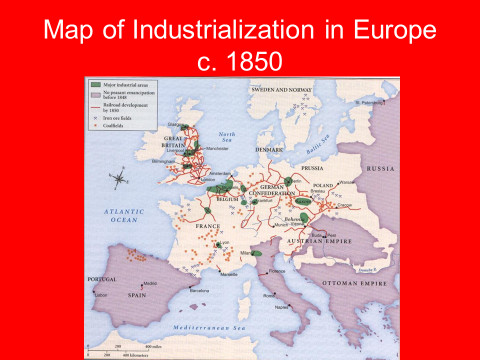
Industrialization in Europe, c. 1850
The First Industrial Revolution centered on textiles, coal, iron, and steam. The Second Industrial Revolution, after about 1870, brought steel, chemicals, electricity, petroleum, internal combustion, and modern communications.
How Industrialization Changed Everyday Life
Industrial growth pulled people into cities. Manchester became the classic industrial city, rich from textiles but crowded, dirty, and unhealthy.
- Urbanization brought overcrowding, pollution, poor sanitation, disease, and social dislocation.
- The Hungry Forties and the Irish Potato Famine showed that rural suffering still mattered in industrial Europe.
Industrial society also sharpened class lines:
- Bourgeoisie = factory owners, bankers, merchants, managers, professionals.
- Proletariat = industrial wage workers such as factory laborers and miners.
Family life changed too.
- Factory bells and clocks imposed time discipline instead of household control over work pace.
- Women and children often worked for low wages in early factories and mines.
- The bourgeois cult of domesticity imagined men in public work and women in the private home.
- Working-class families often needed several wage earners.
- The Factory Act of 1833 restricted child labor in Britain and created inspection.
Living standards are a common AP trap. Early industrialization often meant harsh work and bad housing. Later in the 1800s, real wages, cheaper goods, sanitation, and reform improved life for many.
Ideas and Responses to Industrial Society
Industrialization mixed with post-French Revolution politics and produced new ideologies.
- Liberalism backed constitutional government, rights, property, and economic freedom.
- Conservatism defended order, hierarchy, and tradition, though it could accept limited reform.
- Socialism attacked inequality under capitalism.
- Marxism argued history moved through class struggle between bourgeoisie and proletariat.
- Anarchism rejected coercive state authority.
People organized collectively through trade unions, mutual aid societies, cooperatives, and labor or socialist parties. Feminists tied women’s status to work and economic dependence.
Governments responded too:
- factory laws
- limits on child and female labor
- compulsory education
- sewers, clean water, sanitation, parks, policing, and urban planning
By 1914, industrialization had reshaped Europe’s economy, society, politics, and the role of the state.
Key Takeaways
Industrialization / Industrial Revolution
The long-term transformation from agrarian, handicraft production to machine-powered factories, wage labor, mineral energy, and large markets, beginning in late-eighteenth-century Britain
Domestic System / Cottage Industry / Putting-Out System
A merchant supplied raw materials to rural households, which made goods with hand tools and returned the finished products for sale
Mechanization
The replacement or supplementation of skilled hand labor with machines
Factory System
The concentration of workers, machinery, power, and raw materials in one workplace under centralized employer supervision
Wage Labor
Work performed for monetary wages rather than through independent production with one's own land or tools
Capitalism
An economic system in which privately owned capital is invested in production for profit and goods and labor are exchanged through markets
First Industrial Revolution
The industrial phase beginning in late-eighteenth-century Britain and centered on textiles, coal, iron, steam power, and mechanized factories
Great Exhibition of 1851
A London exhibition in the glass-and-iron Crystal Palace that displayed British machinery, manufactured goods, imperial products, and industrial dominance
Second Industrial Revolution
The industrial phase from about 1870 to 1914 centered on steel, chemicals, electricity, petroleum, communications, and large-scale production
Zollverein
A customs union that reduced trade barriers among many German states and helped integrate markets and promote industrialization
Urbanization
The growth of towns and cities and the increasing proportion of the population living in them
Social Dislocation
The disruption of established communities, occupations, customs, and family arrangements by economic and social change
Bourgeoisie
The property-owning and educated middle class of merchants, industrialists, professionals, managers, and civil servants
Proletariat
The industrial working class whose members lacked sufficient productive property and therefore sold their labor for wages
Cult of Domesticity
The middle-class ideal that men belonged in the public world of work and politics while women governed the private home and family
Companionate Marriage
A model of marriage based more openly on affection and companionship, though economic considerations remained important
Consumerism
The expansion of mass purchasing encouraged by cheaper manufactured goods, improved distribution, advertising, and mass marketing
Notes
Industrialization / Industrial Revolution
The long-term transformation from agrarian, handicraft production to machine-powered factories, wage labor, mineral energy, and large markets, beginning in late-eighteenth-century Britain
Domestic System / Cottage Industry / Putting-Out System
A merchant supplied raw materials to rural households, which made goods with hand tools and returned the finished products for sale
Mechanization
The replacement or supplementation of skilled hand labor with machines
Factory System
The concentration of workers, machinery, power, and raw materials in one workplace under centralized employer supervision
Wage Labor
Work performed for monetary wages rather than through independent production with one's own land or tools
Capitalism
An economic system in which privately owned capital is invested in production for profit and goods and labor are exchanged through markets
First Industrial Revolution
The industrial phase beginning in late-eighteenth-century Britain and centered on textiles, coal, iron, steam power, and mechanized factories
Great Exhibition of 1851
A London exhibition in the glass-and-iron Crystal Palace that displayed British machinery, manufactured goods, imperial products, and industrial dominance
Second Industrial Revolution
The industrial phase from about 1870 to 1914 centered on steel, chemicals, electricity, petroleum, communications, and large-scale production
Zollverein
A customs union that reduced trade barriers among many German states and helped integrate markets and promote industrialization
Urbanization
The growth of towns and cities and the increasing proportion of the population living in them
Social Dislocation
The disruption of established communities, occupations, customs, and family arrangements by economic and social change
Bourgeoisie
The property-owning and educated middle class of merchants, industrialists, professionals, managers, and civil servants
Proletariat
The industrial working class whose members lacked sufficient productive property and therefore sold their labor for wages
Cult of Domesticity
The middle-class ideal that men belonged in the public world of work and politics while women governed the private home and family
Companionate Marriage
A model of marriage based more openly on affection and companionship, though economic considerations remained important
Consumerism
The expansion of mass purchasing encouraged by cheaper manufactured goods, improved distribution, advertising, and mass marketing
