Topic 8.10 Notes – 20th-Century Cultural, Intellectual, and Artistic Developments
How Faith in Progress Broke Down
In the 1800s, many Europeans linked progress to science, industry, medicine, and education. The old Enlightenment idea was still powerful. If people used reason, society would improve.
That belief weakened before 1914 and collapsed much further after World War I. The key change was not that Europeans stopped believing in science. They stopped assuming science produced simple truth or moral good.
- World War I made this painfully clear. Industrial science gave Europe:
- machine guns
- poison gas
- heavy artillery
- submarines
- mass death on a huge scale
- The war showed that modern technology could make killing more efficient, not make civilization more humane.
- The lost generation came out of this trauma. Many people grew cynical about governments, nationalism, religion, and even the idea of Western civilization as a force for good.
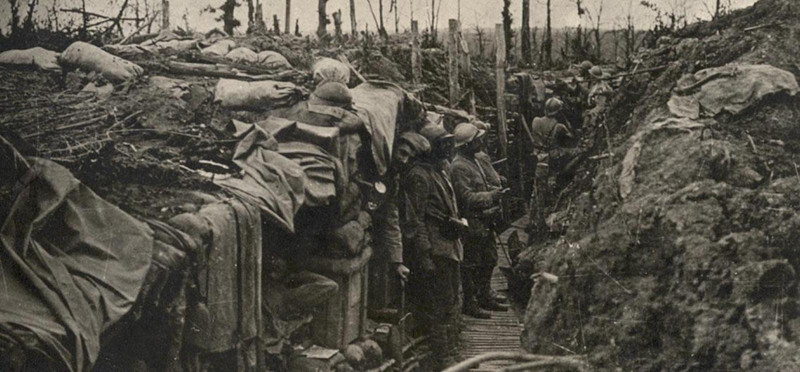
World War I trench warfare
This trench scene captures the reality behind that shift in attitude. Modern industry and scientific innovation had not produced a more humane Europe. They had helped create mechanized slaughter.
This is one of the strongest AP arguments in the unit. The first half of the 20th century challenged old faith in rationality, morality, and steady human progress.
Ideas That Challenged Old Certainties
These doubts were already building before the war. Thinkers and scientists were questioning whether truth, morality, and even reality were as stable as people had assumed.
Friedrich Nietzsche
Nietzsche attacked Christian morality and the claim that universal truth existed.
- “God is dead” meant traditional religious authority was losing its grip on European culture.
- He warned this could lead to nihilism, the belief that life has no objective meaning once the old moral system collapses.
Sigmund Freud
Freud challenged the idea that people are fully rational.
- In The Interpretation of Dreams (1900), he argued that the unconscious mind shapes behavior.
- Psychoanalysis tried to uncover hidden motives through dream interpretation and free association.
- His model of personality:
- id = instinct and desire
- ego = conscious self trying to manage reality
- superego = internalized rules and morality
Freud mattered far beyond psychology. He shaped literature, ideas about sexuality, and surrealism.
New physics
Newton had pictured the universe as orderly and predictable. New physics made that picture much less certain.
- Max Planck developed quantum theory.
- Albert Einstein
- special relativity (1905)
- general relativity (1915)
- space and time were not absolute
- Niels Bohr developed an atomic model.
- Werner Heisenberg proposed the uncertainty principle.
- Erwin Schrödinger developed wave mechanics.
This did not mean “truth is fake” or “everything is relative.” It meant the universe was more complex and less mechanically predictable than the Newtonian model suggested.
Enrico Fermi and nuclear science
Fermi led the first controlled nuclear chain reaction in Chicago in 1942. Nuclear science led to both atomic energy and atomic weapons. Hiroshima and Nagasaki became the clearest example of science’s double edge.
Modernism in Art and Literature
As old certainties weakened, artists and writers rejected realism, fixed perspective, and stable meaning. Modernism started before World War I, then intensified after it.
Picasso’s Les Demoiselles d’Avignon is a good example of that break. The figures are flattened, angular, and deliberately unsettling.
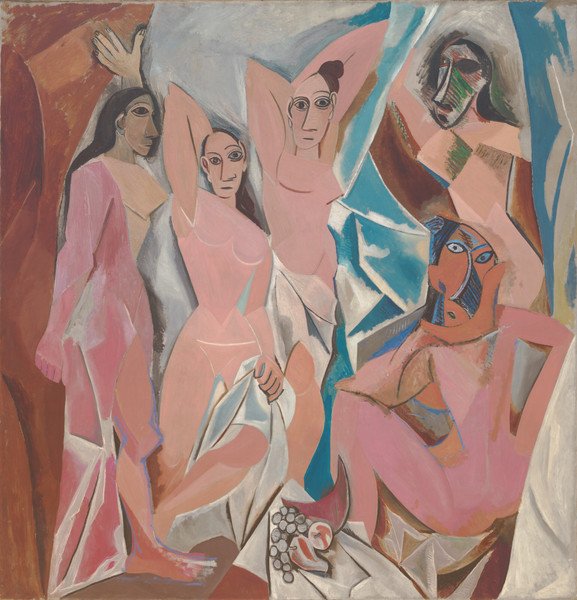
Picasso, Les Demoiselles d’Avignon
- Expressionism distorted color and form to show emotion and anxiety.
- Cubism
- linked to Pablo Picasso and Georges Braque
- showed fractured forms and multiple viewpoints
- Les Demoiselles d’Avignon broke sharply with realism before 1914
- Guernica turned modernist style into a response to the violence of the Spanish Civil War
- Dada
- anti-rational, anti-art reaction to World War I
- centered at Cabaret Voltaire in Zurich, 1916
- Marcel Duchamp’s Fountain challenged who gets to define art
- Surrealism
- shaped by Freud and the unconscious
- André Breton’s Surrealist Manifesto (1924)
- Salvador Dalí used dreamlike, irrational images
- Bauhaus
- linked to Walter Gropius
- simple, functional design using modern materials
Modernist literature did the same thing in words.
- stream of consciousness and fragmented narration tried to show how thought actually moves
- James Joyce, Ulysses
- Virginia Woolf, Mrs Dalloway
- Franz Kafka explored alienation under impersonal systems
- T. S. Eliot, The Waste Land captured cultural fragmentation
World War I, Social Change, and the Lost Generation
World War I changed culture because it changed everyday life.
- Gertrude Stein popularized “lost generation.”
- Ernest Hemingway used it in The Sun Also Rises.
- Erich Maria Remarque’s All Quiet on the Western Front is the classic antiwar novel of trauma and disillusionment.
The war also pushed limited democratization.
- mass sacrifice led more people to demand political rights
- old empires fell
- republics and parliamentary governments spread
Women’s roles expanded because total war needed total mobilization.
- women worked in factories, transport, offices, agriculture, nursing, civil defense, and auxiliaries
- this proved women could do industrial and public work previously denied to them
Suffrage gains
| Country | Date |
|---|---|
| Russia | 1917 |
| Britain | 1918, then equal rights in 1928 |
| Germany | 1918 |
| Austria | 1918 |
| Netherlands | 1919 |
| France | 1944 |
| Italy | 1945 |
War expanded women’s opportunities, but it did not create full equality.
Culture and Power in the Age of Mass Politics
The same century that expanded freedom also expanded state power. Authoritarian regimes hated modernist ambiguity because they wanted culture to deliver one clear message.
- Nazis condemned modern art as “degenerate.”
- Stalinist USSR imposed socialist realism.
- radio, film, architecture, education, and spectacle became tools of ideological control.
The best overall way to connect this topic is simple. Thinkers and artists had already questioned certainty before 1914. The world wars made those doubts impossible to ignore by exposing the destructive side of science, technology, and mass society.
Key Takeaways
Friedrich Nietzsche
Critic of Christian morality and universal truth whose claim that “God is dead” warned that declining religious authority could produce nihilism
Nihilism
The belief that life has no objective meaning, moral purpose, or universally valid values
Sigmund Freud and Psychoanalysis
Freud’s theory and method holding that unconscious desires and conflicts shape behavior, investigated through dream interpretation and free association
Newtonian Worldview
The model of an orderly, measurable universe governed by universal laws that made physical behavior appear predictable
Max Planck’s Quantum Theory
The 1900 proposal that energy is emitted or absorbed in discrete quantities rather than in a wholly continuous flow
Albert Einstein’s Special Theory of Relativity
The 1905 theory that space and time measurements depend on relative motion, the speed of light is constant, and mass and energy are linked by E = mc².
Albert Einstein’s General Theory of Relativity
Einstein’s 1915 theory explaining gravity as the curvature of space-time
Quantum Mechanics
Modern physics describing matter and energy at atomic scales through quantized and often probabilistic relationships rather than complete classical predictability
Niels Bohr’s Atomic Model
The 1913 atomic model that applied quantum ideas to the behavior of electrons
Erwin Schrödinger’s Wave Mechanics
A formulation of quantum mechanics using a wave function to describe the probable behavior of particles
Werner Heisenberg’s Uncertainty Principle
The 1927 principle that properties such as a particle’s position and momentum cannot both be known with unlimited precision
Enrico Fermi
Nuclear physicist who directed the team that achieved the first controlled, self-sustaining nuclear chain reaction in 1942
Manhattan Project
The U.S.-led wartime program that combined science, industry, state funding, and military organization to build atomic bombs
Modernism
A broad cultural movement that rejected or radically revised inherited conventions through fragmentation, abstraction, shifting perspective, and experimentation
Expressionism
Modernist art that distorted color, shape, and perspective to communicate emotion, anxiety, or subjective experience
Cubism
Modernist art that fragmented objects into geometric forms and presented multiple viewpoints within one composition
Abstraction
Modernist art using color and form while moving partly or entirely away from recognizable objects and realistic representation
Futurism
Modernist movement celebrating speed, machinery, youth, violence, and the dynamism of industrial society
Dada
World War I-era anti-art movement that used absurdity, chance, collage, and provocation to reject a supposedly rational culture that had produced mechanized slaughter
Surrealism
Postwar movement influenced by Freud that used dreams, unconscious desires, and irrational combinations of images to bypass conscious logic
Functional Modernist Architecture
Architecture favoring practical use, simple geometric forms, and modern materials over historical ornament
Bauhaus
German school founded by Walter Gropius in 1919 that united architecture, fine art, design, and industrial production
Les Demoiselles d’Avignon
Picasso’s 1907 painting of fractured figures and multiple perspectives that marked a prewar break with naturalism and conventional beauty
Guernica
Picasso’s 1937 black, white, and gray painting using fractured figures to express civilian terror after the German and Italian bombing of Guernica during the Spanish Civil War
Modernist Literature
Literature that disrupted chronology and stable narration through fragmented allusions, shifting viewpoints, linguistic experimentation, and attention to inner consciousness
Stream of Consciousness
A literary technique representing memories, sensations, impressions, and associations as they flow through a character’s mind
Lost Generation
The generation traumatized or disillusioned by World War I, especially writers who portrayed postwar alienation, cynicism, and purposelessness
Degenerate Art
The Nazi label for modernist and experimental art condemned as racially corrupt, culturally disordered, or politically subversive
Socialist Realism
Soviet-mandated art portraying idealized workers, peasants, and party leaders in accessible, heroic forms supporting communist ideology
Readymades
Ordinary manufactured objects selected and presented as art to challenge conventional standards of beauty, craftsmanship, and artistic authority
Marcel Duchamp’s Fountain
Duchamp’s 1917 readymade urinal, submitted as “R. Mutt,” that challenged who had the authority to define an object as art
Women’s Participation in Total War
Women entered war production, administration, nursing, civil defense, resistance, and auxiliary service, challenging traditional gender roles and strengthening demands for political rights without achieving full equality
Democratization of Society Through World War I
Wartime sacrifice and mass mobilization widened suffrage and political participation, weakened some class and monarchical hierarchies, and strengthened labor and mass parties, though these gains were incomplete and reversible
Notes
Friedrich Nietzsche
Critic of Christian morality and universal truth whose claim that “God is dead” warned that declining religious authority could produce nihilism
Nihilism
The belief that life has no objective meaning, moral purpose, or universally valid values
Sigmund Freud and Psychoanalysis
Freud’s theory and method holding that unconscious desires and conflicts shape behavior, investigated through dream interpretation and free association
Newtonian Worldview
The model of an orderly, measurable universe governed by universal laws that made physical behavior appear predictable
Max Planck’s Quantum Theory
The 1900 proposal that energy is emitted or absorbed in discrete quantities rather than in a wholly continuous flow
Albert Einstein’s Special Theory of Relativity
The 1905 theory that space and time measurements depend on relative motion, the speed of light is constant, and mass and energy are linked by E = mc².
Albert Einstein’s General Theory of Relativity
Einstein’s 1915 theory explaining gravity as the curvature of space-time
Quantum Mechanics
Modern physics describing matter and energy at atomic scales through quantized and often probabilistic relationships rather than complete classical predictability
Niels Bohr’s Atomic Model
The 1913 atomic model that applied quantum ideas to the behavior of electrons
Erwin Schrödinger’s Wave Mechanics
A formulation of quantum mechanics using a wave function to describe the probable behavior of particles
Werner Heisenberg’s Uncertainty Principle
The 1927 principle that properties such as a particle’s position and momentum cannot both be known with unlimited precision
Enrico Fermi
Nuclear physicist who directed the team that achieved the first controlled, self-sustaining nuclear chain reaction in 1942
Manhattan Project
The U.S.-led wartime program that combined science, industry, state funding, and military organization to build atomic bombs
Modernism
A broad cultural movement that rejected or radically revised inherited conventions through fragmentation, abstraction, shifting perspective, and experimentation
Expressionism
Modernist art that distorted color, shape, and perspective to communicate emotion, anxiety, or subjective experience
Cubism
Modernist art that fragmented objects into geometric forms and presented multiple viewpoints within one composition
Abstraction
Modernist art using color and form while moving partly or entirely away from recognizable objects and realistic representation
Futurism
Modernist movement celebrating speed, machinery, youth, violence, and the dynamism of industrial society
Dada
World War I-era anti-art movement that used absurdity, chance, collage, and provocation to reject a supposedly rational culture that had produced mechanized slaughter
Surrealism
Postwar movement influenced by Freud that used dreams, unconscious desires, and irrational combinations of images to bypass conscious logic
Functional Modernist Architecture
Architecture favoring practical use, simple geometric forms, and modern materials over historical ornament
Bauhaus
German school founded by Walter Gropius in 1919 that united architecture, fine art, design, and industrial production
Les Demoiselles d’Avignon
Picasso’s 1907 painting of fractured figures and multiple perspectives that marked a prewar break with naturalism and conventional beauty
Guernica
Picasso’s 1937 black, white, and gray painting using fractured figures to express civilian terror after the German and Italian bombing of Guernica during the Spanish Civil War
Modernist Literature
Literature that disrupted chronology and stable narration through fragmented allusions, shifting viewpoints, linguistic experimentation, and attention to inner consciousness
Stream of Consciousness
A literary technique representing memories, sensations, impressions, and associations as they flow through a character’s mind
Lost Generation
The generation traumatized or disillusioned by World War I, especially writers who portrayed postwar alienation, cynicism, and purposelessness
Degenerate Art
The Nazi label for modernist and experimental art condemned as racially corrupt, culturally disordered, or politically subversive
Socialist Realism
Soviet-mandated art portraying idealized workers, peasants, and party leaders in accessible, heroic forms supporting communist ideology
Readymades
Ordinary manufactured objects selected and presented as art to challenge conventional standards of beauty, craftsmanship, and artistic authority
Marcel Duchamp’s Fountain
Duchamp’s 1917 readymade urinal, submitted as “R. Mutt,” that challenged who had the authority to define an object as art
Women’s Participation in Total War
Women entered war production, administration, nursing, civil defense, resistance, and auxiliary service, challenging traditional gender roles and strengthening demands for political rights without achieving full equality
Democratization of Society Through World War I
Wartime sacrifice and mass mobilization widened suffrage and political participation, weakened some class and monarchical hierarchies, and strengthened labor and mass parties, though these gains were incomplete and reversible
