Topic 8.8 Notes – World War II
How World War II Was Fought and Why Technology Mattered
World War II grew out of interwar instability, appeasement, fascism, the Great Depression, and the Nazi-Soviet Pact. That context set up the war. This topic is about how it was fought and won.
Total war meant whole societies were mobilized. Governments directed factories, rationed food, moved workers, used propaganda, and treated civilians as part of the war effort.
The war depended on systems, not just famous weapons:
- Industry made tanks, planes, ships, trucks, and ammunition in huge numbers.
- Logistics kept armies supplied with fuel, food, and spare parts.
- Communications let commanders coordinate fast-moving forces.
- Intelligence gave advance knowledge of enemy plans.
- Scientific research produced radar, codebreaking methods, rockets, and the atomic bomb.
The pattern you want to lock in is simple. Axis early success came from speed, surprise, and coordination. Allied victory came from production, cooperation, and endurance.
Major powers:
- Axis: Germany, Italy, Japan
- Allies: Britain, USSR, United States, China, Free French, resistance movements, British Empire/Commonwealth
How the Axis Won Early
Blitzkrieg
Blitzkrieg was fast, concentrated combined-arms warfare. Germany used tanks, motorized infantry, aircraft, artillery, and radios together. The key was coordination. No single “superweapon” won these campaigns.
Standard examples:
- Poland, 1939: Germany invaded from the west, then the USSR attacked from the east under the Nazi-Soviet Pact.
- France, 1940: Germans bypassed the Maginot Line through the Ardennes and split Allied forces.
- Barbarossa, 1941: early German gains in the USSR also showed Blitzkrieg’s power.
Poland, France, and Britain
Poland fell quickly because it faced two invasions and little direct Allied help. France collapsed after Germany moved through the Ardennes. At Dunkirk, Britain saved many troops but lost heavy equipment.
France then split:
- Vichy France under Philippe Pétain cooperated with Germany.
- Free French under Charles de Gaulle kept fighting.
The Battle of Britain
Hitler’s first major failure came when the RAF stopped the Luftwaffe. Britain used radar, ground observation, and strong communications to direct fighters efficiently. Churchill’s leadership helped keep morale high. The Blitz also showed that civilians were now direct targets.
Japan’s early victories
Japan brought the U.S. fully in with Pearl Harbor in 1941, then quickly took Hong Kong, Malaya, Singapore, the Dutch East Indies, and the Philippines. Surprise, naval aviation, experienced forces, and weak Allied defenses explain those gains.
How the Allies Turned the War Around
The Allies won because Britain survived, the USSR absorbed the main land war, the U.S. outproduced everyone, and the Allies coordinated strategy.
The USSR and the Eastern Front
Operation Barbarossa slowed because of distance, supply problems, Soviet resistance, scorched earth, and relocated industry. Stalingrad in 1942-43 was the major turning point. Germany’s Sixth Army was encircled and surrendered. Kursk in 1943 ended Germany’s ability to retake the initiative. The Red Army carried the heaviest land fighting against Germany.
Anglo-American cooperation
The Allies followed a Germany first strategy. Lend-Lease sent trucks, food, fuel, and weapons to Britain and the USSR. The Tehran Conference helped coordinate strategy.
In North Africa and Italy:
- El Alamein stopped Axis advances.
- Operation Torch brought U.S. and British troops into North Africa.
- Mussolini fell after Allied invasion.
D-Day in 1944 opened the western front and depended on landing craft, air superiority, deception, engineering, and weather forecasting.
The Pacific turnaround
Coral Sea showed aircraft carriers had replaced battleships. Midway turned naval momentum, helped by U.S. codebreaking. Then island hopping, submarines, bombers, and massive logistics steadily isolated Japan.
The Technologies That Changed the War
- Radio + mechanization + combined arms made Blitzkrieg possible.
- Radar helped Britain survive and sonar helped defeat U-boats in the Atlantic.
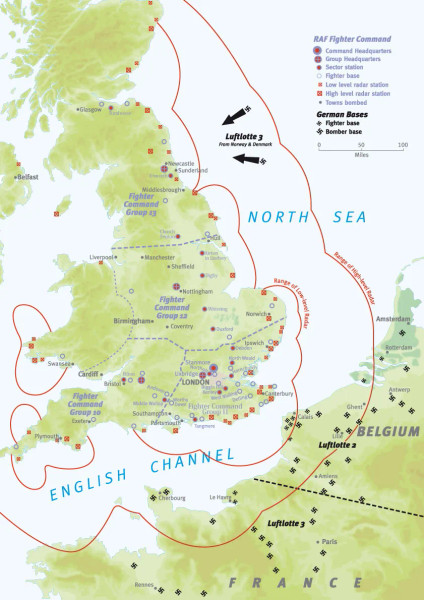
Battle of Britain radar and fighter defense map
- Codebreaking mattered hugely. Bletchley Park cracked Enigma and produced Ultra intelligence. U.S. codebreaking helped win Midway.
- Strategic bombing hit Warsaw, Rotterdam, London, Coventry, Hamburg, Dresden, and Tokyo. It damaged industry and infrastructure, but bombing alone did not win the war.
- V-1, V-2, and jet aircraft came too late to change the outcome. Their bigger impact was postwar missile and aviation development.
What World War II Showed About Modern Warfare
Technology increased destructive power, but people and governments decided how to use it. That matters for the Holocaust, which developed under wartime conquest and used bureaucracy, transport, and industrial capacity. The detailed Holocaust topic comes next, but here you need the link between war and genocide.
The Manhattan Project tied science, state power, and industry together. Hiroshima and Nagasaki began the nuclear age. Soviet entry into the war against Japan also mattered in Japan’s surrender.
Long-term effects:
- Europe was devastated and weakened.
- The U.S. and USSR emerged as superpowers.
- Nuclear weapons created the risk of global nuclear war.
Key Takeaways
Axis Powers
Germany, Italy, and Japan, whose offensives brought rapid early victories but whose resources could not sustain a prolonged global war
Allied Powers
Coalition led by Britain, the Soviet Union, the United States, and China that defeated the Axis through cooperation and superior resources
Blitzkrieg
“Lightning war” coordinating tanks, motorized infantry, aircraft, artillery, and radio to penetrate, encircle, and rapidly defeat enemy forces
Battle of France
Germany’s rapid 1940 defeat of France through the Low Countries and Ardennes, bypassing major French defenses and encircling Allied armies
Maginot Line
French fortified defensive line along much of the German frontier that German mobile forces largely bypassed through the Ardennes in 1940
Dunkirk Evacuation
1940 naval and civilian-boat evacuation that rescued much of the British Expeditionary Force from France but abandoned its heavy equipment
Battle of Britain
Britain’s successful 1940 air defense against the Luftwaffe, aided by radar, integrated command systems, fighter aircraft, and civilian endurance
The Blitz
German bombing campaign against British cities that caused heavy civilian destruction but failed to break morale or force Britain from the war
Radar
System using radio waves to detect aircraft or ships, crucial to Britain’s air defense and later Allied air and naval operations
Winston Churchill
British prime minister whose leadership and broadcasts sustained resistance in 1940 and helped maintain Britain and Allied cooperation
Operation Barbarossa
Germany’s June 1941 invasion of the Soviet Union, whose early Blitzkrieg gains ended in logistical overextension and sustained Soviet resistance
Eastern Front
The vast German-Soviet theater where the USSR’s total mobilization absorbed and destroyed most of Germany’s land-fighting power
Battle of Stalingrad
1942–1943 battle in which Soviet forces encircled and destroyed Germany’s Sixth Army, decisively shifting strategic momentum in the east
Battle of Kursk
Massive 1943 tank battle that ended Germany’s ability to regain the strategic initiative on the Eastern Front
Attack on Pearl Harbor
Japan’s December 7, 1941 surprise attack on the U.S. Pacific Fleet, bringing the United States directly into World War II.
Battle of the Coral Sea
May 1942 carrier battle fought mainly by aircraft without opposing principal ships seeing one another, halting a Japanese advance
Battle of Midway
June 1942 American victory, aided by codebreaking, that sank four Japanese carriers and shifted the Pacific naval balance
Carrier Aviation
Use of aircraft launched from naval carriers, which displaced battleships as the central instrument of Pacific naval power
Island Hopping
Allied Pacific strategy of capturing strategically useful islands while bypassing some heavily fortified Japanese positions
Second Battle of El Alamein
Late-1942 British victory under Bernard Montgomery that stopped the Axis advance into Egypt and helped reverse the North African war
Operation Torch
November 1942 American and British landings in French North Africa that helped trap and defeat Axis forces there
Germany First Strategy
Allied decision to prioritize defeating Nazi Germany as the greater threat even after Japan attacked the United States
Tehran Conference
1943 meeting where Roosevelt, Churchill, and Stalin coordinated strategy and confirmed plans for the Allied invasion of France
Lend-Lease
American program supplying Allies with weapons, vehicles, food, fuel, and materials before and during direct U.S. participation
Arsenal of Democracy
Description of the United States as the mass producer of ships, aircraft, vehicles, weapons, food, and supplies for the Allies
Battle of the Atlantic
Struggle to protect Allied shipping from German U-boats, won through convoys, escorts, radar, sonar, aircraft, and codebreaking
Sonar
Underwater detection technology that, with escorts and depth charges, helped Allied forces locate and destroy German submarines
Bletchley Park
British codebreaking center that deciphered significant portions of German encrypted communications
Enigma
German encryption system whose messages Allied codebreakers partially deciphered to obtain valuable military intelligence
Ultra
Highly secret Allied intelligence obtained from decrypted Axis communications, especially German Enigma messages
Strategic Bombing
Long-range bombing intended to destroy an enemy’s industry, transportation, oil supplies, cities, and willingness to fight
V-1 Flying Bomb
German flying bomb used against Allied cities late in the war but deployed too late and in too few numbers to reverse Germany’s defeat
V-2 Ballistic Missile
First long-range guided ballistic missile used in warfare, developed by Germany and foundational to postwar missile and space technology
Civilian Resistance
Opposition to Axis occupation through intelligence, sabotage, illegal publications, sheltering fugitives, and armed partisan warfare
French Resistance
Networks that gathered intelligence, sheltered fugitives, and disrupted German communications, especially around the 1944 Allied invasion
Yugoslav Partisans
Communist-led resistance forces under Josip Broz Tito that tied down Axis troops and liberated much of Yugoslavia
Warsaw Uprising
1944 Polish Home Army revolt against German occupation that was crushed while expected immediate Soviet assistance failed to arrive
D-Day / Operation Overlord
June 6, 1944 Allied invasion of Normandy, enabled by multinational planning, landing craft, air superiority, engineering, intelligence, and deception
Battle of the Bulge
Germany’s final major western offensive in 1944–1945, which surprised the Allies but exhausted irreplaceable German reserves
Manhattan Project
American-led scientific and industrial program that combined nuclear physics, state investment, and enormous facilities to create the atomic bomb
Atomic Bombings of Hiroshima and Nagasaki
August 1945 U.S. nuclear attacks that released unprecedented destructive power from single weapons, killing civilians through blast, fire, and radiation before Japan’s surrender
Nuclear Proliferation
Spread of nuclear weapons to additional states, beginning when the Soviet test of 1949 ended the American nuclear monopoly
Nazi–Soviet Non-Aggression Pact / Molotov–Ribbentrop Pact
August 1939 agreement that temporarily prevented a German-Soviet war and secretly divided Poland and much of eastern Europe into spheres of influence
Industrialized Warfare
Warfare using mass-produced mechanized weapons and state mobilization of industry, science, bureaucracy, and entire societies
Notes
Axis Powers
Germany, Italy, and Japan, whose offensives brought rapid early victories but whose resources could not sustain a prolonged global war
Allied Powers
Coalition led by Britain, the Soviet Union, the United States, and China that defeated the Axis through cooperation and superior resources
Blitzkrieg
“Lightning war” coordinating tanks, motorized infantry, aircraft, artillery, and radio to penetrate, encircle, and rapidly defeat enemy forces
Battle of France
Germany’s rapid 1940 defeat of France through the Low Countries and Ardennes, bypassing major French defenses and encircling Allied armies
Maginot Line
French fortified defensive line along much of the German frontier that German mobile forces largely bypassed through the Ardennes in 1940
Dunkirk Evacuation
1940 naval and civilian-boat evacuation that rescued much of the British Expeditionary Force from France but abandoned its heavy equipment
Battle of Britain
Britain’s successful 1940 air defense against the Luftwaffe, aided by radar, integrated command systems, fighter aircraft, and civilian endurance
The Blitz
German bombing campaign against British cities that caused heavy civilian destruction but failed to break morale or force Britain from the war
Radar
System using radio waves to detect aircraft or ships, crucial to Britain’s air defense and later Allied air and naval operations
Winston Churchill
British prime minister whose leadership and broadcasts sustained resistance in 1940 and helped maintain Britain and Allied cooperation
Operation Barbarossa
Germany’s June 1941 invasion of the Soviet Union, whose early Blitzkrieg gains ended in logistical overextension and sustained Soviet resistance
Eastern Front
The vast German-Soviet theater where the USSR’s total mobilization absorbed and destroyed most of Germany’s land-fighting power
Battle of Stalingrad
1942–1943 battle in which Soviet forces encircled and destroyed Germany’s Sixth Army, decisively shifting strategic momentum in the east
Battle of Kursk
Massive 1943 tank battle that ended Germany’s ability to regain the strategic initiative on the Eastern Front
Attack on Pearl Harbor
Japan’s December 7, 1941 surprise attack on the U.S. Pacific Fleet, bringing the United States directly into World War II.
Battle of the Coral Sea
May 1942 carrier battle fought mainly by aircraft without opposing principal ships seeing one another, halting a Japanese advance
Battle of Midway
June 1942 American victory, aided by codebreaking, that sank four Japanese carriers and shifted the Pacific naval balance
Carrier Aviation
Use of aircraft launched from naval carriers, which displaced battleships as the central instrument of Pacific naval power
Island Hopping
Allied Pacific strategy of capturing strategically useful islands while bypassing some heavily fortified Japanese positions
Second Battle of El Alamein
Late-1942 British victory under Bernard Montgomery that stopped the Axis advance into Egypt and helped reverse the North African war
Operation Torch
November 1942 American and British landings in French North Africa that helped trap and defeat Axis forces there
Germany First Strategy
Allied decision to prioritize defeating Nazi Germany as the greater threat even after Japan attacked the United States
Tehran Conference
1943 meeting where Roosevelt, Churchill, and Stalin coordinated strategy and confirmed plans for the Allied invasion of France
Lend-Lease
American program supplying Allies with weapons, vehicles, food, fuel, and materials before and during direct U.S. participation
Arsenal of Democracy
Description of the United States as the mass producer of ships, aircraft, vehicles, weapons, food, and supplies for the Allies
Battle of the Atlantic
Struggle to protect Allied shipping from German U-boats, won through convoys, escorts, radar, sonar, aircraft, and codebreaking
Sonar
Underwater detection technology that, with escorts and depth charges, helped Allied forces locate and destroy German submarines
Bletchley Park
British codebreaking center that deciphered significant portions of German encrypted communications
Enigma
German encryption system whose messages Allied codebreakers partially deciphered to obtain valuable military intelligence
Ultra
Highly secret Allied intelligence obtained from decrypted Axis communications, especially German Enigma messages
Strategic Bombing
Long-range bombing intended to destroy an enemy’s industry, transportation, oil supplies, cities, and willingness to fight
V-1 Flying Bomb
German flying bomb used against Allied cities late in the war but deployed too late and in too few numbers to reverse Germany’s defeat
V-2 Ballistic Missile
First long-range guided ballistic missile used in warfare, developed by Germany and foundational to postwar missile and space technology
Civilian Resistance
Opposition to Axis occupation through intelligence, sabotage, illegal publications, sheltering fugitives, and armed partisan warfare
French Resistance
Networks that gathered intelligence, sheltered fugitives, and disrupted German communications, especially around the 1944 Allied invasion
Yugoslav Partisans
Communist-led resistance forces under Josip Broz Tito that tied down Axis troops and liberated much of Yugoslavia
Warsaw Uprising
1944 Polish Home Army revolt against German occupation that was crushed while expected immediate Soviet assistance failed to arrive
D-Day / Operation Overlord
June 6, 1944 Allied invasion of Normandy, enabled by multinational planning, landing craft, air superiority, engineering, intelligence, and deception
Battle of the Bulge
Germany’s final major western offensive in 1944–1945, which surprised the Allies but exhausted irreplaceable German reserves
Manhattan Project
American-led scientific and industrial program that combined nuclear physics, state investment, and enormous facilities to create the atomic bomb
Atomic Bombings of Hiroshima and Nagasaki
August 1945 U.S. nuclear attacks that released unprecedented destructive power from single weapons, killing civilians through blast, fire, and radiation before Japan’s surrender
Nuclear Proliferation
Spread of nuclear weapons to additional states, beginning when the Soviet test of 1949 ended the American nuclear monopoly
Nazi–Soviet Non-Aggression Pact / Molotov–Ribbentrop Pact
August 1939 agreement that temporarily prevented a German-Soviet war and secretly divided Poland and much of eastern Europe into spheres of influence
Industrialized Warfare
Warfare using mass-produced mechanized weapons and state mobilization of industry, science, bureaucracy, and entire societies
