Topic 2.8 Notes – Causation in the Age of Reformation and the Wars of Religion
How the Reformation Reshaped Europe
Europe started the 1500s with one western church, but reform became permanent because religious criticism lined up with political opportunity. Church abuses, Renaissance humanism, the printing press, and Luther’s 1517 challenge opened the break. Printing mattered because it spread pamphlets, sermons, and vernacular Bibles fast, and princes or city governments could protect reformers from being crushed.
By the mid-1500s, western and central Europe were no longer religiously unified.
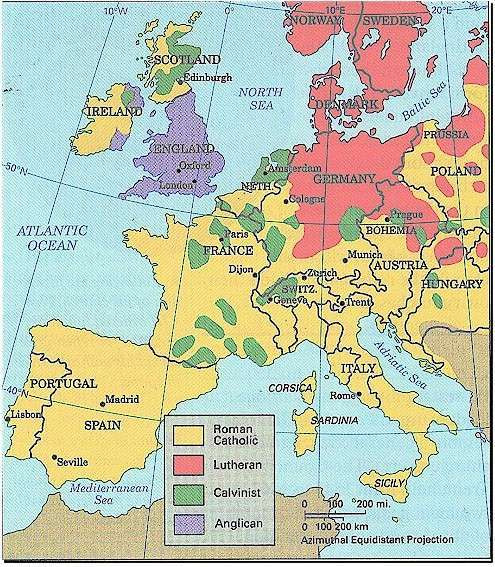
Religious divisions in Reformation Europe
The main confessions fit together like this:
- Catholicism stayed dominant in Spain, Italy, much of France, and parts of the Habsburg lands.
- Lutheranism spread in German states and Scandinavia.
- Calvinism or Reformed Protestantism became strong in Switzerland, the Netherlands, Scotland, France, and parts of central Europe.
- Anglicanism grew from England’s national church.
- Anabaptists and other radicals rejected infant baptism and often wanted churches separated from state control.
Theology that changed institutions
- Luther taught salvation by faith alone, scripture alone, and the priesthood of all believers. That weakened the special spiritual status of clergy.
- Calvin stressed predestination and wanted a disciplined godly community with strict moral order.
- Radicals pushed further. Adult baptism meant faith had to be chosen, not assigned at birth.
Catholic renewal
The Catholic Reformation was a real reform movement, not just panic.
- Council of Trent reaffirmed Catholic doctrine and cleaned up clerical discipline.
- Jesuits, founded by Ignatius of Loyola, focused on education, missionary work, and loyalty to the church.
- Roman Inquisition and Index of Prohibited Books tried to stop heresy.
- Teresa of Ávila represented intense renewed spirituality.
- Ursulines expanded women’s religious education.
The lasting result was religious pluralism. No single church could rule all of western Europe anymore.
How Religion Changed Political Power
The Reformation usually tied church and state closer together. This is confessionalization. Rulers and churches worked together to define correct belief, supervise clergy, regulate schools, marriage, poor relief, and morality. Religion became a tool of obedience and social discipline.
Stronger state control
- Henry VIII used the Act of Supremacy to make the English monarch head of the church.
- The dissolution of the monasteries gave the crown land and wealth, and created elites loyal to the new order.
- Elizabeth I used the Church of England as a political settlement to hold England together.
- Peace of Augsburg in 1555 established cuius regio, eius religio. Each prince in the Holy Roman Empire chose Catholicism or Lutheranism for his territory.
Resistance to rulers
Reform also gave people arguments against authority.
- Calvinist resistance theory said “lesser magistrates” could resist ungodly rulers.
- Huguenots in France, Puritans in England, and Protestant nobles in Habsburg lands and Poland challenged rulers in religious language.
- The German Peasants’ War shows the limit. Peasants used reform ideas, but Luther backed the princes, not the rebels.
Why the Wars of Religion Happened
These wars were about belief, but never only belief. Dynastic rivalry, taxes, noble privileges, land, and trade all mixed in.
French Wars of Religion
Catholics fought Huguenots. The Guise family pushed militant Catholicism, and Catherine de’ Medici tried to manage factional chaos. The St. Bartholomew’s Day Massacre turned conflict into horror. Henry IV converted to Catholicism to secure the throne, then issued the Edict of Nantes for limited toleration.
Spain, England, and the Netherlands
- Philip II linked Catholic unity to royal authority.
- The Dutch Revolt mixed Calvinism with anti-tax anger, defense of local privileges, and commercial interests.
- Elizabeth I backed Protestant causes partly to block Spanish power.
- The Spanish Armada was defeated in 1588.
Thirty Years’ War
The war began with the Defenestration of Prague and the Bohemian revolt. Denmark and Sweden intervened for Protestants. France, though Catholic, joined against the Catholic Habsburgs. That is classic raison d’état. State interest could matter more than shared religion.
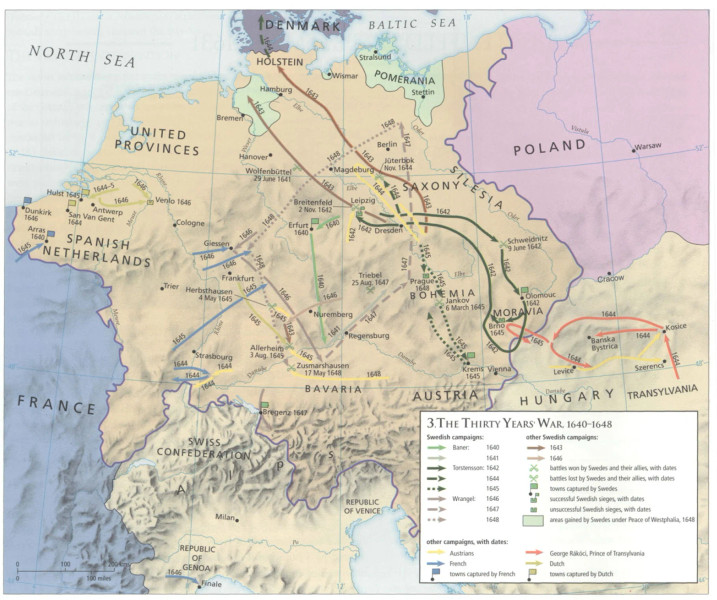
Thirty Years’ War campaigns, 1640-1648
The map highlights the later phase of the conflict, when Swedish and French campaigns cut across the Holy Roman Empire. The empire was devastated by looting, famine, disease, and trade collapse.
What Changed by 1648
The Peace of Westphalia ended the Thirty Years’ War, recognized Dutch independence, and recognized Calvinism alongside Lutheranism and Catholicism. It confirmed, step by step, that neither pope nor emperor could restore one Christian Europe. Territorial rulers gained more authority inside their states. Westphalia did not invent modern states, but it confirmed the move away from universal Christendom.
Limited toleration appeared for practical reasons in the Edict of Nantes, the Dutch Republic, and the Warsaw Confederation in Poland-Lithuania.
Socially, older structures survived even as life changed. Commercialization and urban growth strained cities. The family stayed the basic economic unit, and patriarchy stayed strong. Protestant marriage ideals and closed convents reshaped women’s roles in Protestant lands, while Catholic women still found paths in new orders. Churches and states regulated sex, drinking, Sabbath observance, poor relief, and festivals. Carnival, fairs, charivari, and public punishment still mattered. Witch hunts peaked around 1580 to 1650, fed by fear, war, social tension, and gender assumptions.
Art also changed. Baroque art, especially Bernini and Rubens, projected persuasion and authority. Bernini’s Ecstasy of Saint Teresa, shown here, captures the emotional intensity and theatrical style that made Baroque art such an effective tool of the Catholic Reformation. Mannerism, seen in El Greco, looked less balanced and more strained. Artemisia Gentileschi stands out as a major female artist.
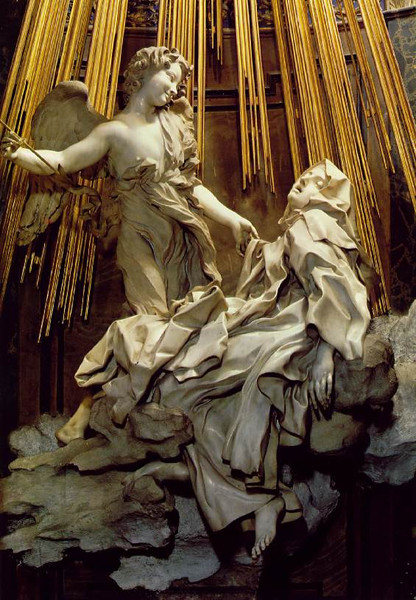
Bernini, Ecstasy of Saint Teresa
Key Takeaways
Confessionalization
Process by which governments and churches defined orthodox belief and enforced worship and conduct, linking confessional identity to political loyalty
Religious Pluralism
Continued coexistence of multiple Christian confessions, usually accepted through limited, pragmatic toleration rather than religious equality
Sovereign State
Territorial political authority recognizing no superior temporal power within its jurisdiction
Notes
Confessionalization
Process by which governments and churches defined orthodox belief and enforced worship and conduct, linking confessional identity to political loyalty
Religious Pluralism
Continued coexistence of multiple Christian confessions, usually accepted through limited, pragmatic toleration rather than religious equality
Sovereign State
Territorial political authority recognizing no superior temporal power within its jurisdiction
