Topic 9.8 Notes – 20th-Century Feminism
How Women’s Status Changed in 20th-Century Europe
Europe entered the 1900s with patriarchal laws and culture. Men dominated politics, universities, and most professions. Middle-class ideals pushed women toward being wives and mothers, even though many working-class women had long done paid labor too.
What changed was huge. Women gained political citizenship, broader education, access to professions, more control over marriage and reproduction, and greater access to public office. What did not disappear was inequality.
The pattern you want in your head is this:
- First-wave feminism pushed hardest for suffrage and basic legal rights.
- Second-wave feminism pushed beyond voting into work, family, sexuality, and representation.
- Economic modernization, mass education, secularization, welfare states, and the world wars all widened women’s roles.
- Western Europe changed mainly through feminist pressure and reform politics.
- Eastern Europe and the Soviet Union changed more through top-down communist policy.
Key terms:
- Occupational segregation means women were concentrated in certain jobs such as teaching, nursing, and clerical work.
- Glass ceiling means invisible barriers blocked women from top positions.
- Double burden or second shift means paid work plus most household labor.
Voting Rights, Education, and Work
Suffrage was the central goal of first-wave feminism, but it arrived at different times in different countries.
| Country | Suffrage date |
|---|---|
| Finland | 1906 |
| Norway | 1913 |
| Denmark | 1915 |
| Russia | 1917 under Provisional Government |
| Britain | 1918 partial, 1928 equal with men |
| Germany | 1918 |
| France | 1944, first voted nationally in 1945 |
| Italy | 1945, voted in 1946 |
| Switzerland | 1971 federal suffrage |
In Britain, campaigns for voting rights included large public demonstrations like this National Union of Women's Suffrage Societies procession.
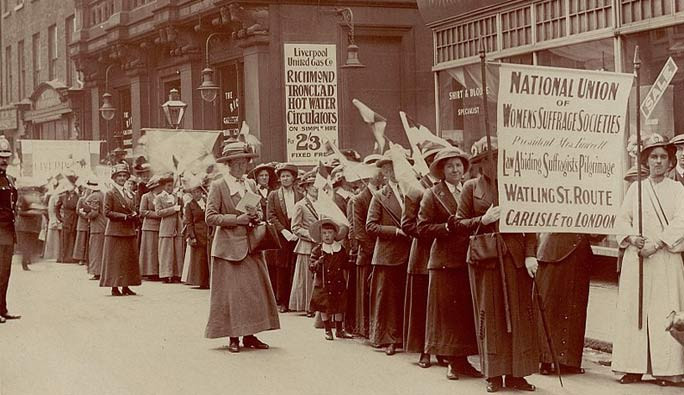
British suffrage march
Suffrage gave women formal political citizenship. It did not give equal power right away. Parties, cabinets, and legislatures stayed mostly male.
The world wars sped up change because women filled jobs in factories, transport, agriculture, offices, and medical care. After World War II, labor shortages and the growth of the service sector pulled even more married women into paid work. Expanded education opened teaching, nursing, clerical work, medicine, law, research, and government service.
Continuities mattered just as much:
- women usually earned less
- women were funneled into “female” jobs
- careers were often interrupted by childrearing
- promotion remained harder
- housework stayed unequal
Second-Wave Feminism and Simone de Beauvoir
From the 1960s to the 1980s, second-wave feminism argued that inequality lived inside everyday life, not just voting laws.
Its major demands included:
- equal pay and equal access to jobs
- access to universities and professions
- anti-discrimination laws
- reform of marriage and divorce
- contraception and abortion access
- recognition of unpaid domestic labor
- protection from harassment and violence
- more women in politics
Methods included demonstrations, lobbying, publications, consciousness-raising, and legal campaigns.
Different strands explained oppression differently:
- Liberal feminism wanted equal rights inside existing institutions.
- Socialist/Marxist feminism tied women’s oppression to capitalism and unpaid labor.
- Radical feminism focused on patriarchy in family, sexuality, and culture.
Simone de Beauvoir
Simone de Beauvoir was a French existentialist writer. In The Second Sex (1949), she argued that woman had been constructed as the subordinate “Other.” Her most famous idea was that gender roles are socially created, not just biological. That helped make private life political.
Key reforms to know:
- Treaty of Rome (1957) included equal pay for equal work.
- Britain’s Equal Pay Act (1970) turned that demand into national law.
Eastern Europe, Family Life, and Reproductive Choice
Communist states promoted formal equality, female education, and high labor-force participation. Women often entered technical and professional fields faster than in some Western countries. But party leadership stayed mostly male, independent feminist activism was restricted, and women still carried the double burden.
Soviet family policy changed with state needs:
- divorce liberalized after 1917
- abortion legalized in 1920
- abortion restricted under Stalin in 1936
- abortion legalized again in 1955
Across Europe, personal life became less rigid. More permissive divorce laws, cohabitation, and delayed marriage gave women more choices. Britain’s Divorce Reform Act of 1969 is a key example.
Reproductive autonomy expanded fast:
- the birth control pill in the early 1960s helped women plan school, work, and family
- France’s Neuwirth Law (1967) legalized contraception
- Simone Veil and the Veil Law (1975) legalized abortion under certain conditions in France
- IVF expanded choice in another direction
- Louise Brown (Britain, 1978) was the first baby born through IVF
Women in High Office and the Big Historical Takeaway
By the late 20th century, women reached top office more often. That showed expanded access, even though equality was still incomplete.
- Margaret Thatcher became Britain’s first female prime minister in 1979.
- Mary Robinson became Ireland’s first female president in 1990.
- Édith Cresson became France’s first female prime minister in 1991.
- Angela Merkel is a major later German example.
France also tried to raise representation through a 1999 constitutional amendment and 2000 parity law.
Key Takeaways
Feminism
Ideas and movements seeking greater political, legal, economic, and social equality for women
First-Wave Feminism
Feminist activism focused chiefly on political and legal rights, especially women’s suffrage
Second-Wave Feminism
Feminist thought and activism from the 1960s through the 1980s addressing inequality in work, education, sexuality, marriage, family life, and culture
Liberal Feminism
Approach seeking equal rights and access for women within existing political, economic, and social institutions
Socialist and Marxist Feminism
Approach connecting women’s subordination to capitalism, class inequality, and unpaid domestic labor
Radical Feminism
Approach emphasizing patriarchal power in sexuality, family life, and culture as a source of women’s subordination
Simone de Beauvoir
French existentialist philosopher whose The Second Sex argued that society constructed women’s dependent roles
The Second Sex
Simone de Beauvoir’s 1949 work arguing that culture made woman the subordinate “Other” rather than femininity following naturally from biology
Western vs. Eastern European Paths to Women’s Equality
Western feminists pressed pluralist governments for reform, while communist states imposed formal equality and female employment but restricted independent activism
Glass Ceiling
Informal or institutional barriers preventing women from reaching an occupation’s highest levels despite the absence of explicit legal exclusion
Occupational Segregation
The concentration of men and women in different kinds or levels of work, often leaving women in lower-paid positions
Double Burden / Second Shift
Women’s combined responsibility for paid employment and a disproportionate share of unpaid housework and childcare
Birth Control Pill
Reliable contraception introduced in Europe in the early 1960s that enabled women to plan childbirth and separate sexual activity more effectively from reproduction
In Vitro Fertilization (IVF)
A reproductive procedure in which an egg is fertilized outside the body and an embryo is transferred to the uterus
Margaret Thatcher
Britain’s first female prime minister, serving from 1979 to 1990; her rise demonstrated women’s access to executive power, not necessarily a feminist program
Mary Robinson
First female president of Ireland, serving from 1990 to 1997
Édith Cresson
France’s first female prime minister, serving from 1991 to 1992
Angela Merkel
Chancellor of Germany from 2005 to 2021 and a prominent example of women’s continued rise to national leadership
Notes
Feminism
Ideas and movements seeking greater political, legal, economic, and social equality for women
First-Wave Feminism
Feminist activism focused chiefly on political and legal rights, especially women’s suffrage
Second-Wave Feminism
Feminist thought and activism from the 1960s through the 1980s addressing inequality in work, education, sexuality, marriage, family life, and culture
Liberal Feminism
Approach seeking equal rights and access for women within existing political, economic, and social institutions
Socialist and Marxist Feminism
Approach connecting women’s subordination to capitalism, class inequality, and unpaid domestic labor
Radical Feminism
Approach emphasizing patriarchal power in sexuality, family life, and culture as a source of women’s subordination
Simone de Beauvoir
French existentialist philosopher whose The Second Sex argued that society constructed women’s dependent roles
The Second Sex
Simone de Beauvoir’s 1949 work arguing that culture made woman the subordinate “Other” rather than femininity following naturally from biology
Western vs. Eastern European Paths to Women’s Equality
Western feminists pressed pluralist governments for reform, while communist states imposed formal equality and female employment but restricted independent activism
Glass Ceiling
Informal or institutional barriers preventing women from reaching an occupation’s highest levels despite the absence of explicit legal exclusion
Occupational Segregation
The concentration of men and women in different kinds or levels of work, often leaving women in lower-paid positions
Double Burden / Second Shift
Women’s combined responsibility for paid employment and a disproportionate share of unpaid housework and childcare
Birth Control Pill
Reliable contraception introduced in Europe in the early 1960s that enabled women to plan childbirth and separate sexual activity more effectively from reproduction
In Vitro Fertilization (IVF)
A reproductive procedure in which an egg is fertilized outside the body and an embryo is transferred to the uterus
Margaret Thatcher
Britain’s first female prime minister, serving from 1979 to 1990; her rise demonstrated women’s access to executive power, not necessarily a feminist program
Mary Robinson
First female president of Ireland, serving from 1990 to 1997
Édith Cresson
France’s first female prime minister, serving from 1991 to 1992
Angela Merkel
Chancellor of Germany from 2005 to 2021 and a prominent example of women’s continued rise to national leadership
