Topic 7.8 Notes – 19th-Century Culture and Arts
How European Art Changed from 1815 to 1914
After the Enlightenment, the French Revolution, and early industrialization, artists stopped agreeing on one standard. The core tension was reason vs. emotion and objective reality vs. subjective experience.
- Romanticism pushed back against Enlightenment rationalism and Neoclassical order. It cared about feeling, imagination, nature, the sublime, the supernatural, and national history.
- Realism pushed back against Romantic heroics, especially after 1848. It turned toward workers, peasants, poverty, and class inequality.
- Modern art asked whether art even had to copy visible reality. It moved toward perception, expressive color, fragmentation, and abstraction.
These were overlapping movements, not a clean sequence. Academic and classical art still mattered the whole time. That’s a favorite exam point. The change was a growing argument over what art was supposed to do.
Romanticism in Art, Literature, and Music
Romanticism made emotion and individuality central. It also helped nationalism by turning folklore, landscapes, myths, and heroic history into symbols of the nation. Delacroix’s Liberty Leading the People, shown here, is a classic example of that mix of emotion, rebellion, and national identity.
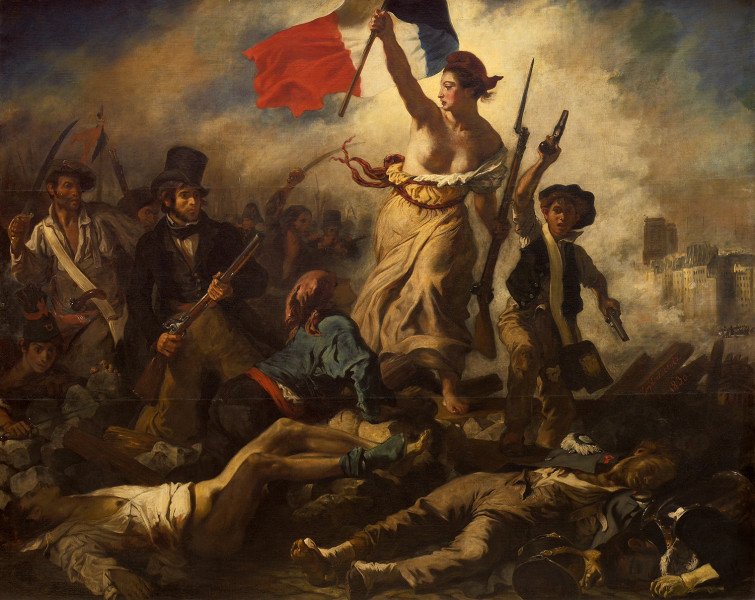
Eugène Delacroix, Liberty Leading the People
Themes
- Emotion over reason
- Nature and the sublime which means awe mixed with fear
- Dreams, madness, imagination, supernatural
- Rebellion and individual genius
- Folklore, medievalism, nationalism
Visual artists
- Francisco Goya, The Third of May 1808 shows horror and suffering in war, not glorious victory.
- Caspar David Friedrich, Wanderer above the Sea of Fog shows one person facing vast, overpowering nature.
- J. M. W. Turner, Rain, Steam and Speed makes nature and industry feel overwhelming at once.
- John Constable, The Hay Wain gives rural landscape emotional meaning.
- Eugène Delacroix, Liberty Leading the People turns revolution into dramatic national myth.
Writers and composers
- Goethe, Faust explores ambition, striving, danger.
- Wordsworth writes about nature and ordinary rural life.
- Lord Byron creates the rebellious Byronic hero and supported Greek independence.
- Percy Shelley ties imagination to liberation.
- John Keats writes about beauty and mortality.
- Mary Shelley, Frankenstein asks what happens when science outruns responsibility.
- Victor Hugo, Les Misérables mixes emotion, history, and social criticism.
- Beethoven bridges Classical and Romantic styles. Think Eroica and the Ninth Symphony.
- Chopin uses Polish forms to express nationalism.
- Wagner uses myth and opera to build German national culture.
- Tchaikovsky is known for emotional orchestral drama.
Realism and Naturalism after 1848
After the failed revolutions of 1848, many artists lost faith in heroic dreams. Industrialization, urban growth, positivism, and materialism pushed attention toward observable social life.
That shift shows up clearly in works like Courbet’s A Burial at Ornans, which gives an ordinary provincial funeral the scale and seriousness earlier artists often reserved for grand historical subjects.
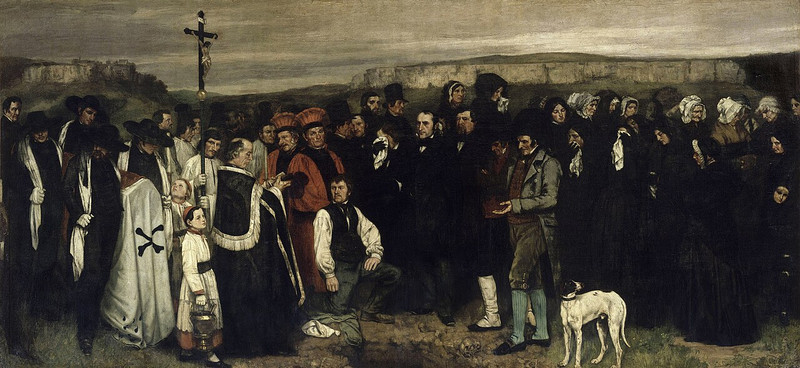
Gustave Courbet, A Burial at Ornans
- Ordinary people replaced heroes
- Workers and peasants got serious treatment
- Poverty, institutions, and class conflict became central subjects
Key figures
- Gustave Courbet, The Stone Breakers and A Burial at Ornans used huge canvases for ordinary life.
- Jean-François Millet, The Gleaners shows peasant labor and inequality.
- Honoré Daumier, caricatures, lithographs, and The Third-Class Carriage criticize bourgeois society.
Writers did the same in novels:
- Balzac, The Human Comedy tracks money and ambition.
- Dickens, Hard Times attacks industrial discipline and utilitarian thinking.
- George Eliot studies gender, morality, provincial life.
- Dostoevsky explores poverty and psychology.
- Tolstoy examines society, war, moral conflict.
- Émile Zola develops naturalism, where heredity and environment shape people.
- Thomas Hardy shows rural disruption and pessimism.
Modern Art and the Break from Representation
Photography took over painting’s old job of recording appearances. At the same time, cities, galleries, critics, and new audiences weakened academy control. Artists gained more freedom to experiment.
Impressionism
You can see that shift clearly in Monet’s Impression, Sunrise, where light, color, and atmosphere matter more than precise detail.
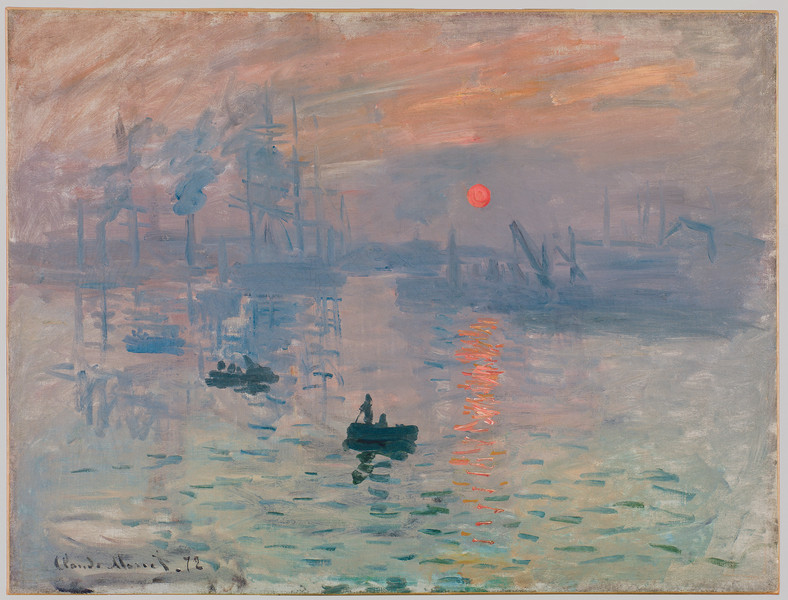
Impression, Sunrise, Claude Monet, 1872
- Monet, Impression, Sunrise, plus haystacks, Rouen Cathedral, and water lilies, studied changing light and atmosphere.
- Degas painted dancers, cafés, and rehearsals with cropped modern viewpoints.
- Manet was a bridge figure, especially through the Salon des Refusés.
Post-Impressionism and Fauvism
- Cézanne, Mont Sainte-Victoire, used structure and geometry.
- Van Gogh, The Starry Night, used expressive color and brushwork.
- Matisse, Woman with a Hat, made color itself expressive in Fauvism.
Cubism
- Picasso, Les Demoiselles d’Avignon, fractured space and used multiple viewpoints. This was a major break from idealized beauty and single-point perspective.
Many people hated modern art because they expected beauty, morality, and patriotism.
Continuity and Change You Should Be Able to Explain
Romanticism moved toward emotion and national feeling. Realism moved toward social observation and criticism. Modern art moved toward perception, expression, and abstraction.
Still, some things stayed the same:
- Art kept responding to revolution, industrialization, nationalism, class conflict, and modern life.
- Academic traditions survived beside new styles.
- Objectivity and subjectivity coexisted the whole time.
Key Takeaways
Academic Art
Officially favored art emphasizing technical finish, recognizable subjects, idealized beauty, and prestigious historical, religious, classical, or patriotic themes
Romanticism
Movement rejecting Neoclassical order and rationalism in favor of emotion, intuition, individuality, nature, the supernatural, and national history
The Sublime
Romantic experience of awe mixed with fear before nature or forces that appear vast, violent, mysterious, or beyond human control
Francisco Goya
Romantic precursor whose The Third of May 1808 used emotional immediacy and harsh contrasts to expose warfare's violence and suffering
Caspar David Friedrich
Romantic painter whose solitary figures and mysterious landscapes, including Wanderer above the Sea of Fog, evoked sublime spiritual contemplation
John Constable
Romantic painter who closely observed weather and light while presenting the English countryside as emotionally meaningful and harmonious
J. M. W. Turner
Romantic painter who dissolved forms into light, color, mist, and motion, making nature and industry appear sublime
Eugène Delacroix
Romantic painter whose Liberty Leading the People transformed the July Revolution into an emotional national myth through allegory and dramatic movement
Johann Wolfgang von Goethe
German writer whose Faust explored intense striving and the creative but dangerous pursuit of knowledge and experience
William Wordsworth
British Romantic poet who found moral and spiritual meaning in nature and ordinary rural life, contrasting them with urban industrial society
Lord Byron
British Romantic poet associated with rebellious, alienated heroes and support for national liberation, especially Greek independence
Percy Bysshe Shelley
British Romantic poet who connected imagination and emotional expression with political liberation and social transformation
John Keats
British Romantic poet concerned with beauty, mortality, imagination, and the intensity of sensory experience
Mary Shelley
Author of Frankenstein, which combined Gothic elements with questions about scientific ambition, isolation, creation, and moral responsibility
Victor Hugo
French author whose Les Misérables combined Romantic heroism and emotion with criticism of poverty, law, and social injustice
Ludwig van Beethoven
Composer who bridged Classical and Romantic music by transforming classical forms through dramatic contrasts, heroic intensity, and personal expression
Frédéric Chopin
Romantic piano composer whose use of Polish dances such as the polonaise and mazurka gave his music nationalist significance
Richard Wagner
Romantic composer who united music, drama, poetry, myth, and stage design in operas drawing on Germanic and Norse legends
Pyotr Ilyich Tchaikovsky
Romantic composer known for emotional melody, dramatic contrasts, large orchestral expression, ballets, and historical works such as the 1812 Overture
Cultural Nationalism
Use of language, folklore, music, medieval history, and legend to portray a nation as an ancient and distinctive cultural community
Positivism
Belief that reliable knowledge comes from empirical and scientific investigation rather than metaphysical speculation
Realism
Movement portraying contemporary ordinary life and material social conditions without heroic idealization, often highlighting poverty, labor, and inequality
Gustave Courbet
Realist painter who gave ordinary labor and provincial life monumental treatment in works such as The Stone Breakers and A Burial at Ornans
Jean-François Millet
Realist painter who dignified strenuous peasant labor while revealing rural poverty and class inequality, notably in The Gleaners
Honoré Daumier
Realist artist and caricaturist who used paintings and mass-circulated prints to criticize corruption, bourgeois society, and urban inequality
Honoré de Balzac
Realist novelist whose Human Comedy portrayed French society as a system shaped by money, ambition, status, and social mobility
Charles Dickens
British novelist who used social observation, satire, sentiment, and serialized plots to expose industrial and urban problems
George Eliot (Mary Ann Evans)
English novelist who examined provincial society and constraints imposed by family, gender, reputation, and moral choice
Fyodor Dostoevsky
Russian Realist novelist who explored poverty, crime, religious doubt, alienation, and extreme psychological states
Leo Tolstoy
Russian Realist novelist who portrayed families, social classes, warfare, and moral conflict with broad scope and psychological depth
Literary Naturalism
Intensified form of literary Realism portraying behavior as shaped by heredity, environment, economic conditions, and bodily drives
Émile Zola
French writer who developed literary naturalism and examined workers, miners, sexuality, and urban life in a quasi-scientific manner
Thomas Hardy
English novelist who portrayed rural communities disrupted by convention, economic change, environment, and forces beyond individual control
Modern Art
Umbrella term for movements that questioned conventional representation and emphasized subjective perception, expressive color and form, or abstraction
Impressionism
Modern movement using visible brushstrokes and broken color to capture fleeting effects of light, atmosphere, movement, and immediate perception
Claude Monet
Leading Impressionist who used broken color and changing light to emphasize temporary perception in Impression, Sunrise and his later series
Edgar Degas
Impressionist associated with dancers, cafés, rehearsals, and racetracks, using cropped figures and unexpected viewpoints influenced by photography and Japanese prints
Édouard Manet
Painter who bridged academic traditions and Impressionism through unconventional paint handling and provocative modernization of older artistic subjects
Salon des Refusés
1863 exhibition of works rejected by the official Paris Salon, marking the declining monopoly of academic artistic institutions
Post-Impressionism
Diverse movement building on Impressionism while emphasizing durable structure, symbolism, emotional intensity, or personal organization of color and form
Paul Cézanne
Post-Impressionist who reconstructed landscapes and still lifes through simplified planes and geometric relationships, helping prepare the way for Cubism
Vincent van Gogh
Post-Impressionist who used forceful brushstrokes and intensified, nonnaturalistic colors to express emotional and spiritual experience
Fauvism
Early-20th-century movement using intense, nonnaturalistic color as an independent means of expression rather than merely imitating appearances
Henri Matisse
Leading Fauvist who made bold, nonnaturalistic color an independent expressive element in works such as Woman with a Hat
Cubism
Movement fragmenting subjects into geometric planes and combining multiple viewpoints, rejecting fixed Renaissance perspective and idealized representation
Pablo Picasso
Co-developer of Cubism whose Les Demoiselles d’Avignon fractured bodies and space while rejecting idealized beauty and coherent classical perspective
Georges Braque
French painter who co-developed Cubism with Picasso by fragmenting objects and space into geometric planes and multiple viewpoints
Notes
Academic Art
Officially favored art emphasizing technical finish, recognizable subjects, idealized beauty, and prestigious historical, religious, classical, or patriotic themes
Romanticism
Movement rejecting Neoclassical order and rationalism in favor of emotion, intuition, individuality, nature, the supernatural, and national history
The Sublime
Romantic experience of awe mixed with fear before nature or forces that appear vast, violent, mysterious, or beyond human control
Francisco Goya
Romantic precursor whose The Third of May 1808 used emotional immediacy and harsh contrasts to expose warfare's violence and suffering
Caspar David Friedrich
Romantic painter whose solitary figures and mysterious landscapes, including Wanderer above the Sea of Fog, evoked sublime spiritual contemplation
John Constable
Romantic painter who closely observed weather and light while presenting the English countryside as emotionally meaningful and harmonious
J. M. W. Turner
Romantic painter who dissolved forms into light, color, mist, and motion, making nature and industry appear sublime
Eugène Delacroix
Romantic painter whose Liberty Leading the People transformed the July Revolution into an emotional national myth through allegory and dramatic movement
Johann Wolfgang von Goethe
German writer whose Faust explored intense striving and the creative but dangerous pursuit of knowledge and experience
William Wordsworth
British Romantic poet who found moral and spiritual meaning in nature and ordinary rural life, contrasting them with urban industrial society
Lord Byron
British Romantic poet associated with rebellious, alienated heroes and support for national liberation, especially Greek independence
Percy Bysshe Shelley
British Romantic poet who connected imagination and emotional expression with political liberation and social transformation
John Keats
British Romantic poet concerned with beauty, mortality, imagination, and the intensity of sensory experience
Mary Shelley
Author of Frankenstein, which combined Gothic elements with questions about scientific ambition, isolation, creation, and moral responsibility
Victor Hugo
French author whose Les Misérables combined Romantic heroism and emotion with criticism of poverty, law, and social injustice
Ludwig van Beethoven
Composer who bridged Classical and Romantic music by transforming classical forms through dramatic contrasts, heroic intensity, and personal expression
Frédéric Chopin
Romantic piano composer whose use of Polish dances such as the polonaise and mazurka gave his music nationalist significance
Richard Wagner
Romantic composer who united music, drama, poetry, myth, and stage design in operas drawing on Germanic and Norse legends
Pyotr Ilyich Tchaikovsky
Romantic composer known for emotional melody, dramatic contrasts, large orchestral expression, ballets, and historical works such as the 1812 Overture
Cultural Nationalism
Use of language, folklore, music, medieval history, and legend to portray a nation as an ancient and distinctive cultural community
Positivism
Belief that reliable knowledge comes from empirical and scientific investigation rather than metaphysical speculation
Realism
Movement portraying contemporary ordinary life and material social conditions without heroic idealization, often highlighting poverty, labor, and inequality
Gustave Courbet
Realist painter who gave ordinary labor and provincial life monumental treatment in works such as The Stone Breakers and A Burial at Ornans
Jean-François Millet
Realist painter who dignified strenuous peasant labor while revealing rural poverty and class inequality, notably in The Gleaners
Honoré Daumier
Realist artist and caricaturist who used paintings and mass-circulated prints to criticize corruption, bourgeois society, and urban inequality
Honoré de Balzac
Realist novelist whose Human Comedy portrayed French society as a system shaped by money, ambition, status, and social mobility
Charles Dickens
British novelist who used social observation, satire, sentiment, and serialized plots to expose industrial and urban problems
George Eliot (Mary Ann Evans)
English novelist who examined provincial society and constraints imposed by family, gender, reputation, and moral choice
Fyodor Dostoevsky
Russian Realist novelist who explored poverty, crime, religious doubt, alienation, and extreme psychological states
Leo Tolstoy
Russian Realist novelist who portrayed families, social classes, warfare, and moral conflict with broad scope and psychological depth
Literary Naturalism
Intensified form of literary Realism portraying behavior as shaped by heredity, environment, economic conditions, and bodily drives
Émile Zola
French writer who developed literary naturalism and examined workers, miners, sexuality, and urban life in a quasi-scientific manner
Thomas Hardy
English novelist who portrayed rural communities disrupted by convention, economic change, environment, and forces beyond individual control
Modern Art
Umbrella term for movements that questioned conventional representation and emphasized subjective perception, expressive color and form, or abstraction
Impressionism
Modern movement using visible brushstrokes and broken color to capture fleeting effects of light, atmosphere, movement, and immediate perception
Claude Monet
Leading Impressionist who used broken color and changing light to emphasize temporary perception in Impression, Sunrise and his later series
Edgar Degas
Impressionist associated with dancers, cafés, rehearsals, and racetracks, using cropped figures and unexpected viewpoints influenced by photography and Japanese prints
Édouard Manet
Painter who bridged academic traditions and Impressionism through unconventional paint handling and provocative modernization of older artistic subjects
Salon des Refusés
1863 exhibition of works rejected by the official Paris Salon, marking the declining monopoly of academic artistic institutions
Post-Impressionism
Diverse movement building on Impressionism while emphasizing durable structure, symbolism, emotional intensity, or personal organization of color and form
Paul Cézanne
Post-Impressionist who reconstructed landscapes and still lifes through simplified planes and geometric relationships, helping prepare the way for Cubism
Vincent van Gogh
Post-Impressionist who used forceful brushstrokes and intensified, nonnaturalistic colors to express emotional and spiritual experience
Fauvism
Early-20th-century movement using intense, nonnaturalistic color as an independent means of expression rather than merely imitating appearances
Henri Matisse
Leading Fauvist who made bold, nonnaturalistic color an independent expressive element in works such as Woman with a Hat
Cubism
Movement fragmenting subjects into geometric planes and combining multiple viewpoints, rejecting fixed Renaissance perspective and idealized representation
Pablo Picasso
Co-developer of Cubism whose Les Demoiselles d’Avignon fractured bodies and space while rejecting idealized beauty and coherent classical perspective
Georges Braque
French painter who co-developed Cubism with Picasso by fragmenting objects and space into geometric planes and multiple viewpoints
