Topic 3.4 Notes – Economic Development and Mercantilism
What Mercantilism Was
Mercantilism was a state-directed economic system. The basic idea was simple. Wealth and trade were treated as competitive, often like a zero-sum game. If one state gained trade and bullion, a rival lost ground.
Governments wanted a favorable balance of trade. That meant exporting more than importing so money, especially gold and silver, would flow in. But mercantilism was never just about bullion.
It also valued:
- shipping because carrying goods produced profits and strengthened navies
- manufacturing because finished goods brought in more value than raw materials
- raw materials because states wanted secure supplies
- colonies because they provided resources, markets, and strategic ports
- taxable trade because customs revenue helped pay armies and bureaucracies
This built on older European habits like tariffs, monopolies, and long-distance trade. What changed after 1648 was scale, state control, and imperial integration.
Mercantilism worked with early capitalism:
- Private merchants, investors, plantation owners, and manufacturers chased profit.
- States used tariffs, subsidies, navigation laws, chartered companies, colonial restrictions, navies, and ports to steer that profit toward national power.
By the late 1700s, Adam Smith attacked monopolies and overregulation in The Wealth of Nations (1776). Freer-trade ideas spread, but mercantilist practices did not vanish.
How States Used Colonies and Trade Networks
Under mercantilism, colonies existed to benefit the mother country, not to be equal partners.
Colonies supplied:
- raw materials like timber, cotton, dyestuffs, and metals
- plantation crops like sugar, tobacco, coffee, and later more cotton
- markets for European textiles, tools, metalware, ceramics, and weapons
- customs revenue, ports, and naval bases
Colonial economies were tied to metropolitan interests. Colonies exported commodities. The mother country shipped, refined, taxed, and reexported them.
Trade was also bigger than the Atlantic world.
- The Atlantic system linked Europe, Africa, and the Americas through triangular trade, where European goods went to Africa, enslaved people were shipped to the Americas, and colonial products returned to Europe.
- Asian trade brought tea, silk, cotton textiles, spices, and porcelain.
That exam point matters. Overseas regions gave Europe both raw materials and finished luxury or manufactured goods.
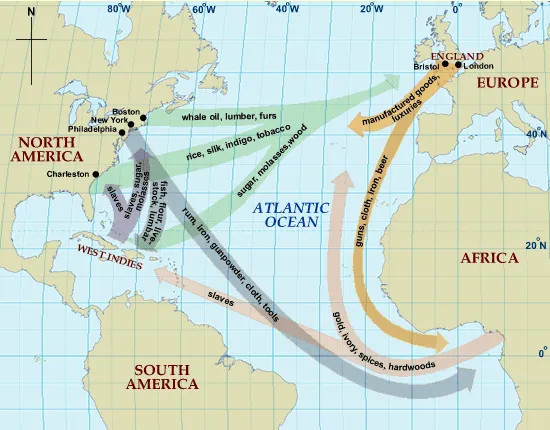
Atlantic triangular trade network
Chartered companies
These companies linked state power and private capital.
- English East India Company
- Dutch East India Company
- French trading companies
They had monopoly rights, which lowered risk and pooled capital for expensive overseas trade. They also often became corrupt or inefficient.
Mercantilist rules were never perfectly enforced. Smuggling and illegal trade mattered because distance and profit made regulation messy.
France and Britain as Mercantilist Models
Two classic examples show that mercantilism was used by different kinds of states.
Colbertism in France
Under Louis XIV, Jean-Baptiste Colbert pushed state-backed industry. He promoted textiles, glass, tapestries, and luxury goods through subsidies, standards, tariffs, canals, ports, shipbuilding, naval growth, and colonial expansion.
The goal was to strengthen exports, reduce dependence on imports, raise royal revenue, and build state power. The weakness was France’s constant warfare. War costs and weak finances limited success.
The Navigation Acts
England’s first major Navigation Act came in 1651 and expanded after the Restoration. These laws aimed at Dutch shipping power.
They required much trade to travel on English or colonial ships. Enumerated goods like tobacco and sugar had to move through English imperial channels. This helped build a British trading system and fed into the Anglo-Dutch Wars.
Plantation Trade, Slavery, and Consumer Culture
Rising European demand for colonial goods drove plantation expansion. Sugar was the most important and most labor-intensive crop. Tobacco, coffee, rice, indigo, and later cotton also mattered.
Labor systems shifted toward racialized hereditary slavery. Millions of Africans were forcibly sent across the Atlantic. The Middle Passage was the brutal ocean crossing. Enslaved people resisted through revolt, sabotage, escape, and cultural survival.
One of the most famous abolitionist images showed just how tightly people were packed aboard slave ships during the Middle Passage.
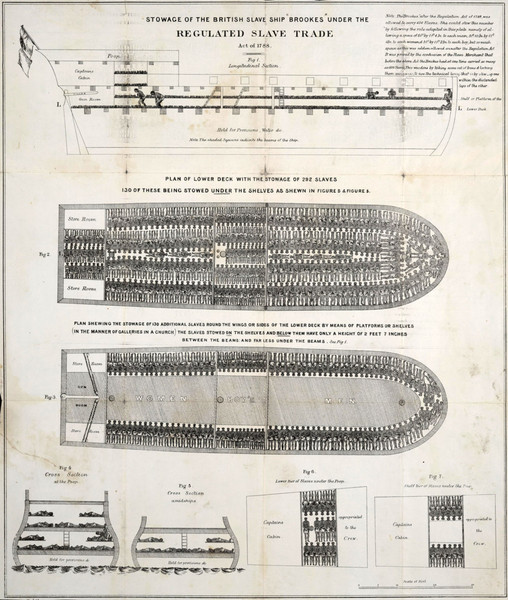
Slave ship Brookes diagram
Triangular trade is the standard model:
- European manufactured goods to Africa
- Enslaved Africans to the Americas
- American commodities to Europe
It was not one fixed route, but it shows the interdependence clearly.
Overseas goods fueled an 18th-century consumer revolution. Europeans bought sugar, tea, coffee, tobacco, rum, silk, cotton textiles, chocolate, and porcelain. Tea and coffee usually went with plantation sugar. Coffeehouses and shops became part of new commercial culture, and imported or imitation goods spread beyond elites.
Why Overseas Commerce Mattered to Europe
Overseas commerce changed Europe itself. American crops increased the food supply. The potato mattered most in the 18th century, and maize spread especially in southern and eastern Europe. Along with Agricultural Revolution changes, this supported population growth.
Port cities grew stronger:
- London
- Liverpool
- Bristol
- Bordeaux
- Nantes
- Amsterdam
- Lisbon
Overseas trade brought raw materials, markets, shipping profits, insurance, finance, and investment capital. It helped lay foundations for later industrialization, though it was never the only cause.
There was continuity too. Europe stayed mostly rural, regulation stayed strong, and coerced labor remained central. The big changes were larger Atlantic trade, more slave trading, tighter colonial integration, and wider access to overseas goods.
Key Takeaways
Mercantilism
Early modern system of state-directed commerce that used tariffs, monopolies, colonies, and protected trade to increase national wealth and power
Favorable Balance of Trade
A condition in which exports exceed imports, producing a surplus expected to bring money and bullion into the country
Mother Country (Metropolitan State)
The imperial state that controlled a colony and directed its resources, markets, and trade toward metropolitan interests
Colbertism
Jean-Baptiste Colbert’s French mercantilist program of tariffs, subsidies, production standards, infrastructure, colonial expansion, and support for manufacturing and shipping
Navigation Acts
English laws beginning in 1651 that reserved much imperial trade for English ships and routed specified colonial goods and imports through England
Chartered Trading Company
A private company granted a government monopoly over trade in a region, sometimes with authority to build forts, govern settlements, negotiate, or wage war
Joint-Stock Company
A business in which multiple investors purchased shares and divided the profits or losses of costly commercial ventures
European-Dominated Worldwide Economic Network
An integrated system linking Europe, Africa, Asia, and the Americas in which Europeans gained disproportionate control over shipping, colonial markets, and oceanic trade routes
Atlantic System
The commercial network linking Europe, Africa, and the Americas through manufactured goods, enslaved people, plantation commodities, foodstuffs, and precious metals
Plantation Agriculture
Large-scale commercial farming organized to produce export crops such as sugar, tobacco, coffee, rice, indigo, and cotton with bound or enslaved labor
Transatlantic Slave-Labor System
The racialized, hereditary system that used enslaved Africans and their descendants as coerced labor, especially on American plantations
Transatlantic Slave Trade
The forced transportation and sale of millions of Africans across the Atlantic to supply enslaved labor in the Americas
Triangular Trade
Model of Atlantic trade in which European goods went to Africa, enslaved Africans went to the Americas, and American commodities went to Europe
Middle Passage
The brutal Atlantic crossing that forcibly carried enslaved Africans from Africa to the Americas under deadly, overcrowded conditions
Consumer Revolution (Rise of Consumer Culture)
The eighteenth-century expansion of purchases by broader social groups of imported and commercially produced goods such as sugar, tea, coffee, tobacco, textiles, and porcelain
Notes
Mercantilism
Early modern system of state-directed commerce that used tariffs, monopolies, colonies, and protected trade to increase national wealth and power
Favorable Balance of Trade
A condition in which exports exceed imports, producing a surplus expected to bring money and bullion into the country
Mother Country (Metropolitan State)
The imperial state that controlled a colony and directed its resources, markets, and trade toward metropolitan interests
Colbertism
Jean-Baptiste Colbert’s French mercantilist program of tariffs, subsidies, production standards, infrastructure, colonial expansion, and support for manufacturing and shipping
Navigation Acts
English laws beginning in 1651 that reserved much imperial trade for English ships and routed specified colonial goods and imports through England
Chartered Trading Company
A private company granted a government monopoly over trade in a region, sometimes with authority to build forts, govern settlements, negotiate, or wage war
Joint-Stock Company
A business in which multiple investors purchased shares and divided the profits or losses of costly commercial ventures
European-Dominated Worldwide Economic Network
An integrated system linking Europe, Africa, Asia, and the Americas in which Europeans gained disproportionate control over shipping, colonial markets, and oceanic trade routes
Atlantic System
The commercial network linking Europe, Africa, and the Americas through manufactured goods, enslaved people, plantation commodities, foodstuffs, and precious metals
Plantation Agriculture
Large-scale commercial farming organized to produce export crops such as sugar, tobacco, coffee, rice, indigo, and cotton with bound or enslaved labor
Transatlantic Slave-Labor System
The racialized, hereditary system that used enslaved Africans and their descendants as coerced labor, especially on American plantations
Transatlantic Slave Trade
The forced transportation and sale of millions of Africans across the Atlantic to supply enslaved labor in the Americas
Triangular Trade
Model of Atlantic trade in which European goods went to Africa, enslaved Africans went to the Americas, and American commodities went to Europe
Middle Passage
The brutal Atlantic crossing that forcibly carried enslaved Africans from Africa to the Americas under deadly, overcrowded conditions
Consumer Revolution (Rise of Consumer Culture)
The eighteenth-century expansion of purchases by broader social groups of imported and commercially produced goods such as sugar, tea, coffee, tobacco, textiles, and porcelain
