Topic 4.7 Notes – Causation in the Age of the Scientific Revolution and the Enlightenment
How Reason and Natural Law Challenged Tradition
Europeans did not wake up one day and invent reason. The shift grew out of earlier changes that had already weakened a single unquestioned authority.
- The Renaissance brought back Greek and Roman texts, which gave Europeans more than one intellectual tradition to compare.
- Printing spread arguments fast and made it harder for one institution to control knowledge.
- Exploration showed that ancient writers did not know everything about the world.
- The Reformation shattered Christian unity, so Europe no longer had one accepted religious voice.
Once natural philosophers proved that old explanations of the heavens or body could be wrong, people started asking a dangerous question. If authorities were wrong about nature, why not about politics, economics, or religion too?
Natural law mattered here. Many thinkers believed nature and human life followed discoverable rules. That fed the idea of progress, the belief that society could improve through reason. On the exam, be careful here. Science did not automatically create democracy. It created habits of criticism that made unjust or irrational institutions easier to challenge.
How the Scientific Revolution Undermined Inherited Knowledge
New standards of knowledge
- Francis Bacon pushed empiricism. Knowledge should come from observation and experiment, then move upward through inductive reasoning.
- René Descartes pushed rationalism. Start with doubt, then use logic and deduction to reach reliable truth.
- The scientific method blended these habits. Observation, measurement, experiment, and logic became the new standard.
Astronomy and the mechanical universe
The clearest early challenge to inherited knowledge came in astronomy. Once thinkers began questioning the old Earth-centered model, they opened the door to a much broader rethinking of authority.
- Copernicus, On the Revolutions of the Heavenly Spheres (1543), argued for heliocentrism, which challenged Ptolemy’s Earth-centered universe.
- Tycho Brahe gathered careful observations that Kepler used.
- Kepler showed planets moved in elliptical orbits, not perfect circles.
- Galileo used a telescope to see Jupiter’s moons, Venus’s phases, and sunspots. The heavens were not perfect.
- In 1633, the Roman Inquisition condemned Galileo. That became the classic symbol of conflict between new science and church authority.
- Newton, in Principia (1687), united heaven and earth with laws of motion and universal gravitation.
Anatomy and medicine
- Vesalius, On the Fabric of the Human Body, used human dissection to correct Galen.
- William Harvey explained the circulation of blood.
- Paracelsus promoted chemical remedies over old humoral theory.
Older beliefs still stayed alive. Alchemy, astrology, and humoral medicine continued, and even Kepler and Newton engaged with them. The change was growing scientific authority, not total replacement.
How Enlightenment Thinkers Challenged Government, Economics, and Religion
Enlightenment thinkers disagreed with each other, but they shared the habit of using reason against custom.
| Area | Thinkers and ideas |
|---|---|
| Political | Locke argued for natural rights, consent, and resistance to tyranny. Montesquieu wanted separation of powers. Rousseau argued for popular sovereignty and the general will. Beccaria attacked torture and arbitrary punishment. |
| Economic | Physiocrats like Quesnay and Turgot attacked mercantilist controls and argued for a natural economic order. Adam Smith, The Wealth of Nations, praised division of labor, competition, and less state control. |
| Religious | Deists believed in a rational creator but downplayed miracles and revelation. Voltaire attacked intolerance and clerical privilege. Hume doubted miracles and certainty. d’Holbach went further toward atheism. |
Equality had limits. Mary Wollstonecraft and Condorcet supported women’s equality, but Rousseau still defended traditional gender roles.
How Enlightenment Ideas Spread and Changed Society
Ideas mattered because they spread beyond scholars into public life.
- Diderot and d’Alembert’s Encyclopédie gathered and spread useful, critical knowledge.
- Enlightenment discussion flourished in salons, coffeehouses, academies, lending libraries, reading societies, Masonic lodges, newspapers, pamphlets, and the Republic of Letters.
- This helped create public opinion, a force outside direct court and church control.
An aristocratic salon like the one below shows one of the social spaces where elite discussion helped circulate Enlightenment ideas.
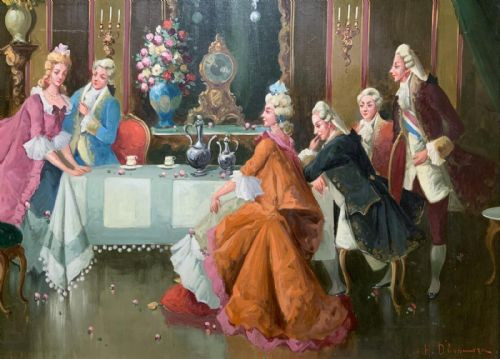
Eighteenth-century salon
Enlightened absolutism
- Frederick II of Prussia supported toleration and legal reform, but also strengthened the army and state.
- Joseph II of Austria issued a toleration patent, reformed the church, limited serfdom, and centralized administration.
- Maria Theresa laid groundwork with earlier reforms.
These rulers used Enlightenment ideas to make states more efficient. They did not create popular sovereignty.
Everyday life changed too. The Agricultural Revolution, better transport, and steadier food supplies helped population growth. Lady Mary Wortley Montagu promoted smallpox inoculation, which came before Jenner’s later vaccination. People married later, cities grew, consumer goods spread, homes became more private, and childhood received more attention.
