Topic 1.6 Notes – Technological Advances and the Age of Exploration
How European Exploration Became Possible
Europeans did not “discover” world trade from scratch. They already bought Asian goods through Venice and other Mediterranean and Middle Eastern intermediaries. What changed was the desire for a more direct route to spices, luxury goods, and precious metals.
At the same time, stronger monarchies in Portugal and Spain could do what smaller feudal rulers could not:
- Fund voyages that were expensive and risky
- Grant charters and legal backing to merchants and explorers
- Protect trade with armed ships
- Turn exploration into lasting empire
The key distinction here is huge for tests. Technology explains how Europeans could expand. Economic, political, and religious motives explain why they wanted to.
Europeans also borrowed and adapted knowledge from many places:
- Compass and gunpowder came from China
- The astrolabe was developed further in the Islamic world
- Lateen sails and sailing techniques came from Mediterranean and Indian Ocean traditions
These connected sea routes help show what that expansion eventually looked like, with Iberian ports linked to the Atlantic world, Africa, Asia, and the Americas.
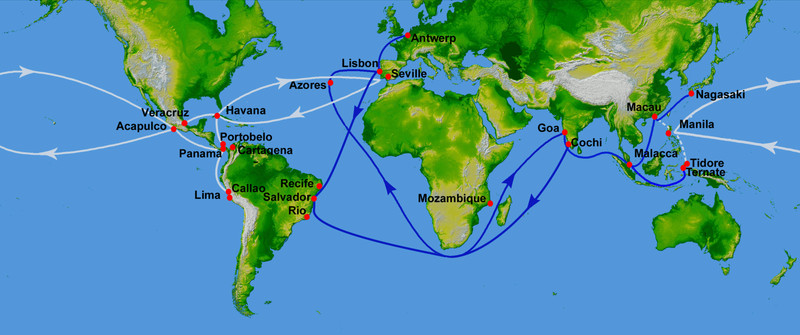
Early modern oceanic trade routes
The Technologies That Made Overseas Expansion Work
No single invention did this alone. Oceanic expansion came from a combination of tools and practical seamanship.
- Magnetic compass gave sailors direction when they could not see land. It helped them keep a heading across open water, often with dead reckoning. It did not tell exact location.
- Quadrant and astrolabe helped estimate latitude by measuring the sun or stars. They did not determine longitude, so they could not tell sailors exactly where they were.
- Portolani were detailed nautical charts with coastlines, harbors, hazards, and compass bearings. Better voyages improved maps, and better maps improved later voyages.
- Sternpost rudder made larger ships easier to steer and control.
- Lateen rig used triangular sails that let ships tack and sail closer to the wind. They still could not sail directly into it.
- Caravel was the classic Portuguese ship. It was light, maneuverable, had a shallow draft, and could use flexible sail plans.
- Volta do mar showed that knowing winds and currents mattered as much as instruments. Sailors sometimes had to go farther out into the Atlantic to catch the right winds home.
- Guns and gunpowder let Europeans attack or defend ports, forts, and sea lanes. Still, cannon alone did not guarantee control. Europeans often needed local allies and existing trade networks.
A caravel pulls several of these features together, especially the lateen sails that helped make Portuguese voyages more flexible.
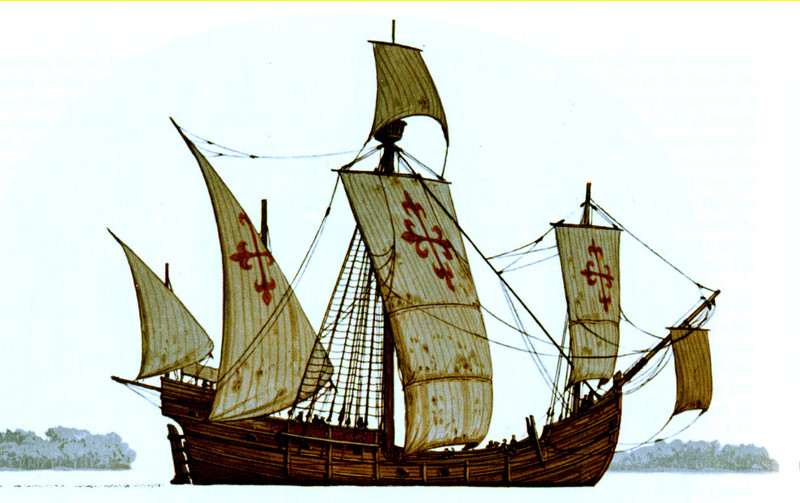
Portuguese caravel
Why European States Backed Exploration
Gold, spices, and luxury goods
Rulers and merchants wanted direct access to pepper, cloves, cinnamon, silk, porcelain, gold, and silver. Cutting out middlemen meant more profit and more tax revenue. Wealth then financed war, government, and royal prestige.
Mercantilism
Mercantilism treated trade as a source of state power.
| Idea | What it meant |
|---|---|
| Wealth = power | Bullion and profitable trade strengthened the state |
| Colonies matter | They supplied raw materials and markets |
| Government role | States used regulation, monopolies, chartered companies, and navies |
Jean-Baptiste Colbert is the classic example, even though he comes a bit later. He shows the same logic clearly.
Christianity
After the Reconquista and the conquest of Granada in 1492, Iberian rulers linked expansion with spreading the faith. Christianity was a real motive, and it also became a justification for conquest and forced cultural change.
Jesuits are the standard example:
- Ignatius of Loyola founded the order
- Francis Xavier worked in Goa, Southeast Asia, and Japan
- Matteo Ricci entered China by using mathematics, astronomy, and cultural accommodation
The Main Exploration Patterns and Examples
- Portugal in the Indian Ocean
- Prince Henry the Navigator sponsored early voyages
- Bartolomeu Dias rounded the Cape of Good Hope in 1488
- Vasco da Gama reached India in 1498
- Portugal built a trading-post empire at places like Goa and Malacca
- Cabral claimed Brazil in 1500
- Spain in the Atlantic and Americas
- Ferdinand and Isabella backed Columbus in 1492
- Columbus wanted Asia, but reached the Caribbean
- Spain then moved into conquest and colonization
- Cortés conquered the Aztecs
- Pizarro conquered the Incas
- Magellan-Elcano completed the first circumnavigation, 1519 to 1522
- Dutch in Asian trade
- In the seventeenth century, the Dutch challenged Portugal in the East Indies
- Their success showed how merchant capital + armed fleets + state support worked together
What Exploration Immediately Changed
These voyages created direct sea links across the Atlantic, Indian, and Pacific worlds. Portugal built a commercial empire, Spain built a territorial empire rich in silver, and the Dutch entered the Asian spice trade. Europeans also established colonies, forts, ports, missions, and trade networks overseas, which shifted power toward Atlantic-facing states.
Columbus’s 1493 letter is the key source example. His claim is that the voyage benefited Spain. His evidence is wealth, possession of land, and people who could be converted. That source is great because it shows the motives overlapping in one document.
Key Takeaways
Magnetic Compass
A magnetized needle that indicated north and south, allowing sailors to maintain headings across open water
Dead Reckoning
Estimating a ship’s current position from its previous position, course, speed, and elapsed time
Quadrant
A quarter-circle instrument used to estimate latitude by measuring the altitude of the sun or a star
Mariner’s Astrolabe
A weighted circular instrument used to estimate latitude from the angle of the sun or a star above the horizon
Portolani / Portolan Charts
Nautical charts showing coastlines, ports, hazards, distances, and rhumb lines representing compass bearings
Sternpost Rudder
A vertical rudder at a ship’s rear that improved steering, stability, and maneuverability
Lateen Rig / Lateen Sail
A triangular fore-and-aft sail that allowed ships to sail closer to the wind and tack
Caravel
A light, maneuverable Portuguese ship with a shallow draft and lateen or mixed sails, suited to Atlantic and coastal exploration
Volta do Mar
Portuguese technique of sailing west into the Atlantic to find winds that carried ships north and east toward Europe
Cartography
Mapmaking and the systematic recording of coastlines, harbors, routes, distances, winds, currents, and latitude
Gunpowder Weapons
Shipboard cannon and handheld firearms used to attack vessels and ports and defend overseas forts and trading positions
Prince Henry the Navigator
Portuguese prince who sponsored expeditions, mapmaking, and maritime activity along Africa’s coast but rarely sailed himself
Bartolomeu Dias
Portuguese navigator who rounded southern Africa in 1488, proving that the Atlantic and Indian Oceans were connected by sea
Vasco da Gama
Portuguese navigator who reached India by sailing around Africa in 1498, opening a direct European maritime route to the Indian Ocean
Portuguese Trading-Post Empire
Portugal’s network of fortified ports and trading posts intended to control strategic sea-lanes and commerce around Africa and across the Indian Ocean
Ferdinand and Isabella
Spanish monarchs who completed the conquest of Granada and financed Columbus’s 1492 westward voyage
Columbus’s 1493 Letter
Report that claimed Caribbean islands for Spain and portrayed them as profitable and receptive to conversion to demonstrate the voyage’s value to the crown
Magellan-Elcano Expedition / First Circumnavigation
1519–1522 expedition begun by Ferdinand Magellan and completed by Juan Sebastián Elcano that first sailed around the globe
Mercantilism
Policies treating commerce and colonies as sources of state power through regulated trade, monopolies, exports, precious metals, and limits on imports
Reconquista
Centuries of Christian expansion against Muslim-ruled states in Iberia, ending with Spain’s conquest of Granada in 1492
Society of Jesus / Jesuits
Catholic missionary order founded by Ignatius of Loyola that spread Christianity through missions, education, diplomacy, and selective cultural accommodation
Christopher Columbus
Navigator sponsored by Spain who sailed west seeking Asia in 1492 but reached the Caribbean, initiating sustained Spanish expansion in the Americas
Notes
Magnetic Compass
A magnetized needle that indicated north and south, allowing sailors to maintain headings across open water
Dead Reckoning
Estimating a ship’s current position from its previous position, course, speed, and elapsed time
Quadrant
A quarter-circle instrument used to estimate latitude by measuring the altitude of the sun or a star
Mariner’s Astrolabe
A weighted circular instrument used to estimate latitude from the angle of the sun or a star above the horizon
Portolani / Portolan Charts
Nautical charts showing coastlines, ports, hazards, distances, and rhumb lines representing compass bearings
Sternpost Rudder
A vertical rudder at a ship’s rear that improved steering, stability, and maneuverability
Lateen Rig / Lateen Sail
A triangular fore-and-aft sail that allowed ships to sail closer to the wind and tack
Caravel
A light, maneuverable Portuguese ship with a shallow draft and lateen or mixed sails, suited to Atlantic and coastal exploration
Volta do Mar
Portuguese technique of sailing west into the Atlantic to find winds that carried ships north and east toward Europe
Cartography
Mapmaking and the systematic recording of coastlines, harbors, routes, distances, winds, currents, and latitude
Gunpowder Weapons
Shipboard cannon and handheld firearms used to attack vessels and ports and defend overseas forts and trading positions
Prince Henry the Navigator
Portuguese prince who sponsored expeditions, mapmaking, and maritime activity along Africa’s coast but rarely sailed himself
Bartolomeu Dias
Portuguese navigator who rounded southern Africa in 1488, proving that the Atlantic and Indian Oceans were connected by sea
Vasco da Gama
Portuguese navigator who reached India by sailing around Africa in 1498, opening a direct European maritime route to the Indian Ocean
Portuguese Trading-Post Empire
Portugal’s network of fortified ports and trading posts intended to control strategic sea-lanes and commerce around Africa and across the Indian Ocean
Ferdinand and Isabella
Spanish monarchs who completed the conquest of Granada and financed Columbus’s 1492 westward voyage
Columbus’s 1493 Letter
Report that claimed Caribbean islands for Spain and portrayed them as profitable and receptive to conversion to demonstrate the voyage’s value to the crown
Magellan-Elcano Expedition / First Circumnavigation
1519–1522 expedition begun by Ferdinand Magellan and completed by Juan Sebastián Elcano that first sailed around the globe
Mercantilism
Policies treating commerce and colonies as sources of state power through regulated trade, monopolies, exports, precious metals, and limits on imports
Reconquista
Centuries of Christian expansion against Muslim-ruled states in Iberia, ending with Spain’s conquest of Granada in 1492
Society of Jesus / Jesuits
Catholic missionary order founded by Ignatius of Loyola that spread Christianity through missions, education, diplomacy, and selective cultural accommodation
Christopher Columbus
Navigator sponsored by Spain who sailed west seeking Asia in 1492 but reached the Caribbean, initiating sustained Spanish expansion in the Americas
