Topic 3.8 Notes – Comparison in the Age of Absolutism and Constitutionalism
Sovereignty in the Age of Absolutism and Constitutionalism
After the Peace of Westphalia in 1648, Europe moved further away from the old idea that pope or emperor stood above everyone else. States claimed authority inside their own borders. That shift is what sovereignty means here. It asks where final political power rests inside a state.
The map below helps place that turning point. Westphalia did not create neat modern nation-states overnight, but it did strengthen the idea that rulers controlled politics within their own territories.
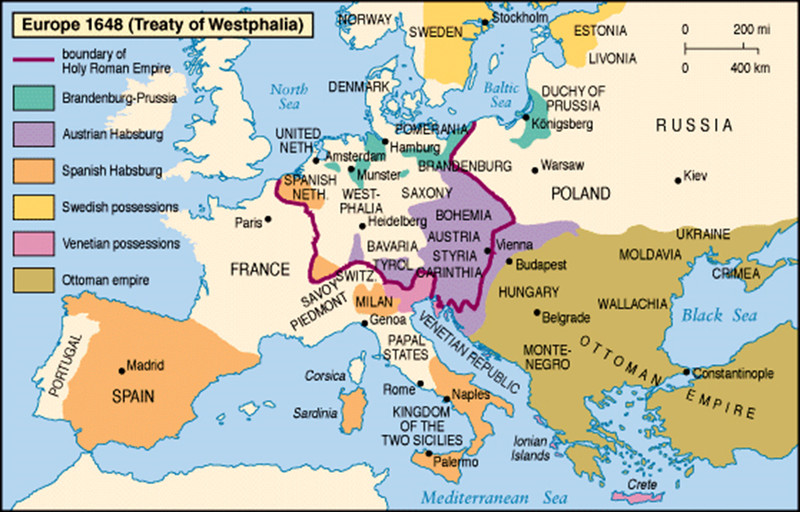
Europe after the Peace of Westphalia, 1648
Two main answers appeared:
- Absolutism put ultimate authority in the monarch. The ruler claimed control over law, taxes, administration, the military, and often religion.
- Constitutionalism limited the ruler through law and required power-sharing with representative bodies or corporate institutions.
Neither was democratic. In both systems, nobles and wealthy elites kept privilege. The difference was who governed with them and how much the ruler was restrained.
How Absolutism Worked
Absolutism tried to centralize power and weaken the independence of nobles, provinces, churches, and estates. Its classic defense was divine-right monarchy, especially in the writings of Jacques-Bénigne Bossuet, who argued kings ruled by God’s authority.
Still, absolutism had limits. Kings had to work around noble privilege, provincial rights, weak tax systems, and local customs.
France under Louis XIV
Louis XIV became the model absolutist ruler. The Fronde (1648-1653) was a revolt by nobles and judges against royal authority. Its failure helped the monarchy come back stronger.
- The Estates-General did not meet after 1614, so Louis ruled without a national representative body.
- Intendants carried royal power into the provinces and supervised taxes, justice, and order.
- Versailles helped control nobles by keeping them close to court, where status depended on royal favor.
- Colbert pushed mercantilism through tariffs, monopolies, regulated manufactures, and a favorable balance of trade.
- Louis built a large standing army and bigger bureaucracy.
- In 1685 he revoked the Edict of Nantes, attacking Huguenots and enforcing Catholic unity.
- Limits remained. Tax exemptions, venal offices, and uneven collection kept France fiscally weak.
The Palace of Versailles captures the style and scale Louis XIV used to project royal power and keep nobles tied to court life.

Hall of Mirrors, Palace of Versailles
Russia under Peter the Great
Peter used westernization to strengthen the state, not to make Russia liberal.
- He expanded the army and built a navy.
- The Table of Ranks tied noble standing to state service.
- St. Petersburg symbolized a western-facing Russia.
- The Holy Synod brought the Orthodox Church under state control.
- The poll tax and harsher serfdom show the coercive side of Russian absolutism.
- Catherine the Great kept centralizing power while preserving noble privilege.
How Constitutionalism Worked
Constitutional states still had kings or ruling elites, but power operated under law and bargaining became part of government.
England
England’s system came out of conflict over taxes, religion, and royal power under James I and Charles I.
- English Civil War
- Execution of Charles I in 1649
- Unstable Cromwell period
- Restoration of the monarchy
- Glorious Revolution of 1688 removes James II
- William and Mary accept limits on royal power
The Bill of Rights (1689) said no suspending laws, no taxation, and no standing army in peacetime without Parliament. This established parliamentary sovereignty. In the 1700s, cabinet government and the prime minister grew gradually. The Toleration Act gave limited freedom to Protestants, not full religious equality.
Dutch Republic
The Dutch Republic was a different answer to absolutism. It was a confederal republic, not a monarchy.
- Independence recognized in Westphalia
- Provinces kept major autonomy
- Power was shared by urban regents, landholders, provincial estates, and the States General
- The stadholder from the House of Orange could be powerful, but not absolute
- Dutch strength came from commerce, Amsterdam finance, and overseas trade
- Toleration was practical but incomplete
The Best Side-by-Side Comparison
| Issue | France and Russia | England | Dutch Republic |
|---|---|---|---|
| Sovereignty | Crown | Crown-in-Parliament | Dispersed among provinces and oligarchies |
| Elites | Kept privilege, less independent politically | Kept privilege and governed directly | Merchant and landholding oligarchs governed |
| Tax and war | More coercive extraction | Parliamentary taxation and public credit | Commercial wealth supported power |
| Religion | More state control and uniformity | Anglican state with limited toleration | Reformed Church privileged, more pluralism |
All of them used mercantilism, chartered companies, colonial trade, and slavery. The difference was not participation in the global economy. It was how rulers and elites worked together inside the state. England’s Bank of England (1694) and funded national debt made its fiscal-military state especially strong.
Why Europe Developed Different Political Systems
Different outcomes came from different starting institutions and different conflicts.
- England already had a strong Parliament.
- The Dutch Republic had strong provincial institutions.
- France and Russia had weaker or more subordinated representative bodies.
- The Fronde failed in France, which helped absolutism.
- The English Civil War and Glorious Revolution blocked absolutism.
Centralization also faced resistance from regions and corporate groups.
- The Catalan revolt showed resistance to central demands.
- After 1688, Scotland and Ireland remained major problem areas for the English state.
- Across Europe, local privileges kept states from becoming fully uniform.
A great counterexample is the Polish-Lithuanian Commonwealth. Its elective monarchy and liberum veto gave nobles so much power that the state became weak and paralyzed.
Key Takeaways
Corporate Group
A legally recognized body, such as a noble estate, church, town, guild, provincial assembly, or university, possessing collective rights and privileges
Notes
Corporate Group
A legally recognized body, such as a noble estate, church, town, guild, provincial assembly, or university, possessing collective rights and privileges
