Topic 5.5 Notes – The French Revolution’s Effects
What the French Revolution Changed in Political and Social Thought
Before 1789, most of Europe still rested on monarchy, hereditary privilege, and established churches. The Revolution shook that whole system by saying political power came from the nation, not from God giving authority to kings.
Core principles
The Revolution pushed Enlightenment ideas into real politics:
- Natural rights meant people had rights because they were human, not because a ruler granted them.
- Popular sovereignty meant authority rested in the people or nation.
- Legal equality meant the law should apply to citizens equally, instead of giving nobles special privileges.
- Citizenship replaced older ideas of being a subject who simply obeyed.
- Consent of the governed meant government was legitimate only if the people accepted it.
The clearest statement was the Declaration of the Rights of Man and of the Citizen in 1789.
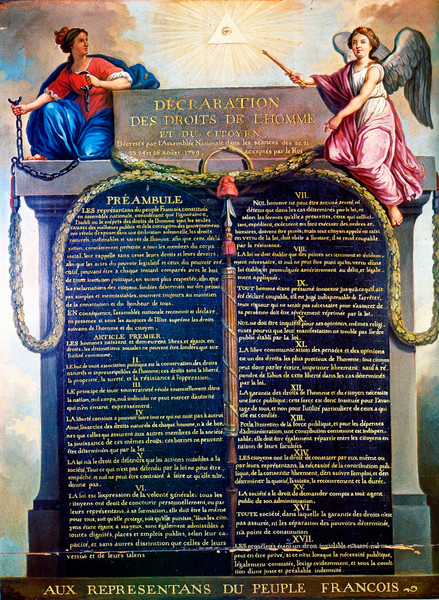
Declaration of the Rights of Man and of the Citizen, 1789
- Men are born free and equal in rights.
- Sovereignty resides in the nation.
- Law expresses the general will.
That challenged:
- Divine-right monarchy
- Aristocratic and feudal privilege
- Corporate rights of estates, guilds, provinces, and churches
- Obedience based on inherited status
The famous ideals were liberty, equality, fraternity. Be careful with equality, though. In AP Euro, this usually means legal equality, not equal wealth, full women’s rights, racial equality, or universal suffrage.
How Revolutionary Ideas Spread and Why They Were Contradictory
These ideas spread fast through newspapers, pamphlets, speeches, songs, symbols, festivals, political clubs, and war. French armies carried revolutionary language across Europe, and the Atlantic world carried it into the colonies.
This also made mass politics stronger than ever:
- crowds in the streets
- petitions
- clubs like the Jacobins
- print culture
- mass armies fighting for the nation
The huge pattern here is universal language vs limited application.
- France proclaimed liberty while still keeping colonial slavery for a time.
- Women took part in politics but were denied full citizenship.
- Poor people, religious minorities, free people of color, and enslaved people used revolutionary language to demand inclusion.
That is one of the most testable ideas in this topic. The Revolution changed the terms of debate even when governments refused to live up to their own words.
The Haitian Revolution as the Biggest Global Effect
The sharpest example of those contradictions came in Saint-Domingue, France’s richest colony.
Saint-Domingue
- Wealth came from sugar and coffee plantations.
- The economy depended on brutal slave labor.
- Society was deeply divided among whites, free people of color, and an enslaved majority.
French revolutionary ideas hit each group differently:
- White planters wanted more autonomy
- Free people of color demanded equal rights
- Enslaved people demanded freedom
The revolution in Haiti
- A major slave uprising began in 1791.
- Toussaint L’Ouverture, a formerly enslaved man, became the key military and political leader.
- French commissioners emancipated enslaved people in 1793.
- The French National Convention abolished slavery in the empire in 1794.
- Toussaint’s 1801 constitution kept emancipation and a nominal link to France.
- Napoleon sent an expedition in 1802 to restore control.
- Toussaint was captured and died in France, but Jean-Jacques Dessalines continued the fight.
- Haiti declared independence in 1804.
Haiti matters because it was the first successful large-scale enslaved people’s revolt and the first independent Black republic in the modern Atlantic world. French ideas mattered, but so did plantation brutality, war, and weakened imperial control.
Supporters of Revolution and the Expansion of Rights
Revolutionary supporters judged institutions by reason and rights, not just by age or tradition.
| Thinker | Key work | Main idea |
|---|---|---|
| Thomas Paine | Rights of Man (1791-1792) | Rights belong to living people; government needs consent |
| Mary Wollstonecraft | A Vindication of the Rights of Men (1790); A Vindication of the Rights of Woman (1792) | Women seemed inferior because education trained them for dependence |
Wollstonecraft is especially important because she applied natural-rights logic to women and exposed the gap between universal principles and actual exclusion.
Burke and the Conservative Backlash
Edmund Burke answered the Revolution in Reflections on the Revolution in France (1790). He was not against all reform. He feared sudden, abstract rebuilding of society.
Burke argued:
- Society is an organic inheritance
- Institutions contain the wisdom of generations
- Monarchy, aristocracy, and church help preserve order
- Abstract rights without institutions lead to instability
- Destroying inherited authority can lead to mob rule or tyranny
The Reign of Terror seemed to prove his warning through executions, purges, de-Christianization, and coercion.
A key distinction:
- Reactionary = wants to reverse revolution entirely
- Conservative = prefers order, continuity, and gradual reform
By 1815, the mixed legacy was obvious. The Revolution inspired equality claims and emancipation, but it also inspired repression, fear of disorder, and organized conservatism.
Key Takeaways
Declaration of the Rights of Man and of the Citizen
The 1789 declaration that proclaimed natural rights, legal equality, national sovereignty, and law as the expression of the general will
Liberty, Equality, Fraternity
Revolutionary slogan linking freedom from arbitrary authority, equality before the law, and solidarity among citizens
Mass Politics
Political participation by broad populations through crowds, petitions, demonstrations, clubs, print culture, and military mobilization
Saint-Domingue
France’s wealthy sugar- and coffee-producing slave colony in western Hispaniola, where the Haitian Revolution began
Haitian Revolution
The 1791–1804 revolt of enslaved and formerly enslaved people in Saint-Domingue that defeated France and created independent Haiti
Toussaint L’Ouverture
Formerly enslaved political and military leader who defended emancipation, defeated foreign forces, and became the dominant leader of revolutionary Saint-Domingue
Thomas Paine — Rights of Man
Paine’s 1791–1792 defense of the French Revolution, arguing that natural rights and consent of the governed outweighed inherited authority
Mary Wollstonecraft — A Vindication of the Rights of Woman
Wollstonecraft’s 1792 argument that women’s apparent inferiority resulted from unequal education and that natural rights reasoning should include women
Edmund Burke — Reflections on the Revolution in France
Burke’s 1790 critique warning that destroying inherited institutions in favor of abstract rights would produce disorder, violence, and tyranny
Conservatism
An ideology favoring order, inherited institutions, social continuity, and gradual reform over sudden revolutionary reconstruction
Reactionary Politics
The effort to reverse revolutionary changes and restore an earlier political or social order
Notes
Declaration of the Rights of Man and of the Citizen
The 1789 declaration that proclaimed natural rights, legal equality, national sovereignty, and law as the expression of the general will
Liberty, Equality, Fraternity
Revolutionary slogan linking freedom from arbitrary authority, equality before the law, and solidarity among citizens
Mass Politics
Political participation by broad populations through crowds, petitions, demonstrations, clubs, print culture, and military mobilization
Saint-Domingue
France’s wealthy sugar- and coffee-producing slave colony in western Hispaniola, where the Haitian Revolution began
Haitian Revolution
The 1791–1804 revolt of enslaved and formerly enslaved people in Saint-Domingue that defeated France and created independent Haiti
Toussaint L’Ouverture
Formerly enslaved political and military leader who defended emancipation, defeated foreign forces, and became the dominant leader of revolutionary Saint-Domingue
Thomas Paine — Rights of Man
Paine’s 1791–1792 defense of the French Revolution, arguing that natural rights and consent of the governed outweighed inherited authority
Mary Wollstonecraft — A Vindication of the Rights of Woman
Wollstonecraft’s 1792 argument that women’s apparent inferiority resulted from unequal education and that natural rights reasoning should include women
Edmund Burke — Reflections on the Revolution in France
Burke’s 1790 critique warning that destroying inherited institutions in favor of abstract rights would produce disorder, violence, and tyranny
Conservatism
An ideology favoring order, inherited institutions, social continuity, and gradual reform over sudden revolutionary reconstruction
Reactionary Politics
The effort to reverse revolutionary changes and restore an earlier political or social order
