Topic 1.5 Notes – New Monarchies
What New Monarchies Were
New monarchies were western European kingdoms whose rulers increased direct control over their lands between 1450 and 1648. “New” does not mean fully modern or fully absolute. It means they had more central authority than medieval kings.
A map of Europe around 1500 helps show the pattern. Larger kingdoms like England, France, and Spain stand out next to the political patchwork of Italy and the Holy Roman Empire.
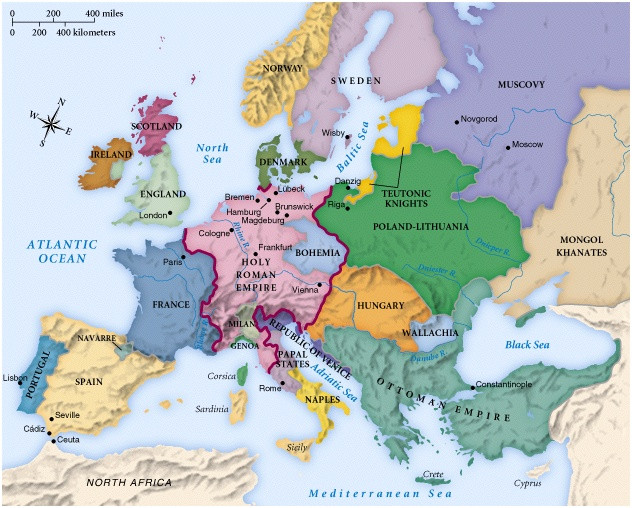
Europe around 1500
The core change was a move away from feudal fragmentation toward sovereignty inside a defined territory. Kings tried to make the crown, not nobles or church courts, the highest authority.
They laid groundwork for the modern state by gaining more control over:
- taxation so rulers could fund government regularly
- military force so nobles could not fight private wars
- justice so subjects depended more on royal courts
- religion so rulers could shape belief and public order
The strongest examples were the Tudors in England, the Valois in France, and Ferdinand and Isabella in Spain. That contrast matters because Italy and the Holy Roman Empire stayed politically divided, which is exactly what the map makes easy to spot.
Centralization became possible because:
- nobles were weakened by conflict such as the Wars of the Roses
- gunpowder and professional armies reduced the importance of feudal knights
- growing commerce gave monarchs more tax money and access to loans
- Renaissance-trained lawyers helped build bureaucracies
- the Reformation let rulers take charge of religion from above
How Monarchs Built Central Power
These monarchies did not grow through one policy. They grew by combining money, force, law, and religion.
Taxation and administration
Regular taxes paid for officials, armies, diplomacy, and courts. Monarchs built councils and bureaucracies with written records. In France, the taille was a major direct tax.
Still, kings were not all-powerful. Tax exemptions, local privileges, and representative bodies limited them.
Military force
Rulers reduced private noble armies. Artillery and mercenary or professional soldiers favored kings who had money.
- France moved closest to a standing army.
- Spain strengthened royal military control through the conquest of Granada in 1492.
- England relied less on a standing army and more on controlling nobles through law and finance.
Royal justice
Royal courts extended crown power into local areas. People could appeal beyond a feudal lord, which made monarchy useful to many subjects.
A key English example was the Star Chamber under Henry VII. It punished powerful nobles who might escape ordinary courts. Bonds and recognizances were financial threats that kept nobles obedient.
Religion and morality
Religion remained central to political order. Rulers did not separate church and state. They tried to supervise worship, clergy, and moral behavior.
Know these examples together:
| Example | What it shows |
|---|---|
| Spanish Inquisition | monarchy used religion to enforce Catholic unity |
| Concordat of Bologna | French king gained power to nominate bishops and abbots |
| Book of Common Prayer | English crown standardized worship |
| Peace of Augsburg | rulers chose religion in their territories |
| Edict of Nantes | monarchy used limited toleration to restore order |
The Main New Monarchies
Spain under Ferdinand and Isabella
Their marriage united Castile and Aragon dynastically, but Spain was still not a fully unified state. They used corregidores and the Santa Hermandad to enforce royal authority, cut noble independence, and strengthen the military. The Spanish Inquisition targeted conversos and tied Catholic uniformity to loyalty. In 1492, Jews were expelled and Muslims faced growing pressure.
France under the Valois
Louis XI weakened major nobles, especially Burgundy. France developed stronger taxation and military institutions than England. The Concordat of Bologna in 1516 let Francis I nominate top clergy. Selling offices expanded the state, and nobles of the robe rose through legal and administrative service. Henry IV’s Edict of Nantes in 1598 gave limited rights to Huguenots to restore order.
Tudor England
Henry VII restored order after Bosworth and the Wars of the Roses. He used the Star Chamber, the royal council, and financial penalties against nobles. Local rule depended heavily on the gentry and justices of the peace. Henry VIII’s Act of Supremacy in 1534 made the king head of the Church of England, and the dissolution of the monasteries increased royal wealth. Elizabeth I restored the Anglican settlement, and the Book of Common Prayer enforced common worship.
Fragmentation, Territorial Religion, and New Political Thinking
The places that stayed divided mattered too, because they show the limits of centralization and helped produce new political ideas.
In the Holy Roman Empire, the emperor could not impose one religion. The Peace of Augsburg in 1555 established cuius regio, eius religio. The ruler determined the territory’s religion. It recognized Catholicism and Lutheranism, not Calvinism, and it was not modern religious freedom. The empire’s patchwork of territories helps explain why this settlement mattered. The Peace of Westphalia in 1648 later reinforced the sovereignty of territorial rulers.
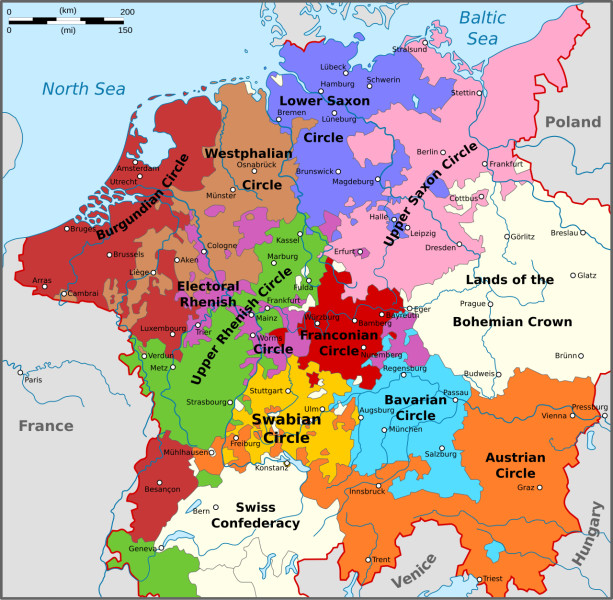
Holy Roman Empire territorial fragmentation
Renaissance Italy stayed divided among Florence, Venice, Milan, Naples, and the Papal States. That fragmentation encouraged more secular political analysis.
- Machiavelli, in The Prince, explained politics through power, necessity, virtù, fortuna, and reason of state.
- Jean Bodin, in Six Books of the Commonwealth, defined sovereignty as absolute and perpetual power in the state.
- Hugo Grotius, in On the Law of War and Peace, used natural law to help lay the foundation for international law between sovereign states.
Effects and Limits of New Monarchies
These monarchies created more centralized taxation, justice, and military organization. Noble independence and private warfare declined. Religion became more tightly controlled by the state. Merchants, financiers, lawyers, gentry, and nobles of the robe gained influence because rulers needed their money and skills.
The limits matter just as much:
- England still depended on Parliament.
- France kept provincial privileges and noble tax exemptions.
- Spain remained a composite monarchy.
- Italy and the Holy Roman Empire stayed fragmented.
Key Takeaways
New Monarchies
Late-fifteenth- and early-sixteenth-century monarchies that increased crown control over taxation, armed force, justice, administration, and religion, laying foundations for centralized modern states
Sovereignty / Sovereign State
Supreme political authority within a defined territory; a sovereign state claims final authority against independent nobles, churches, cities, assemblies, and foreign powers
Composite Monarchy
A monarchy whose territories share a ruler but retain separate laws, institutions, privileges, and tax systems, as Castile and Aragon did
Wars of the Roses
English dynastic wars that weakened the nobility and ended with Henry VII’s victory in 1485, enabling Tudor centralization
Ferdinand of Aragon and Isabella of Castile / Catholic Monarchs
Their 1469 marriage created a dynastic union that strengthened royal administration, military power, and Catholic conformity while leaving Castile and Aragon institutionally separate
Corregidores
Royal officials appointed to represent Ferdinand and Isabella and enforce crown authority in Castilian towns
Santa Hermandad
Crown-directed federation of local Castilian militias that suppressed disorder and enforced royal justice under Ferdinand and Isabella
Conquest of Granada
Ferdinand and Isabella’s 1492 conquest of the last Muslim-ruled kingdom on the Iberian Peninsula, enhancing the monarchy’s military prestige
Spanish Inquisition
Royal-controlled tribunal authorized in 1478 to investigate alleged heresy, initially among conversos, and enforce Catholic religious conformity
Expulsion of the Jews from Spain
Ferdinand and Isabella’s 1492 expulsion of practicing Jews, enforcing Catholic conformity while causing persecution, migration, and loss of skilled populations
Louis XI
French new monarch who used diplomacy, war, patronage, and administrative pressure to weaken rival princes and expand Valois royal authority
Taille
Direct royal tax that gave the French crown regular revenue for administration and military forces, reducing dependence on the Estates-General
Concordat of Bologna
The 1516 agreement allowing the French king to nominate bishops and abbots while the pope formally confirmed them, expanding royal control over the French Church
Nobles of the Robe vs. Nobles of the Sword
Nobles of the robe gained status through law, officeholding, and royal service; nobles of the sword claimed status from hereditary landholding and military service
Edict of Nantes
Henry IV’s 1598 settlement granting Huguenots limited worship, civil protections, and fortified places while preserving Catholicism as France’s official religion
Henry VII
First Tudor king, who strengthened the English crown by restricting noble retainers, using royal justice and financial penalties, and cooperating with gentry and local officials
Court of Star Chamber
Tudor royal court derived from the king’s council that used juryless procedures to punish powerful offenders and curb aristocratic independence
Bonds and Recognizances
Financial obligations used by Henry VII to bind nobles to good behavior and impose costly penalties for disobedience
Justices of the Peace
Local officials drawn mainly from the English gentry who administered royal law in the counties without requiring a large paid bureaucracy
Henry VIII
Tudor king who used Parliament to sever England from Rome and establish crown supremacy over the English church after the pope refused his annulment
Act of Supremacy
The 1534 statute recognizing Henry VIII as supreme head of the Church of England and formalizing England’s institutional break with Rome
Dissolution of the Monasteries
Henry VIII’s suppression of English monasteries and seizure of their property, much of which the crown sold or granted to lay elites
English Reformation
Top-down religious transformation in which the Tudor crown broke with Rome, created a national church, and used law and standardized worship to control religion
Book of Common Prayer
Standard English-language liturgy first issued under Edward VI and restored in modified form by Elizabeth I to enforce uniform worship in the national church
Elizabeth I
Tudor queen whose 1559 religious settlement restored royal supremacy and required outward conformity to standardized Church of England worship
Peace of Augsburg / Cuius Regio, Eius Religio
The 1555 settlement recognizing Catholic and Lutheran territories under the principle that each territorial ruler would determine the territory’s religion
Peace of Westphalia
The 1648 settlement ending the Thirty Years’ War, recognizing Calvinism and confirming the authority of territorial rulers within the Holy Roman Empire
Medici Family
Florentine banking and merchant family that converted commercial wealth into political authority in Renaissance Italy
Fugger Family
Northern European financier family that gained influence by lending large sums to dynastic rulers
Political Fragmentation of Renaissance Italy
Division of Italy among competing city-states, principalities, republics, and the Papal States, with no ruler able to centralize the peninsula
Secular State
A conception of political authority analyzed through power, law, security, and human behavior rather than solely through church claims or Christian moral theology
Niccolò Machiavelli and The Prince
Machiavelli’s 1513 analysis of how rulers acquire and preserve power through force, deception, public opinion, and adaptation to necessity
Virtù
Machiavelli’s term for a ruler’s capacity to act decisively, adapt to circumstances, and shape political outcomes
Fortuna
Machiavelli’s term for the unpredictable conditions and chance events that an effective ruler must master as far as possible
Jean Bodin and Six Books of the Commonwealth
Bodin’s 1576 work defined sovereignty as absolute, perpetual, supreme, and indivisible authority needed to prevent civil disorder
Hugo Grotius and On the Law of War and Peace
Grotius’s 1625 work argued that reason-based natural law governed war, treaties, property, and relations among sovereign states, helping found international law
Notes
New Monarchies
Late-fifteenth- and early-sixteenth-century monarchies that increased crown control over taxation, armed force, justice, administration, and religion, laying foundations for centralized modern states
Sovereignty / Sovereign State
Supreme political authority within a defined territory; a sovereign state claims final authority against independent nobles, churches, cities, assemblies, and foreign powers
Composite Monarchy
A monarchy whose territories share a ruler but retain separate laws, institutions, privileges, and tax systems, as Castile and Aragon did
Wars of the Roses
English dynastic wars that weakened the nobility and ended with Henry VII’s victory in 1485, enabling Tudor centralization
Ferdinand of Aragon and Isabella of Castile / Catholic Monarchs
Their 1469 marriage created a dynastic union that strengthened royal administration, military power, and Catholic conformity while leaving Castile and Aragon institutionally separate
Corregidores
Royal officials appointed to represent Ferdinand and Isabella and enforce crown authority in Castilian towns
Santa Hermandad
Crown-directed federation of local Castilian militias that suppressed disorder and enforced royal justice under Ferdinand and Isabella
Conquest of Granada
Ferdinand and Isabella’s 1492 conquest of the last Muslim-ruled kingdom on the Iberian Peninsula, enhancing the monarchy’s military prestige
Spanish Inquisition
Royal-controlled tribunal authorized in 1478 to investigate alleged heresy, initially among conversos, and enforce Catholic religious conformity
Expulsion of the Jews from Spain
Ferdinand and Isabella’s 1492 expulsion of practicing Jews, enforcing Catholic conformity while causing persecution, migration, and loss of skilled populations
Louis XI
French new monarch who used diplomacy, war, patronage, and administrative pressure to weaken rival princes and expand Valois royal authority
Taille
Direct royal tax that gave the French crown regular revenue for administration and military forces, reducing dependence on the Estates-General
Concordat of Bologna
The 1516 agreement allowing the French king to nominate bishops and abbots while the pope formally confirmed them, expanding royal control over the French Church
Nobles of the Robe vs. Nobles of the Sword
Nobles of the robe gained status through law, officeholding, and royal service; nobles of the sword claimed status from hereditary landholding and military service
Edict of Nantes
Henry IV’s 1598 settlement granting Huguenots limited worship, civil protections, and fortified places while preserving Catholicism as France’s official religion
Henry VII
First Tudor king, who strengthened the English crown by restricting noble retainers, using royal justice and financial penalties, and cooperating with gentry and local officials
Court of Star Chamber
Tudor royal court derived from the king’s council that used juryless procedures to punish powerful offenders and curb aristocratic independence
Bonds and Recognizances
Financial obligations used by Henry VII to bind nobles to good behavior and impose costly penalties for disobedience
Justices of the Peace
Local officials drawn mainly from the English gentry who administered royal law in the counties without requiring a large paid bureaucracy
Henry VIII
Tudor king who used Parliament to sever England from Rome and establish crown supremacy over the English church after the pope refused his annulment
Act of Supremacy
The 1534 statute recognizing Henry VIII as supreme head of the Church of England and formalizing England’s institutional break with Rome
Dissolution of the Monasteries
Henry VIII’s suppression of English monasteries and seizure of their property, much of which the crown sold or granted to lay elites
English Reformation
Top-down religious transformation in which the Tudor crown broke with Rome, created a national church, and used law and standardized worship to control religion
Book of Common Prayer
Standard English-language liturgy first issued under Edward VI and restored in modified form by Elizabeth I to enforce uniform worship in the national church
Elizabeth I
Tudor queen whose 1559 religious settlement restored royal supremacy and required outward conformity to standardized Church of England worship
Peace of Augsburg / Cuius Regio, Eius Religio
The 1555 settlement recognizing Catholic and Lutheran territories under the principle that each territorial ruler would determine the territory’s religion
Peace of Westphalia
The 1648 settlement ending the Thirty Years’ War, recognizing Calvinism and confirming the authority of territorial rulers within the Holy Roman Empire
Medici Family
Florentine banking and merchant family that converted commercial wealth into political authority in Renaissance Italy
Fugger Family
Northern European financier family that gained influence by lending large sums to dynastic rulers
Political Fragmentation of Renaissance Italy
Division of Italy among competing city-states, principalities, republics, and the Papal States, with no ruler able to centralize the peninsula
Secular State
A conception of political authority analyzed through power, law, security, and human behavior rather than solely through church claims or Christian moral theology
Niccolò Machiavelli and The Prince
Machiavelli’s 1513 analysis of how rulers acquire and preserve power through force, deception, public opinion, and adaptation to necessity
Virtù
Machiavelli’s term for a ruler’s capacity to act decisively, adapt to circumstances, and shape political outcomes
Fortuna
Machiavelli’s term for the unpredictable conditions and chance events that an effective ruler must master as far as possible
Jean Bodin and Six Books of the Commonwealth
Bodin’s 1576 work defined sovereignty as absolute, perpetual, supreme, and indivisible authority needed to prevent civil disorder
Hugo Grotius and On the Law of War and Peace
Grotius’s 1625 work argued that reason-based natural law governed war, treaties, property, and relations among sovereign states, helping found international law
