Topic 9.15 Notes – Continuity and Change in the 20th and 21st Centuries
What It Meant to Be European by the 21st Century
In 1914, Europe was mostly about nation-states, empires, and rivalry. By the 2000s, it had become a more layered identity tied to democracy, social welfare, human rights, and institutions like the EU.
Three dates anchor the whole story:
- 1914 begins the age of total war and the collapse of the old order.
- 1945 ends fascism’s rise and begins Cold War division, reconstruction, and integration.
- 1989-1991 marks the fall of communism and the spread of democracy and capitalism eastward.
The best overall claim is this: Europe changed a lot, but nationalism, sovereignty fights, ethnic conflict, inequality, and religious difference stayed powerful.
From Total War and Ideological Conflict to a Divided Europe
The two world wars destroyed the Europe that had dominated the world.
- Total war meant governments controlled factories, labor, food, propaganda, and civilian life on a huge scale.
- After World War I, four empires collapsed:
- German
- Russian
- Austro-Hungarian
- Ottoman
The interwar years were unstable. The Great Depression weakened faith in liberal democracy and helped authoritarian movements grow.
Rival ideologies
These systems answered the same question differently. How much power should the state have over people?
| Ideology | Core idea |
|---|---|
| Liberal democracy | representative government, civil liberties, pluralism |
| Communism | central planning, one-party control, limited civil rights |
| Fascism | authoritarian nationalism, mass mobilization, repression, militarism |
Nazi Germany became the most extreme form of racial nationalism. The Holocaust, genocide, forced migration, and mass bombing showed how destructive a modern state could become.
After 1945, much of Europe reacted against that history with stronger support for constitutional government, antiracism, and human rights. That postwar divide lasted for decades, then began to break down in 1989.
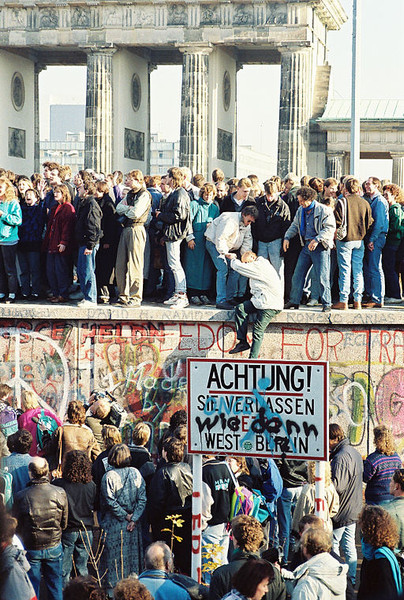
Crowds at the Berlin Wall, 1989
Cold War Division and the End of Communism
Europe did not reunite after World War II. It split into West and East.
West
- Marshall Plan funded reconstruction.
- NATO tied western Europe to the United States.
- Politics and society leaned toward capitalism, parliamentary democracy, and consumer prosperity.
East
- Soviet domination shaped politics.
- COMECON coordinated communist economies.
- Warsaw Pact organized the military bloc.
- Life included planned economies, censorship, secret police, and restricted movement.
Churchill called this the Iron Curtain. The clearest symbols were divided Germany and the Berlin Wall.
The USSR also crushed dissent:
- Hungarian Revolt, 1956
- Prague Spring, 1968
Even with deep differences, both blocs shared one continuity. The state played a larger role in daily life and social provision than it had before 1914.
Collapse of communism
- Economic stagnation hit the Soviet bloc in the 1970s-1980s.
- Gorbachev introduced perestroika and glasnost.
- Reform opened criticism instead of saving the system.
- Solidarity in Poland helped break communist control.
- The Berlin Wall fell in 1989.
- Germany reunified in 1990.
- The Soviet Union dissolved in 1991.
The result was more democracy and capitalism, but also privatization, unemployment, and uneven transitions.
Integration and Nationalism at the Same Time
Western Europeans wanted to prevent another Franco-German war, so they tied their economies together.
- European Coal and Steel Community, 1951
- Treaty of Rome and EEC, 1957
- Maastricht Treaty and EU, 1992-1993
- Euro and freer movement across borders for many states
The map sequence shows how that integration widened over time, from the original core to a much larger European Union.
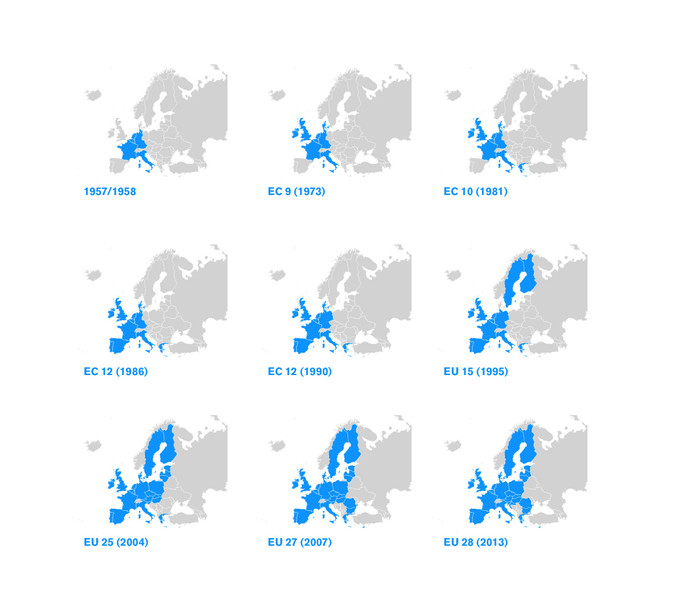
Expansion of the European Community and European Union
This mattered because states shared some sovereignty and built economic interdependence. A European identity could exist alongside national identity.
That had limits. Disputes over sovereignty, immigration, and uneven development remained. Brexit in 2016, completed in 2020, proved integration was reversible.
Nationalism also kept showing up in different forms:
- Resistance to Soviet rule in Poland drew strength from Catholic identity, Solidarity, and Pope John Paul II.
- Peaceful nationalism shaped German reunification and the Velvet Divorce in Czechoslovakia.
- Violent nationalism exploded in the Yugoslav wars, with ethnic cleansing, Srebrenica, and Kosovo.
- Separatism appeared in ETA in Spain, Northern Ireland, Flemish nationalism, and Chechnya.
New Voices and a More Plural Europe
Europe also changed because it lost its empires and became more diverse at home.
- Decolonization ended Europe’s unquestioned global dominance.
- India, 1947
- Indonesia
- Indochina, ending in French defeat at Dien Bien Phu
- Algerian War
Migration reshaped society:
- Turkish guest workers in West Germany
- Caribbean and South Asian migration to Britain
- North and West African migration to France
This sparked debates over citizenship, religion, multiculturalism, and anti-immigrant politics, including the National Front in France and Freedom Party in Austria.
Women gained a larger public voice through suffrage, second-wave feminism, contraception, reproductive rights, and changing family roles. Simone de Beauvoir’s The Second Sex was a major influence. Leaders like Margaret Thatcher showed women could reach top office, even though inequality remained.
Religion lost authority in much of western Europe, but it did not disappear. The Second Vatican Council modernized Catholic practice. Bonhoeffer, Niemöller, and John Paul II show religion still mattered politically. Immigration also expanded Muslim, Hindu, and Sikh communities.
Culture became more plural too. War and crisis fed existentialism through Jean-Paul Sartre. Postmodernism questioned universal truth and grand narratives. Modernist and avant-garde culture included Dadaism, Surrealism, Bauhaus, Kafka, Joyce, Woolf, and Remarque.
