Topic 7.6 Notes – New Imperialism: Motivations and Methods
What New Imperialism Was
This was intensified European expansion from about 1870 to 1914, especially in Africa and Asia. Earlier imperialism had focused more on the Americas, sea routes, coastal trade posts, and plantation colonies. This phase pushed inland and brought stronger political control.
Imperialism means extending power over another territory or people. Colonialism is more specific. It means direct acquisition and administration. European control could take several forms:
- Colonies where Europeans ruled directly
- Protectorates where a local ruler stayed, but real power was lost
- Spheres of influence where one power got special rights without full annexation
- Unequal treaties that forced ports, trade rights, and legal privileges open
- Chartered companies that acted like mini-states
- Military occupation and economic dependence without full legal takeover
The exam loves one distinction here. Motivations explain why Europeans wanted empire. Methods explain how they built and held it.
Keep the map pattern in your head. In 1880, most of Africa was still under indigenous control. By 1914, almost all of it had been partitioned by Europeans, with Liberia and Ethiopia as the key exceptions.
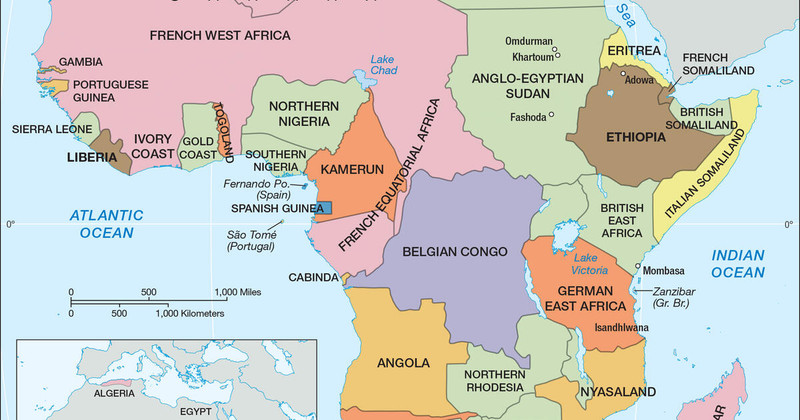
Africa during the age of New Imperialism
In Asia, know British India, French Indochina, Dutch East Indies, and spheres of influence in China.
Why Europeans Wanted Empires
European imperialism came from three connected motives.
Economic motives
Industrial Europe wanted raw materials and places to sell goods.
- Raw materials included cotton, rubber, palm oil, copper, and tin.
- Markets mattered because factories produced manufactured goods that needed buyers.
- Investment opportunities included railways, mines, plantations, ports, and canals.
A common mistake is assuming every colony made instant profit. Some did not. What mattered was the expectation of future advantage.
A classic example is rubber. Industrial economies needed it for machinery and insulation, and later for bicycle and automobile tires.
Political and strategic motives
Empires were also about power between states.
- Colonies gave naval bases, coaling stations, ports, and control of trade routes.
- Rivalry pushed countries to grab land before someone else did.
- After German and Italian unification, empire became a sign of Great Power status.
- France used empire partly to recover prestige after defeat in the Franco-Prussian War.
- Jingoism and chauvinism turned empire into mass patriotism.
Cultural and ideological motives
Europeans justified empire by claiming they were superior.
- Social Darwinism misused Darwin’s ideas to say domination was natural.
- Scientific racism ranked peoples in a racial hierarchy with white Europeans at the top.
- Mission civilisatrice was the French claim that they were spreading civilization.
- “The White Man’s Burden” framed empire as a moral duty.
- Missionary Christianity presented conquest as humanitarian.
How Europeans Took and Controlled Empires
Europeans did not rule every place the same way.
| Form | What it meant | Common example |
|---|---|---|
| Direct rule | European officials governed through colonial bureaucracy | Often associated with France |
| Indirect rule | Europeans ruled through local elites and institutions | Often associated with Britain |
| Protectorate | Local ruler remained, but sovereignty was mostly gone | Egypt fits this pattern |
| Sphere of influence | Special foreign access without full annexation | China |
| Concessions / unequal treaties | Forced ports, trade rights, tariff advantages, legal privileges | China treaty ports |
These are broad tendencies, not perfect categories.
Private companies often opened the door. The British East India Company is the standard case. After the Indian Rebellion of 1857, Britain switched to direct Crown rule in 1858.
Control also depended on everyday administration. Europeans used local soldiers, clerks, translators, and intermediaries, plus maps, censuses, and photography to classify and govern populations.
What Made New Imperialism Possible
Europe wanted empire for economic, political, and ideological reasons. Industrial tools made it practical.
Advanced weaponry
- Minié ball improved rifle range and accuracy.
- Breech-loading rifles increased rate of fire and made reloading easier.
- Maxim gun gave overwhelming machine-gun firepower.
- Military advantage also came from artillery, logistics, navies, and industrial production.
Transportation and communication
- Steamships moved troops and goods faster and more reliably.
- Railways linked mines and plantations to ports and moved troops inland.
- Telegraph and undersea cables let empires coordinate quickly.
- Photography and mapping supported surveillance, administration, and propaganda.
- Suez Canal opened in 1869. Britain bought shares in 1875 and occupied Egypt in 1882 to protect the route to India.
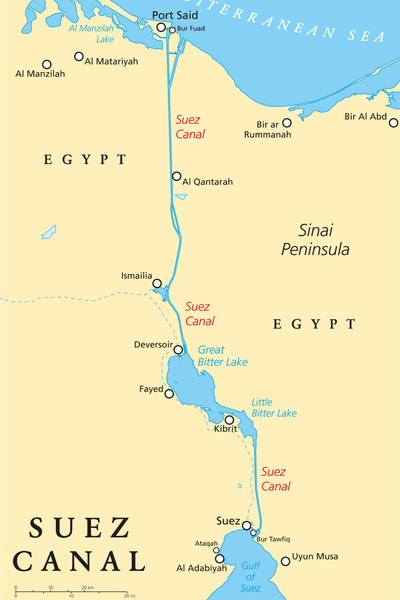
Suez Canal
Medicine
- Quinine reduced malaria deaths.
- Pasteur’s germ theory improved disease prevention.
- Anesthesia and antiseptics improved treatment.
- Public health projects improved sanitation in colonial centers.
The Main Causation Pattern and Limits
The cleanest formula is this: economic interests created demand, nationalism and rivalry intensified competition, racial ideology justified domination, and technology plus medicine enabled conquest.
One of the most testable nuances is that technology was not the motive. It was the tool.
European power was huge, but not absolute. Ethiopia defeated Italy at the Battle of Adwa in 1896, which is the standard reminder that Europeans were powerful, not unstoppable.
Key Takeaways
Imperialism
Extension of one state’s political, economic, or military power over another territory or people, with or without formal annexation
Colonialism
Acquisition, settlement, and administration of overseas territory by an imperial power
New Imperialism
Rapid intensification of European control over Africa and Asia, especially from about 1870 to 1914, enabled by industrial power
Scramble for Africa
Rapid late-nineteenth-century European competition to claim and partition nearly all of Africa
Suez Canal
Canal opened in 1869 linking the Mediterranean and Red Seas; Britain bought shares in 1875 and occupied Egypt in 1882 to secure trade and the route to India
Chauvinism / Jingoism
Aggressive, boastful nationalism that celebrated expansion and presented colonial acquisition as proof of national strength
Social Darwinism
Misapplication of evolutionary competition and “survival of the fittest” to peoples and states to portray conquest and racial domination as natural
Scientific Racism
Use of supposedly scientific measurements and classifications to divide humanity into fixed, unequal races headed by white Europeans
Mission Civilisatrice / Civilizing Mission
French claim that empire spread a supposedly superior civilization through French language, education, law, and culture
The White Man’s Burden
Rudyard Kipling’s 1899 formulation of empire as a supposed racial duty of white peoples to govern and civilize nonwhite peoples
Colony
Territory formally controlled and administered by an imperial power
Direct Rule
Colonial government in which European officials replaced or subordinated existing authorities and governed through a centralized bureaucracy
Indirect Rule
Colonial government through existing local rulers or institutions while the imperial power controlled taxation, trade, foreign policy, or military affairs
Protectorate
Territory retaining a nominal local government while an imperial power controls external affairs and decisively influences internal policy
Sphere of Influence
Area where a foreign power claimed privileged economic or political access without necessarily annexing or directly governing it
Concession
Specific privilege granted to a foreign power, such as port access, mining rights, railway construction, or favorable tariffs
Unequal Treaty
Coerced agreement granting a stronger foreign power special commercial or legal privileges at the expense of a weaker state’s sovereignty
Informal Empire
Foreign economic or political domination exercised without complete annexation or direct colonial government
Chartered Company
Private company authorized by a government to trade, make treaties, administer territory, or maintain armed forces overseas
Minié Ball
Conical bullet that made rifled firearms practical to load in battle, giving infantry greater range and accuracy than smoothbore muskets
Breech-Loading Rifle
Rifle loaded from the rear of the barrel, allowing faster fire and reloading while kneeling or lying down
Maxim Gun
Recoil-operated machine gun patented in 1884 that allowed a small force to direct sustained fire against much larger formations
Steamship
Steam-powered vessel that moved on predictable schedules, traveled upriver against currents, and transported imperial troops, officials, and goods
Colonial Railway
Rail line commonly linking inland mines or plantations to ports while also moving troops and European manufactured goods
Electric Telegraph
Rapid long-distance communication system whose landlines and undersea cables let governments coordinate colonial officials, commerce, and military forces
Photography
Imperial administrative and propaganda tool used to document, survey, classify, and portray colonized lands and peoples for European audiences
Quinine
Medicine derived from cinchona bark that prevented and treated malaria, reducing European mortality in tropical regions
Louis Pasteur’s Germ Theory of Disease
Theory that microorganisms cause many diseases, encouraging sterilization, sanitation, vaccination research, and systematic prevention
Notes
Imperialism
Extension of one state’s political, economic, or military power over another territory or people, with or without formal annexation
Colonialism
Acquisition, settlement, and administration of overseas territory by an imperial power
New Imperialism
Rapid intensification of European control over Africa and Asia, especially from about 1870 to 1914, enabled by industrial power
Scramble for Africa
Rapid late-nineteenth-century European competition to claim and partition nearly all of Africa
Suez Canal
Canal opened in 1869 linking the Mediterranean and Red Seas; Britain bought shares in 1875 and occupied Egypt in 1882 to secure trade and the route to India
Chauvinism / Jingoism
Aggressive, boastful nationalism that celebrated expansion and presented colonial acquisition as proof of national strength
Social Darwinism
Misapplication of evolutionary competition and “survival of the fittest” to peoples and states to portray conquest and racial domination as natural
Scientific Racism
Use of supposedly scientific measurements and classifications to divide humanity into fixed, unequal races headed by white Europeans
Mission Civilisatrice / Civilizing Mission
French claim that empire spread a supposedly superior civilization through French language, education, law, and culture
The White Man’s Burden
Rudyard Kipling’s 1899 formulation of empire as a supposed racial duty of white peoples to govern and civilize nonwhite peoples
Colony
Territory formally controlled and administered by an imperial power
Direct Rule
Colonial government in which European officials replaced or subordinated existing authorities and governed through a centralized bureaucracy
Indirect Rule
Colonial government through existing local rulers or institutions while the imperial power controlled taxation, trade, foreign policy, or military affairs
Protectorate
Territory retaining a nominal local government while an imperial power controls external affairs and decisively influences internal policy
Sphere of Influence
Area where a foreign power claimed privileged economic or political access without necessarily annexing or directly governing it
Concession
Specific privilege granted to a foreign power, such as port access, mining rights, railway construction, or favorable tariffs
Unequal Treaty
Coerced agreement granting a stronger foreign power special commercial or legal privileges at the expense of a weaker state’s sovereignty
Informal Empire
Foreign economic or political domination exercised without complete annexation or direct colonial government
Chartered Company
Private company authorized by a government to trade, make treaties, administer territory, or maintain armed forces overseas
Minié Ball
Conical bullet that made rifled firearms practical to load in battle, giving infantry greater range and accuracy than smoothbore muskets
Breech-Loading Rifle
Rifle loaded from the rear of the barrel, allowing faster fire and reloading while kneeling or lying down
Maxim Gun
Recoil-operated machine gun patented in 1884 that allowed a small force to direct sustained fire against much larger formations
Steamship
Steam-powered vessel that moved on predictable schedules, traveled upriver against currents, and transported imperial troops, officials, and goods
Colonial Railway
Rail line commonly linking inland mines or plantations to ports while also moving troops and European manufactured goods
Electric Telegraph
Rapid long-distance communication system whose landlines and undersea cables let governments coordinate colonial officials, commerce, and military forces
Photography
Imperial administrative and propaganda tool used to document, survey, classify, and portray colonized lands and peoples for European audiences
Quinine
Medicine derived from cinchona bark that prevented and treated malaria, reducing European mortality in tropical regions
Louis Pasteur’s Germ Theory of Disease
Theory that microorganisms cause many diseases, encouraging sterilization, sanitation, vaccination research, and systematic prevention
