Topic 1.2 Notes – Italian Renaissance
What Italian Renaissance Humanism Was
The core of humanism was a new kind of learning built on Greek and Roman texts. In Italy, that took off because wealthy city-states had the money, rivalry, and patrons to support scholars and artists.
Humanism differed from medieval scholasticism. Scholastics usually centered theology, logic, and commentary on accepted authorities. Humanists cared more about reading classical works directly and learning from their language, history, and moral lessons.
The studia humanitatis included:
- Grammar so you could read and write well
- Rhetoric so you could persuade
- Poetry for style and expression
- History for examples from the past
- Moral philosophy for judgment and character
The goal was to form an educated person who was eloquent, morally serious, and useful in public life.
Petrarch
Petrarch is called the “father of humanism.” He matters as background because later Renaissance scholars built on what he started.
- He searched for lost Latin manuscripts.
- He admired Cicero and other Roman writers as models of style and wisdom.
- He attacked dry scholastic learning for caring too little about language and human experience.
Why Italy first
- Urban wealth from trade, banking, and manufacturing funded culture.
- Competition among Florence, Venice, Milan, Rome, and Naples pushed cities to show off.
- Roman ruins and law made the classical past feel present.
- Byzantine scholars brought Greek learning and manuscripts, especially after 1453.
- Patrons like the Medici paid scholars and artists.
A political map of the Italian peninsula helps explain that mix of wealth and rivalry. Focus on the major states and cities that drove Renaissance culture, especially Florence, Venice, Milan, Rome, and Naples.
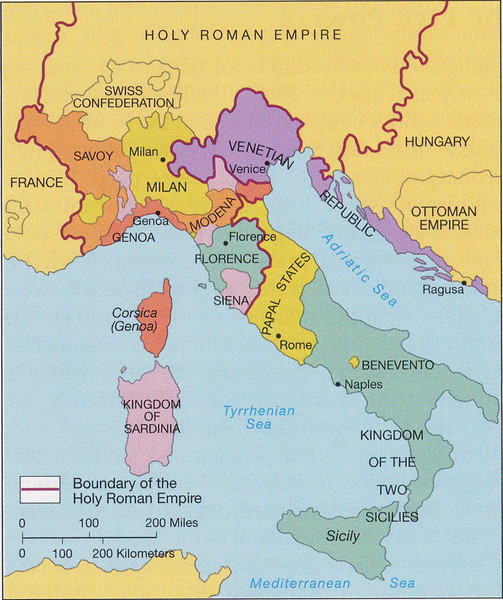
Major states of Renaissance Italy
How Classical Revival Changed Scholarship and Education
Reading old books was only the start. Humanists hunted for manuscripts, compared copies, fixed mistakes, and asked what a text meant in its own time. Later, the printing press spread these corrected works much farther.
Philology
Philology means close study of language, vocabulary, and historical context.
The standard example is Lorenzo Valla. He proved the Donation of Constantine was a forgery because its Latin came from a later age, not Constantine’s time. That mattered far beyond one document. It showed that authority could be tested with evidence.
Humanism and scholasticism
| Humanism | Scholasticism |
|---|---|
| Direct study of classical texts | Commentary on accepted authorities |
| Style, context, authenticity | Logic and formal disputation |
| History and moral example | Theology as central focus |
This challenged universities and the Church intellectually, even though neither disappeared.
Humanist education also trained diplomats, officials, and civic leaders. That habit of checking sources and questioning errors helped prepare the way for later scientific thinking, though the Scientific Revolution is a later topic.
Secularism, Individualism, and Civic Life
Renaissance culture paid more attention to worldly life. People cared more about politics, reputation, education, and public action. That is secularism in this topic. It does not mean atheism.
Individualism showed up in praise for talent, fame, personality, and portraiture. Artists became celebrated as individuals. This mostly stayed an elite idea because society was still very hierarchical.
Major humanists and ideas
- Marsilio Ficino translated Plato and tried to fit classical philosophy with Christianity.
- Pico della Mirandola, in Oration on the Dignity of Man, emphasized human potential and self-shaping within God’s order.
Civic humanism
Civic humanism applied classical learning to citizenship and service.
- Leonardo Bruni served as Florentine chancellor and linked eloquence, history, and active citizenship.
- Leon Battista Alberti represented the broadly educated “Renaissance person.”
Secular Models for Behavior and Power
Three writers show how humanism shaped conduct and politics.
- Niccolò Machiavelli, in The Prince, looked at politics realistically. Virtù meant skill, boldness, and adaptability. Fortuna meant chance. A ruler might need deception or cruelty to save the state. In Discourses on Livy, he praised republican government too.
- Baldassare Castiglione, in The Book of the Courtier, described the ideal courtier as educated, graceful, and skilled in both arms and arts. Sprezzatura meant making excellence look effortless.
- Francesco Guicciardini, in History of Italy, explained politics through evidence, self-interest, and circumstances, not just God’s plan.
Renaissance Art and Patronage
Art turned humanist ideas into something visible. Patrons used it for prestige, devotion, family power, and civic pride.
Patrons and artistic features
Patrons included the Medici, guilds, civic governments, rulers, and popes.
Three major features appeared again and again:
- Classicism with columns, domes, arches, contrapposto, and ideal proportion
- Naturalism with lifelike bodies, emotion, movement, and portraits
- Geometric perspective with mathematical depth, developed by Brunelleschi and explained by Alberti
Raphael’s School of Athens pulls those features together in one famous image. The classical architecture frames ancient philosophers, and the receding lines draw your eye into the space.
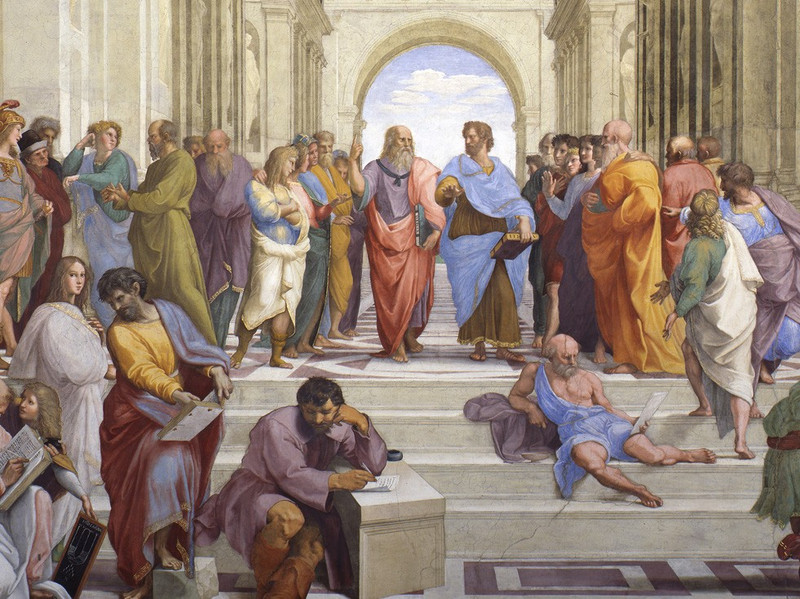
Raphael, School of Athens
Artists and examples
- Brunelleschi built the dome of Florence Cathedral. It showed engineering skill and Florentine civic pride.
- Donatello made the bronze David, a freestanding nude with classical influence.
- Michelangelo created David and painted the Sistine Chapel ceiling for Pope Julius II.
- Raphael painted School of Athens, which brought humanism into the Vatican itself.
- Andrea Palladio used classical symmetry and temple fronts in architecture.
Renaissance art was often both religious and secular at once. A pope could sponsor a painting full of pagan philosophers, and a biblical figure could be shown with a classical body.
Key Takeaways
Italian Renaissance
Intellectual and cultural movement in the Italian city-states that revived classical learning and promoted humanism, secular analysis, individual achievement, and classically inspired art
Humanism
Renaissance educational and scholarly movement based on recovering and studying classical Greek and Roman texts to cultivate eloquence, judgment, morality, and public effectiveness
Studia Humanitatis
The humanist curriculum of grammar, rhetoric, poetry, history, and moral philosophy
Scholasticism
Medieval university method using formal logic and disputation to reconcile authoritative texts, especially Christian theology and Aristotelian philosophy
Francesco Petrarch
The “father of humanism,” who recovered Latin manuscripts, promoted classical literary style, and helped establish the humanist revival while remaining Christian
Philology
Humanist study of a text's language, manuscripts, and historical context to determine its origin, meaning, and most authentic form
Lorenzo Valla
Humanist philologist who used anachronistic Latin vocabulary and style to prove that the Donation of Constantine was a medieval forgery
Donation of Constantine
Forged document claiming Constantine transferred western political authority to the pope; Valla's philological analysis exposed its medieval origin
Secularism
Increased attention to worldly affairs and explanations not based exclusively on theology, without necessarily rejecting Christianity
Individualism
Renaissance emphasis on an individual's distinctive abilities, achievements, reputation, personality, and capacity for self-development
Marsilio Ficino
Medici-supported humanist who translated Plato and sought to reconcile Platonic philosophy with Christianity
Renaissance Neoplatonism
Renaissance revival of Plato and later Platonic thought, often reconciled with Christianity
Giovanni Pico della Mirandola
Humanist philosopher who emphasized people's God-given freedom and capacity to shape and elevate themselves through choice, study, and moral development
Oration on the Dignity of Man
Pico's work presenting human beings as unusually free to shape and elevate themselves within a divinely created order
Civic Humanism
Application of classical learning to active citizenship, public service, political participation, defense of liberty, and service to the state
Leonardo Bruni
Florentine chancellor and civic humanist who used classical history and eloquence to celebrate republican liberty, citizenship, and public service
Renaissance Person
Humanist ideal of a broadly cultivated individual accomplished in several intellectual, artistic, and practical fields
Leon Battista Alberti
Humanist, artist, and architect who applied mathematics, harmonious proportion, and classical principles to artistic theory and design
Niccolò Machiavelli
Florentine diplomat who used classical history and contemporary observation to analyze how states acquire power, preserve order, and survive conflict
The Prince
Machiavelli's 1513 analysis of how rulers gain and preserve states, judging deception, coercion, and other actions by their political effectiveness
Virtù and Fortuna
Machiavelli's contrast between a ruler's skill, boldness, and adaptability and the unpredictable circumstances or fortune that resist control
Baldassare Castiglione
Italian humanist whose Book of the Courtier defined the education, talents, manners, and self-presentation expected of an accomplished court noble
The Book of the Courtier
Castiglione's guide to the ideal courtier, who combined classical education, military and artistic skill, eloquence, graceful manners, and social discipline
Sprezzatura
Castiglione's ideal of appearing effortlessly graceful while concealing the training and calculation behind one's performance
Francesco Guicciardini
Florentine statesman and historian who explained politics through evidence, experience, ambition, interest, and contingent human decisions rather than providence alone
Patronage
Financial and political support through which rulers, popes, governments, guilds, and wealthy families commissioned culture to display devotion, status, and authority
Medici Family
Florentine banking dynasty that converted wealth into political influence and patronage of humanists, artists, architects, and philosophers
Renaissance Classicism
Revival of Greek and Roman subjects, proportions, balance, anatomy, and architectural forms such as columns, arches, domes, and pediments
Naturalism
Artistic effort to depict bodies, faces, emotion, movement, light, objects, and physical space in convincing lifelike ways
Geometric or Linear Perspective
Mathematical technique for creating depth in which receding parallel lines converge at a vanishing point on the viewer's horizon line
Contrapposto
Classical sculptural stance with most weight on one leg, creating a natural shift in the figure's hips and shoulders
Filippo Brunelleschi
Florentine architect associated with the early systematic development of linear perspective and the revival of classical proportions, rounded arches, columns, and ordered spaces
Dome of Florence Cathedral
Brunelleschi’s dome over Florence Cathedral’s enormous octagonal crossing, built without traditional wooden centering and celebrated as a symbol of Florentine ingenuity and civic prestige
Donatello's David
Medici-associated bronze that rendered a biblical hero as a freestanding nude with classical contrapposto and naturalistic anatomy
Leonardo da Vinci
Renaissance artist and investigator whose studies of anatomy, mechanics, engineering, and nature joined artistic naturalism with close observation
The Last Supper
Leonardo's religious painting using converging perspective, ordered composition, and individualized emotional reactions to center attention on Christ
Michelangelo
High Renaissance sculptor, painter, and architect known for monumental, idealized, anatomically powerful human figures in civic and papal commissions
Michelangelo's David
Monumental classical-style nude showing the biblical David tense before combat; displayed publicly as a symbol of Florentine courage and independence
Sistine Chapel Ceiling
Michelangelo's Julius II–commissioned biblical program whose idealized, anatomically powerful figures glorified Christianity, Rome, and papal prestige
Raphael's School of Athens
Vatican fresco depicting ancient thinkers in classical architecture, with balanced naturalistic figures and perspective centered on Plato and Aristotle
Andrea Palladio
Renaissance architect who systematically adapted Greek and Roman symmetry, proportion, temple fronts, columns, and pediments to villas and other buildings
Villa Rotonda
Palladio’s symmetrical villa with classical porticoes arranged around a central domed space
Notes
Italian Renaissance
Intellectual and cultural movement in the Italian city-states that revived classical learning and promoted humanism, secular analysis, individual achievement, and classically inspired art
Humanism
Renaissance educational and scholarly movement based on recovering and studying classical Greek and Roman texts to cultivate eloquence, judgment, morality, and public effectiveness
Studia Humanitatis
The humanist curriculum of grammar, rhetoric, poetry, history, and moral philosophy
Scholasticism
Medieval university method using formal logic and disputation to reconcile authoritative texts, especially Christian theology and Aristotelian philosophy
Francesco Petrarch
The “father of humanism,” who recovered Latin manuscripts, promoted classical literary style, and helped establish the humanist revival while remaining Christian
Philology
Humanist study of a text's language, manuscripts, and historical context to determine its origin, meaning, and most authentic form
Lorenzo Valla
Humanist philologist who used anachronistic Latin vocabulary and style to prove that the Donation of Constantine was a medieval forgery
Donation of Constantine
Forged document claiming Constantine transferred western political authority to the pope; Valla's philological analysis exposed its medieval origin
Secularism
Increased attention to worldly affairs and explanations not based exclusively on theology, without necessarily rejecting Christianity
Individualism
Renaissance emphasis on an individual's distinctive abilities, achievements, reputation, personality, and capacity for self-development
Marsilio Ficino
Medici-supported humanist who translated Plato and sought to reconcile Platonic philosophy with Christianity
Renaissance Neoplatonism
Renaissance revival of Plato and later Platonic thought, often reconciled with Christianity
Giovanni Pico della Mirandola
Humanist philosopher who emphasized people's God-given freedom and capacity to shape and elevate themselves through choice, study, and moral development
Oration on the Dignity of Man
Pico's work presenting human beings as unusually free to shape and elevate themselves within a divinely created order
Civic Humanism
Application of classical learning to active citizenship, public service, political participation, defense of liberty, and service to the state
Leonardo Bruni
Florentine chancellor and civic humanist who used classical history and eloquence to celebrate republican liberty, citizenship, and public service
Renaissance Person
Humanist ideal of a broadly cultivated individual accomplished in several intellectual, artistic, and practical fields
Leon Battista Alberti
Humanist, artist, and architect who applied mathematics, harmonious proportion, and classical principles to artistic theory and design
Niccolò Machiavelli
Florentine diplomat who used classical history and contemporary observation to analyze how states acquire power, preserve order, and survive conflict
The Prince
Machiavelli's 1513 analysis of how rulers gain and preserve states, judging deception, coercion, and other actions by their political effectiveness
Virtù and Fortuna
Machiavelli's contrast between a ruler's skill, boldness, and adaptability and the unpredictable circumstances or fortune that resist control
Baldassare Castiglione
Italian humanist whose Book of the Courtier defined the education, talents, manners, and self-presentation expected of an accomplished court noble
The Book of the Courtier
Castiglione's guide to the ideal courtier, who combined classical education, military and artistic skill, eloquence, graceful manners, and social discipline
Sprezzatura
Castiglione's ideal of appearing effortlessly graceful while concealing the training and calculation behind one's performance
Francesco Guicciardini
Florentine statesman and historian who explained politics through evidence, experience, ambition, interest, and contingent human decisions rather than providence alone
Patronage
Financial and political support through which rulers, popes, governments, guilds, and wealthy families commissioned culture to display devotion, status, and authority
Medici Family
Florentine banking dynasty that converted wealth into political influence and patronage of humanists, artists, architects, and philosophers
Renaissance Classicism
Revival of Greek and Roman subjects, proportions, balance, anatomy, and architectural forms such as columns, arches, domes, and pediments
Naturalism
Artistic effort to depict bodies, faces, emotion, movement, light, objects, and physical space in convincing lifelike ways
Geometric or Linear Perspective
Mathematical technique for creating depth in which receding parallel lines converge at a vanishing point on the viewer's horizon line
Contrapposto
Classical sculptural stance with most weight on one leg, creating a natural shift in the figure's hips and shoulders
Filippo Brunelleschi
Florentine architect associated with the early systematic development of linear perspective and the revival of classical proportions, rounded arches, columns, and ordered spaces
Dome of Florence Cathedral
Brunelleschi’s dome over Florence Cathedral’s enormous octagonal crossing, built without traditional wooden centering and celebrated as a symbol of Florentine ingenuity and civic prestige
Donatello's David
Medici-associated bronze that rendered a biblical hero as a freestanding nude with classical contrapposto and naturalistic anatomy
Leonardo da Vinci
Renaissance artist and investigator whose studies of anatomy, mechanics, engineering, and nature joined artistic naturalism with close observation
The Last Supper
Leonardo's religious painting using converging perspective, ordered composition, and individualized emotional reactions to center attention on Christ
Michelangelo
High Renaissance sculptor, painter, and architect known for monumental, idealized, anatomically powerful human figures in civic and papal commissions
Michelangelo's David
Monumental classical-style nude showing the biblical David tense before combat; displayed publicly as a symbol of Florentine courage and independence
Sistine Chapel Ceiling
Michelangelo's Julius II–commissioned biblical program whose idealized, anatomically powerful figures glorified Christianity, Rome, and papal prestige
Raphael's School of Athens
Vatican fresco depicting ancient thinkers in classical architecture, with balanced naturalistic figures and perspective centered on Plato and Aristotle
Andrea Palladio
Renaissance architect who systematically adapted Greek and Roman symmetry, proportion, temple fronts, columns, and pediments to villas and other buildings
Villa Rotonda
Palladio’s symmetrical villa with classical porticoes arranged around a central domed space
