Topic 2.3 Notes – Protestant Reform Continues
How Protestant Reform Spread and Lasted
Luther had already challenged Rome. The story here is how that challenge stopped being one man’s protest and became a permanent split in Christianity.
The printing press made that possible. It did not cause the Reformation by itself. Complaints about Church abuses, humanist scholarship, and political support from rulers already existed. Print acted like an accelerator. It moved ideas fast, across borders, and made them hard to erase.
You can see that print culture in the flood of small Luther publications that circulated in the 1520s and 1530s.
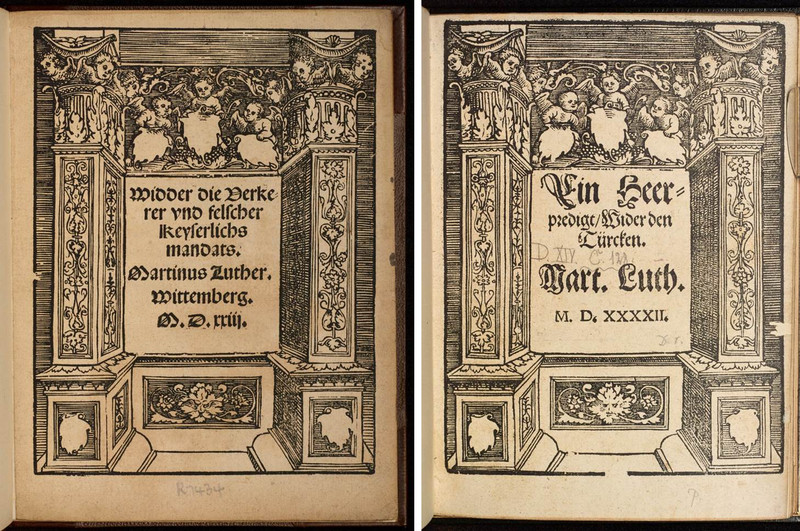
Early printed works by Martin Luther
- Martin Luther used print better than anyone early on.
- He wrote in German for ordinary lay readers and in Latin for educated scholars.
- His short pamphlets were cheap and easy to copy, unlike huge theology books.
- Protestant ideas also spread through broadsheets, woodcuts, songs, sermons, and public readings. That matters because plenty of people were not highly literate, but they could still hear or see reform ideas.
Vernacular Bibles
The strongest Protestant print tool was the Bible in the local language.
- Luther’s German New Testament (1522) and full German Bible (1534) made scripture more available in German lands.
- William Tyndale’s English New Testament (1526) did the same in English.
- The Geneva Bible (1560) became especially important for English Calvinists and Puritans.
Why this mattered:
- It supported sola scriptura, the idea that scripture is the highest authority.
- It weakened the clergy’s monopoly on religious knowledge.
- It encouraged lay reading and household devotion, so religion moved more into daily family life.
Other Protestant print helped reform last:
- Catechisms taught doctrine in question-and-answer form.
- Confessions of faith defined what each denomination believed.
- Church ordinances standardized worship and discipline.
- Hymns made doctrine easy to remember.
This is a common AP move. Print spread dissent, but it also built stable Protestant churches. Catholic and state authorities fought back with censorship, licensing, book seizures, and punishment of printers, but they could not fully stop the flow.
The Main Protestant Paths After Luther
Once people rejected papal authority, they did not all agree on what should replace it. Protestants split over baptism, the Eucharist, church government, and the state’s role in religion.
A useful divide is magisterial versus radical reformers.
- Magisterial reformers worked with civil rulers.
- Radical reformers challenged the whole church-state partnership.
Calvinism
John Calvin gave Protestant reform a more systematic shape in his Institutes of the Christian Religion (1536).
- He stressed God’s sovereignty, predestination, moral discipline, and an orderly church.
- Geneva became the center of the Reformed tradition.
Calvinism spread to France, the Netherlands, Scotland, England, the Holy Roman Empire, and east-central Europe through ministers, exiles, and print.
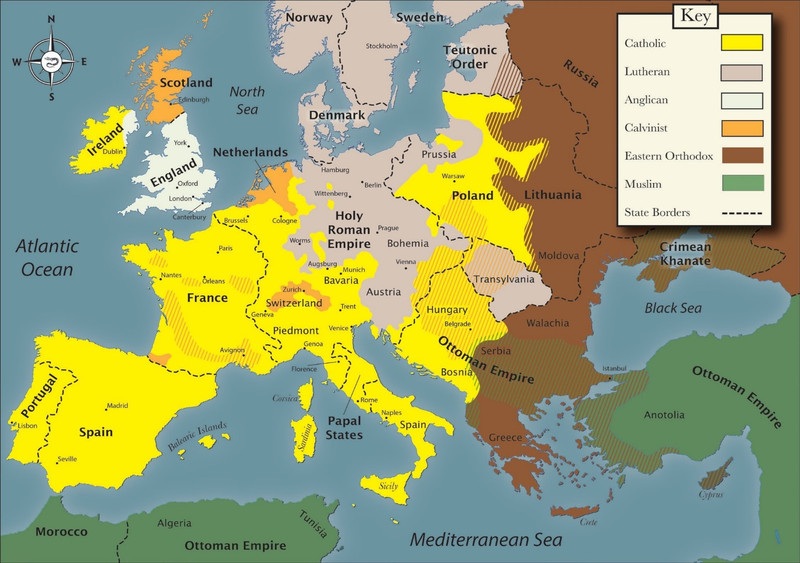
Religious divisions in Reformation Europe
In Geneva, the Ecclesiastical Ordinances organized church offices:
| Office | Role |
|---|---|
| Pastors | preached and led sacraments |
| Teachers | instructed believers |
| Deacons | cared for the poor |
| Elders | supervised conduct |
The Consistory enforced moral discipline. Calvin wanted the church to have real authority over doctrine, membership, and sacraments. He did not support full religious freedom. The execution of Michael Servetus for heresy in 1553 shows Calvinist intolerance. Still, Calvin resisted total secular control of the church.
Anabaptists
The Anabaptists emerged in Zürich in 1525 and took a more radical path.
- They believed in believers’ baptism, so they rejected infant baptism.
- They wanted a voluntary church made up of committed adults.
- Many favored separation from state religion, pacifism, refusal of oaths, and refusal to bear arms.
Rulers saw them as dangerous because early modern states depended on obedience, military service, and religious unity. Both Catholics and Protestants persecuted them. Münster (1534 to 1535) was the famous violent exception, but Menno Simons and the Mennonites are the better long-term example because they represented peaceful Anabaptism.
The key contrast is simple. Calvinists wanted an autonomous church within society. Anabaptists often wanted a church separate from coercive state control.
Competing Models of Church and State
By this point, Europe had several different religious-political models:
- Catholic states remained under papal leadership.
- Lutheran territories often became prince-controlled territorial churches.
- England created a monarch-controlled national church.
- Reformed communities claimed church authority independent of rulers.
- Anabaptists favored voluntary congregations apart from state religion.
England
England is the clearest state-control example.
- The Act of Supremacy (1534) under Henry VIII made the monarch head of the Church of England.
- Under Elizabeth I in 1559, the title became supreme governor, but royal control remained.
The political point is huge. The Reformation could strengthen states by giving rulers control over churches, or it could give people reasons to resist rulers.
Religious Conflict as a Challenge to Monarchs
Once Europe had multiple confessions, religious loyalty could compete with loyalty to the monarch.
Huguenots in France
The Huguenots were French Calvinists.
- They built their own congregations and networks under a Catholic monarchy.
- Parts of the nobility supported them.
- They challenged the crown’s claim to impose one religion.
Huguenot resistance tied into resistance theory, especially the idea that lesser magistrates could resist ungodly rulers.
Puritans in England
Puritans were English Protestants shaped by Calvinism who wanted the Church of England further reformed.
- Some attacked bishops and preferred presbyterian government.
- Separatists broke away entirely.
Because the monarch controlled the church, attacks on church structure also challenged royal authority. This became major background for later Stuart conflicts and the English Civil War.
Nobles in Poland-Lithuania
In Poland-Lithuania, the szlachta already had strong privileges and limited royal power.
- The state was religiously diverse, including Catholics, Lutherans, Calvinists, Orthodox Christians, Jews, and Polish Brethren.
- The Warsaw Confederation (1573) protected religious peace among nobles.
This shows nobles using religious pluralism to constrain monarchy. It was not modern religious equality, since protections mainly covered nobles.
Key Takeaways
Vernacular Bible
A Bible translated from Latin, Greek, or Hebrew into a commonly spoken language, widening lay access to scripture and spreading Protestant teaching
Catechism
A question-and-answer summary of religious beliefs used to standardize doctrine and instruct clergy, families, schools, and congregations
Confession of Faith
A formal statement defining a church’s doctrines and distinguishing its beliefs from those of competing confessions
Protestant Pluralism
The division of Protestantism into movements that disagreed over doctrine, worship, church government, and relations with secular authority
Magisterial Reformation vs. Radical Reformation
Magisterial reformers worked with civil rulers to reform public religion, while radical reformers often rejected the union of church and state
John Calvin
French Protestant reformer who systematized Reformed theology and helped establish an autonomous, disciplined church in Geneva
Institutes of the Christian Religion
Calvin’s systematic account of Protestant theology, first published in 1536 and expanded in later editions
Calvinism (Reformed Tradition)
International Protestant tradition emphasizing God’s sovereignty, predestination, disciplined conduct, and an independently governed church
Geneva
Self-governing city republic that became Calvinism’s institutional center, training ministers, sheltering exiles, and printing Reformed works
Ecclesiastical Ordinances
Geneva’s 1541 rules organizing the Reformed church around pastors, teachers, deacons, elders, and the Consistory
Consistory
Geneva’s body of pastors and lay elders that supervised conduct, admonished offenders, and could exclude them from communion
Ecclesiastical Autonomy
The principle that a church governs its own doctrine, sacraments, membership, and discipline rather than serving merely as a branch of the state
Lesser Magistrates and Calvinist Resistance Theory
The argument that subordinate officials or representative bodies could resist a lawbreaking tyrant who persecuted true religion
Anabaptists
Radical Protestants who rejected infant baptism and commonly favored voluntary congregations outside state-enforced religion
Believers’ Baptism
Baptism of people who consciously profess faith, based on the Anabaptist rejection of infant baptism as invalid
Voluntary Church
A congregation composed of committed believers who freely profess faith rather than everyone born within a state or territory
Mennonites
Peaceful Anabaptist communities consolidated by Menno Simons that emphasized voluntary faith and nonviolence
Huguenots
French Calvinists whose independent churches and demands for protected worship challenged the Catholic monarchy’s religious authority
Puritans
English Calvinist-influenced Protestants who sought to remove remaining Catholic features from the monarch-controlled Church of England
Presbyterian Church Government
Church government by assemblies of ministers and elected elders rather than by bishops appointed under royal authority
Separatists
Radical Puritans who considered the Church of England too corrupt to reform and formed independent congregations outside it
Polish-Lithuanian Commonwealth
Decentralized, religiously diverse elective monarchy in which powerful nobles used representative institutions to limit royal religious control
Szlachta
The privileged Polish-Lithuanian nobility whose political power and representative institutions limited the elective monarch
Warsaw Confederation
The 1573 agreement pledging religious peace among Poland-Lithuania’s nobility and protecting noble religious practice
Act of Supremacy
The 1534 law that made Henry VIII supreme head of the Church of England, replacing papal supremacy with royal control
Notes
Vernacular Bible
A Bible translated from Latin, Greek, or Hebrew into a commonly spoken language, widening lay access to scripture and spreading Protestant teaching
Catechism
A question-and-answer summary of religious beliefs used to standardize doctrine and instruct clergy, families, schools, and congregations
Confession of Faith
A formal statement defining a church’s doctrines and distinguishing its beliefs from those of competing confessions
Protestant Pluralism
The division of Protestantism into movements that disagreed over doctrine, worship, church government, and relations with secular authority
Magisterial Reformation vs. Radical Reformation
Magisterial reformers worked with civil rulers to reform public religion, while radical reformers often rejected the union of church and state
John Calvin
French Protestant reformer who systematized Reformed theology and helped establish an autonomous, disciplined church in Geneva
Institutes of the Christian Religion
Calvin’s systematic account of Protestant theology, first published in 1536 and expanded in later editions
Calvinism (Reformed Tradition)
International Protestant tradition emphasizing God’s sovereignty, predestination, disciplined conduct, and an independently governed church
Geneva
Self-governing city republic that became Calvinism’s institutional center, training ministers, sheltering exiles, and printing Reformed works
Ecclesiastical Ordinances
Geneva’s 1541 rules organizing the Reformed church around pastors, teachers, deacons, elders, and the Consistory
Consistory
Geneva’s body of pastors and lay elders that supervised conduct, admonished offenders, and could exclude them from communion
Ecclesiastical Autonomy
The principle that a church governs its own doctrine, sacraments, membership, and discipline rather than serving merely as a branch of the state
Lesser Magistrates and Calvinist Resistance Theory
The argument that subordinate officials or representative bodies could resist a lawbreaking tyrant who persecuted true religion
Anabaptists
Radical Protestants who rejected infant baptism and commonly favored voluntary congregations outside state-enforced religion
Believers’ Baptism
Baptism of people who consciously profess faith, based on the Anabaptist rejection of infant baptism as invalid
Voluntary Church
A congregation composed of committed believers who freely profess faith rather than everyone born within a state or territory
Mennonites
Peaceful Anabaptist communities consolidated by Menno Simons that emphasized voluntary faith and nonviolence
Huguenots
French Calvinists whose independent churches and demands for protected worship challenged the Catholic monarchy’s religious authority
Puritans
English Calvinist-influenced Protestants who sought to remove remaining Catholic features from the monarch-controlled Church of England
Presbyterian Church Government
Church government by assemblies of ministers and elected elders rather than by bishops appointed under royal authority
Separatists
Radical Puritans who considered the Church of England too corrupt to reform and formed independent congregations outside it
Polish-Lithuanian Commonwealth
Decentralized, religiously diverse elective monarchy in which powerful nobles used representative institutions to limit royal religious control
Szlachta
The privileged Polish-Lithuanian nobility whose political power and representative institutions limited the elective monarch
Warsaw Confederation
The 1573 agreement pledging religious peace among Poland-Lithuania’s nobility and protecting noble religious practice
Act of Supremacy
The 1534 law that made Henry VIII supreme head of the Church of England, replacing papal supremacy with royal control
