Topic 8.5 Notes – Global Economic Crisis
How the Global Economic Crisis Worked
Europe did not crash out of nowhere in 1929. World War I had already left debt, inflation, damaged currencies, and broken trade networks behind. The 1920s recovery looked better on the surface than it actually was.
The key weak point was a circular payment system:
- American banks lent money to Germany
- Germany paid reparations to France and Britain
- France and Britain used that money to repay war debts to the United States
The diagram below shows that cycle at the center of the Dawes Plan.
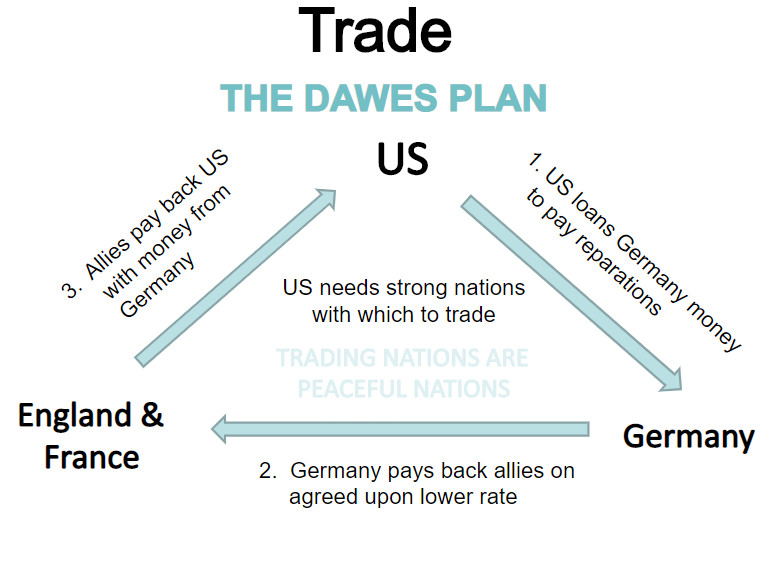
The Dawes Plan payment cycle
This only worked if American lending kept going. The Dawes Plan in 1924 helped restart the system by easing immediate pressure on Germany and opening the door to U.S. loans. The Young Plan in 1929 tried to reduce and reorganize reparations, but by then the whole structure was already about to crack.
The exam loves this distinction. The Wall Street crash was the trigger, not the full cause.
Why the Depression Became Global
The crash spread because the world economy was already fragile in several ways at once:
- War debts and reparations kept politics bitter and finances unstable.
- Disrupted trade followed the breakup of empires like Austria-Hungary and the Ottoman Empire. New borders meant new tariffs and customs barriers.
- Protectionism made recovery harder. The Fordney-McCumber Tariff of 1922 and Smoot-Hawley Tariff of 1930 cut trade when countries needed markets.
- Overproduction hurt both farmers and factories. Farmers had expanded during World War I, then prices collapsed. Industry could produce more goods than workers could afford to buy.
- Currency problems undermined confidence. Germany’s hyperinflation in 1923 during the Ruhr crisis destroyed savings. Britain returned to the gold standard in 1925 with an overvalued pound, which hurt exports.
- Speculation and weak banks made collapse easier. In the U.S., investors bought stocks on margin, using borrowed money. Banks also made risky loans with weak reserves.
When the U.S. market crashed in 1929, American money stopped flowing to Europe. Then the 1931 banking crisis spread panic:
- Creditanstalt failed in Austria
- German banks came under severe pressure
- Britain abandoned the gold standard in 1931
The result was a downward spiral of falling production, deflation, shrinking trade, unemployment, and weaker demand.
What the Crisis Did to European Society and Politics
The clearest social effect was mass unemployment. Germany had about 6 million unemployed by 1932. In Britain, older industrial regions such as coal and shipbuilding areas were hit hardest.
That turned into daily hardship:
- poverty, hunger, homelessness, foreclosures
- delayed marriage and fewer families formed
- anger at immigrants, minorities, financiers, and political enemies
Liberal democracy looked weak because many governments stuck to balanced budgets, spending cuts, and gold-standard thinking instead of aggressive relief. That made parliamentary governments seem helpless.
Extremists benefited:
- Communists said capitalism had failed.
- Fascists promised order, nationalism, jobs, public works, and anti-Marxism.
Germany is the clearest case. The Weimar Republic was already weakened by Versailles, memories of hyperinflation, and unstable coalitions. After 1929, unemployment and fear of communism helped the Nazi Party grow fast.
How Democracies Tried to Respond
Britain
Britain formed a National Government in 1931 under Ramsay MacDonald. It left the gold standard, lowered interest rates, and used tariffs plus imperial preference.
John Maynard Keynes challenged old ideas. Keynesianism said depressions happen when aggregate demand is too low, so governments should spend and borrow to create jobs. His major work was The General Theory of Employment, Interest and Money in 1936.
Scandinavia
In Sweden, Denmark, and Norway, social democratic governments worked with labor, farmers, and business instead of letting politics break apart.
- public works
- welfare and unemployment relief
- collective bargaining
Sweden’s Social Democrats took power in 1932 and promoted folkhemmet, the “people’s home.” The Saltsjöbaden Agreement of 1938 became a major labor-employer compromise.
France
France’s Popular Front won in 1936 under Léon Blum. It united Socialists and Radicals, with Communist support.
Its reforms included:
- Matignon Agreements recognizing collective bargaining and wage gains
- forty-hour workweek
- two weeks’ paid vacation
It defended democracy for a time, but it did not end the Depression or political division.
Spain
Spain also had a Popular Front in 1936, but that connects more directly to the Spanish Civil War, which belongs more to the next topic.
Why This Crisis Matters
The Depression exposed the weakness of the whole postwar system built on debt, reparations, tariffs, and American credit. It also showed that defending gold, balanced budgets, and laissez-faire often made things worse.
States took on a larger economic role in different ways:
- democratic intervention
- communist planning
- fascist state control
The comparison matters most:
- Germany moved toward Nazism
- Britain preserved democracy
- Scandinavia strengthened democracy through welfare and cooperation
- France kept the republic but stayed unstable
Key Takeaways
Great Depression
Worldwide economic collapse beginning in 1929 that caused bank failures, falling production and trade, deflation, mass unemployment, and growing political extremism
Occupation of the Ruhr
French and Belgian occupation of Germany’s Ruhr industrial region in 1923 after Germany fell behind on reparations, provoking German passive resistance and accelerating inflation
German Hyperinflation of 1923
Collapse of the German mark caused by postwar fiscal breakdown and money printing during the Ruhr crisis; it destroyed savings, weakened confidence in Weimar, and ended with the Rentenmark
Dawes Plan
1924 plan that reorganized German reparations, reduced immediate payments, and promoted American loans to Germany, producing temporary but credit-dependent stability
Young Plan
1929 plan that reduced and rescheduled Germany’s remaining reparations just as the global financial crisis began dismantling the payment system
Overproduction
Production exceeding what consumers could purchase profitably, leading to falling prices, reduced output, layoffs, and still weaker demand
Protectionism / Nationalistic Tariff Policies
Tariffs and import restrictions intended to protect domestic producers but which provoked retaliation, reduced world trade, and obstructed international debt repayment
Autarky
A policy of pursuing national economic self-sufficiency rather than relying on international trade
Gold Standard
Monetary system tying currencies to gold at fixed rates; governments defending it often raised interest rates and cut spending, worsening deflation and unemployment
Speculation
Purchasing securities or other assets in expectation of continued price increases, creating financial vulnerability when prices fell
Buying Stocks on Margin
Purchasing stocks with only a partial payment while borrowing the remainder, magnifying both profits and losses
Wall Street Crash / Stock Market Crash of 1929
October 1929 collapse in American stock prices that destroyed wealth and confidence and triggered the withdrawal of American capital from Europe
Creditanstalt Crisis / Banking Crisis of 1931
Failure of Austria’s largest bank in May 1931 that spread panic through central European banks and currencies and helped force Britain off gold
Deflation
A sustained fall in prices and incomes that increased the real burden of fixed debts and contributed to bankruptcies, restricted credit, and unemployment
Britain’s National Government
Emergency coalition formed under Ramsay MacDonald in 1931 that preserved parliamentary rule and pursued currency, tariff, and financial measures producing partial recovery
Cooperative Social Action in Scandinavia
Democratic cooperation among social democrats, labor, farmers, employers, and the state through public works, welfare, collective bargaining, and support for purchasing power
French Popular Front
Antifascist electoral alliance of Socialists and Radicals, supported by Communists, that brought Léon Blum to power in 1936 and enacted labor reforms without securing recovery
Matignon Agreements
June 1936 French agreements that recognized collective bargaining, raised wages, and strengthened workers’ rights during the Popular Front government
International Debt-and-Reparations System
Postwar payment chain in which American loans funded German reparations to France and Britain, which used the money to repay war debts to the United States
Withdrawal of American Capital
Reduction and recall of American loans after the 1929 crash that destabilized European banks, businesses, and the debt-and-reparations system, especially in Germany
Keynesianism (John Maynard Keynes)
Keynes’s theory that insufficient aggregate demand can prolong unemployment and that governments should borrow and spend during downturns to support demand and employment
Notes
Great Depression
Worldwide economic collapse beginning in 1929 that caused bank failures, falling production and trade, deflation, mass unemployment, and growing political extremism
Occupation of the Ruhr
French and Belgian occupation of Germany’s Ruhr industrial region in 1923 after Germany fell behind on reparations, provoking German passive resistance and accelerating inflation
German Hyperinflation of 1923
Collapse of the German mark caused by postwar fiscal breakdown and money printing during the Ruhr crisis; it destroyed savings, weakened confidence in Weimar, and ended with the Rentenmark
Dawes Plan
1924 plan that reorganized German reparations, reduced immediate payments, and promoted American loans to Germany, producing temporary but credit-dependent stability
Young Plan
1929 plan that reduced and rescheduled Germany’s remaining reparations just as the global financial crisis began dismantling the payment system
Overproduction
Production exceeding what consumers could purchase profitably, leading to falling prices, reduced output, layoffs, and still weaker demand
Protectionism / Nationalistic Tariff Policies
Tariffs and import restrictions intended to protect domestic producers but which provoked retaliation, reduced world trade, and obstructed international debt repayment
Autarky
A policy of pursuing national economic self-sufficiency rather than relying on international trade
Gold Standard
Monetary system tying currencies to gold at fixed rates; governments defending it often raised interest rates and cut spending, worsening deflation and unemployment
Speculation
Purchasing securities or other assets in expectation of continued price increases, creating financial vulnerability when prices fell
Buying Stocks on Margin
Purchasing stocks with only a partial payment while borrowing the remainder, magnifying both profits and losses
Wall Street Crash / Stock Market Crash of 1929
October 1929 collapse in American stock prices that destroyed wealth and confidence and triggered the withdrawal of American capital from Europe
Creditanstalt Crisis / Banking Crisis of 1931
Failure of Austria’s largest bank in May 1931 that spread panic through central European banks and currencies and helped force Britain off gold
Deflation
A sustained fall in prices and incomes that increased the real burden of fixed debts and contributed to bankruptcies, restricted credit, and unemployment
Britain’s National Government
Emergency coalition formed under Ramsay MacDonald in 1931 that preserved parliamentary rule and pursued currency, tariff, and financial measures producing partial recovery
Cooperative Social Action in Scandinavia
Democratic cooperation among social democrats, labor, farmers, employers, and the state through public works, welfare, collective bargaining, and support for purchasing power
French Popular Front
Antifascist electoral alliance of Socialists and Radicals, supported by Communists, that brought Léon Blum to power in 1936 and enacted labor reforms without securing recovery
Matignon Agreements
June 1936 French agreements that recognized collective bargaining, raised wages, and strengthened workers’ rights during the Popular Front government
International Debt-and-Reparations System
Postwar payment chain in which American loans funded German reparations to France and Britain, which used the money to repay war debts to the United States
Withdrawal of American Capital
Reduction and recall of American loans after the 1929 crash that destabilized European banks, businesses, and the debt-and-reparations system, especially in Germany
Keynesianism (John Maynard Keynes)
Keynes’s theory that insufficient aggregate demand can prolong unemployment and that governments should borrow and spend during downturns to support demand and employment
