Topic 8.9 Notes – The Holocaust
How the Nazis Turned Racial Ideology into State Policy
Nazi antisemitism grew out of older European prejudice against Jews, but it changed in a major way. Earlier antisemitism was often religious. The Nazis treated Jewishness as racial and hereditary, using fake science, eugenics, and extreme nationalism.
- The Volksgemeinschaft was the Nazi idea of a racial national community. It promised unity, but only for people the regime called racially “German.”
- Aryan identity came from blood and ancestry. You could not choose it, earn it, or keep it through citizenship alone.
- Jews became the main racial enemy in Nazi thinking. The regime also persecuted Roma and Sinti, disabled people, Slavs, gay men, political opponents, and Jehovah’s Witnesses.
- Lebensraum meant “living space” in eastern Europe. It justified conquest, displacement, enslavement, and murder so Germans could dominate the East.
The key shift is that identity was no longer personal or civic. The state imposed identity through records, laws, police, and violence. Dictatorship made this much more dangerous because modern bureaucracy, censuses, propaganda, railways, and occupation let persecution spread across Europe.
The chart below shows how that worked in practice under the Nuremberg Laws. The regime classified people by ancestry, especially grandparents, and then used those categories to police marriage and citizenship.
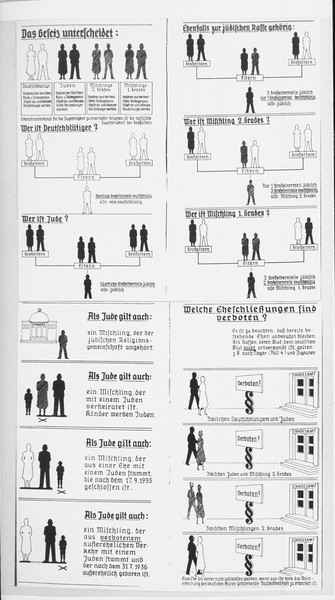
Nazi racial classifications under the Nuremberg Laws
From Exclusion to Genocide 1933-1945
The Holocaust happened in stages. It did not begin with gas chambers.
After 1933, the regime boycotted Jewish businesses, pushed Jews out of civil service, schools, and professions, and seized property through Aryanization. Dachau, opened in 1933, first held political opponents and later other targeted groups.
Nuremberg Laws 1935
- Reich Citizenship Law stripped Jews of full citizenship.
- Law for the Protection of German Blood and German Honor banned marriage and sex between Jews and people of “German blood.”
- Jewish identity was defined by grandparents and ancestry, including Mischlinge.
- This mattered because the state legally turned Germans into racial outsiders.
Kristallnacht 1938 brought organized public violence. Synagogues burned, businesses were smashed, about 100 Jews were killed, and about 30,000 Jewish men were arrested.
War after 1939 expanded Nazi control. The invasion of Poland put millions more Jews under German rule. Ghettos, especially the Warsaw Ghetto, meant starvation, disease, forced labor, and deportation. The Warsaw Ghetto Uprising in 1943 showed armed Jewish resistance.
Operation Barbarossa 1941 radicalized policy further. Einsatzgruppen mobile killing squads shot Jews across eastern Europe. Babi Yar near Kyiv is a key massacre.
Final Solution
- The Wannsee Conference in 1942 coordinated deportation and murder. It did not begin the Holocaust.
- Nazis used euphemisms like “resettlement” and “special treatment.”
- Extermination centers in occupied Poland were Chełmno, Bełżec, Sobibór, Treblinka, Auschwitz-Birkenau, and Majdanek.
Auschwitz became the best-known symbol of the Holocaust because it combined selections, forced labor, Zyklon B gas, and mass killing. This map helps you connect the stages above to geography by showing how Nazi control spread across Europe and how ghettos, camps, and deportation routes concentrated especially in occupied Poland and the east.
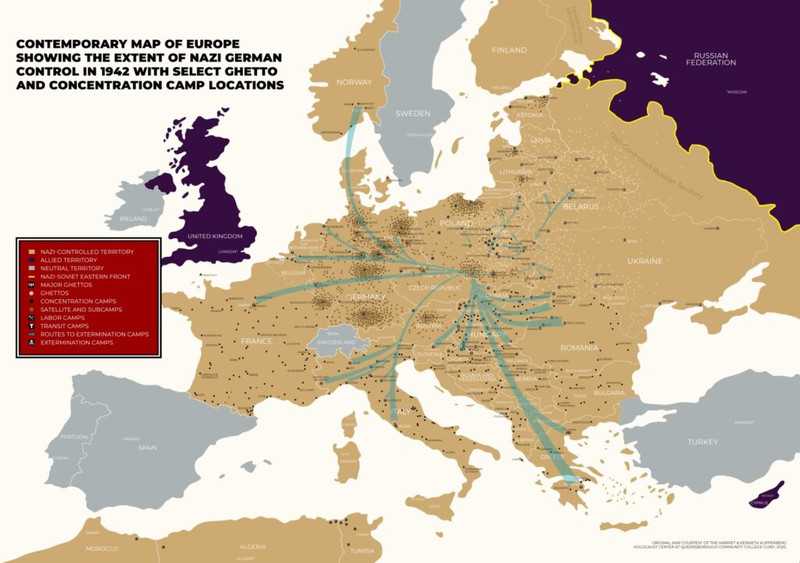
Nazi control, ghettos, camps, and deportation routes in Europe, 1942
Who Was Targeted and How
The Nazis targeted many groups, but not all in the same way.
| Group | How targeted |
|---|---|
| Jews | About 6 million murdered; only group targeted for total annihilation everywhere Nazis could reach |
| Roma and Sinti | Racial classification, deportation, forced labor, murder |
| People with disabilities | Sterilization and Aktion T4 killings; gas chambers disguised as showers |
| Soviet POWs and Slavic civilians | Starvation, execution, neglect, mass death |
| Gay men, political opponents, Jehovah’s Witnesses | Imprisonment, forced labor, persecution for refusing conformity |
Aktion T4 also mattered as a bridge. It trained personnel and methods later used in extermination camps.
Collaboration, Resistance, and the End of the Holocaust
Nazi Germany directed the genocide, but it depended on help from others.
- Vichy France helped with arrests and deportations.
- Slovakia deported Jews.
- Romania carried out mass killings.
- The Croatian Ustaše murdered Jews and others.
- Hungary, after German occupation in 1944, deported about 437,000 Jews to Auschwitz.
There were also rescue efforts, though they were limited by fear, occupation, and state power.
- Denmark helped more than 7,000 Jews escape to Sweden.
- Bulgaria protected most Jews in prewar Bulgaria, but deported Jews from occupied territories.
Jewish resistance was much broader than armed revolt. It included underground schools, diaries, archives, religion, mutual aid, smuggling, partisan fighting, and revolts at Warsaw, Sobibór, Treblinka, and Auschwitz.
As Allied armies advanced, the SS evacuated camps in death marches. The Soviets liberated Majdanek and Auschwitz. U.S. and British forces liberated camps including Buchenwald, Dachau, and Bergen-Belsen. Survivors often ended up in displaced persons camps, and many communities were shattered beyond repair.
Key Takeaways
The Holocaust
Nazi Germany’s systematic persecution and murder of approximately six million European Jews, culminating in continent-wide genocide during World War II.
Nazi New Racial Order
Nazi project to reorganize Europe by a supposed biological hierarchy, with “Aryan” Germans dominant and designated inferior populations excluded, exploited, displaced, or murdered
Religious Antisemitism vs. Racial Antisemitism
Religious antisemitism targeted Jewish belief, while racial antisemitism classified Jewish identity as hereditary and unchangeable regardless of conversion or assimilation
Volksgemeinschaft
Nazi “national racial community” promising unity among supposedly acceptable Germans while excluding Jews and others classified as alien, hereditary, disabled, or dangerous
Aryanization
Coerced transfer of Jewish businesses, homes, and other property to non-Jewish owners, generally for far less than their value
Concentration Camp
Site of extrajudicial imprisonment, terror, and often forced labor; unlike an extermination center, it was not necessarily created primarily for immediate mass killing
Nuremberg Laws
Nazi racial laws of 1935 that stripped Jews of citizenship rights, prohibited relations with “German blood,” and classified Jewish identity by ancestry
Reich Citizenship Law
Central Nuremberg Law that deprived Jews of full German citizenship and reduced them to subjects without equal political rights
Law for the Protection of German Blood and German Honor
Central Nuremberg Law prohibiting marriage and sexual relations between Jews and people classified as being of “German or related blood.”
Mischlinge
Nazi legal category for people of “mixed ancestry,” generally those classified as having one or two Jewish grandparents
Kristallnacht (November Pogrom)
Regime-organized pogrom of November 9–10, 1938, that destroyed Jewish property and synagogues, killed about 100 Jews, and sent about 30,000 Jewish men to camps
Roma and Sinti
Groups racially classified and persecuted by the Nazis through registration, confinement, forced labor, deportation, shootings, and camp murder; roughly 220,000–500,000 were killed
Aktion T4
Nazi program that murdered people with disabilities, including through gas chambers, and supplied personnel and techniques later used in extermination centers
Paragraph 175
German criminal-code provision used by the Nazis to prosecute gay men, who faced imprisonment, forced labor, castration, and death in concentration camps
Ghetto
Sealed, segregated urban district in which German authorities confined Jews under lethal conditions before deportation or death
Judenräte (Jewish Councils)
Jewish councils compelled to administer some German orders in ghettos under coercive conditions that allowed no genuine freedom of choice
Warsaw Ghetto Uprising
April–May 1943 armed Jewish resistance against German liquidation of the Warsaw Ghetto, lasting almost a month before German forces destroyed the ghetto
Operation Barbarossa
Germany’s June 1941 invasion of the Soviet Union, a racial-ideological war that enabled mass shootings of Jews and other targeted populations
Einsatzgruppen
Mobile German killing units that followed the army into Soviet territory and, with other forces and collaborators, shot entire Jewish communities
Babi Yar
Ravine near Kyiv where German forces and auxiliaries murdered 33,771 Jews on September 29–30, 1941
Final Solution to the Jewish Question
Nazi euphemism for the coordinated program to annihilate Europe’s Jews through deportation, shootings, forced labor, starvation, and extermination centers
Extermination Centers (Death Camps or Killing Centers)
German Nazi facilities in occupied Poland created primarily for mass murder, unlike concentration camps, which principally imprisoned and exploited inmates
Operation Reinhard
Program to murder the Jews of occupied Poland’s General Government, principally at the Bełżec, Sobibór, and Treblinka extermination centers
Auschwitz-Birkenau
Largest Nazi killing center, combining selection, forced labor, and mass murder with Zyklon B; about one million of its at least 1.1 million victims were Jews
Death Marches
Late-war forced evacuations of camp prisoners during which guards murdered stragglers and many others died from starvation, exposure, disease, and exhaustion
Displaced-Persons Camps
Postwar camps housing survivors and other uprooted people who could not immediately return home, often while awaiting emigration
Wannsee Conference
January 1942 meeting where German officials coordinated government agencies’ roles in deporting Europe’s Jews and implementing the already-underway Final Solution
Wannsee Protocol
Eichmann’s euphemistically worded minutes of the Wannsee Conference, documenting the Final Solution’s continental scope and interdepartmental coordination
Notes
The Holocaust
Nazi Germany’s systematic persecution and murder of approximately six million European Jews, culminating in continent-wide genocide during World War II.
Nazi New Racial Order
Nazi project to reorganize Europe by a supposed biological hierarchy, with “Aryan” Germans dominant and designated inferior populations excluded, exploited, displaced, or murdered
Religious Antisemitism vs. Racial Antisemitism
Religious antisemitism targeted Jewish belief, while racial antisemitism classified Jewish identity as hereditary and unchangeable regardless of conversion or assimilation
Volksgemeinschaft
Nazi “national racial community” promising unity among supposedly acceptable Germans while excluding Jews and others classified as alien, hereditary, disabled, or dangerous
Aryanization
Coerced transfer of Jewish businesses, homes, and other property to non-Jewish owners, generally for far less than their value
Concentration Camp
Site of extrajudicial imprisonment, terror, and often forced labor; unlike an extermination center, it was not necessarily created primarily for immediate mass killing
Nuremberg Laws
Nazi racial laws of 1935 that stripped Jews of citizenship rights, prohibited relations with “German blood,” and classified Jewish identity by ancestry
Reich Citizenship Law
Central Nuremberg Law that deprived Jews of full German citizenship and reduced them to subjects without equal political rights
Law for the Protection of German Blood and German Honor
Central Nuremberg Law prohibiting marriage and sexual relations between Jews and people classified as being of “German or related blood.”
Mischlinge
Nazi legal category for people of “mixed ancestry,” generally those classified as having one or two Jewish grandparents
Kristallnacht (November Pogrom)
Regime-organized pogrom of November 9–10, 1938, that destroyed Jewish property and synagogues, killed about 100 Jews, and sent about 30,000 Jewish men to camps
Roma and Sinti
Groups racially classified and persecuted by the Nazis through registration, confinement, forced labor, deportation, shootings, and camp murder; roughly 220,000–500,000 were killed
Aktion T4
Nazi program that murdered people with disabilities, including through gas chambers, and supplied personnel and techniques later used in extermination centers
Paragraph 175
German criminal-code provision used by the Nazis to prosecute gay men, who faced imprisonment, forced labor, castration, and death in concentration camps
Ghetto
Sealed, segregated urban district in which German authorities confined Jews under lethal conditions before deportation or death
Judenräte (Jewish Councils)
Jewish councils compelled to administer some German orders in ghettos under coercive conditions that allowed no genuine freedom of choice
Warsaw Ghetto Uprising
April–May 1943 armed Jewish resistance against German liquidation of the Warsaw Ghetto, lasting almost a month before German forces destroyed the ghetto
Operation Barbarossa
Germany’s June 1941 invasion of the Soviet Union, a racial-ideological war that enabled mass shootings of Jews and other targeted populations
Einsatzgruppen
Mobile German killing units that followed the army into Soviet territory and, with other forces and collaborators, shot entire Jewish communities
Babi Yar
Ravine near Kyiv where German forces and auxiliaries murdered 33,771 Jews on September 29–30, 1941
Final Solution to the Jewish Question
Nazi euphemism for the coordinated program to annihilate Europe’s Jews through deportation, shootings, forced labor, starvation, and extermination centers
Extermination Centers (Death Camps or Killing Centers)
German Nazi facilities in occupied Poland created primarily for mass murder, unlike concentration camps, which principally imprisoned and exploited inmates
Operation Reinhard
Program to murder the Jews of occupied Poland’s General Government, principally at the Bełżec, Sobibór, and Treblinka extermination centers
Auschwitz-Birkenau
Largest Nazi killing center, combining selection, forced labor, and mass murder with Zyklon B; about one million of its at least 1.1 million victims were Jews
Death Marches
Late-war forced evacuations of camp prisoners during which guards murdered stragglers and many others died from starvation, exposure, disease, and exhaustion
Displaced-Persons Camps
Postwar camps housing survivors and other uprooted people who could not immediately return home, often while awaiting emigration
Wannsee Conference
January 1942 meeting where German officials coordinated government agencies’ roles in deporting Europe’s Jews and implementing the already-underway Final Solution
Wannsee Protocol
Eichmann’s euphemistically worded minutes of the Wannsee Conference, documenting the Final Solution’s continental scope and interdepartmental coordination
