Topic 5.4 Notes – The French Revolution
How the French Revolution Destroyed the Old Regime
France’s Ancien Régime was built on monarchy, legal privilege, and an established Catholic Church. People were not equal citizens. Your rights depended on the social order you were born into.
The Three Estates
| Estate | Who they were | Main advantages or burdens |
|---|---|---|
| First Estate | Clergy | Owned land, collected the tithe, had major tax privileges |
| Second Estate | Nobility | Held elite offices, had seigneurial rights over peasants, enjoyed tax advantages |
| Third Estate | Bourgeoisie, urban workers, peasants | Paid most taxes and had the fewest privileges |
Different groups hated the system for different reasons:
- Bourgeoisie resented that wealth and education did not guarantee political power or top offices if you lacked noble birth.
- Peasants were angry over feudal dues, rents, tithes, and unfair taxes.
- Urban workers were crushed by rising bread prices and unemployment.
Enlightenment thinkers gave people the language to attack the system:
- Rousseau argued that sovereignty came from the people.
- Montesquieu argued power should be limited.
- Voltaire attacked intolerance and privilege.
Louis XVI made the crisis worse. He needed reform, but nobles and parlements blocked him. That matters because the monarchy looked “absolute” in theory but weak in practice.
The immediate trigger was money and hunger:
- debt from the Seven Years’ War
- even more debt from helping the American Revolution
- failure of the Assembly of Notables
- bad harvests and bread shortages in 1788 to 1789
This is the classic AP setup. Long-term inequality plus Enlightenment ideas plus short-term fiscal and food crisis.
From the Estates-General to Constitutional Monarchy
In 1789 the Estates-General met, and the first fight was over voting. If each estate got one vote, the First and Second Estates could outvote the Third every time.
The cahiers de doléances showed that many French people still wanted reform under a king, but they wanted fairer taxes and regular representation.
Sieyès and the nation
In What Is the Third Estate?, Abbé Sieyès said the Third Estate was “the nation.” That shifted sovereignty away from privileged orders and toward the people.
National Assembly and the Bastille
The Third Estate declared itself the National Assembly and took the Tennis Court Oath, promising to write a constitution.
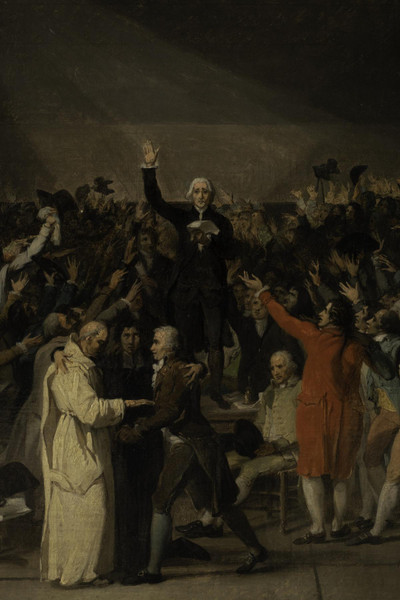
The Tennis Court Oath
That oath became one of the revolution’s founding moments because it claimed that political authority came from the nation, not just the king.
The storming of the Bastille on July 14, 1789 mattered less for the prisoners inside and more because it showed that crowds could shape the revolution.
The countryside exploded in the Great Fear. Peasants attacked manor records, and the August Decrees abolished feudal privilege and hereditary legal inequality.
Moderate reforms 1789 to 1791
- Declaration of the Rights of Man and of the Citizen proclaimed liberty, property, security, resistance to oppression, equality before the law, and national sovereignty.
- The October March on Versailles, led by market women, forced the king back to Paris under pressure from the bread crisis.
- France abolished old provinces and created 83 departments for more uniform rule.
- Church lands were nationalized, and assignats were issued.
- The Civil Constitution of the Clergy made clergy state officials and split them into juring and refractory priests.
- The Constitution of 1791 created a constitutional monarchy, but only property-owning men counted as active citizens.
The Flight to Varennes wrecked trust in Louis XVI. After that, many people stopped believing he would cooperate with the revolution.
Why the Revolution Turned Radical
War pushed the revolution into a new phase. France fought Austria and Prussia in 1792, and fear of foreign intervention exploded after the Declaration of Pillnitz and the Brunswick Manifesto.
On August 10, 1792, the monarchy was overthrown. The September Massacres showed how fear of conspiracy could turn into political violence.
The National Convention declared a republic, and the victory at Valmy helped save it.
The main radical forces worked together but were not identical:
- Jacobins and the Mountain pushed hard for radical republican action.
- Sans-culottes were urban workers and militants who demanded price controls and harsh action against enemies.
- Key leaders included Robespierre, Georges Danton, and Jean-Paul Marat.
The execution of Louis XVI in January 1793 destroyed monarchy as a sacred institution. Radicalization was driven by foreign war, the Vendée revolt, federalist revolts, inflation, shortages, and fear of plots.
The Radical Republic and Its Consequences
The Committee of Public Safety became the emergency government.
- The levée en masse created mass conscription and linked citizenship to military service.
- Revolutionary armies spread anti-feudal changes beyond France.
- The General Maximum imposed price and wage controls.
Reign of Terror
The Reign of Terror used the Law of Suspects, Revolutionary Tribunal, and executions to crush enemies. Marie Antoinette, Danton, and Olympe de Gouges were all executed. The core contradiction is easy to test on. The revolution defended liberty through coercion.
De-Christianization and women
De-Christianization closed churches, promoted the revolutionary calendar and Cult of Reason, and later Robespierre’s Cult of the Supreme Being. This calendar image is the clearest example of the attempt to break with the Christian past and reorganize daily life around revolutionary values. Keep this separate from the earlier Civil Constitution of the Clergy, which controlled the Church rather than trying to erase Christian public life.
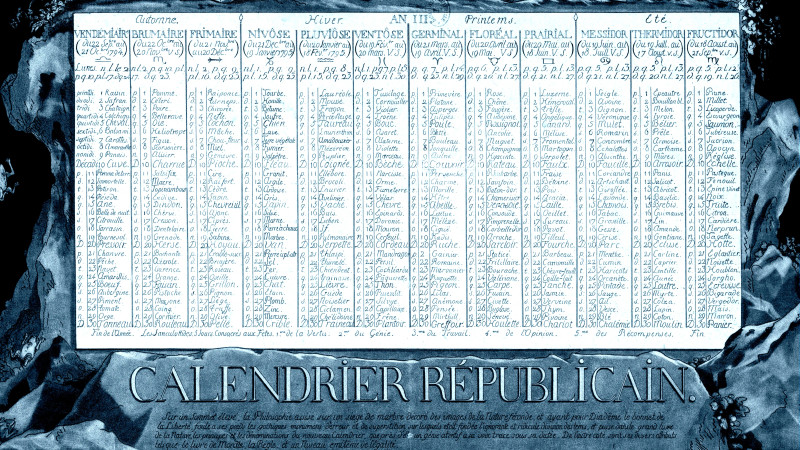
French Republican calendar
Women played a major role early on. Olympe de Gouges demanded rights for women, and the Society of Republican Revolutionary Women pushed activism. Women gained some civil reforms like divorce and inheritance changes, but no political citizenship. Women’s clubs were banned in 1793.
After Thermidor, Robespierre fell in 1794. The Directory, created by the Constitution of Year III, restored property qualifications, stayed unstable, relied on the army, and ended with Napoleon’s coup in 1799.
What the French Revolution Changed
The revolution permanently changed politics in France and across Europe:
- It ended feudalism and hereditary privilege.
- It replaced divine-right monarchy with national sovereignty.
- It created constitutions, male citizenship, and legal equality.
- It subordinated the Catholic Church to the state.
- It expanded mass politics through clubs, petitions, elections, and crowds.
- It built a stronger, more centralized, more coercive state.
- It made warfare national and ideological through mass conscription.
Key Takeaways
French Revolution
Political and social upheaval from 1789 to 1799 that destroyed France’s Old Regime, established national sovereignty and legal equality, and passed through constitutional, radical, and conservative republican phases
Old Regime (Ancien Régime)
Pre-1789 French system of hereditary monarchy, legally privileged estates, regional differences, and an established Catholic Church
First Estate
The clergy, who owned substantial land, collected tithes, and enjoyed important tax and legal privileges under the Old Regime
Second Estate
The nobility, who held seigneurial rights, dominated prestigious offices, and enjoyed exemptions from important direct taxes
Third Estate
The roughly 97–98 percent of French society comprising the bourgeoisie, urban workers, artisans, and peasants
Bourgeoisie
Property-owning merchants, lawyers, officeholders, and professionals who resented aristocratic privilege and restrictions on advancement
Parlements
Noble-dominated French high courts that registered royal edicts and could delay reforms through remonstrances; they were not elected legislatures
Assembly of Notables
Meeting of leading nobles and clergy called in 1787 that rejected Calonne’s fiscal reforms and insisted that the Estates-General approve major taxation changes
Estates-General
Representative body of the three estates summoned by Louis XVI in May 1789 to address the monarchy’s fiscal crisis
Cahiers de Doléances
Lists of grievances compiled before the Estates-General demanding reforms such as tax equality, representative government, and an end to arbitrary rule
Voting by Estate vs. Voting by Head
Voting by estate gave each order one collective vote; voting by head counted individual deputies and would give the enlarged Third Estate greater influence
What Is the Third Estate?
Abbé Sieyès’s pamphlet arguing that the productive Third Estate constituted the nation and should possess political sovereignty
National Assembly
Body proclaimed by Third Estate deputies on June 17, 1789, claiming authority to legislate and tax in the name of the French nation
Tennis Court Oath
June 20, 1789 pledge by National Assembly deputies not to separate until they had given France a constitution
Storming of the Bastille
Parisian seizure of a royal fortress and prison on July 14, 1789, symbolizing the defeat of arbitrary royal power through popular action
Great Fear
Summer 1789 rural panic in which peasants attacked manor houses and destroyed records of feudal obligations
August Decrees
August 1789 measures abolishing noble and clerical privileges and personal feudal obligations while making many remaining seigneurial dues redeemable
Liberal Phase of the French Revolution
The 1789–1791 phase that abolished hereditary privilege, expanded male participation, subordinated the Church to the state, and established a constitutional monarchy
Declaration of the Rights of Man and of the Citizen
August 1789 declaration affirming natural rights, legal equality, freedom of opinion and religion, and sovereignty residing in the nation
October March on Versailles
October 1789 march led by market women that forced the royal family and National Assembly to relocate to Paris under popular pressure
Departments
Eighty-three standardized administrative units that replaced France’s varied provinces and weakened inherited regional privileges
Nationalization of Church Lands
The National Assembly’s 1789 confiscation and sale of Catholic Church property to raise state revenue
Assignats
Paper notes initially backed by confiscated church lands that depreciated and contributed to inflation when issued in large quantities
Civil Constitution of the Clergy
1790 law making clergy salaried public officials, aligning dioceses with departments, providing for clerical elections, and requiring an oath to the state
Juring vs. Refractory Clergy
Juring clergy swore loyalty to the revolutionary church settlement; refractory clergy refused and became a major focus of Catholic opposition
Constitution of 1791
Constitution establishing a unicameral legislature, a king with executive power and a suspensive veto, and tax-qualified male voting
Active vs. Passive Citizens
Under the Constitution of 1791, active male citizens met tax qualifications and could vote, while passive citizens held civil but not electoral rights
Olympe de Gouges
French revolutionary writer who demanded equal rights for women in the Declaration of the Rights of Woman and was executed in 1793
Declaration of the Rights of Woman and of the Female Citizen
Olympe de Gouges’s 1791 declaration applying revolutionary equality to women and demanding political, legal, and property rights
Flight to Varennes
Louis XVI’s failed June 1791 attempt to flee Paris, which severely damaged confidence in his loyalty to the constitutional revolution
Declaration of Pillnitz
Conditional 1791 Austrian-Prussian statement supporting the French royal family that revolutionaries interpreted as a threat of foreign intervention
Brunswick Manifesto
1792 proclamation threatening Paris if the royal family were harmed, which appeared to confirm that Louis XVI’s interests aligned with the invading monarchies
Overthrow of the French Monarchy
August 10, 1792 attack on the Tuileries Palace by Parisian militants and provincial volunteers that suspended and imprisoned Louis XVI.
September Massacres
September 1792 killings of more than a thousand prisoners by crowds fearing counterrevolution as foreign armies approached Paris
National Convention
Assembly elected in 1792 that abolished the monarchy, proclaimed the French Republic, tried Louis XVI, and governed during the radical phase
Battle of Valmy
French victory over Prussian forces on September 20, 1792, that helped save the revolution from immediate military defeat and strengthened the new republic
Radical Republic
The 1792–1794 phase in which a Jacobin-influenced republic used mass mobilization, economic controls, de-Christianization, and terror against internal and foreign enemies
Jacobins
Radical republican political club associated with centralized government, Robespierre, the Mountain, and emergency measures during the Terror
Girondins vs. the Mountain
Girondins distrusted Parisian pressure and favored less centralization; the Jacobin-associated Mountain favored more radical, centralized policies
Sans-Culottes
Urban artisans, shopkeepers, workers, and militants who demanded direct action, price controls, social equality, and harsh measures against counterrevolutionaries
Maximilien Robespierre
Leading Jacobin and Committee of Public Safety member who defended terror as emergency justice necessary to preserve a virtuous republic
Execution of Louis XVI
January 21, 1793 execution of the former king for treason, decisively rejecting sacred hereditary monarchy and intensifying domestic and foreign conflict
Guillotine
Uniform execution device promoted as consistent with legal equality that became the principal symbol of the Reign of Terror
Vendée Revolt
Western French rebellion driven by resistance to conscription, support for refractory priests and Catholicism, local hostility, and royalism
Committee of Public Safety
Central executive body created in 1793 to coordinate war, administration, and internal security during the radical republic
Levée en Masse
August 1793 mass mobilization that conscripted young men and assigned other citizens to support the war effort, linking military service to citizenship
General Maximum
1793 law imposing ceilings on prices and wages to make necessities affordable during wartime scarcity
Reign of Terror
The 1793–1794 use of exceptional courts, surveillance, mass arrests, and executions against people classified as enemies of the revolution
Law of Suspects
1793 law broadly defining people who could be arrested and detained as suspected enemies of the revolution
De-Christianization
Radical campaign closing or repurposing churches, removing Christian symbols, pressuring clergy to resign, and promoting alternative civic cults
French Revolutionary Calendar
Calendar dating the republic from September 1792, using new seasonal month names and ten-day weeks to break with Christian tradition
Cult of the Supreme Being
Robespierre’s deistic civic religion, introduced in 1794 as an alternative to both Catholicism and militant atheism
Society of Republican Revolutionary Women
Militant women’s political organization founded in 1793 and suppressed when the Convention banned women’s political clubs
Thermidorian Reaction
Overthrow and execution of Robespierre in July 1794 followed by the weakening of Jacobin institutions, terror, and economic controls
White Terror
Post-Thermidor violence against former Jacobins and sans-culottes in parts of France
Constitution of Year III
1795 constitution establishing property-qualified participation, a bicameral legislature, and a five-member executive
Directory
Five-director government of 1795–1799 that preserved legal equality and the end of feudal privilege but relied increasingly on military force
Coup of 18 Brumaire
Napoleon Bonaparte’s November 9, 1799 overthrow of the Directory and establishment of the Consulate, conventionally ending the French Revolution
Louis XVI
French king whose fiscal crisis led him to summon the Estates-General; his resistance and attempted flight discredited the monarchy, and he was executed in 1793
Notes
French Revolution
Political and social upheaval from 1789 to 1799 that destroyed France’s Old Regime, established national sovereignty and legal equality, and passed through constitutional, radical, and conservative republican phases
Old Regime (Ancien Régime)
Pre-1789 French system of hereditary monarchy, legally privileged estates, regional differences, and an established Catholic Church
First Estate
The clergy, who owned substantial land, collected tithes, and enjoyed important tax and legal privileges under the Old Regime
Second Estate
The nobility, who held seigneurial rights, dominated prestigious offices, and enjoyed exemptions from important direct taxes
Third Estate
The roughly 97–98 percent of French society comprising the bourgeoisie, urban workers, artisans, and peasants
Bourgeoisie
Property-owning merchants, lawyers, officeholders, and professionals who resented aristocratic privilege and restrictions on advancement
Parlements
Noble-dominated French high courts that registered royal edicts and could delay reforms through remonstrances; they were not elected legislatures
Assembly of Notables
Meeting of leading nobles and clergy called in 1787 that rejected Calonne’s fiscal reforms and insisted that the Estates-General approve major taxation changes
Estates-General
Representative body of the three estates summoned by Louis XVI in May 1789 to address the monarchy’s fiscal crisis
Cahiers de Doléances
Lists of grievances compiled before the Estates-General demanding reforms such as tax equality, representative government, and an end to arbitrary rule
Voting by Estate vs. Voting by Head
Voting by estate gave each order one collective vote; voting by head counted individual deputies and would give the enlarged Third Estate greater influence
What Is the Third Estate?
Abbé Sieyès’s pamphlet arguing that the productive Third Estate constituted the nation and should possess political sovereignty
National Assembly
Body proclaimed by Third Estate deputies on June 17, 1789, claiming authority to legislate and tax in the name of the French nation
Tennis Court Oath
June 20, 1789 pledge by National Assembly deputies not to separate until they had given France a constitution
Storming of the Bastille
Parisian seizure of a royal fortress and prison on July 14, 1789, symbolizing the defeat of arbitrary royal power through popular action
Great Fear
Summer 1789 rural panic in which peasants attacked manor houses and destroyed records of feudal obligations
August Decrees
August 1789 measures abolishing noble and clerical privileges and personal feudal obligations while making many remaining seigneurial dues redeemable
Liberal Phase of the French Revolution
The 1789–1791 phase that abolished hereditary privilege, expanded male participation, subordinated the Church to the state, and established a constitutional monarchy
Declaration of the Rights of Man and of the Citizen
August 1789 declaration affirming natural rights, legal equality, freedom of opinion and religion, and sovereignty residing in the nation
October March on Versailles
October 1789 march led by market women that forced the royal family and National Assembly to relocate to Paris under popular pressure
Departments
Eighty-three standardized administrative units that replaced France’s varied provinces and weakened inherited regional privileges
Nationalization of Church Lands
The National Assembly’s 1789 confiscation and sale of Catholic Church property to raise state revenue
Assignats
Paper notes initially backed by confiscated church lands that depreciated and contributed to inflation when issued in large quantities
Civil Constitution of the Clergy
1790 law making clergy salaried public officials, aligning dioceses with departments, providing for clerical elections, and requiring an oath to the state
Juring vs. Refractory Clergy
Juring clergy swore loyalty to the revolutionary church settlement; refractory clergy refused and became a major focus of Catholic opposition
Constitution of 1791
Constitution establishing a unicameral legislature, a king with executive power and a suspensive veto, and tax-qualified male voting
Active vs. Passive Citizens
Under the Constitution of 1791, active male citizens met tax qualifications and could vote, while passive citizens held civil but not electoral rights
Olympe de Gouges
French revolutionary writer who demanded equal rights for women in the Declaration of the Rights of Woman and was executed in 1793
Declaration of the Rights of Woman and of the Female Citizen
Olympe de Gouges’s 1791 declaration applying revolutionary equality to women and demanding political, legal, and property rights
Flight to Varennes
Louis XVI’s failed June 1791 attempt to flee Paris, which severely damaged confidence in his loyalty to the constitutional revolution
Declaration of Pillnitz
Conditional 1791 Austrian-Prussian statement supporting the French royal family that revolutionaries interpreted as a threat of foreign intervention
Brunswick Manifesto
1792 proclamation threatening Paris if the royal family were harmed, which appeared to confirm that Louis XVI’s interests aligned with the invading monarchies
Overthrow of the French Monarchy
August 10, 1792 attack on the Tuileries Palace by Parisian militants and provincial volunteers that suspended and imprisoned Louis XVI.
September Massacres
September 1792 killings of more than a thousand prisoners by crowds fearing counterrevolution as foreign armies approached Paris
National Convention
Assembly elected in 1792 that abolished the monarchy, proclaimed the French Republic, tried Louis XVI, and governed during the radical phase
Battle of Valmy
French victory over Prussian forces on September 20, 1792, that helped save the revolution from immediate military defeat and strengthened the new republic
Radical Republic
The 1792–1794 phase in which a Jacobin-influenced republic used mass mobilization, economic controls, de-Christianization, and terror against internal and foreign enemies
Jacobins
Radical republican political club associated with centralized government, Robespierre, the Mountain, and emergency measures during the Terror
Girondins vs. the Mountain
Girondins distrusted Parisian pressure and favored less centralization; the Jacobin-associated Mountain favored more radical, centralized policies
Sans-Culottes
Urban artisans, shopkeepers, workers, and militants who demanded direct action, price controls, social equality, and harsh measures against counterrevolutionaries
Maximilien Robespierre
Leading Jacobin and Committee of Public Safety member who defended terror as emergency justice necessary to preserve a virtuous republic
Execution of Louis XVI
January 21, 1793 execution of the former king for treason, decisively rejecting sacred hereditary monarchy and intensifying domestic and foreign conflict
Guillotine
Uniform execution device promoted as consistent with legal equality that became the principal symbol of the Reign of Terror
Vendée Revolt
Western French rebellion driven by resistance to conscription, support for refractory priests and Catholicism, local hostility, and royalism
Committee of Public Safety
Central executive body created in 1793 to coordinate war, administration, and internal security during the radical republic
Levée en Masse
August 1793 mass mobilization that conscripted young men and assigned other citizens to support the war effort, linking military service to citizenship
General Maximum
1793 law imposing ceilings on prices and wages to make necessities affordable during wartime scarcity
Reign of Terror
The 1793–1794 use of exceptional courts, surveillance, mass arrests, and executions against people classified as enemies of the revolution
Law of Suspects
1793 law broadly defining people who could be arrested and detained as suspected enemies of the revolution
De-Christianization
Radical campaign closing or repurposing churches, removing Christian symbols, pressuring clergy to resign, and promoting alternative civic cults
French Revolutionary Calendar
Calendar dating the republic from September 1792, using new seasonal month names and ten-day weeks to break with Christian tradition
Cult of the Supreme Being
Robespierre’s deistic civic religion, introduced in 1794 as an alternative to both Catholicism and militant atheism
Society of Republican Revolutionary Women
Militant women’s political organization founded in 1793 and suppressed when the Convention banned women’s political clubs
Thermidorian Reaction
Overthrow and execution of Robespierre in July 1794 followed by the weakening of Jacobin institutions, terror, and economic controls
White Terror
Post-Thermidor violence against former Jacobins and sans-culottes in parts of France
Constitution of Year III
1795 constitution establishing property-qualified participation, a bicameral legislature, and a five-member executive
Directory
Five-director government of 1795–1799 that preserved legal equality and the end of feudal privilege but relied increasingly on military force
Coup of 18 Brumaire
Napoleon Bonaparte’s November 9, 1799 overthrow of the Directory and establishment of the Consulate, conventionally ending the French Revolution
Louis XVI
French king whose fiscal crisis led him to summon the Estates-General; his resistance and attempted flight discredited the monarchy, and he was executed in 1793
